
Market Calls / United States
Market Call — U.S. Markets: The AI Unwind Meets a Hawkish Fed
A brutal week leaves stocks in correction, volatility above 35, and investors looking to Wednesday’s inflation report for relief.
Market date
Sunday, November 22, 2026
NYSE / Nasdaq | Closing data through November 20
0. Headline
The worst week since April 2025 ended with a rout.
On Friday, the Nasdaq Composite fell 5.28% to 22,617.73—its second-largest point decline on record—erasing its remaining gains for 2026. The S&P 500 dropped 3.70% to 6,910.39, its seventh consecutive decline, while the Dow lost 1.93% to 48,147.33. Both the S&P and the Dow finished in correction territory, more than 10% below their records.
The Nasdaq-100 fell 5.61% and briefly entered bear-market territory during the session. The VIX closed at 35.89, up roughly 26%, its highest close since March.
Weekly losses were severe: approximately 8.6%–9.3% for the S&P 500, 10%–11% for the Nasdaq Composite, and about 8% for the Dow. Technology fell 7.3% on Friday. Consumer staples, up 0.7%, was the only sector to finish higher. Within the S&P 500, decliners outnumbered advancers 376 to 123.
The draft’s underlying reporting points to five overlapping pressures:
- An unwind of the AI trade as investors question the returns on data-center capital spending.
- A 14% decline in Nvidia to $125.53 amid reports of Jensen Huang’s resignation as CEO, Colette Kress’s appointment as interim CEO, a Reuters report that the SEC is examining potential accounting issues, and a California attorney general subpoena concerning chips that allegedly reached China.
- Anthropic’s IPO, described in the underlying reporting as the largest on record, which appears to have drawn retail liquidity away from other AI stocks.
- Expectations for a Federal Reserve rate increase on December 9.
- TSMC’s pause in advanced orders from Chinese customers following new U.S. export rules on November 19.
Those corporate and regulatory developments are presented here as reported in the material underlying this call, rather than as independently confirmed findings.
My read is that this looks like a concentrated AI-positioning unwind, amplified by high real yields and a Fed still leaning toward tighter policy. A VIX above 35 after seven consecutive S&P declines is consistent with capitulation-like conditions. It is not proof of a bottom.
The relative resilience of healthcare and consumer staples also fits a late-cycle defensive rotation. But staples being the only sector to rise on Friday is a reminder that relative protection and outright gains are not the same thing.

1. Indexes — November 20 Close
- S&P 500: 6,910.39; down 3.70% on the day, down 9.3% for the week, and up 0.5% year to date.
- Nasdaq Composite: 22,617.73; down 5.28% on the day, down 11.0% for the week, and down 3.7% year to date.
- Nasdaq-100: 25,028.98; down 5.61% on the day, down 11.5% for the week, and down 1.9% year to date.
- Dow Jones Industrial Average: 48,147.33; down 1.93% on the day, down 8.3% for the week, and up 0.1% year to date.
- Russell 2000: 2,581.79; down 2.76% on the day, down 8.0% for the week, and up 3.6% year to date.
- VIX: 35.89; up 26.2% on the day and 91% for the week.
Weekly and year-to-date changes above use the TradingView figures supplied for this call. Other reporting puts the S&P 500’s weekly decline at 8.6%, a discrepancy attributed in the draft to different calculation bases.
From their respective records, the Nasdaq Composite is down approximately 18% and the S&P 500 about 12%, with both peaks dated October 6. The Dow is roughly 11% below its August 5 record.
The damage is no longer confined to a handful of speculative names. Small caps, broad-market benchmarks, and technology all suffered substantial weekly losses, even if AI-linked stocks remain the center of the selling.
2. Dollar
The DXY closed at 103.84, down 0.08% on Friday after reaching a 19-month high on Thursday. It still gained 0.6% for the week and 5.7% year to date.
EUR/USD stood at 1.0965. USD/JPY fell 0.7% to 158.56. USD/BRL reached 5.95, up 5.5% for the week and 18% over one month.
The dollar’s small daily retreat does little to change the underlying picture. A strong dollar alongside expectations for higher U.S. rates continues to tighten global financial conditions. The real’s decline fits that pressure on risk-sensitive currencies.
3. Treasuries
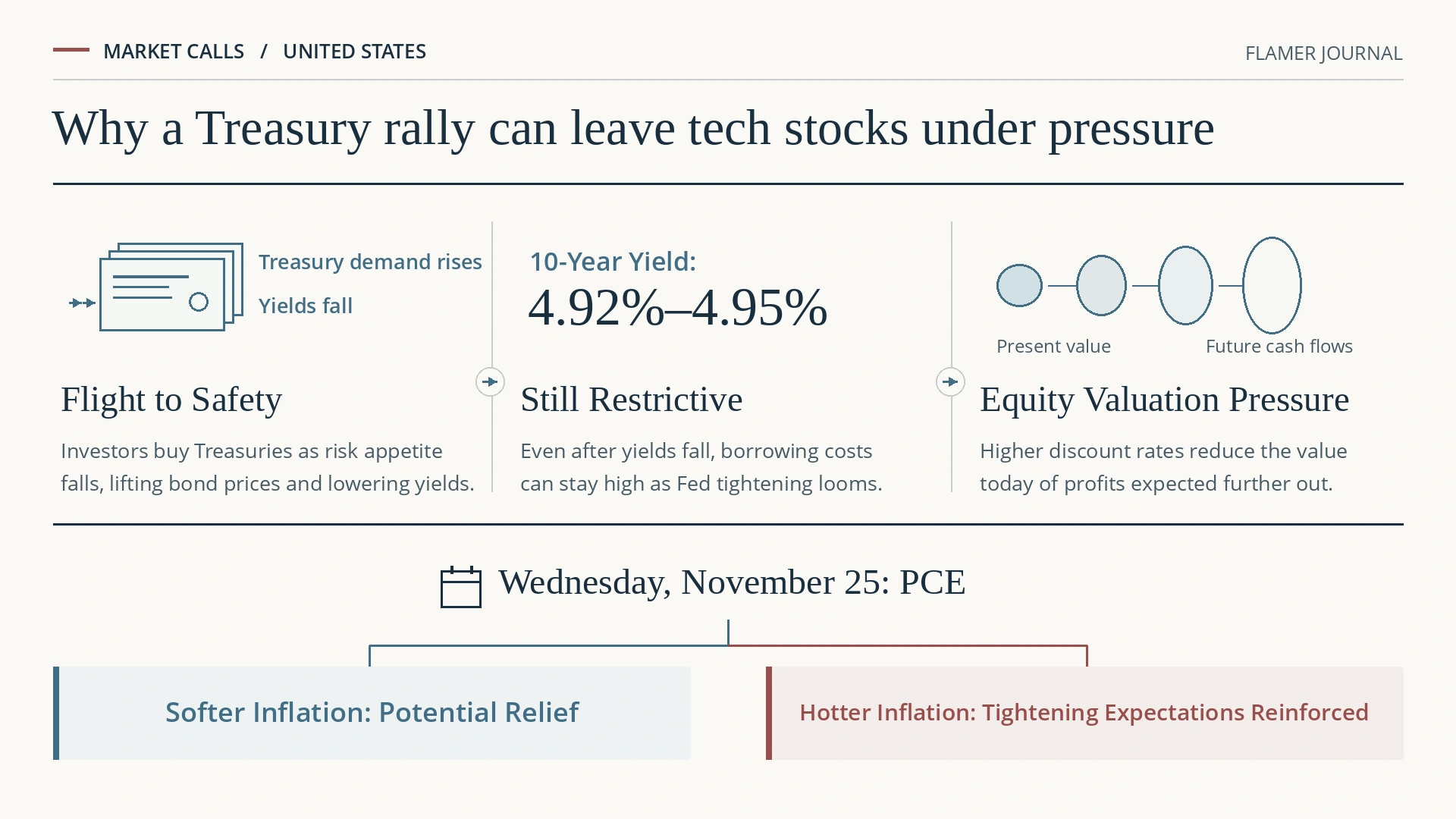
Treasuries rallied as investors sought safety:
- Two-year yield: 4.63%–4.65%, down 12–13 basis points.
- Ten-year yield: 4.92%–4.95%, down 10–12 basis points, its largest decline since October 22.
- Thirty-year yield: 5.31%–5.34%, down 7–9 basis points.
- Two-year/ten-year spread: approximately 29 basis points.
- MBA 30-year mortgage rate: 7.35%.
The bond rally offered some relief, but not a clean escape from the valuation problem. A ten-year yield near 5% still puts pressure on long-duration equities, particularly technology companies whose valuations depend heavily on profits expected far into the future.
Stocks and Treasury yields can fall together without making equities cheap enough to stabilize.
4. Fed
Friday morning’s CME FedWatch reading assigned a 93.9% probability to a 25-basis-point increase on December 9 and a 6.1% probability to a 50-basis-point increase.
Kalshi pricing was somewhat less aggressive: 90% for a 25-basis-point increase and 9% for no change.
Philadelphia Fed President Anna Paulson said she was open to consecutive increases. Fed Governor Lisa Cook warned about the risk of falling behind the curve. New York Fed President John Williams is scheduled to speak Monday at 4 p.m. ET.
The policy assumption embedded in those probabilities matters: investors are not positioning for the Fed to rescue an equity market already in correction.
My working view is that an above-consensus PCE report on Wednesday would reinforce expectations for a December increase. A softer reading could reopen the debate and provide a catalyst for relief. Neither outcome should be treated as predetermined.
5. Inflation and Economic Data
The week’s releases offered a mixed picture:
- Final November University of Michigan consumer sentiment: 51.5, in line with expectations and above October’s 48.0.
- One-year inflation expectations: 3.7%, down from 4.3% in the preliminary reading and the lowest since March.
- Initial jobless claims: 203,000 versus a 197,000 consensus.
- Philadelphia Fed manufacturing index: 6.3 versus expectations of 20.
- Housing starts: 1.309 million, above expectations.
- Building permits: 1.295 million, below expectations.
- Pending home sales: down 4.7%.
Wednesday, November 25, brings October PCE inflation. Consensus calls for headline inflation of 0.3% month over month and 3.8% year over year, compared with a previous annual reading of 3.6%. Core PCE is expected to rise 0.3% month over month.
The second estimate of third-quarter GDP is also due, with consensus at 3.4% versus the previous 1.5% estimate.
A rise in headline inflation to 3.8% despite lower oil would be consistent with pressure elsewhere, potentially in services. It would not, by itself, establish the source of that pressure. Meanwhile, the Philadelphia Fed reading points to softer manufacturing momentum.
That is the uncomfortable combination facing the market: signs of slowing activity without enough inflation relief to make easier policy an obvious response.
6. Oil, Metals, and Crypto
WTI rose 0.9% to $83.98 but recorded its third consecutive weekly decline. Brent gained 0.6% to $92.57.
Gold was quoted around $3,515–$3,538, with reported declines ranging from 2.4% to 4.6%, and reached a 14.5-month low. Silver fell 7.4% to $41.03. Copper lost 2.8%.
Bitcoin briefly reached approximately $59,000, breaking below $60,000 for the first time since July. It was trading around $60,600 over the weekend, down roughly 25% in a month. Ether stood near $1,618, down 7.8%.
On geopolitics, the underlying reporting cites Houthi threats against Saudi ports and Iranian incidents involving tankers in the Strait of Hormuz. Trump also spoke of “penalties” for American companies building data centers overseas.
Gold’s decline alongside equities is consistent with investors selling liquid assets to meet margin calls or raise cash. That is a plausible liquidity explanation—not a confirmed account of the selling, and not necessarily a change in the longer-term case for the metal.
7. Corporate News
Nvidia and the AI Complex
Nvidia (NVDA) closed at $125.53, down 14.01%, on volume of 633 million shares. Market capitalization stood at approximately $3.03 trillion. Shares rose 3.6% after hours to $130.03.
The stock has lost roughly one-third of its value in two weeks despite reporting better-than-expected results earlier in the week. The reported leadership transition, SEC examination, and California subpoena added company-specific uncertainty to an already weakening AI trade. An appearance by Huang before Congress on December 1 is mentioned in the draft but remains unverified.
Anthropic (ANT) priced its IPO at $83, above the indicated $70–$78 range, with 980 million shares offered. It opened Thursday at $111.50 and closed Friday at $88.91, down 8.5% for the session, after touching $83.05 intraday. Its reported market capitalization was $1.18 trillion. Seaport initiated coverage at Neutral.
The selling across semiconductors and AI infrastructure was broad:
- AMD: down 13.3%.
- Micron: down 13.9% to $594.51.
- Broadcom: down 12.2%.
- Arm: down 14.1%.
- SanDisk: down 16.1%.
- Nebius: down 16.1%.
- Bloom Energy: down 15.3%.
- CoreWeave: down 12%.
- Astera: down 14.8%.
- SOXX semiconductor ETF: down 11%.
Among the large-company moves listed in the draft, Tesla fell 8%, SpaceX 8%, Meta 6%, and Apple 1.9%.
Other Movers
- Intuit (INTU) fell 12.8% after cutting its Credit Karma revenue outlook to $2.72 billion–$2.83 billion.
- Global Payments (GPN) rose 9.95% after Bloomberg reported that GTCR was considering an acquisition valued at approximately $50 billion, including debt.
- Gap (GAP) gained 11.4%. Adjusted earnings of $0.82 per share exceeded expectations of $0.78, although the company reduced its full-year outlook.
- Bill Holdings (BILL) fell 4.1% after agreeing to an all-cash acquisition by TPG and Corpay at $63.25 per share.
- Keysight fell 7.1% amid supply constraints, despite guidance for approximately 20% growth.
- BJ’s fell 5.4%.
- Ross fell 2.9% after issuing a fourth-quarter outlook below expectations.
- UnitedHealth rose 2.8% and Humana gained 2.6% following TD Cowen upgrades.
Fund flows added another measure of selling pressure: SPY recorded $11.65 billion in outflows, while QQQ saw $1.29 billion in redemptions.
8. Stocks in Focus — November 20
- NVDA — Nvidia: $125.53, down 14.0%. Reported Huang departure, SEC examination, and California subpoena; volume of 633 million shares.
- ANT — Anthropic: $88.91, down 8.5%. First full post-IPO trading session; volume of 401 million shares.
- MU — Micron: $594.51, down 13.9%. Selling across memory stocks.
- AMD — AMD: closing price unavailable; down 13.3%. AI-related liquidation.
- INTU — Intuit: closing price unavailable; down 12.8%. Lower Credit Karma revenue guidance.
- GAP — Gap: closing price unavailable; up 11.4%. Third-quarter earnings beat.
- GPN — Global Payments: closing price unavailable; up 9.95%. Reported GTCR acquisition interest.
- BKE — Buckle: closing price unavailable; up 5.7%. Third-quarter earnings of $0.94 per share exceeded expectations.
- PLMR — Palomar: closing price unavailable; up 4.4%. Defensive rotation is a possible explanation; no specific company catalyst was identified in the underlying material.
- UNH — UnitedHealth: closing price unavailable; up 2.8%. TD Cowen upgrade with a $455 price target.
Some closing prices were unavailable because the TradingView retrieval limit had been reached. Percentage changes are retained from the reporting supplied for this call.
9. Potential Multibagger Screen — Not a Recommendation
The data limitations matter here. Fundamentals are drawn from the StockAnalysis figures supplied in the draft. For PLMR, BKE, and GPN, the available price and valuation snapshots date from late October through November 13, before this week’s market moves. Their current multiples may differ materially. The MU snapshot is dated November 20.
PLMR — Palomar Holdings: The Closest Fit
Last available price: $141.78 on October 23. Shares rose 4.4% on November 20. Reported market capitalization: approximately $3.7 billion.
The supplied fundamentals show:
- Trailing revenue of $1.09 billion and net income of $203 million.
- Operating margin of 24.9%, net margin of 18.6%, and free-cash-flow margin of 38%.
- Debt of $296 million and cash of $63 million. The draft notes that, for an insurer, operating liquidity also sits within the investment portfolio.
- Trailing P/E of 19.0 times, forward P/E of 12.9 times, and price-to-sales of 3.4 times.
- Return on equity of 22%.
- Projected annual revenue growth of approximately 22.8% over three years.
- A Buy consensus across eight analysts and a $159 price target.
The thesis is straightforward: a niche insurer operating in earthquake, catastrophe, and excess-and-surplus lines, with strong profitability and growth that does not depend directly on AI spending or the consumer cycle. Its smaller size leaves more room for long-term compounding than the megacaps dominating the market.
Potential catalysts include January 1 reinsurance renewals, fourth-quarter results, and higher investment income from elevated rates.
The risks are inseparable from the business: a major catastrophe, particularly a California earthquake; more expensive reinsurance; and a turn in insurance pricing.
BKE — Buckle: Strong Economics, Limited Growth
Last available price: $47.02 on October 26. Shares rose 5.7% on November 20. Reported market capitalization: approximately $2.4 billion.
The supplied figures show:
- Trailing revenue of $1.33 billion and net income of $221 million.
- Gross margin of 58.9%, operating margin of 20.8%, and net margin of 16.6%.
- Debt of $421 million, probably including lease liabilities, against cash of $287 million.
- Free cash flow of $191 million.
- P/E of 10.7 times and EV/EBITDA of 8.2 times.
- Return on invested capital of 35%.
- Dividend yield of 3.0%, with a history of additional special dividends.
- Third-quarter earnings of $0.94 per share, above expectations.
Buckle combines unusually strong retail profitability with a valuation that suggests considerable skepticism. The investment case would depend more on dividends and repurchases than on rapid expansion.
Projected annual growth of roughly 4% is not an obvious multibagger profile. Weak consumer spending and changing fashion preferences remain the central risks.
MU — Micron: Cheap Earnings, Expensive Cycle Risk
November 20 price: $594.51, down 13.9%. Reported market capitalization: $673 billion.
The supplied snapshot shows:
- Trailing revenue of $133 billion and net income of $85 billion.
- Gross margin of 80.7% and operating margin of 74.6%.
- Net cash of $68 billion.
- Free cash flow of $59 billion.
- Trailing P/E of 8.0 times, forward P/E of 3.4 times, and EV/EBITDA of 5.6 times.
- A 163% gain over 52 weeks.
- A Strong Buy consensus across 49 analysts.
The stated average price target of $1,562 appears anomalous and needs verification before being used.
My interpretation is that operating margins near 75% would represent peak-cycle memory economics tied to AI high-bandwidth memory demand. A forward P/E of 3.4 times may say less about a bargain than about the market’s disbelief that those earnings can last.
If AI capital spending holds up, the supplied numbers imply a very low valuation. If spending contracts, earnings could fall sharply; the draft’s downside scenario contemplates a decline of roughly half.
At a reported $673 billion market capitalization, Micron does not fit this screen’s small-company compounding profile. The principal risks are a reversal in the memory cycle, additional HBM supply from Samsung and SK Hynix, and export restrictions.
GPN — Global Payments: A Special Situation
Last available price: $96.84 on October 30. Shares rose 9.95% on November 20 following the acquisition report.
The supplied figures show:
- Trailing revenue of $11.5 billion.
- A net loss of $1.29 billion, reflecting accounting write-downs.
- Operating margin of 17.2%.
- Debt of $23.7 billion against cash of $5.6 billion.
- Forward P/E of 5.9 times.
- EV/EBITDA of 8.6 times.
- Price-to-book of 1.05 times.
The thesis now depends heavily on whether GTCR makes an offer and what premium it might include. That is a transaction-driven situation, not a straightforward growth-and-quality compounder.
The balance sheet is too leveraged to satisfy this screen’s preference for financial strength.
Screen Assessment
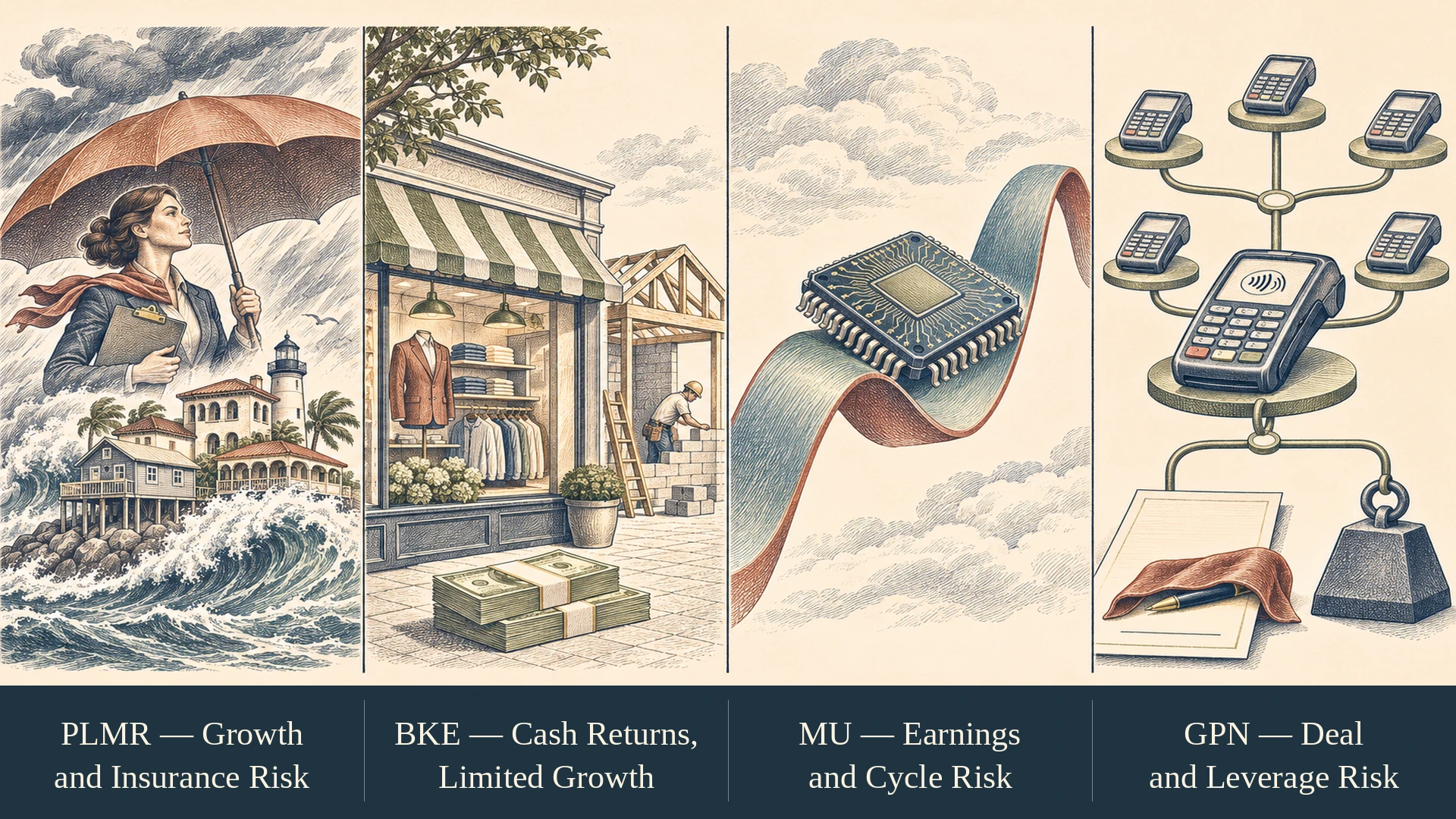
PLMR is the only name in this group that combines the growth, margins, return on equity, and company size sought by the screen. BKE offers profitability and cash distributions but limited growth. MU offers apparent earnings cheapness with substantial cycle exposure. GPN is primarily an acquisition-dependent special situation.
For technology exposure, the week’s action leaves me more cautious about treating a lower price as sufficient evidence of value. A declining VIX and the PCE release would provide more useful information about stabilization than a single rebound session.
10. Calendar — Thanksgiving Week
Monday, November 23
- Preliminary November S&P Global PMIs: services consensus of 55.6 and manufacturing consensus of 54.5.
- Two-year Treasury auction.
- John Williams speaks at 4 p.m. ET.
- Earnings: HPE, Zoom, and Agilent.
- Japanese markets closed.
Tuesday, November 24
- Conference Board consumer confidence, with consensus at 92.5.
- Case-Shiller home prices.
- Five-year Treasury auction.
Wednesday, November 25
- October PCE inflation.
- Second estimate of third-quarter GDP.
- Personal income and spending.
- Durable goods orders.
- Initial jobless claims.
- New home sales.
- Seven-year Treasury auction.
Thursday, November 26
Thanksgiving. U.S. stock markets closed.
Friday, November 27
Shortened session: stocks close at 1 p.m. ET and bonds at 2 p.m. ET. Black Friday.
Beyond the Holiday Week
- December 1: possible congressional testimony by Huang; unverified.
- December 9: FOMC decision.
11. Facts, Hypotheses, and Open Questions
The numerical record presented in this call includes index closes, correction thresholds, Treasury yields, the quoted 93.9% FedWatch probability, a 3.8% headline PCE consensus, and company fundamentals with the snapshot dates indicated.
The reported Huang departure, Anthropic IPO details, and regulatory developments are also carried forward from the underlying material. They should be distinguished from independently established facts, particularly where confirmation or investigative status remains outstanding. A reported examination or subpoena does not establish wrongdoing.
The interpretations are separate: that capitulation may be approaching; that margin calls may explain gold’s decline; that PLMR best fits the screening criteria; and that the Fed’s willingness to tighten during an equity correction makes this policy backdrop especially difficult.
Still unresolved are current closing prices for PLMR, BKE, GPN, GAP, and INTU; trading volumes for several other names; the precise status of the reported SEC examination involving Nvidia; and the date and confirmation of Huang’s possible congressional appearance.
Wednesday’s PCE report is the next major test of the market’s policy assumptions. Until then, the distinction between forced liquidation and a lasting reassessment of AI earnings remains unresolved.
Editorial note: This publication is provided for informational and educational purposes only. It is not investment research, a recommendation, an offer or solicitation, or personalized financial advice. Market conditions and available information can change quickly, and the views expressed here may prove incomplete or incorrect. Readers should consult primary sources and seek qualified professional advice where appropriate.