
Market Calls / Brazil
Market Call — Brazil’s Fiscal Risk Premium Keeps Rising
A weaker real, higher forward rates, and falling equities leave fiscal credibility at the center of the week ahead.

Market date
Sunday, November 22, 2026
The Big Picture
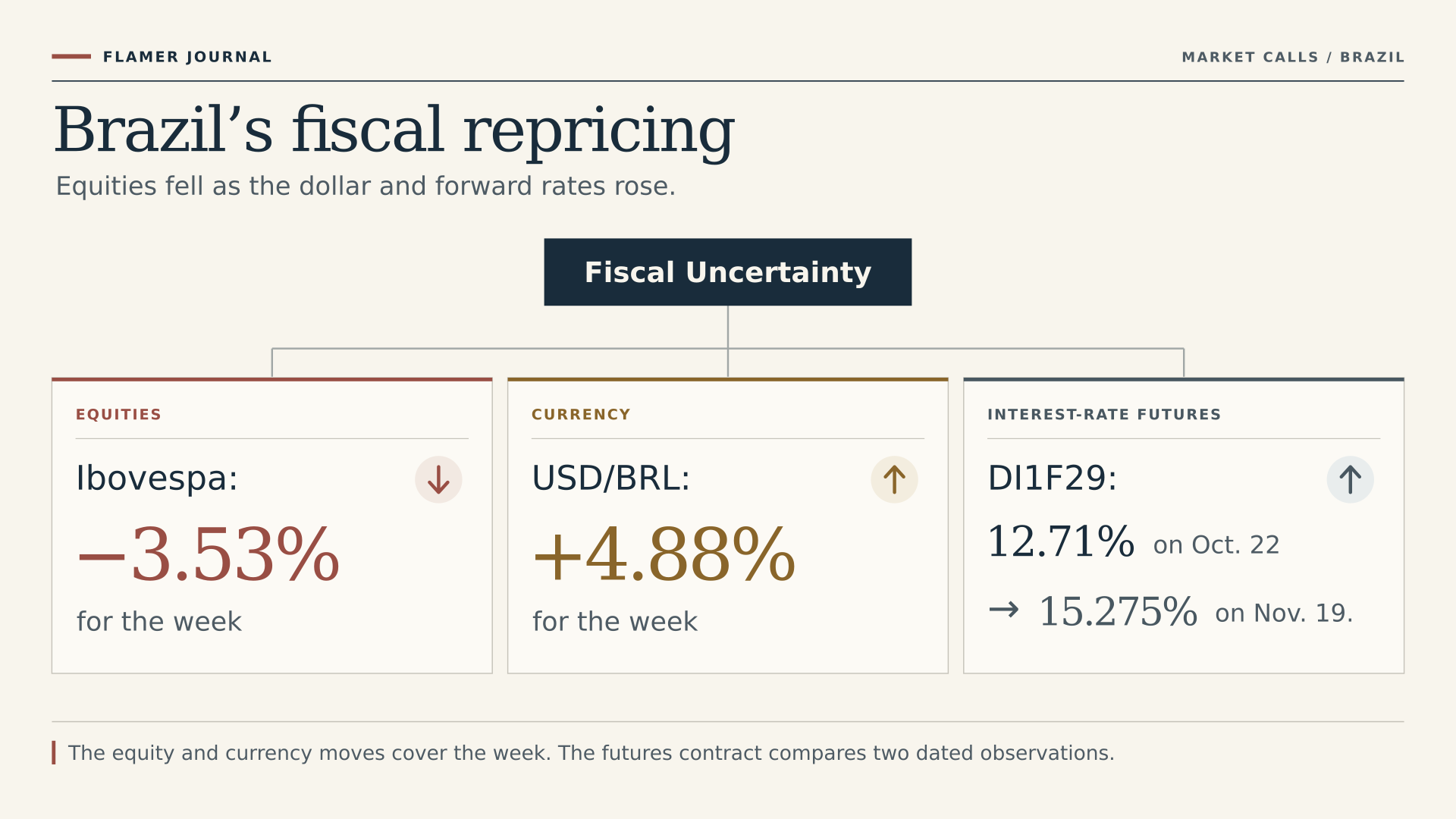
Brazilian equities remain caught in a fiscal-risk repricing. The Ibovespa closed Thursday at 166,376.43, down 0.69%, after trading between 165,833 and 168,498. Turnover reached R$35.9 billion.
The holiday-shortened week ended with a 3.53% loss: Monday −1.83%, Tuesday +0.31%, Wednesday −1.34%, and Thursday −0.69%. The index is down 0.92% in November and 10.71% in the fourth quarter, though it still holds a 3.26% gain for the year.
Measured against the last close before the presidential runoff—205,082 on October 23—the decline is roughly 18.9%. Economic News Brasil reported that the October 26 session brought a 13.88% plunge and triggered a circuit breaker.
The weakness extends beyond the headline index. The small-cap index fell 1.22% on Thursday and 2.60% for the week. IFIX, the listed real estate fund index, lost 3.60% over the week.
The commercial dollar closed at R$5.934, up 1.15%, marking its sixth consecutive advance and its highest level in 19 months. It gained 4.88% for the week despite a US$1 billion spot auction by the Central Bank, which InfoMoney reported had failed to reverse the pressure. The DXY stood at 103.89.
Spot USD/BRL is now roughly R$0.53 above the Focus survey’s median year-end 2026 forecast.
The interest-rate futures curve moved higher across all maturities, with the sharpest increases in the middle of the curve. November 19 closing levels were:
- DI1F27: 13.724%, up 3.3 basis points.
- DI1F28: 14.850%, up 31.5 basis points.
- DI1F29: 15.275%, up 30.5 basis points.
- DI1F31: 15.420%, up 21 basis points.
- DI1F33: 15.495%, up 19.5 basis points.
- DI1F35: 15.460%, up 17.5 basis points.
DI1F29 stood at 12.71% on October 22. That puts the increase at roughly 2.6 percentage points in a month.
The short end remains anchored by the 13.75% Selic rate, which Copom left unchanged on November 4. The 2028–2029 contracts are carrying much of the fiscal repricing. This is not simply an equity selloff: the currency and forward-rate markets are expressing the same loss of confidence.
Inflation, Selic, and the Focus Survey
The November 16 Focus survey lowered the 2026 IPCA inflation forecast to 5.11% from 5.22%, but raised the 2027 forecast to 5.00% from 4.90%.
The year-end 2026 Selic forecast remained at 13.75%. For the end of 2027, it rose to 12.75% from 12.50%.
GDP growth forecasts moved to 1.72% for 2026 and 1.02% for 2027. The exchange-rate forecasts stand at R$5.40 per dollar for the end of 2026 and R$5.45 for the end of 2027.
The uncomfortable combination is further out: higher expected inflation and interest rates in 2027, alongside weaker growth. That leaves domestically exposed equities facing both a more demanding discount rate and a softer earnings backdrop.
Commodities
January Brent settled Thursday at US$91.98 a barrel, while December WTI closed at US$83.21. Both were essentially flat on the day.
Brent was trading at US$113 on October 22. Its roughly 19% decline in a month has removed a major source of support for PETR4, PRIO3, and BRAV3.
Singapore iron ore closed Friday at US$90.35 a metric ton, down 13.6% for the year. InfoMoney reported that iron ore prices in China rose Thursday after six consecutive declines.
Copper fell 2.6% on Friday and 11.4% for the week, ending at US$5.485 a pound. Gold dropped 2.4% on Friday and 8.7% over the week, to US$3,538.
Foreign Flows
Foreign investors withdrew R$5.03 billion from B3 in November through November 10, following 13 consecutive sessions of net outflows, according to BM&C News.
InfoMoney cited an outflow figure of R$5.34 billion in a November 18 report, but did not specify the data cutoff. The two figures should not be treated as directly comparable without that detail.
Year-to-date foreign flows remained positive at R$30.5 billion through November 10. October had brought R$8.2 billion in inflows.
Flows for November 11–19 have not been verified.
Global Markets
Wall Street fell Thursday as investors took profits following Anthropic’s Nasdaq debut, which InfoMoney described as the largest IPO in history. The Dow declined 2.18%, the S&P 500 lost 2.02%, and the Nasdaq fell 2.25%.
On Friday, with B3 closed, the S&P 500 dropped another 3.70% to 6,910, bringing its weekly decline to 9.3%. The 10-year U.S. Treasury yield closed at 4.95%.
Fed Vice Chair Philip Jefferson said artificial intelligence was adding to inflationary pressure. October payroll growth of 165,000 had already reinforced expectations of a U.S. rate increase in December.
Brazil has asked the WTO to adjudicate U.S. tariffs of 25% and 12.5%, with consideration scheduled for November 24.
For Brazilian assets, the timing is awkward. A market already struggling with domestic fiscal uncertainty now has to absorb another sharp decline in U.S. equities that occurred while the local exchange was closed.
Politics and Fiscal Policy
Lula won reelection on October 25 with approximately 51.7% of valid votes against Flávio Bolsonaro’s 48.3%, according to a count published on election night. The official TSE result has not been verified for this edition.
Markets are reacting to the absence of clear signals about the next economic team. Lula has said he is in no hurry to select ministers, including the finance minister. Aloizio Mercadante has denied that he will take either the Finance or Planning portfolio.
The fiscal package, PLP 299/2026, passed the Senate on November 18 and is expected to reach a vote in the Chamber of Deputies on Monday, November 23.
The proposal projects savings of up to R$60 billion in 2027. The IFI, however, estimates that roughly 70% of the adjustment depends on uncertain revenue.
That distinction matters. A headline savings figure may offer little relief if investors doubt that the underlying measures will deliver.
Goldman Sachs, Itaú BBA, Morgan Stanley, UBS, JPMorgan, BTG, and Citi have either downgraded Brazil or become more selective. Morgan Stanley is underweight and projects the Ibovespa at 160,000 in 2027.
Corporate News
Thursday’s biggest gainers were:
- USIM5: +2.59%, closing at R$5.14.
- FLRY3: +2.53%, at R$21.51.
- GOAU4: +2.22%, at R$11.50.
- BBAS3: +1.27%, at R$14.30.
- TEND3: +1.13%, at R$15.23.
The largest decliners were:
- AZZA3: −7.29%, closing at R$14.63.
- NATU3: −6.28%, at R$4.48.
- CSNA3: −6.03%, at R$3.43.
- CEAB3: −4.82%, at R$7.50.
- POMO4: −4.23%, at R$3.62.
Marcopolo fell after a collective bargaining agreement allowed voluntary severance and temporary employment-contract suspensions in Caxias do Sul.
Rede D’Or declined 1.10% following an asset sale, and Hapvida may pursue a similar route.
XP cut its Banco do Brasil price target and maintained a neutral view. Febraban lowered its forecast for credit growth in 2026 to 8.6% from 8.9%, alongside higher delinquency.
Anthropic’s Brazilian depositary receipt, ANTH34, debuted on B3.
For the week, HAPV3 and BEEF3 led the gains, each rising 8.80%. The largest losses came from TEND3, down 11.84%; NATU3, down 11.70%; and BRAV3, down 11.59%.
Stocks in Focus
B3SA3 stood out on relative volume, trading at 1.85 times its 10-day average. It closed at R$14.28 and is down 38% in a month.
BPAC11 traded at 1.57 times its average volume and closed at R$49.69. It is down 9.3% for the week and 37.9% for the month.
BBAS3 recorded the highest number of trades and has lost 41% in a month.
VALE3 fell for an eighth consecutive session, closing at R$58.48 and losing 8.3% over the week. CSNA3 plunged 22.9% for the week and is down 61.6% for the year.
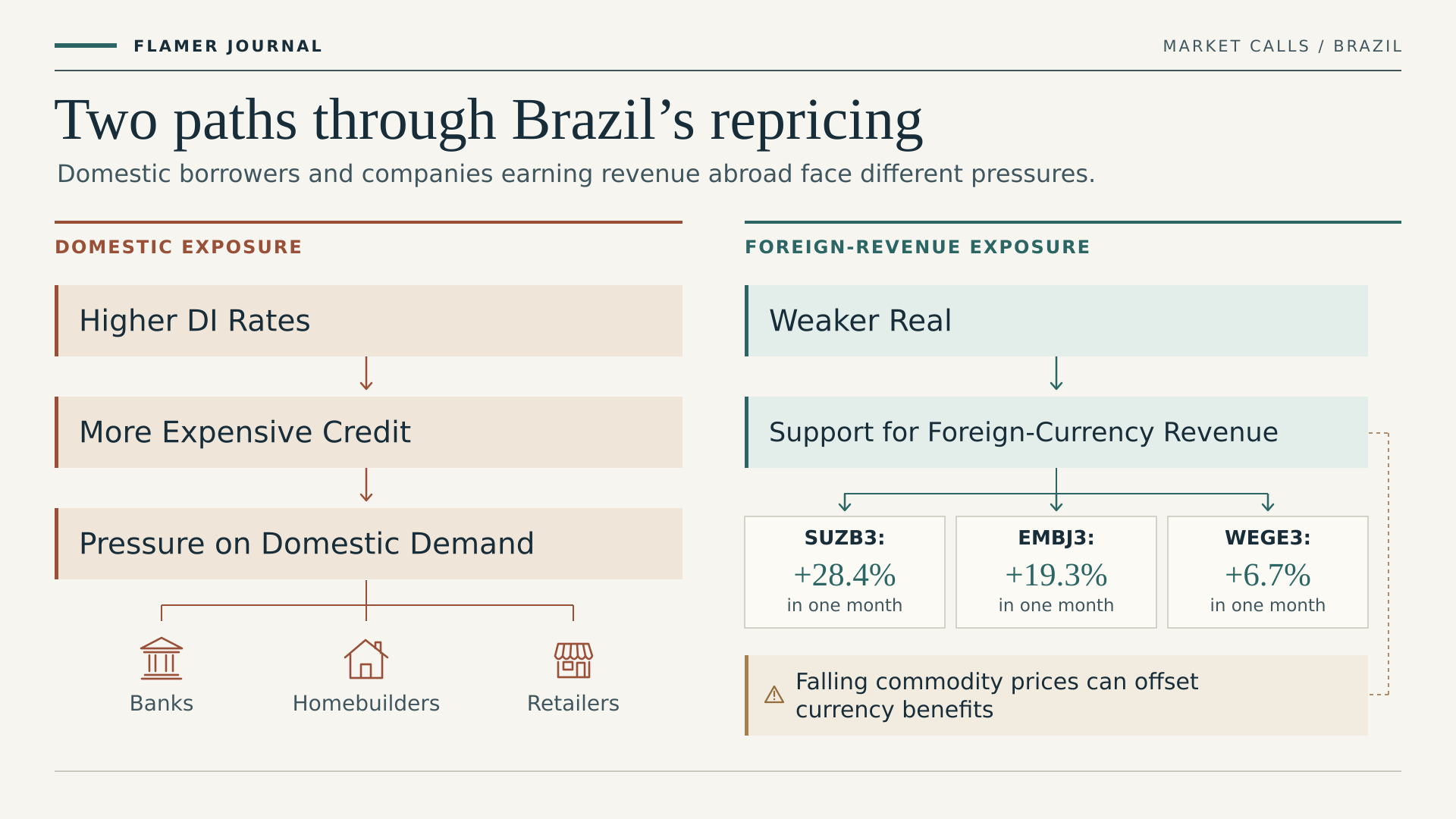
CURY3 lost 14.1% over the week as higher DI futures rates weighed on homebuilders. MGLU3, by contrast, rebounded 7%.
Exporters were the only group to outperform the index over the month:
- SUZB3: +28.4%, at R$55.32.
- EMBJ3: +19.3%, at R$110.15.
- WEGE3: +6.7%, at R$51.13.
The rotation is striking. Domestic financial conditions are tightening, while a weaker real is providing a relative cushion for companies with foreign-currency revenue. That does not make every exporter defensive: falling commodity prices can still offset the currency benefit.
Potential Multibaggers: A Critical Look
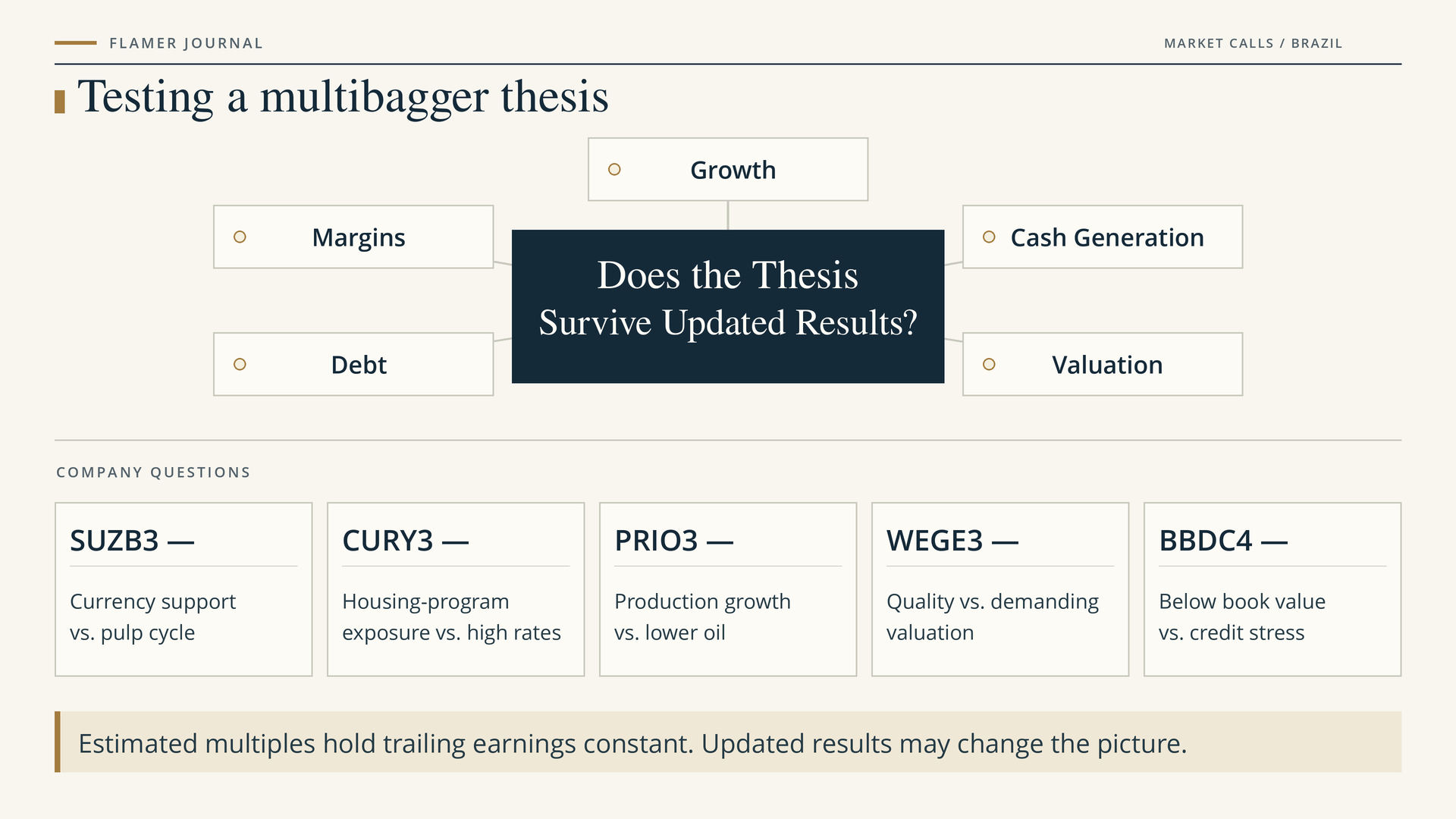
Market capitalizations and valuation multiples marked with an asterisk are estimates. I rescaled the figures from the October 21–22 editions using November 19 share prices, holding trailing-12-month earnings constant.
Third-quarter 2026 results were released in the meantime and have not been incorporated into those estimates. These figures are screening tools, not updated valuations.
None of the companies below currently meets every criterion—growth, margins, debt, cash generation, and valuation—using fully updated data.
Suzano — SUZB3
Suzano closed at R$55.32, down 0.50% on the day and up approximately 28% in a month. Market capitalization and valuation multiples have not been verified.
The observed fact: Suzano was one of the month’s few strong performers while the dollar rose approximately 18% over the same period.
The thesis is that dollar-denominated revenue and a real-denominated cost base could support margins with USD/BRL near R$5.90.
Pulp prices and deleveraging are the main catalysts. Dollar-denominated debt, the pulp cycle, and a reversal in the exchange rate remain the principal risks.
Cury — CURY3
Cury closed at R$25.01, down 1.15% on the day and approximately 14% for the week. Estimated market capitalization is R$7 billion*, with a price-to-earnings ratio of roughly 7 times*.
The October 20 reference figures showed revenue growth of 14%, profit growth of 15%, a net cash position, and high dividend payouts. The stock has fallen 22.6% in a month.
My read is that its focus on Minha Casa Minha Vida may make the business less sensitive to higher DI rates than mid-market residential developers. The selloff may have gone further than the operating exposure warrants, though that remains a hypothesis rather than a conclusion.
Project launches and changes to program rules are the catalysts to watch. Risks include DI rates staying above 15% for longer, construction costs, and changes to FGTS funding rules.
PRIO — PRIO3
PRIO closed at R$60.20, down 2.70% on the day and 15.8% in a month. Estimated market capitalization is R$40 billion*, with a P/E of roughly 13 times*.
The October reference figures showed an EBITDA margin of 58.5%, net debt to EBITDA of 1.74 times, and no dividends paid over the preceding 12 months.
Brent has fallen from US$113 to approximately US$92 in a month. The thesis is that production growth and a stronger dollar could offset part of the decline in oil prices—not eliminate it.
New wells and the exchange rate are the main catalysts. Brent below US$85 and leverage are the principal risks.
WEG — WEGE3
WEG closed at R$51.13, down 0.49% on the day and up 6.7% in a month. Estimated market capitalization is R$220 billion*, with a P/E of roughly 34 times*.
Third-quarter 2026 net income was R$1.66 billion, up 0.9% year over year. The net margin was 15.6%, and the company held a net cash position.
WEG may offer a quality shelter with international revenue exposure. But I would not frame it as a multibagger opportunity at this price: the valuation already asks a great deal of future earnings.
Stagnant profit growth and a global slowdown are the main risks.
Bradesco — BBDC4
Bradesco closed at R$13.83, down 1.78% on the day and 32% in a month. Estimated market capitalization is R$124 billion*, with a P/E of approximately 6.4 times* and a price-to-book ratio of roughly 0.84 times*.
The October reference figures, before third-quarter 2026 results, showed trailing-12-month net income of R$24.6 billion and return on equity of 13.3%. Third-quarter results have not been verified.
Trading below book value, the shares appear to reflect substantial credit stress. A stabilization in the fiscal outlook could create upside asymmetry, but the discount alone does not establish that the stock is cheap.
Delinquencies, high interest rates, and provisions remain the central risks.
Scenarios for the Week — Not Established Facts
The Chamber vote on PLP 299 and the choice of finance minister are the two developments most likely to remove some of the premium embedded in the interest-rate curve.
Without progress on either, the recent pattern could persist: a stronger dollar, higher long-dated DI rates, and continued pressure on banks and domestically exposed companies.
Friday’s 3.7% S&P 500 decline, while B3 was closed, points toward a difficult opening on Monday. EWZ and Sunday-night futures trading should help test that expectation.
The rotation toward exporters—SUZB3, EMBJ3, and WEGE3—could continue while the real remains weak. The durability of that trade will still depend on each company’s earnings exposure, not merely its classification as an exporter.
On a simple price-level map, the first support area is around 165,800, Thursday’s low. Below that, 160,000 is a reference point, although it comes from Morgan Stanley’s 2027 target rather than a verified technical support level.
Resistance sits near 168,500 and 172,500, the latter corresponding to the November 13 close.
Still unverified: foreign flows for November 11–19, Dalian iron ore prices, the November IPCA-15 release date, and third-quarter 2026 results for Bradesco, Itaú, Petrobras, and Vale.
Editorial note: This publication is provided for informational and educational purposes only. It is not investment research, a recommendation, an offer or solicitation, or personalized financial advice. Market conditions and available information can change quickly, and the views expressed here may prove incomplete or incorrect. Readers should consult primary sources and seek qualified professional advice where appropriate.