
Market Calls / Japan
Market Call — Japan’s AI Trade Buckles
The Nikkei’s 7.7% weekly slide looks more like forced deleveraging than a collapse in Japan’s economic outlook. But a fragile yen and a looming BoJ decision leave little room for an easy reset.

Market date
Sunday, November 22, 2026
1. Market Dashboard
Figures below refer to November 20 unless otherwise indicated. Estimates, older observations, and unresolved data discrepancies are identified separately.
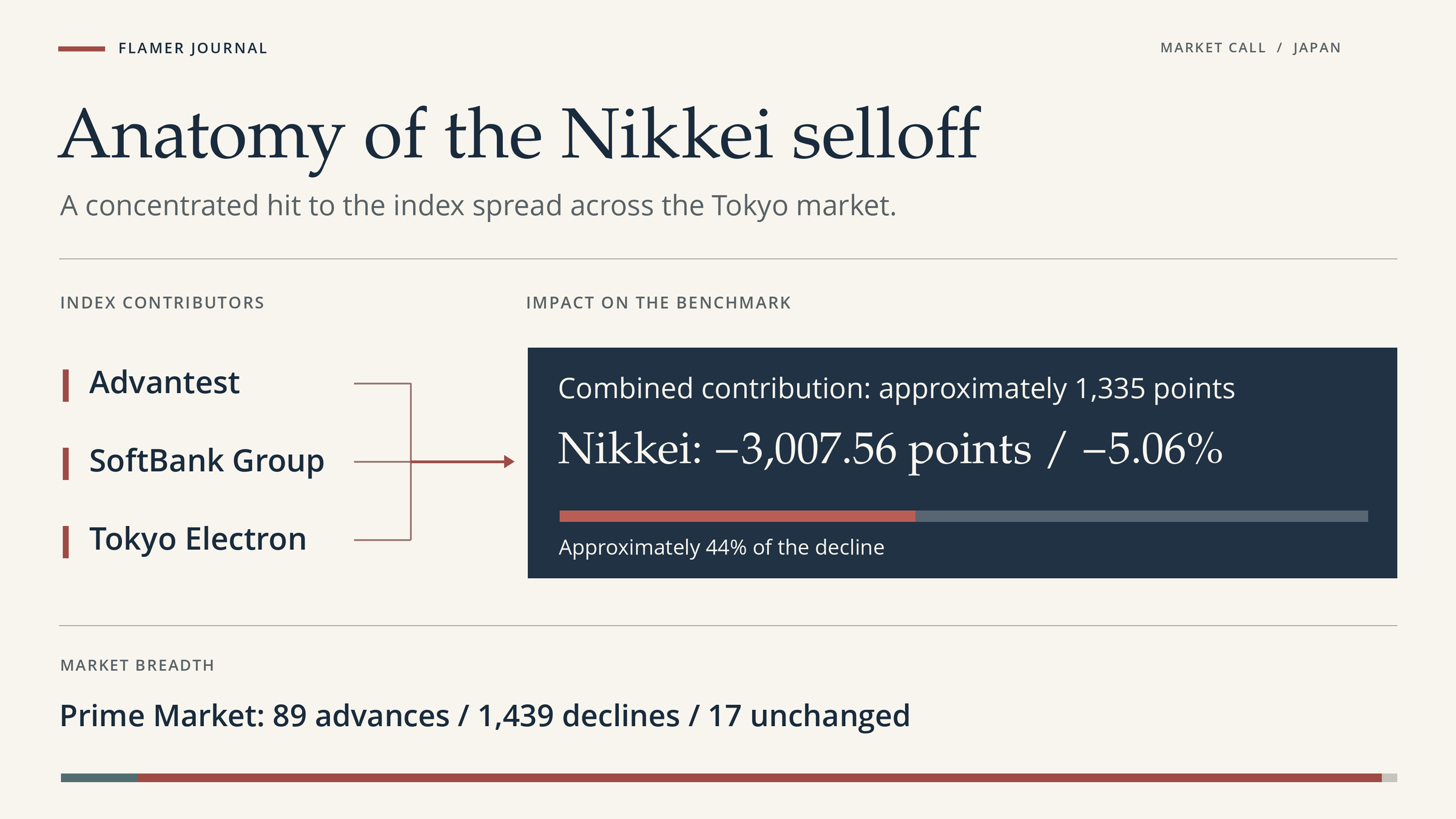
- Nikkei 225: 56,436.65, down 5.06%, or 3,007.56 points. Jiji described it as the fifth-largest point decline on record. The index closed at its session low and below 57,000 for the first time since April 13.
- Nikkei, weekly: down 7.7%, or 4,705.70 points, from the previous Friday’s 61,142.35. According to Democrata, the index remained approximately 9% higher for the year.
- TOPIX: 3,674.22, down 3.88%. Weekly decline: 6.8%.
- Prime Market breadth: 89 advances, 1,439 declines—approximately 93% of issues—and 17 unchanged. Only two of 33 sectors finished higher.
- Trading activity: ¥8.64 trillion in turnover and 3.09 billion shares traded, versus ¥7.72 trillion in turnover on November 19.
- Nikkei night-session futures: 54,773, approximately 2.9% below the cash close.
- USD/JPY: 158.59, versus 159.63 on November 19. The exchange rate remained close to 160 despite approximately US$100 billion in intervention.
- Japan’s 10-year government bond yield: approximately 2.79%, down 3 basis points as investors sought safety in bonds.
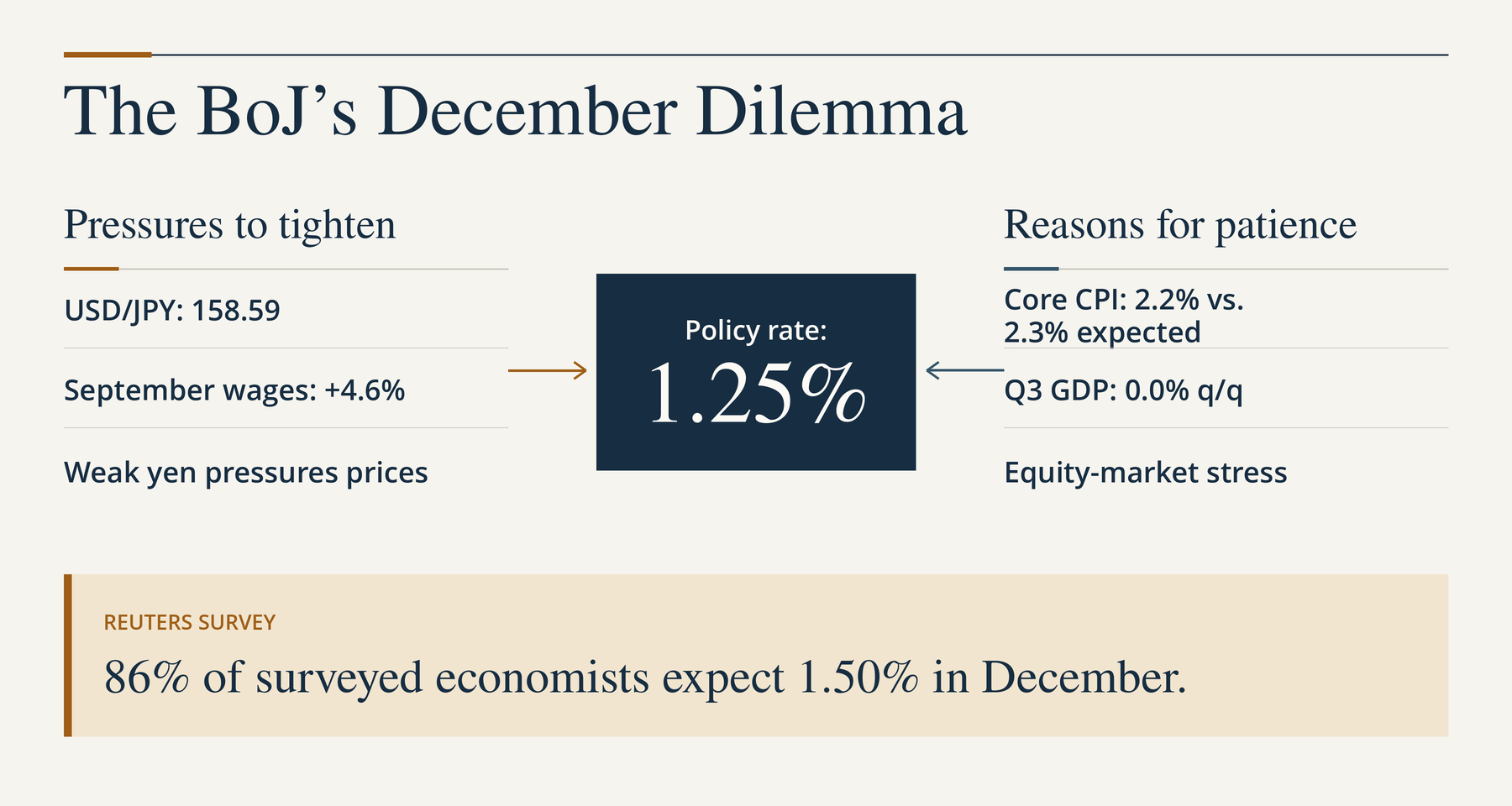
- Bank of Japan policy rate: 1.25%. The next meeting is December 17–18; 86% of economists in a Reuters survey expected an increase to 1.50%.
- October core CPI: 2.2% year over year, below the 2.3% consensus. Core-core inflation was also 2.2%, down from 2.4% in September.
- Wall Street, November 19: reported declines of 5.28% for the Nasdaq and 3.70% for the S&P 500, with the VIX at 35.9. Nvidia reportedly fell 14%. These figures carry the source discrepancy discussed in Section 7.
- Asia, November 20: the Kospi fell 5.21% to 4,870; Taiwan dropped 6.23% and recorded its worst week since 1991; the Hang Seng declined 1.88%.
2. The Week and Friday’s Session
Friday had the character of capitulation in AI and semiconductors. The Nikkei lost 5.06% and finished at its low. Advantest, SoftBank Group, and Tokyo Electron together accounted for approximately 1,335 points of the decline—roughly 44% of the index’s total loss.
The damage had started well before Friday. The Nikkei fell 2.42% on Monday to 59,662, with Jiji linking semiconductor selling to doubts about data-center investment following its report that Jensen Huang had left Nvidia’s leadership the previous week. That reported departure has not been independently verified here and should not be treated as a settled explanation for the selloff.
By Friday’s close, the Nikkei had lost 7.7% for the week.
Anthropic’s Nasdaq debut did not provide the sector with a lasting lift. Its IPO was priced at US$83, and the stock closed its first session on Thursday, November 19, at US$97.17 before falling 8.5% on its second trading day.
SoftBank, with approximately US$64.6 billion invested in OpenAI, fell 14.5%, its largest decline since August 2024. Masayoshi Son reportedly said on November 18 that passing on Anthropic had been a mistake.
The selling spread well beyond a handful of AI names:
- Nonferrous metals: down 9.90%, the weakest sector.
- Electrical equipment and electronics: down 5.70%.
- Glass and ceramics: down 5.21%.
- Machinery: down 4.99%.
- Banks: down 4.95%.
- Insurance: up 0.65%.
- Air transportation: up 0.33%.
Insurance and airlines were the only sectors to advance. Tokio Marine, Otsuka, and SOMPO were among the defensive names that held up.
Jiji attributed part of the selling pressure to position adjustments ahead of the long holiday weekend.
My read is that the week looks more like forced deleveraging in the AI trade than a sudden break in Japan’s domestic macro outlook. That distinction matters, but it does not establish a floor.
Night-session Nikkei futures at 54,773 point to the possibility of another decline of roughly 3% when Tokyo reopens on Tuesday, November 24. A recovery on Wall Street on Monday could change that setup; the futures indication is not a forecast of the opening level.
3. Macro, the Yen, and the BoJ
October’s inflation report, released on November 20, offered some relief without resolving the BoJ’s dilemma.
Headline CPI rose 2.3% year over year, up from 2.1% in September, and increased 0.5% month over month. Core inflation, which excludes fresh food, came in at 2.2%, below the 2.3% consensus. Core-core inflation eased to 2.2% from 2.4%.
Goods inflation was 3.2%; services inflation was 1.4%. Core inflation remained above 2% for a second consecutive month.
The activity data were uneven:
- Third-quarter GDP was flat quarter over quarter and down 0.1% at an annualized rate.
- October exports rose 20.5% year over year, including a 49.7% increase in semiconductor-equipment exports.
- September wages increased 4.6%, with real wages up 2.2%.
- Unemployment stood at 2.4%.
- September household spending fell 6.8% year over year.
- October producer prices rose 7.1% year over year.
This is not a clean picture of either overheating or broad-based weakness. Strong wages and exports sit alongside stagnant GDP and a sharp decline in household spending.
The BoJ’s policy rate stands at 1.25% following increases in June and September and an October hold.
In a Reuters survey of 71 economists conducted November 11–18, 61 respondents—86%—expected a rise to 1.50% on December 18. That would make it the first year with three rate increases in 37 years. Almost 60% expected 1.75% by the end of March, while 83% said the Nikkei’s decline would not prevent the next increase.
Governor Ueda told Parliament that rates should continue rising and that yen weakness was putting upward pressure on prices.
The currency remains the uncomfortable part of this equation. USD/JPY ended Friday at 158.59, with the yen gaining 0.69% on the day as investors sought safety. Yet it had been approaching 160 despite approximately US$100 billion in intervention.
With the U.S. 10-year Treasury yield near 4.9%–5.0%, the yield advantage over Japanese government bonds remained approximately 2.1–2.2 percentage points.
Softer-than-expected core inflation and equity-market volatility could give the BoJ room to postpone a December increase. Dai-ichi economist Shinke has already raised that possibility. But strong wage growth and a yen still close to 160 pull in the opposite direction.
A rate increase during an equity selloff could strengthen the yen and add a currency headwind for exporters already facing falling share prices. That is a plausible scenario, not an automatic market response.
4. Sectors
Semiconductors, chip-related materials within nonferrous metals, and electronics led the decline. Banks also fell sharply, losing 4.95% despite expectations of higher policy rates.
That banking move stands out. My interpretation is that indiscriminate selling and credit concerns outweighed the potential benefit of higher lending margins. The price action alone does not establish that the margin thesis has deteriorated.
Insurance and airlines were the only positive sectors. Insurers may offer a different earnings exposure from the AI complex, with less direct dependence on that investment cycle and potential benefits from higher long-term reinvestment yields. That is a structural argument—not an explanation based on Friday’s bond move, when the 10-year JGB yield fell.
If the market rebounds, the hardest-hit semiconductor names could react first. Durable leadership is another matter. It could migrate toward financials and domestically oriented businesses rather than return automatically to the stocks that led the previous advance.
5. Stocks in Focus
November 20 share prices and daily changes below come from press reports. Market capitalizations and price-to-earnings ratios labeled as November 20 estimates are my calculations using share counts and trailing earnings from Stock Analysis data retrieved several weeks earlier.
Revenue and profit figures are trailing 12-month observations from that same dataset unless otherwise indicated. They are not a substitute for current company filings, particularly where inconsistencies are flagged.
Advantest — 6857
Price: ¥24,255, down 10.32%.
Weekly performance: down 20.8%, from ¥30,610.
Estimated market capitalization: approximately ¥17.6 trillion.
Estimated trailing P/E: approximately 38x, versus roughly 50x at a share price of ¥31,620 on October 26.
Revenue: ¥1.23 trillion, up 36.2%.
Net income: ¥460 billion, up 102.2%.
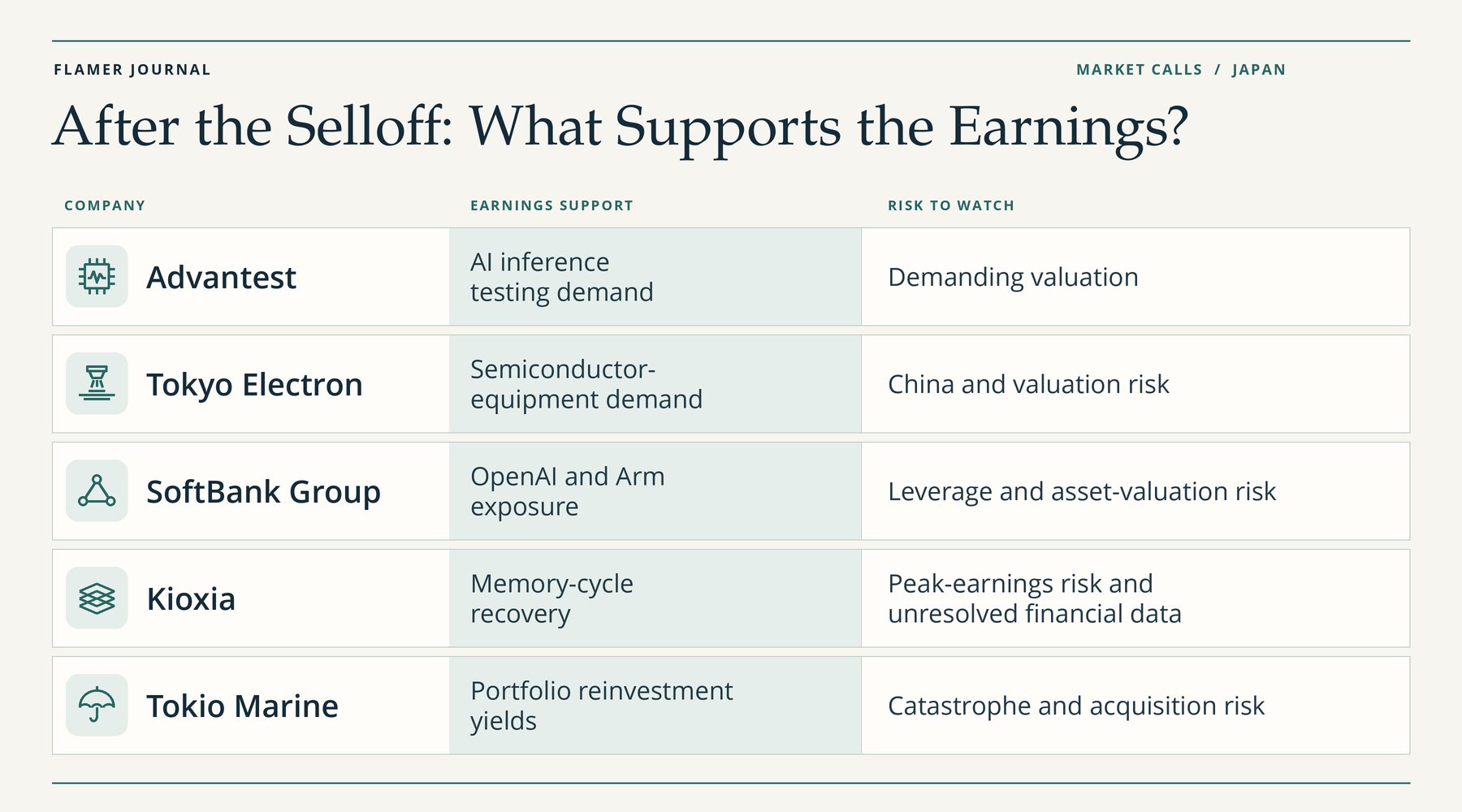
The operating case centers on demand for system-on-chip testers used in AI inference and computing. A report that the company raised profit guidance after a record quarter remains unverified. The cited analyst consensus was Buy, with an average target of ¥43,495; that is an external consensus figure, not my valuation.
Advantest was the largest individual contributor to the Nikkei’s decline. Even after the selloff, its earnings multiple remains demanding. Other concerns include potential margin pressure from memory prices and dependence on AI capital expenditure.
Tokyo Electron — 8035
Price: ¥8,309, down 7.06%.
Weekly performance: down 12.2%, from ¥9,461.
Estimated market capitalization: approximately ¥18.9 trillion.
Estimated trailing P/E: approximately 31x.
Revenue: ¥2.63 trillion, up 8.3%.
Net income: ¥621 billion, up 15.9%.
The operating backdrop includes record fiscal first-quarter sales and gross profit, higher first-half guidance, and a record interim dividend. Japan’s 49.7% increase in October semiconductor-equipment exports provides additional context for the industry’s strength.
The tension is valuation: reported profit growth is considerably lower than the earnings multiple. China exposure, geopolitics, and the industrial-secrets case involving TSMC remain additional risks.
SoftBank Group — 9984
Price: ¥3,025, down 14.48%, after an intraday low near ¥3,007, its lowest level in seven months.
Weekly performance: down 14.7%.
Estimated market capitalization: approximately ¥17.2 trillion.
Estimated trailing P/E: approximately 13x, based on earnings heavily affected by investment results.
Revenue: ¥8.30 trillion, up 10.5%.
Net income: ¥1.30 trillion, down 57.4%.
CNBC reported a fiscal second-quarter loss of approximately ¥1.12 trillion, including investment losses and write-downs on U.S. data centers.
The investment case remains tied to OpenAI’s valuation and Arm’s record results. My hypothesis is that a selloff of this magnitude can widen SoftBank’s discount to the value of its underlying assets—but that discount is only as useful as the valuations assigned to those assets.
Risks include concentration in OpenAI, credit-default swaps that reached a four-year high on November 6, reliance on high-yield financing, and China’s blocking of the US$5.4 billion acquisition of ABB’s robotics business.
Kioxia — 285A
November 20 closing price: not obtained.
Daily performance: down 11.66%.
Last consolidated price available in the dataset: ¥8,511 on November 6.
Market capitalization as of November 6: ¥13.6 trillion; likely materially lower after the subsequent decline, although an updated figure is unavailable.
P/E as of November 6: 5.2x trailing and 1.9x forward.
The dataset lists revenue of ¥5.79 trillion, up 265%, and net income of ¥2.69 trillion, up 1,635%. These figures conflict with fiscal 2026 revenue of ¥2.34 trillion shown by the same source. They require verification against primary filings and should not support a valuation conclusion in their current form.
Reported operating developments include record results on October 30, an interim dividend of ¥90, an expected fourth-quarter recovery, and consideration of a U.S. ADR.
The risks are substantial: weak guidance in early November, when the shares fell as much as 17%; the memory cycle; and the possibility that a low earnings multiple reflects peak profits rather than durable cheapness.
Tokio Marine — 8766: The Defensive Counterpoint
November 20 closing price: not obtained. The insurance sector rose 0.65%, and Tokio Marine was cited among the advancing stocks.
Last consolidated price in the dataset: ¥520.8 on October 1, an old observation that should not be treated as a current quote.
Listed market capitalization: ¥15.3 trillion.
Listed P/E: approximately 28x trailing and 16.6x forward.
Revenue: ¥8.36 trillion, up 0.7%.
Net income: ¥540 billion, down 59.3%. One possible explanation is a comparison period inflated by cross-shareholding disposals, but that interpretation remains unverified.
Potential supports include higher investment-portfolio returns as yields rise, a Berkshire partnership involving a planned ¥287.4 billion investment, and a goal of doubling profit by 2035.
Catastrophe losses remain a central risk. The Financial Times also cited Suncorp in connection with a possible large overseas acquisition.
6. Multibagger Potential: A Hypothesis, Not a Forecast
A weekly decline of roughly 21% in Advantest and 15% in SoftBank creates what I see as the first serious valuation opening since the beginning of the AI cycle. But a lower share price does not settle whether the underlying earnings are structural or cyclical.
That distinction separates these names more meaningfully than the size of their weekly declines.
Advantest has the strongest operating profile in this comparison: profit growth of 102% and testing demand linked to inference. The thesis is that inference-related demand could keep expanding even if spending on training infrastructure slows. That resilience remains an assumption to test, not a guaranteed offset.
Its estimated trailing multiple has fallen from approximately 50x to 38x. That is a meaningful reset, but not an obviously cheap valuation. A forward multiple in the 25x–30x range is a possibility under the earnings assumptions behind this thesis, not a verified current figure.
Tokyo Electron looks comparatively lower-risk within this semiconductor group, though a roughly 31x multiple still leaves a substantial valuation burden against its reported earnings growth.
SoftBank offers a more asymmetric—and more leveraged—exposure. If OpenAI sustains its valuation, the discount to underlying asset value could matter. If that valuation weakens, leverage can amplify the damage.
Kioxia looks cheapest on the displayed multiples and most exposed to the memory cycle. Its unresolved financial-data discrepancies make that apparent cheapness particularly difficult to interpret.
Outside AI, insurers such as Tokio Marine and the banks offer exposure to a different potential driver: further BoJ tightening. Friday’s broad selling dragged banks lower alongside the rest of the market, despite that possible earnings support.
For me, Tuesday’s reopening and the U.S. PCE release on November 25 are more useful tests than the size of Friday’s decline alone. Whether staged exposure would provide a meaningful margin of safety depends on earnings durability, verified valuations, and how the market absorbs those events—not simply on buying at several different prices.
I have no proprietary price targets here. These are valuation hypotheses, not buy, sell, or hold recommendations.
7. Facts vs. Hypotheses
Reported Observations
The central market figures in this call are:
- Nikkei: 56,436.65, down 5.06% on Friday and 7.7% for the week.
- TOPIX: 3,674.22, down 3.88%.
- Advantest: ¥24,255, down 10.32%.
- Tokyo Electron: ¥8,309, down 7.06%.
- SoftBank: ¥3,025, down 14.48%.
- Kioxia: down 11.66%.
- Nikkei night-session futures: 54,773.
- USD/JPY: 158.59.
- Japan’s 10-year government bond yield: approximately 2.79%.
- Core CPI: 2.2%.
- Reuters survey: 86% expected the BoJ rate to reach 1.50% in December.
- Tokyo’s stock market is closed on November 23.
These are the reported observations used in the analysis; they do not resolve the specific verification issues below.
Interpretations
The following remain hypotheses:
- Another decline when Tokyo reopens on Tuesday.
- Forced deleveraging in AI as the main explanation for the selloff.
- A possible postponement of the BoJ’s December increase.
- A valuation opening in Advantest and SoftBank.
- A potential shift in market leadership toward financials.
Still to Verify
The outstanding checks are the November 20 closing prices for Kioxia and Tokio Marine; updated market capitalizations and earnings multiples after the selloff; MUFG’s and Tokio Marine’s fiscal second-quarter results, listed for November 13 and November 19, respectively; and Kioxia’s conflicting fiscal data.
There is also a discrepancy in the U.S. market figures for November 19. The Reuters/Yahoo ticker shows the Nasdaq down 5.28% and the S&P 500 down 3.70%. FinanceFeeds cites declines of 2.25% and 2.02%, respectively, which may refer to November 18. That date mismatch remains unresolved.
Jiji’s report that Jensen Huang left Nvidia’s leadership has not been independently corroborated here. Given its significance, it should remain separate from verified explanations of the market move.
Calendar
- Monday, November 23: Tokyo closed; preliminary PMIs overseas.
- Tuesday, November 24: Tokyo reopens; Japan’s November PMI.
- Wednesday, November 25: U.S. October PCE inflation and revised GDP.
- Thursday, November 26: U.S. markets closed for Thanksgiving.
- Friday, November 27: Tokyo’s November CPI.
- December 17–18: Bank of Japan policy meeting.
Editorial Note
This publication is provided for informational and educational purposes only. It is not investment research, a recommendation, an offer or solicitation, or personalized financial advice. Market conditions and available information can change quickly, and the views expressed here may prove incomplete or incorrect. Readers should consult primary sources and seek qualified professional advice where appropriate.
FTS INPUT
- Region: Japan
- Date: November 20, 2026
- Tone: risk-off
- Main move: Nikkei 56,436.65, down 5.06% on the day and 7.7% for the week; TOPIX down 3.88%.
- Driver: AI and semiconductor selling, intensified by position adjustments ahead of the long weekend.
- Implication: The selloff appears more consistent with stress in concentrated AI exposure than a confirmed break in Japan’s domestic economy.
- Watch next: Tokyo’s reopening on November 24.
- Note: Banks fell despite expected BoJ tightening—a sign that liquidation may have overwhelmed sector-specific earnings logic.