
Market Calls / China
Market Call — Hong Kong’s AI Selloff Meets Mainland Buying
Technology shares are pricing in a harsher return on AI spending. Mainland investors are buying the decline, but weak domestic demand and deteriorating cash flow leave little room for easy reassurance.

Market date
November 22, 2026
1. Indices — Friday, November 20 Close
Hong Kong ended the week under sustained selling pressure. The Hang Seng Index closed at 22,410.80, down 430.82 points, or 1.89%, marking its fourth consecutive decline and its lowest close since the late-April/May 2025 period.
The weekly damage was substantial:
- Hang Seng Index: down 1,226 points, or 5.2%, its largest weekly loss since June 2026.
- Hang Seng Tech Index: down 3.78% on Friday to 3,511.14; down 10.4% for the week and 36.7% for the year, with eight consecutive losing sessions.
- Hang Seng China Enterprises Index: down 1.77% to 7,554.37; down 5.7% for the week.
Main-board turnover approached HK$270 billion. Market breadth was heavily negative, with 448 advancers against 2,012 decliners.
November HSI futures settled at 22,759. Peter Lewis’s briefing points to a Monday opening near 22,445.
Mainland markets offered little shelter. The Shanghai Composite fell 1.23% to 3,533.79, leaving it down 3.4% for the week. The Shenzhen Component dropped 3.09% to 10,256, a 52-week low, and lost 8.7% over the week.
The HSI now sits roughly 20% below its January 29, 2026 peak, placing it in technical bear-market territory and close to its 52-week low of 22,307.
My read is that this was thematic capitulation in AI, semiconductors, and internet stocks—not a shock originating in Hong Kong itself. But the selling is no longer confined to the most speculative names.
HSBC fell 3.1%, AIA lost 1.8%, and HKEX declined 3.7% on roughly three times its average trading volume. Financials generally held up better than technology, yet the liquidation has reached large-cap value stocks as well. That kind of broadening can appear late in a selloff. It is not, by itself, evidence of a bottom.

2. What Drove the Selloff
The immediate pressure came from abroad.
On Thursday, November 19, the S&P 500 fell 2.0% and the Nasdaq lost 2.3%. By the end of the week, the Nasdaq 100 had entered a bear market, while the Philadelphia Semiconductor Index had accumulated a 10.7% weekly decline.
Asia followed on Friday:
- Taiwan’s Taiex fell 6.2%.
- South Korea’s Kospi dropped 5.2% to 4,870.
- Japan’s Nikkei declined 5.1% to 56,437.
Several concerns converged.
First, investors are questioning the returns on AI capital spending. The issue is no longer simply whether demand for AI exists. It is whether the revenue generated will justify the infrastructure bill.
Second, Anthropic’s U.S. IPO debut on November 19 failed to restore confidence in the sector.
Third, expectations of a Federal Reserve rate increase added pressure to long-duration equities and unprofitable biotechnology companies. When more of a company’s valuation depends on earnings far in the future, higher discount rates become harder to absorb.
Fourth, export restrictions are tightening. A Reuters report carried by etnet said TSMC had suspended some advanced-process orders from Chinese chip designers.
Finally, weak earnings from NetEase, Kuaishou, and Tencent gave investors company-specific reasons to sell into an already fragile market.
A stronger dollar also weighed on gold and mining stocks. Gold fell below US$3,600 an ounce.
Geopolitics Offered No Relief
According to Peter Lewis’s briefing, the Trump–Xi–Putin summit in Shenzhen, held on the sidelines of APEC, ended without concrete agreements on tariffs, technology restrictions, rare earths, or Taiwan.
U.S. congressional records showed that the Bureau of Industry and Security had approved roughly 880,000 chips for Chinese companies, including Alibaba, Tencent, Baidu, and BYD. Trump said Blackwell sales to China could come “in two or three years.”
Bloomberg also reported that U.S. lawmakers were nearing legislation to ban Chinese cars.
One BBN Times headline attributed the market decline to “U.S.–Iran negotiations.” I could not access the article, and no other source in the material reviewed corroborated that connection. I would not treat it as an established explanation.
Brent traded around US$92.6 a barrel, while traffic through the Strait of Hormuz had returned to levels close to those seen before the war.
3. Southbound Stock Connect Flows
Mainland investors bought the decline.
Net southbound buying reached HK$11.81 billion on November 20, split between approximately HK$6.56 billion through Shanghai and HK$5.25 billion through Shenzhen.
For the week, net purchases totaled HK$16.5 billion, up from HK$11.9 billion the previous week, with inflows recorded for four consecutive sessions.
ETFs attracted the largest allocations:
- Tracker Fund of Hong Kong, ticker 2800: approximately HK$6.1 billion across the two channels.
- CSOP Hang Seng Tech ETF: HK$2.4 billion.
Among individual stocks, Friday’s leading net purchases were:
- Tencent: HK$1.16 billion.
- Alibaba: HK$636 million.
- Hua Hong Semiconductor: HK$410 million.
The main net sales were:
- CNOOC: HK$283 million.
- Meituan: HK$158 million.
- SMIC: HK$150 million.
The weekly picture was more concentrated than the daily figures suggest. Tencent absorbed HK$7.75 billion, nearly half of total net southbound inflows. Alibaba, despite Friday’s buying, recorded net weekly selling of HK$1.7 billion.
The concentration in broad ETFs during a panic session is consistent with institutional support buying, potentially including the so-called national team. The flow data do not establish who the buyers were, however.
Such purchases can cushion a decline. They cannot reverse a trend on their own.
4. China Macro and the Yuan
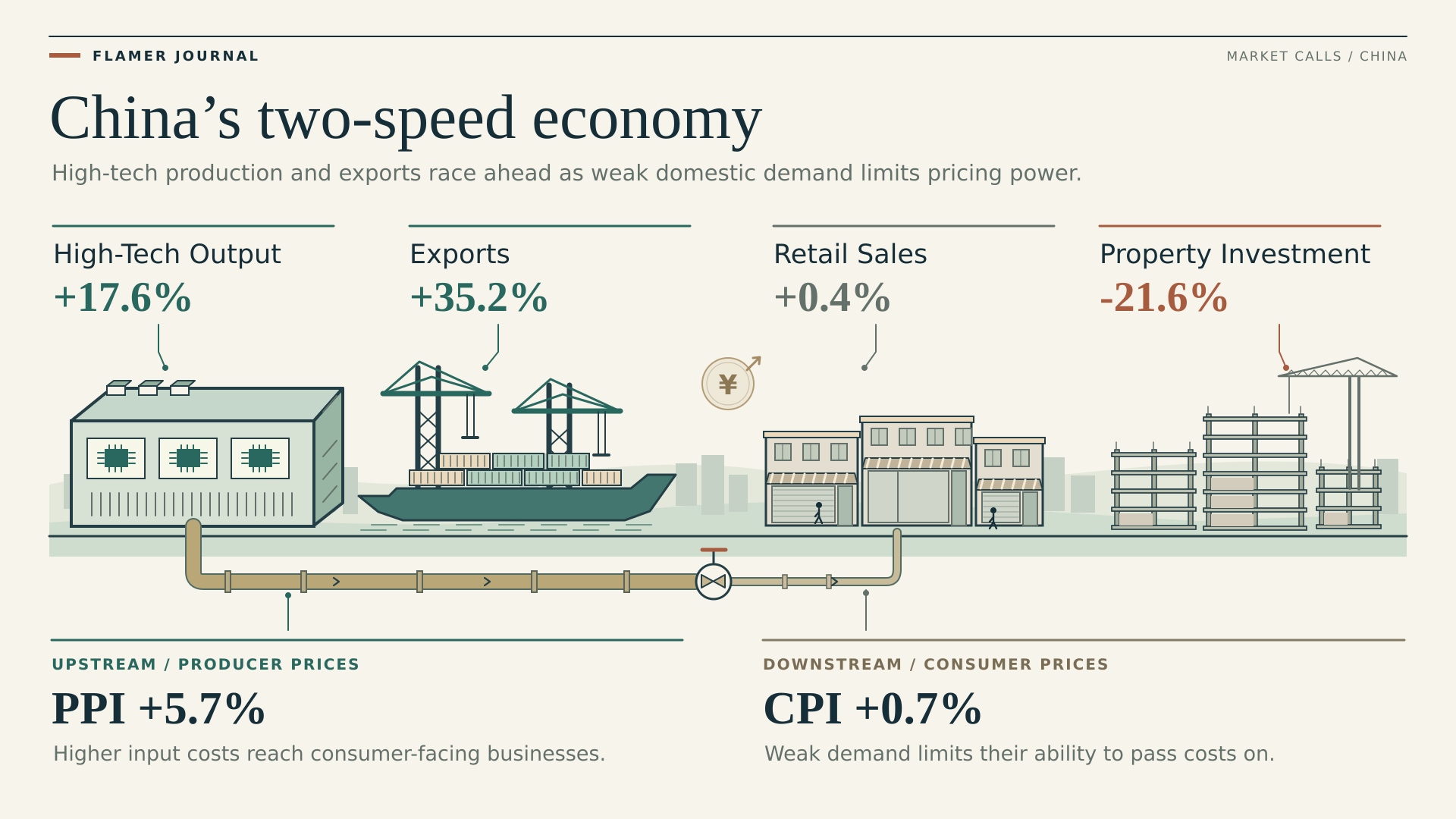
October’s data describe an economy moving at two very different speeds.
The figures below reflect the releases cited in the draft, including the November 16 NBS data:
- Industrial production: up 4.8% year over year, versus 5.5% previously.
- Retail sales: up 0.4% year over year, versus 1.1%.
- Fixed-asset investment, January–October: down 8.1%, versus a 7.2% decline previously.
- Property investment: down 21.6%.
- Urban unemployment: 5.1%, down from 5.2%.
- Exports: up 35.2% to US$412 billion, versus growth of 36.3%.
- Imports: up 41.6%.
- Consumer inflation: 0.7%, versus 0.9%, with core CPI at 0.8%.
- Producer inflation: 5.7%, up from 5.0% and the highest reading since June 2022.
- Passenger-car sales, according to the CPCA: down 27.1%.
- One-year and five-year loan prime rates, November 20: unchanged at 3.00% and 3.50%, respectively—the 18th consecutive month without a change.
High-tech industrial output rose 17.6%, while integrated-circuit exports surged 137%. That strength contrasts sharply with barely growing retail sales, falling car sales, and contracting property investment.
ANZ analysts do not expect additional stimulus in 2026. ING sees more support arriving in 2027.
A Strong Yuan Complicates the Picture
USD/CNH closed at 6.671, leaving the offshore yuan roughly 4.4% stronger for the year and close to the dollar’s 52-week low of 6.643. Onshore USD/CNY stood at 6.6765.
The November 17 fixing cited in the source material was 6.7132. That implied a weaker yuan than the spot rate, suggesting the PBoC was leaning against further appreciation.
The inflation mix matters. PPI at 5.7% alongside CPI of just 0.7% suggests that some consumer-facing businesses may struggle to pass higher input costs through to customers. Upstream producers may enjoy better pricing, while downstream margins come under pressure.
My interpretation is that this divergence, together with the currency backdrop, complicates the case for broad rate cuts. It does not point to a large stimulus package arriving imminently.
For equities, that means less confidence in a near-term policy backstop.
5. Stocks in Focus — Price, Volume, and Catalyst
All prices and daily moves below refer to November 20.
NetEase — 9999
- Closing price: not available in the draft.
- Daily move: down 17.6%.
- Weekly move: not provided.
- Catalyst: third-quarter revenue fell 1.8%, non-GAAP profit declined 4%, and gaming revenue slipped 1.7%.
Kuaishou — 1024
- Closing price: HK$20.42.
- Daily move: down 11.4%.
- Weekly move: down 24.1%.
- Catalyst: third-quarter revenue fell 11.1% and adjusted profit dropped 84%. Trading volume reached five times its average, and the shares hit an all-time low.
Hua Hong Semiconductor — 1347
- Closing price: HK$75.10.
- Daily move: down 10.2%.
- Weekly move: down 5.1%.
- Catalyst: profit-taking after an 8% rise on November 19. The company proposed a RMB300–500 million share repurchase.
Iluvatar CoreX — 9903
- Closing price: HK$52.20.
- Daily move: down 12.4%.
- Weekly move: down 38.1%.
- Catalyst: selling across domestic AI-chip stocks.
MiniMax — 100
- Closing price: HK$102.40.
- Daily move: down 10.8%.
- Weekly move: down 39.3%.
- Catalyst: the unwind in AI IPOs. The shares stood 92% below their peak.
Z.AI / Zhipu — 2513
- Closing price: HK$334.0.
- Daily move: down 7.2%.
- Weekly move: down 27.5%.
- Catalyst: the same retreat from AI IPOs, although the shares remained up 178% for the year.
Akeso — 9926
- Closing price: HK$56.70.
- Daily move: down 7.0%.
- Weekly move: down 31.7%.
- Catalyst: pressure on unprofitable biotechnology companies in a higher-rate environment.
Alibaba — 9988
- Closing price: HK$83.35.
- Daily move: up 3.5%.
- Weekly move: down 10.7%.
- Catalyst: the strongest blue-chip performance of the session, supported by 53% growth in AI cloud revenue. Morgan Stanley and JPMorgan maintained Overweight ratings.
Tencent — 700
- Closing price: HK$344.0.
- Daily move: down 1.3%.
- Weekly move: down 12.5%.
- Catalyst: weak third-quarter results and heavy capital spending. Tencent had the market’s highest turnover and attracted the largest individual-stock southbound purchases.
HKEX — 388
- Closing price: HK$357.0.
- Daily move: down 3.7%.
- Weekly move: down 6.5%.
- Catalyst: trading volume reached three times its average as the shares approached a 52-week low.
Zijin Mining — 2899
- Closing price: HK$23.06.
- Daily move: down 1.3%.
- Weekly move: down 15.8%.
- Catalyst: gold below US$3,600 an ounce. Trading volume was twice its average.
CATL — 3750
- Closing price: HK$335.0.
- Daily move: down 4.2%.
- Weekly move: down 10.5%.
- Catalyst: selling across the EV supply chain, with the shares near a 52-week low.
6. The Week’s Key Earnings
Tencent — Third Quarter 2026
Tencent’s results show how quickly AI spending can change the cash-flow profile of a large internet business:
- Revenue: RMB207.3 billion, up 7.5%.
- IFRS net profit: RMB63.6 billion, up 0.8%.
- Non-IFRS profit: RMB66.5 billion, down 5.7%.
- Capital expenditure: RMB81.4 billion, or 5.3 times the year-earlier level.
- Free cash flow: negative RMB69.1 billion.
The shares fell 6.8% on November 19.
Revenue was still growing. The problem was the scale of the spending required alongside it—and the resulting gap between reported profit and cash generation.
Alibaba — Fiscal Second Quarter Ended September 30
Alibaba delivered growth, but its investment bill remained substantial:
- Revenue: RMB271.5 billion, up 10% and above consensus.
- Adjusted profit: RMB19.9 billion, up 92%, but below consensus of approximately RMB26.6 billion.
- AI cloud revenue: RMB61.0 billion, up 53%.
- Growth from external cloud customers: 64%.
- AI-related product revenue: a 13th consecutive quarter of triple-digit growth.
- Free cash flow: negative RMB34.5 billion.
- Cash and liquid assets: RMB487.9 billion.
- Share repurchases: US$221 million.
The CFO said the company wants free cash flow back in positive territory “as soon as possible.”
Alibaba’s results capture the tension running through the sector: rapid AI monetization is visible, but so is the cash required to support it.
SMIC — Third Quarter 2026
The figures cited in the draft came from a secondary account referencing SMIC’s November 12 HKEX filing:
- Revenue: US$3.19 billion, up 33.9% year over year.
- Gross margin: 29.9%, versus 22.0% a year earlier.
- Profit: US$428 million, up 123%.
- Capacity utilization: 97.3%.
- Fourth-quarter revenue guidance: growth of 4–6% quarter over quarter.
- Fourth-quarter gross-margin guidance: 26–28%.
- Cash: US$13.4 billion.
- Debt: US$14.9 billion.
The operating performance was strong. The lower gross-margin guidance for the fourth quarter is the detail that deserves attention alongside the growth figures.
Lenovo — 992
Lenovo reported record revenue and adjusted profit, but a US$640 million accounting loss tied to mark-to-market changes in warrant derivatives.
The shares fell 5.5% on November 19.
Kuaishou and NetEase are covered in the stock review above.
7. Asymmetry Radar — Potential Multibaggers, Tested Against Fundamentals
A direct caveat: with Hong Kong technology stocks in free fall, none of these names currently offers the full combination of growing earnings, a clean balance sheet, a low valuation, and positive momentum that would make a textbook multibagger case.
What the selloff has produced is a set of potential valuation dislocations.
The multiples below are rough working estimates, not standardized or independently reconciled valuations. Where cash balances, share-count assumptions, or currency conversions remain incomplete, the apparent discount needs particular caution.
1. Kuaishou — 1024
HK$20.42; down 11.4% on the day and 68% for the year.
The operating picture:
- Market capitalization: approximately HK$88 billion.
- Third-quarter revenue: RMB31.6 billion, down 11.1%.
- Adjusted profit: RMB0.79 billion, down 84%.
- Adjusted EBITDA: RMB3.9 billion.
- R&D spending: up 42%, including investment in Kling AI.
- Monthly active users: 818 million, up 12%.
Management warned that advertising and consumption would remain weak in the fourth quarter.
The draft’s rough valuation estimates put annualized price-to-sales near 0.6 times and EV/annualized EBITDA potentially below 6 times. The latter remains provisional because the cash balance was not established.
The thesis is that roughly 0.6 times revenue assigns a deeply distressed valuation to a platform with more than 800 million users and an AI-video asset in Kling. If revenue stabilizes in 2027, the shares could undergo a substantial rerating.
That is a conditional argument, not evidence that stabilization has begun.
Potential catalysts include steadier advertising revenue, Kling monetization or a spin-off, and share repurchases.
The risks are specific: Douyin may be causing structural rather than cyclical revenue pressure; AI spending may continue to erode margins; and the weakest quarter may still lie ahead.
2. Hua Hong Semiconductor — 1347
HK$75.10; down 10.2% on the day and up 1% for the year.
The company proposed a RMB300–500 million buyback, its first since the A-share IPO. Southbound investors bought HK$1.16 billion during the week.
The third-quarter earnings call was described as showing record revenue and rising profit, although detailed quarterly figures were not verified for this edition.
Using an estimated 1.72 billion shares gives a rough market capitalization of HK$129 billion.
The thesis is that Hua Hong could be a major Hong Kong-listed beneficiary of domestic substitution as Chinese designers face tighter access to TSMC. Its exposure to mature and specialty processes is central to that argument. SMIC’s 97% utilization provides a separate indication of strong demand within domestic foundry capacity.
What remains a hypothesis is how much displaced business Hua Hong can actually capture.
Potential catalysts include execution of the buyback, order migration from TSMC, and the Fab 9 ramp.
Risks include heavy capital spending, historically thin margins, sanctions, and extreme share-price volatility. The stock’s 52-week high was HK$219.6; it now trades approximately 66% below that level.
3. Alibaba — 9988
HK$83.35; up 3.5% on the day and down 42% for the year.
Alibaba holds approximately RMB488 billion in cash and liquid assets, but AI capital spending has pushed free cash flow below zero.
The draft’s approximate valuation assumptions are:
- Market capitalization: HK$1.58 trillion, or roughly RMB1.36 trillion.
- Price-to-earnings: about 17 times annualized quarterly adjusted profit, with that quarter’s earnings depressed by quick-commerce subsidies.
- Gross cash and liquid assets: approximately 36% of market value.
These are rough comparisons using the draft’s currency and valuation assumptions. Gross liquidity should not be confused with net cash.
The thesis rests on a cloud business growing 53% and AI-related product revenue expanding at triple-digit rates. In my view, that makes Alibaba one of the clearest expressions of monetized AI exposure in China.
The shares stand roughly 52% below their 52-week high. A doubling over two to three years is a possible upside scenario if execution improves; a five- to tenfold outcome is a much harder argument given the company’s size.
Potential catalysts include a return to positive free cash flow, better cloud margins, and lower quick-commerce losses.
The risks are AI and quick-commerce price wars, dependence on chip licenses, and capital spending that fails to produce adequate returns.
4. SMIC — 981
HK$49.12; down 2.7% on the day and 31% for the year.
Revenue growth of approximately 34%, expanding gross margins, and 97% utilization distinguish SMIC operationally. Net debt is relatively modest at about US$1.5 billion.
The draft uses an approximate market value of HK$390 billion on an H-share-based calculation and an estimated price-to-earnings ratio of 29 times annualized third-quarter profit. Those figures remain working estimates rather than a reconciled valuation across share classes.
This is an operating-quality thesis, not an obvious bargain thesis. The estimated multiple does not make a straightforward multibagger case.
SMIC remains useful as a gauge of China’s semiconductor self-sufficiency effort.
The main risks are the lower fourth-quarter gross-margin guidance of 26–28%, sanctions, and high capital expenditure.
5. Tencent — 700
HK$344; down 1.3% on the day and 43% for the year, at a 52-week low.
Mainland investors bought HK$7.75 billion during the week.
The draft’s rough estimates put market capitalization near HK$3.1 trillion and the price-to-earnings ratio at approximately 10 times annualized third-quarter non-IFRS profit, subject to currency and calculation assumptions.
The thesis is that a high-quality franchise is trading at a low earnings multiple—provided its AI spending eventually produces meaningful revenue and cash returns.
This is less a multibagger argument than a question of what investors are paying for an established business during an investment surge. Tencent is also the name mainland buyers have chosen most decisively.
Risks include continued negative free cash flow while AI spending remains elevated, U.S. restrictions on remote access to chips—which Tencent acknowledged could have a near-term impact—and gaming regulation.
Speculation Is Not the Same as Asymmetry
MiniMax, Z.AI, and Iluvatar fell roughly 27–39% in a single week.
These are unprofitable AI IPOs whose valuations remain heavily dependent on sentiment. A large decline alone does not establish a fundamental floor.
In an AI bear market, I do not see enough in the material reviewed to call a bottom in these names.
8. The Week Ahead — November 23–27
The calendar brings several opportunities to test whether policy and earnings can interrupt the selloff.
- Monday, November 23: Japan’s market is closed.
- Wednesday, November 25: the PBoC’s medium-term lending facility operation is due, with approximately RMB1 trillion of one-year MLF funding maturing in the window.
- Thursday, November 26: Hong Kong releases October trade data. U.S. markets are closed for Thanksgiving.
- Friday, November 27: China releases October industrial profits, and Taiwan reports third-quarter GDP. U.S. equities have a shortened session.
Lundgreen’s expects Chinese industrial profits to rise approximately 14% year over year, compared with 14.4% in September.
For Monday’s opening and the sessions that follow, five developments matter most:
- Whether the HSI holds 22,307. A break below the 52-week low would bring the 21,500–22,000 area into focus under the technical scenario considered here.
- Whether southbound buying remains above HK$10 billion a day. Sustained inflows would suggest mainland investors are continuing to absorb supply rather than responding to a single panic session.
- Whether the Nasdaq and U.S. semiconductor stocks stabilize. They remain the dominant external driver of this selloff.
- The size of the MLF rollover. An operation larger than the amount maturing would offer a modest signal of easier liquidity conditions—not a full policy pivot.
- Whether USD/CNH breaks below 6.64. Further yuan appreciation could support flows into Chinese assets while adding pressure to exporters.
9. Executive Summary
Hong Kong recorded its worst week since June, with the HSI down 5.2% and technology shares down 10.4%. The dominant force was a global liquidation in AI and semiconductors, not a local Hong Kong shock.
Mainland investors responded with HK$16.5 billion of net weekly buying, concentrated in Tencent and ETFs. That demand is meaningful, but it has not yet changed the price trend.
China’s economy remains divided between strong exports and high-tech production, barely growing consumer spending, and contracting property investment. A large stimulus package does not appear imminent.
Meanwhile, internet earnings are making the cost of AI tangible. Revenue growth is not enough to settle the investment debate when capital spending is driving free cash flow sharply negative.
The selloff has produced distressed-looking valuation estimates—around 0.6 times sales for Kuaishou and 10 times earnings for Tencent in the draft’s working calculations. Those figures identify questions worth investigating, not proof that the selling is finished.
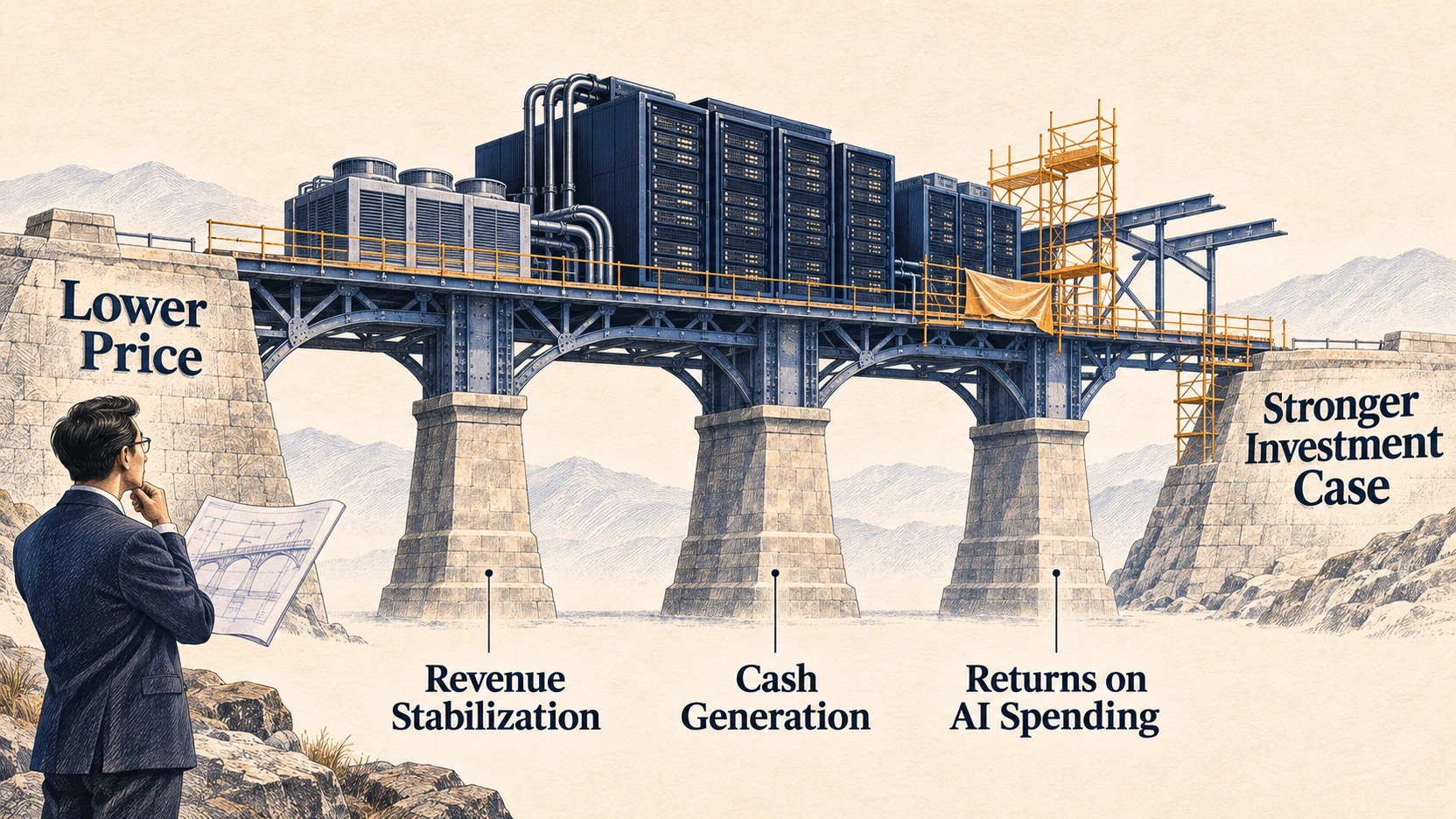
The distinction now is between a lower price and a genuinely stronger investment case. The former has arrived. The latter still depends on revenue stabilization, cash generation, and evidence that AI spending can earn an adequate return.
Editorial note: This publication is provided for informational and educational purposes only. It is not investment research, a recommendation, an offer or solicitation, or personalized financial advice. Market conditions and available information can change quickly, and the views expressed here may prove incomplete or incorrect. Readers should consult primary sources and seek qualified professional advice where appropriate.