
Medicine / Psychiatry
When the Drug Isn’t the Whole Answer
A pediatric emergency trial, Brazilian perspectives on assessment and autonomy, and a Viewpoint on mental-health AI show why clinical purpose and the strength of evidence matter.
Psychiatry | Evidence review | November 25, 2026
A pediatric emergency trial, a Brazilian study of assessment and autonomy, and a Viewpoint on mental-health chatbots ask different questions. Reading them together brings one practical issue into focus: what is an intervention meant to accomplish, and what evidence supports that purpose?
A useful trial without a clear winner
PEAChY-M, published online in JAMA on November 23, compared intramuscular olanzapine and droperidol in children and adolescents with acute behavioral disturbance. It tested whether olanzapine was superior. The primary result did not establish that superiority.
The open-label trial enrolled 348 patients aged 9–17 at ten Australian emergency departments between November 2021 and February 2026. Enrollment reflected a clinical judgment that intramuscular medication was needed; the population should not be reduced to agitation caused solely by psychiatric illness. Participants were assigned to a single study dose, although not everyone received the assigned medication.
The primary outcome combined two requirements: a Sedation Assessment Tool score of zero or below and no additional sedative at one hour after randomization. Outcome data were available for 167 participants in each group.
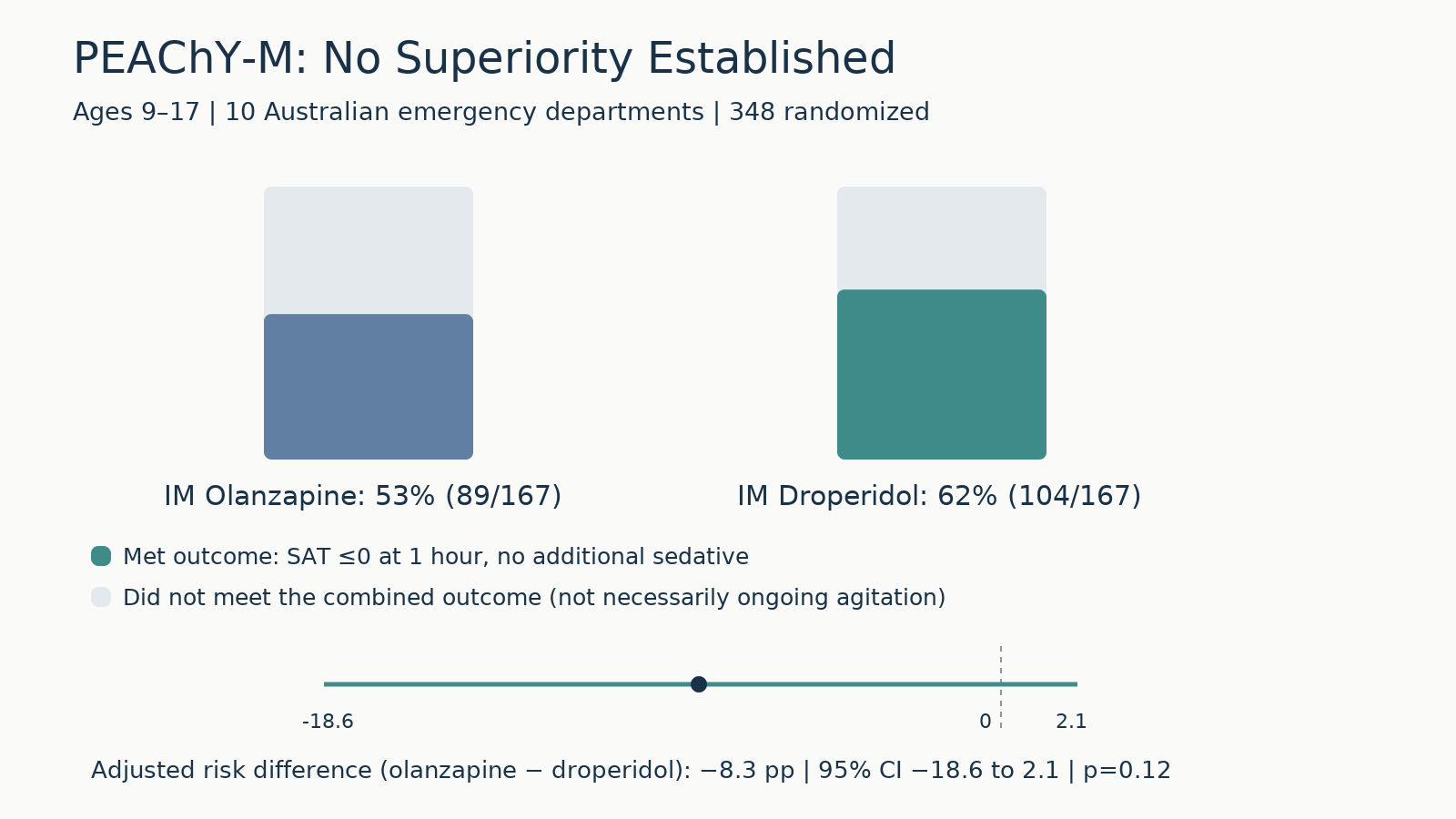
Droperidol had the higher observed proportion: 104 of 167 participants, or 62%, compared with 89 of 167, or 53%, for olanzapine. The adjusted difference, expressed as olanzapine minus droperidol, was −8.3 percentage points (95% CI −18.6 to 2.1; p=0.12). The data do not establish an olanzapine advantage. They also do not prove that the drugs are equivalent, or establish droperidol superiority from this primary comparison.
Study-related adverse events were reported in 12% and 15%, respectively. One participant in the olanzapine group developed apnea after receiving several other sedatives as well, required respiratory support and recovered. These observations matter, but they are not a sufficiently precise comparison of rare harms to label either treatment categorically safer.
Roughly two in five participants overall did not meet the combined endpoint. That does not mean all remained agitated: needing another sedative was enough to count as not meeting it. Nor can this be read as a pure one-dose pharmacological failure rate. Twenty-seven percent of those assigned olanzapine and 20% assigned droperidol never received their allocated intervention. The open-label design and treatment deviations complicate interpretation, while the multicenter setting gives the comparison practical relevance.
For clinicians, the paper offers evidence to review alongside local emergency protocols. It does not make the wider work of care disappear: assessment of the cause, environmental measures, de-escalation and monitoring remain central. This article provides no dosing protocol or recommendation for an individual patient.
Brazilian procurement or availability, on its own, would not establish a pediatric indication or national incorporation. Applying the findings locally requires checking the relevant product information, institutional protocol and available monitoring resources. This review does not establish an updated Brazilian regulatory indication.
Who decides, and what assessment is for
A qualitative study by Costa-Val and colleagues, published online in Culture, Health & Sexuality on November 24, explored how Brazilian professionals understand mental-health assessment before gender-affirming hormone therapy. Nine experienced professionals were interviewed.
Their accounts described three purposes: shared decision-making, clinical support and institutional protection. These are rationales for assessment, not three measured clinical interventions. They also raise different questions about responsibility, access and the autonomy of the person seeking care.
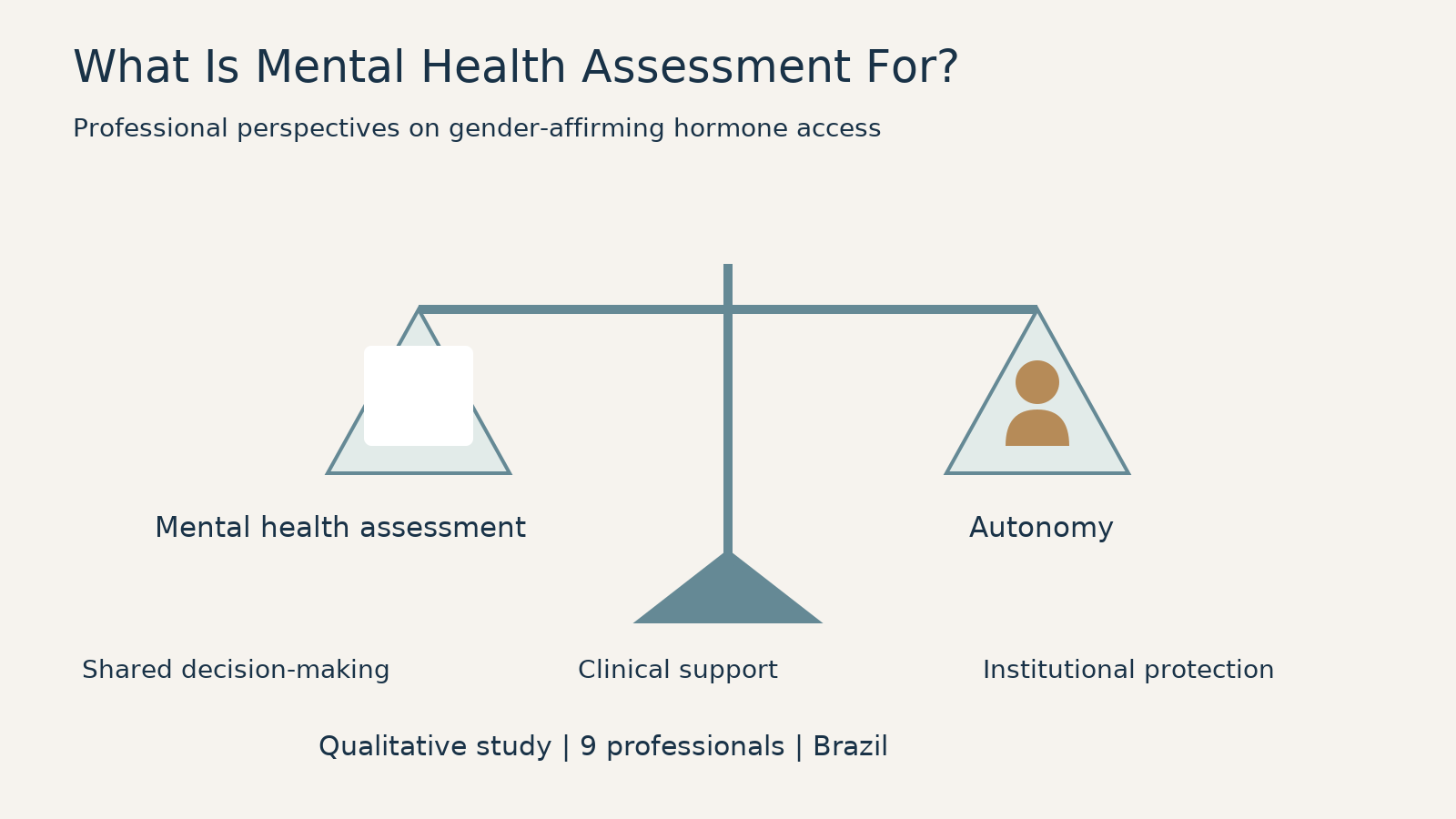
The distinction matters. Professional interviews can explain how decisions are justified, but they cannot estimate how frequently those views occur across Brazil or measure effects on waiting times and health outcomes. This was not a study of patient outcomes.
The authors place their discussion in the context of CFM Resolution No. 2,427/2025. That reference does not make the paper a new regulatory decision, and this review does not assess the resolution’s current legal status. The editorial question is narrower: does an assessment help the person make an informed decision and obtain appropriate support, or does its purpose become an unexplained barrier? A qualitative study can sharpen that discussion without creating new eligibility criteria.
Chatbots: an explanatory framework, not a clinical result
The third publication is a Viewpoint by Blease, Fiorillo and Volpe in European Psychiatry, posted on November 24 as an accepted manuscript. Its title addresses the possible active ingredients, mechanisms and limitations of mental-health support from large language models. It is a conceptual contribution rather than a new comparative clinical trial.
That difference should survive the headline. Discussing a plausible mechanism does not establish efficacy. Discussing a therapeutic alliance does not demonstrate equivalence to a clinician. A framework does not, by itself, validate crisis safety or unsupervised use.
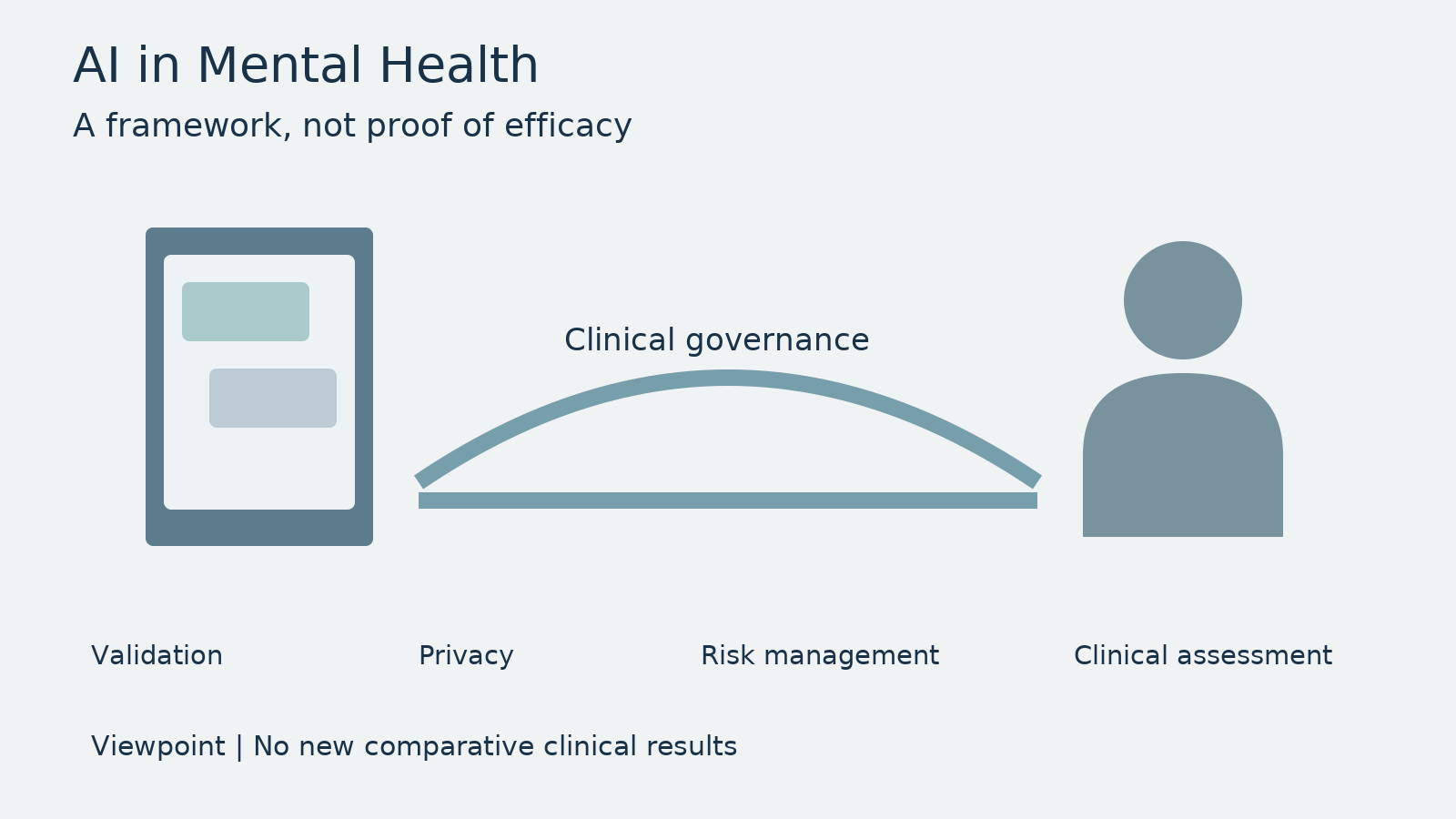
The visual’s four questions—validation, privacy, risk management and clinical assessment—are an editorial way to organize scrutiny. They are not a validated checklist or a certification that any product has met those requirements. The accepted-manuscript status also means the publication may still undergo copyediting and typesetting.
What these papers change—and what they do not
These three publications have different evidentiary roles. The randomized trial informs a comparative treatment question. The qualitative study examines professional reasoning. The Viewpoint helps frame questions about an emerging technology. Combining them should not flatten those differences.
The practical lesson is to state the purpose of care before claiming success. A medication endpoint, an assessment requirement and a conversational interface each need an appropriate standard of evidence. The trial deserves review by teams responsible for pediatric emergency protocols; the other papers support discussion about autonomy and governance. None provides a universal instruction to change practice automatically.
This is a focused review of three publications dated November 23–24, not an exhaustive surveillance report. It cannot establish that no other important psychiatric, regulatory or safety developments occurred during that period.
Priority reading
- Bourke and colleagues, JAMA: the PEAChY-M randomized comparison, including its endpoint definition, treatment deviations and safety findings.
- Costa-Val and colleagues, Culture, Health & Sexuality: professional perspectives on mental-health assessment and gender-affirming hormone access in Brazil.
- Blease, Fiorillo and Volpe, European Psychiatry: a Viewpoint on mechanisms and limitations of large-language-model mental-health support.
Medical editorial note: This article provides scientific and educational commentary. It does not replace individual clinical assessment, current prescribing information or institutional protocols. Study findings should be interpreted in light of their populations, methods and limitations; publication does not itself establish regulatory approval or a new standard of care.
Sources and references
- Bourke et al. — PEAChY-M randomized clinical trial, JAMA, November 23, 2026. DOI: 10.1001/jama.2026.25561
- Costa-Val et al. — Mental health assessment and access to gender-affirming hormone therapy: perspectives of healthcare professionals in Brazil. DOI: 10.1080/13691058.2026.2762117
- Blease, Fiorillo and Volpe — When Patients Speak More to Machines: Active Ingredients, Mechanisms, and Limitations of Mental Health Support from Large Language Models. DOI: 10.1192/j.eurpsy.2026.12280