
Medicine / Pediatrics
Pediatric Science Radar: Malaria Vaccination, iTBS and the Limits of Promising Findings
Five studies on malaria vaccination, adolescent depression, short-form video, prescription opioids and ketogenic diets in autism—what they add, and what remains uncertain for UBS and UPA care.
Pediatrics | November 26, 2026 | Brasília
What the November 19–26 literature does—and does not—change for primary and urgent care.
A community vaccination trial offers a substantial public-health result. A small adolescent depression trial provides an encouraging treatment signal. Three other studies raise questions about digital use, prescription opioids and dietary intervention in autism. Their findings deserve attention, but they do not carry the same evidentiary weight.
None, considered alone, establishes a need for an immediate protocol change in a Brazilian UBS or UPA. This edition prioritizes November 25–26 and widens the window to November 19–26. The assessment draws on accessible abstracts, publisher summaries and bibliographic records; it is not a full-text and supplement audit or a systematic review. Confidence labels below are editorial judgments, not formal GRADE ratings. Coverage and checks against earlier editions remain incomplete.
Malaria: community vaccination reduced infection odds
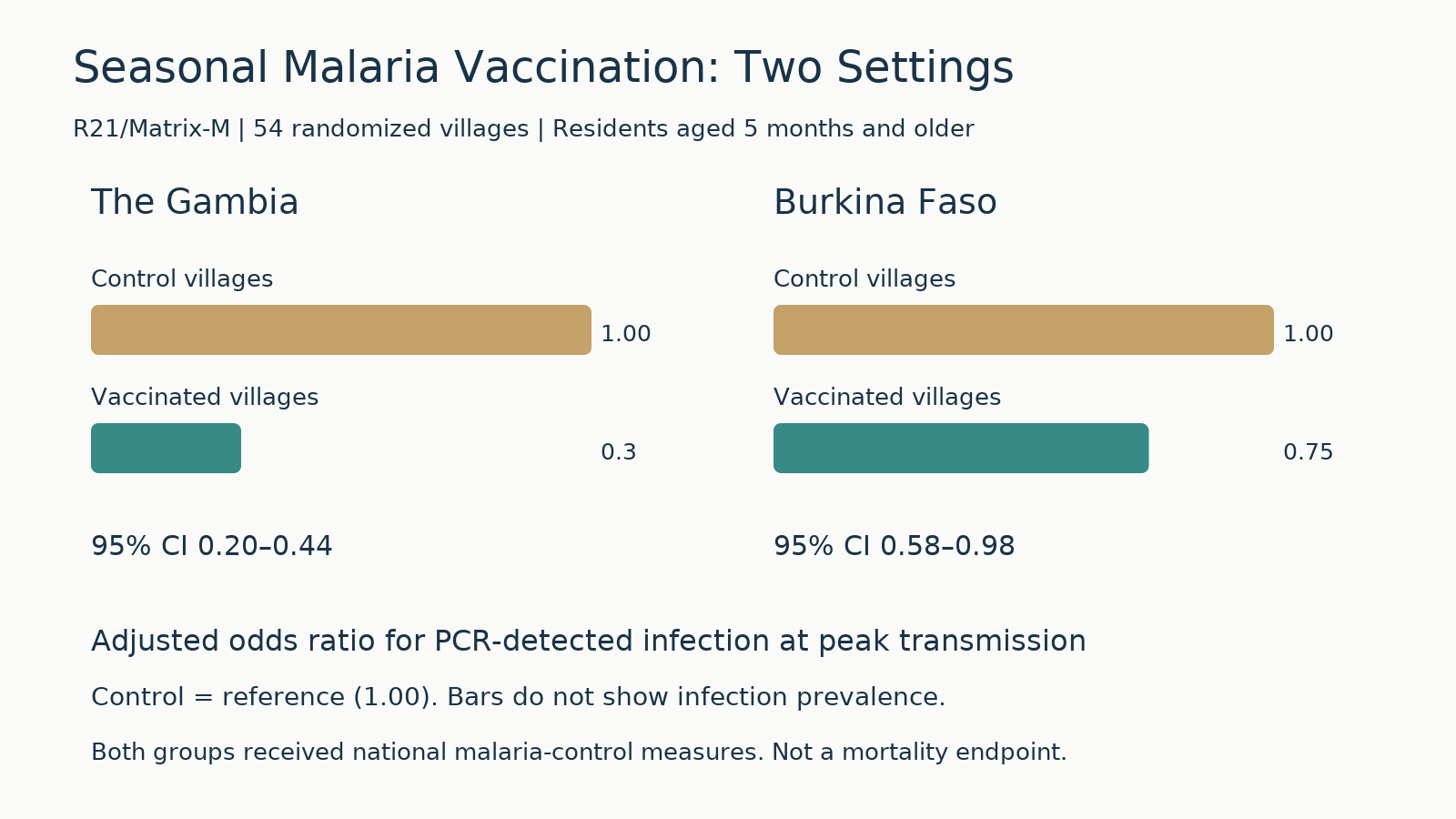
The SERVAL trial evaluated seasonal R21/Matrix-M vaccination alongside national malaria-control measures in The Gambia and Burkina Faso. Fifty-four villages were randomized to vaccination or control. Residents aged five months and older were eligible, so this was a community-wide study with pediatric relevance, not a children-only trial. Three doses were completed by 2,565 participants in The Gambia and 4,072 in Burkina Faso.
At peak transmission, adjusted odds ratios for PCR-detected P. falciparum infection were 0.30 (95% CI 0.20–0.44) in The Gambia and 0.75 (0.58–0.98) in Burkina Faso. These estimates describe lower odds, not absolute reductions in infection probability. They should not be relabeled as individual vaccine efficacy or as a mortality benefit.
Cluster randomization fits the public-health question. The open-label design and differing transmission settings limit generalization. The estimates differ substantially, but a formal claim of between-country effect modification would require the relevant interaction analysis. Among 69 serious adverse events, one febrile seizure was considered vaccine-related.
Editorial assessment: moderate confidence in reduced infection in the studied settings. These results do not establish an equivalent benefit in Brazil or justify exporting the campaign unchanged.
iTBS: a promising short-term depression result
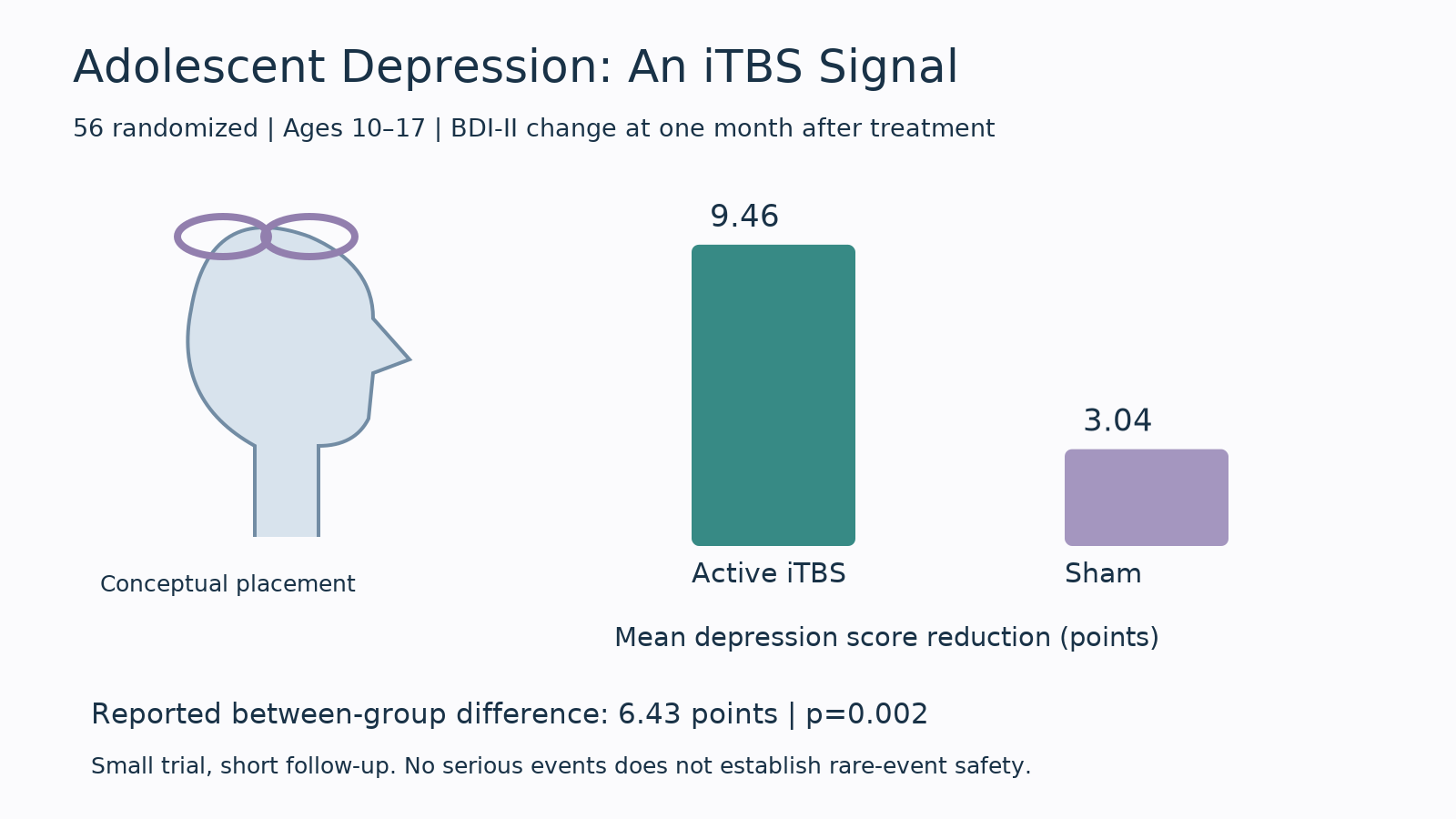
A double-blind, sham-controlled trial randomized 56 adolescents aged 10–17 with major depression after inadequate response to at least one adequate antidepressant trial. Connectivity-guided intermittent theta-burst stimulation was delivered over ten weekdays. The primary endpoint was BDI-II change one month after treatment.
Mean score reductions were 9.46 points with active iTBS and 3.04 with sham. The reported between-group difference was 6.43 points (d=0.87; p=0.002). The small discrepancy between subtracting the displayed means and the reported difference should not be “corrected” by replacing the authors’ estimate. No serious adverse events were reported.
Blinding and a sham comparator strengthen the comparison. The sample and follow-up remain too limited to establish durability or reliably assess rare harms. The exploratory mediation analysis involving anhedonia was imprecise and should not be treated as proof of a biological mechanism.
Editorial assessment: low-to-moderate confidence in a short-term symptom benefit in this selected population. The result warrants further specialist investigation; it does not establish routine use for all adolescents with depression.
Short-form video: exposure patterns matter, but causality remains unresolved
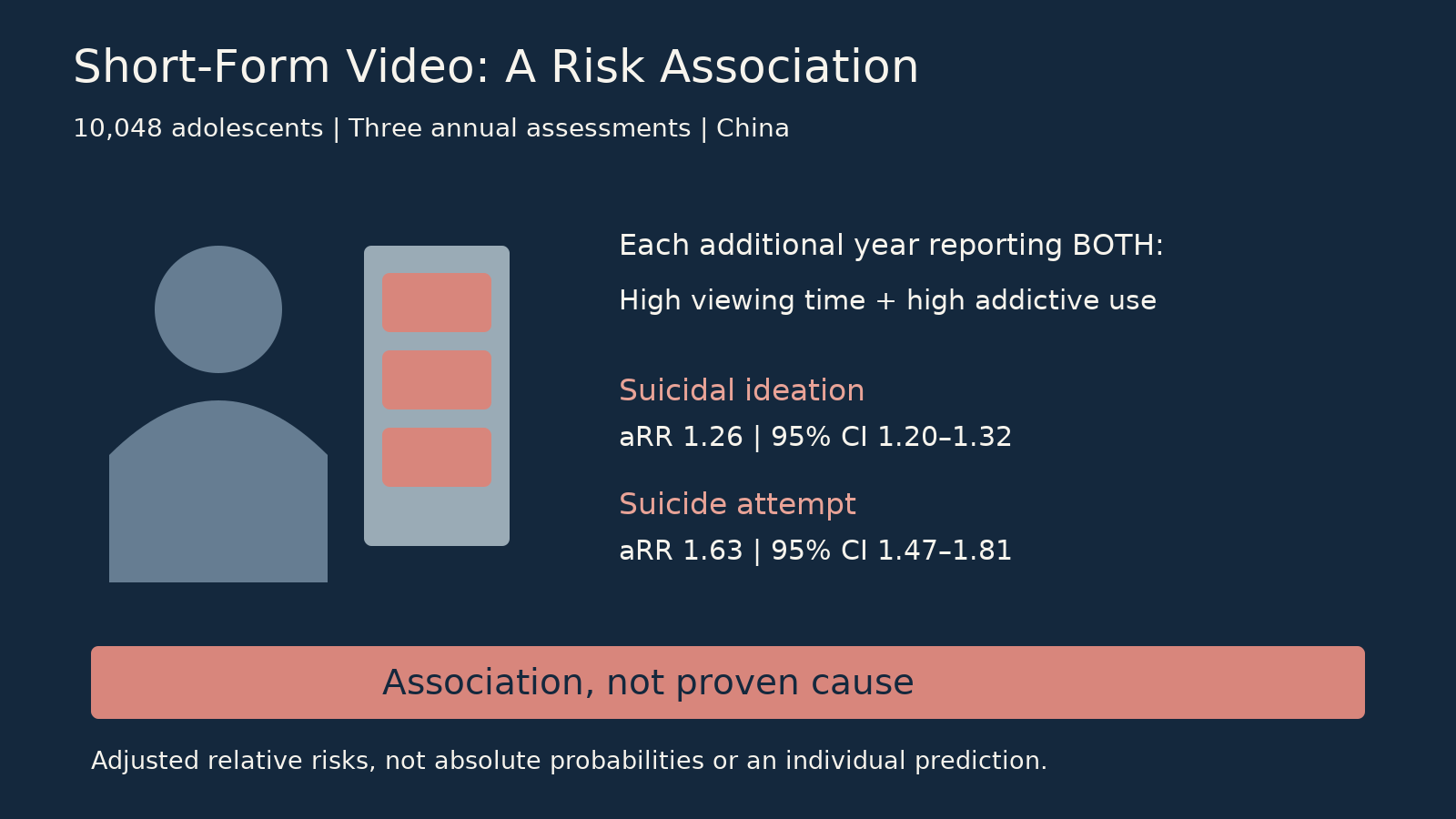
A Chinese cohort followed 10,048 adolescents across three annual assessments. Mean age at entry was 13.9 years. The investigators considered viewing time and addictive-use patterns jointly, rather than treating screen time as a complete measure of exposure.
Each additional year reporting both high viewing time and high addictive use was associated with an adjusted relative risk of 1.26 (95% CI 1.20–1.32) for suicidal ideation and 1.63 (1.47–1.81) for suicide attempt. These are relative associations, not a child’s absolute probability of either outcome.
Repeated measures help establish temporal ordering. They do not eliminate self-report error, residual confounding or bidirectional relationships between distress and digital use. The study did not test whether app restrictions prevent harm.
For a consultation, loss of control and functional impairment are relevant questions alongside hours spent viewing. That is a clinical interpretation, not a newly validated screening instrument or a substitute for an individual risk assessment. Confidence is moderate for the association and low for causality.
Prescription opioids: keep the denominator visible
A cross-sectional analysis of the 2023–2024 U.S. National Survey on Drug Use and Health included 22,906 adolescents aged 12–17 and 27,723 young adults aged 18–25. Past-year prescription opioid use was reported by 13.0% of adolescents (95% CI 12.3%–13.7%).
Among participants reporting prescription opioid use across the two age groups, 7.5% (6.6%–8.3%) reported misuse with a use disorder. That percentage does not describe all adolescents. Additional substance use was more common among those reporting misuse.
The large national sample is useful for describing U.S. patterns, but self-report and exclusion of institutionalized populations matter. The design cannot show that a particular prescription caused a disorder, and the prevalence estimates should not be transferred to Brazil.
Editorial assessment: moderate confidence as U.S. epidemiological description. The findings reinforce attention to medication access, sharing and other substance use; they do not justify withholding indicated analgesia.
Ketogenic diet in autism: adherence limits the signal
A three-month randomized study assigned 47 children to a ketogenic diet and 30 to a control group. The abstract reports improvement in core symptoms but supplies neither a clinical effect size nor a confidence interval, and does not state the age range. Eighteen of the 47 children discontinued the diet after one month.
Attrition complicates interpretation of any benefit. Follow-up was short, and microbiome, metabolomic and brain-spectroscopy assessments were performed in the diet group without equivalent multi-omic sampling in controls. Correlations between biological changes and symptoms do not establish a causal gut–brain mechanism.
Editorial assessment: low confidence. This abstract does not support routine ketogenic-diet prescription for core autism symptoms. It leaves important questions about the analysis population, adherence, nutritional safety and the size of any clinical effect unresolved.
What changes for UBS and UPA?
The observational studies reinforce questions clinicians already need to ask about functioning, digital habits and access to medication. They did not test whether a new consultation strategy improves outcomes. The intervention studies identify questions for specialist review and further research; they do not establish broad new recommendations for Brazilian primary or urgent care.
No selected finding alone warrants abandoning an established practice. No NNT or NNH is calculated here: adequate absolute estimates, with the relevant population and time horizon, were not established in this review.
Publication checks and limits
A November 23 correction to the letter Precision Management After Childhood Acute Kidney Injury concerns author affiliations and the corresponding author’s email address. The notice does not report a correction to scientific findings.
Publication highlights and commentary should be distinguished from new trial reports. The draft flagged a STEP Young highlight, but its dates and underlying trial were not independently confirmed for this edition; it is therefore excluded from the evidence summary.
This is a selected literature radar, not a claim of exhaustive coverage. Electronic publication dates are used, print dates were not verified, and non-repetition against every prior bulletin is not guaranteed.
Medical editorial note: This publication offers scientific and educational commentary. It does not replace individual clinical assessment, current prescribing information or institutional protocols. Preliminary signals, observational associations and editorial confidence ratings are not treatment recommendations or regulatory approvals.
Sources and references
- Dabira et al. — Seasonal mass vaccination with R21/Matrix-M. The Lancet, November 19, 2026. DOI: 10.1016/S0140-6736(26)01562-X
- Duan X et al. — Intermittent Theta-Burst Stimulation for Adolescent Depression. Pediatrics, November 19, 2026. DOI: 10.1542/peds.2026-077541
- Duan Y et al. — Short-Form Video Use and Adolescent Suicidality, Nonsuicidal Self-Injury, and Mental Health. JAMA Pediatrics, November 23, 2026. DOI: 10.1001/jamapediatrics.2026.5235
- Toce et al. — Prescription Opioid Misuse Among Youths. JAMA Pediatrics, November 23, 2026. DOI: 10.1001/jamapediatrics.2026.5628
- Wang et al. — Ketogenic diet and autism: randomized trial with multi-omics. World Journal of Pediatrics, November 25, 2026. DOI: 10.1007/s12519-026-01110-w
- JAMA Pediatrics — Error in Article Information, November 23, 2026. DOI: 10.1001/jamapediatrics.2026.6044