
Medicine / Psychiatry
Psychiatry Radar: Progress Is Not the Same as Practice Change
Lumateperone reached an FDA filing for mania. Ketamine maintenance produced an uncontrolled signal; MDMA and ibogaine remain research developments. What each milestone actually means.

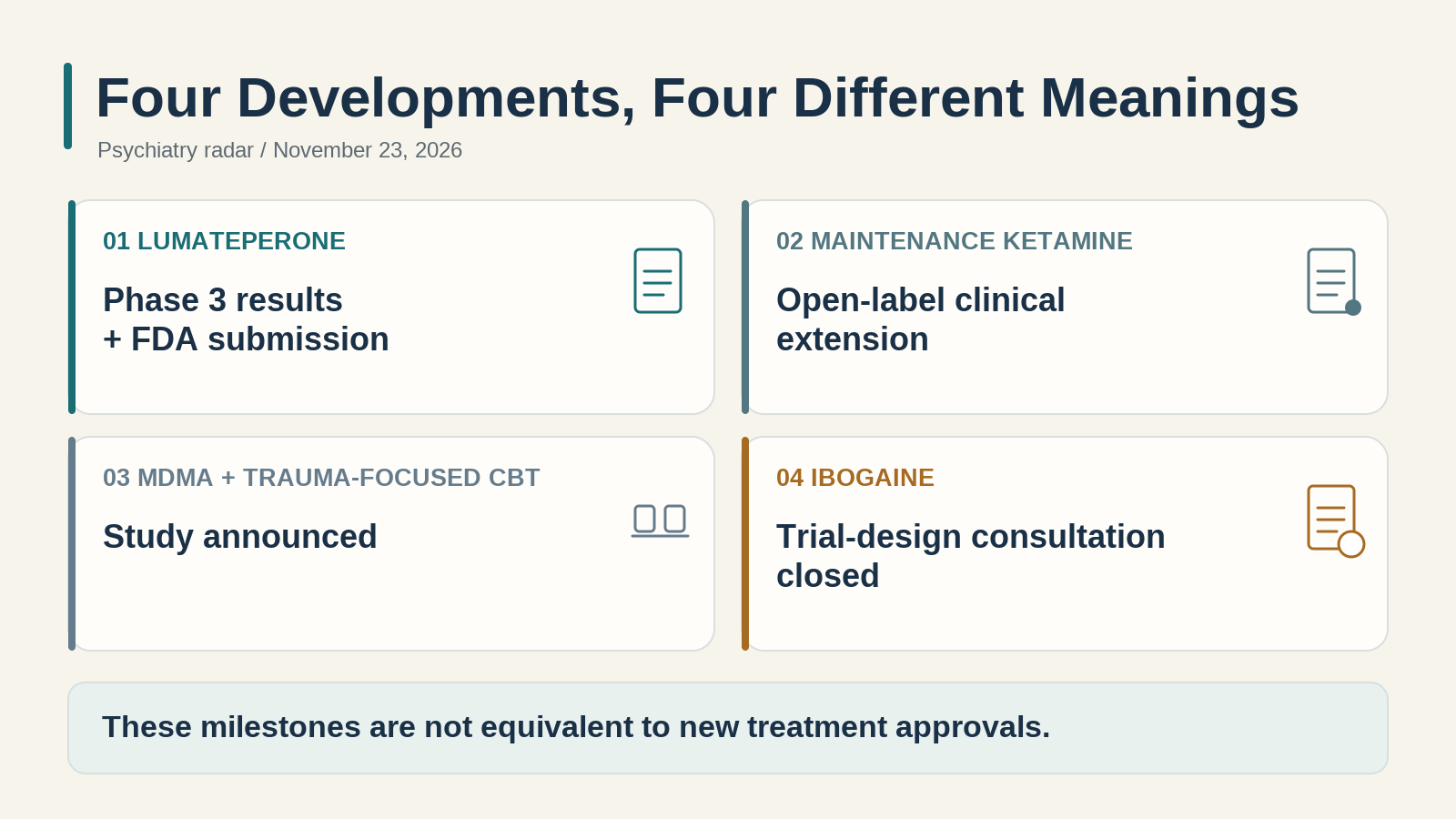
Four developments in psychiatric research arrived at very different points in the evidence cycle. Lumateperone has two positive Phase 3 mania trials behind a U.S. regulatory submission. A small maintenance study of intravenous ketamine followed people who had already benefited from induction for bipolar depression. UCLA announced a study of MDMA alongside trauma-focused cognitive behavioral therapy in young adults with PTSD. The FDA closed a consultation about how early ibogaine trials should be designed.
The clinical question is what each milestone permits us to say now. A filing is not an approval. Improvement within an uncontrolled extension does not isolate a drug effect. A study announcement and a consultation do not supply patient outcomes.
As of November 23, 2026. This is a selected review of the developments cited below, not a survey of all psychiatric research.
Four developments, four different meanings
| Development | What happened | What remains open |
|---|---|---|
| Lumateperone | Two sponsor-reported, placebo-controlled Phase 3 mania trials supported a supplemental FDA application. | FDA review, full trial reporting, comparison with established treatments, and longer-term outcomes. |
| IV ketamine maintenance | A published, single-arm extension followed 36 induction beneficiaries for 12 weeks. | A controlled estimate of maintenance benefit, relapse prevention, and longer-term safety. |
| MDMA plus trauma-focused CBT | UCLA announced a two-year PTSD study for adults aged 18–22. | Recruitment, conduct, and eventual efficacy and safety results. |
| Ibogaine | An FDA comment period on early-phase trial design ended November 20. | How the input will inform research and what future trials will find. |
Lumateperone: a mania application, not a mania approval
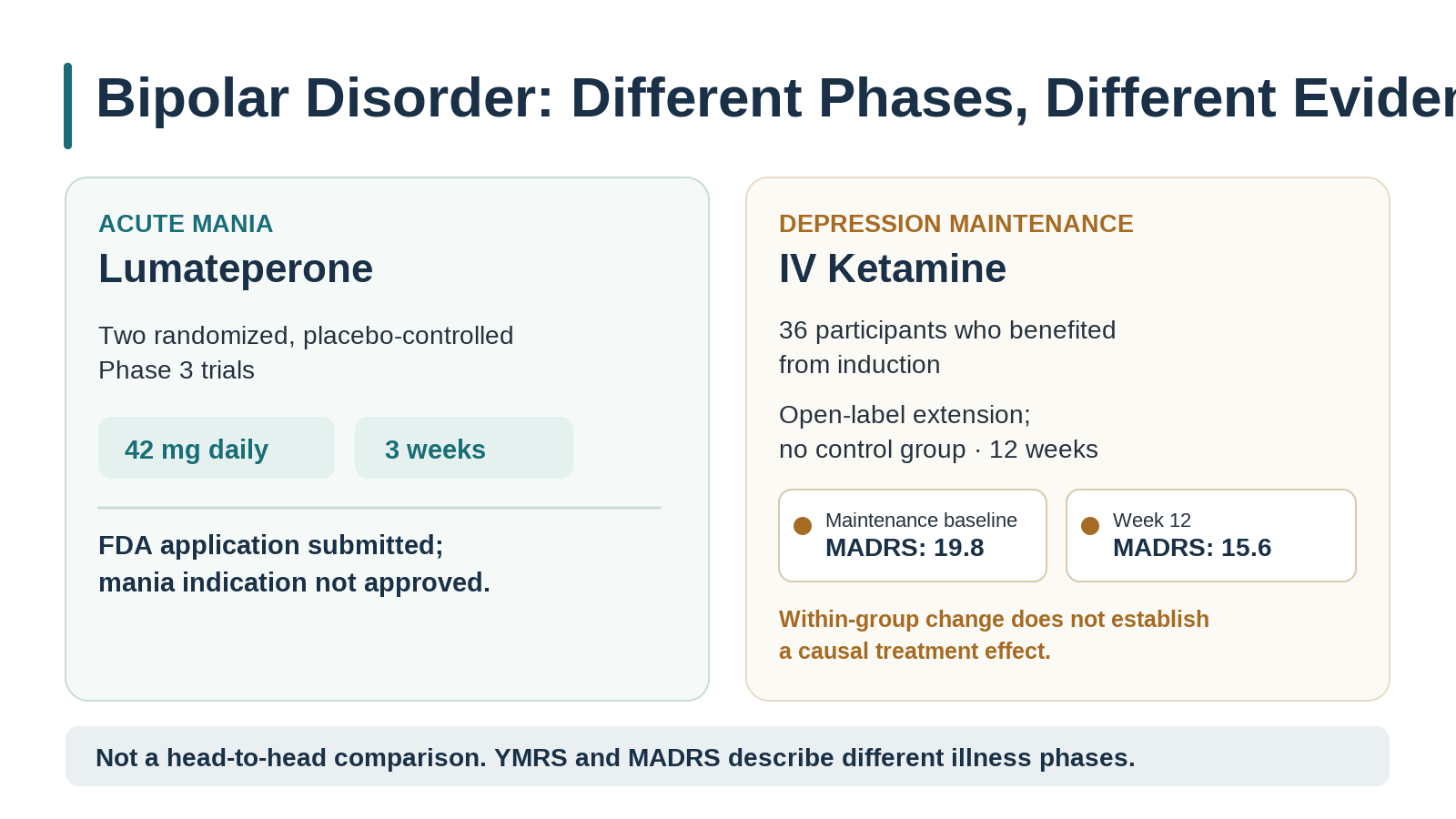
On November 19, Johnson & Johnson announced a supplemental New Drug Application for CAPLYTA (lumateperone) to treat manic or mixed episodes associated with bipolar I disorder in adults. The two supporting studies, 451 and 452, randomized participants to 42 mg once daily or placebo for three weeks. Change in the Young Mania Rating Scale (YMRS) at week 3 was the primary endpoint. The company explicitly says that CAPLYTA is not approved for mania. It already has other U.S. indications, including bipolar depression; an existing depression indication should not be read as a mania indication.
The Study 451 update reported a 4.8-point greater reduction in YMRS than placebo at week 3, with response in 45.8% versus 20.9%. The Study 452 update reported a 3.7-point greater reduction and response in 43.9% versus 23.7%. Here, response meant at least a 50% reduction in YMRS. Both company updates described separation by day 3, sustained through week 3.
Those results make the filing clinically interesting. They do not establish superiority to an existing antimanic drug or a strategy for preventing future episodes. The figures available in this review come from sponsor releases and conference presentations, not a full peer-reviewed account of both pivotal trials. Detailed methods, adverse events, discontinuations and subgroup results remain important to independent assessment. Reported adverse events included dry mouth and nausea in Study 451, and dizziness, dry mouth and somnolence or sedation in Study 452. Existing antipsychotic warnings also need to inform clinical interpretation.
For a Brazilian reader, the U.S. filing says nothing by itself about Brazilian product registration, the mania indication, access or SUS incorporation. The next concrete milestones are the FDA's review and fuller trial publication.
Ketamine: maintenance in a selected bipolar depression group
The maintenance ketamine paper, published online November 18 in Med, asks a different question. Thirty-six people with treatment-resistant bipolar depression entered a 12-week, single-arm, open-label extension after benefiting from an induction course of IV ketamine. They could receive up to six flexibly dosed maintenance infusions.
Estimated mean MADRS scores moved from 19.8 at maintenance baseline to 15.6 at week 12: a within-group difference of −4.20 points (95% CI, −7.34 to −1.06; p=0.009). Response rose from 33.3% to 50.0%, and remission from 27.8% to 36.1%. The authors reported no treatment-emergent mania or psychosis in this small observed group. These measurements begin after induction, not before any ketamine exposure.
The absence of a control group is decisive. Symptom change over time could reflect the maintenance infusions, selection of prior responders, other care, natural variation or some combination. The study cannot establish that this regimen prevents relapse better than another continuation strategy. Its short follow-up and flexible dosing also cannot define a standard long-term schedule. Reduced suicidal ideation was reported, but an uncontrolled change is not evidence of prevention of suicidal behavior. The absence of observed mood switching here does not rule it out in broader or longer use.
Lumateperone and ketamine should therefore stay in separate clinical frames: acute mania in placebo-controlled trials and continuation after induction benefit in an uncontrolled bipolar depression extension. Their YMRS and MADRS results measure different symptoms and are not a head-to-head comparison.
MDMA plus trauma-focused CBT: a question being tested
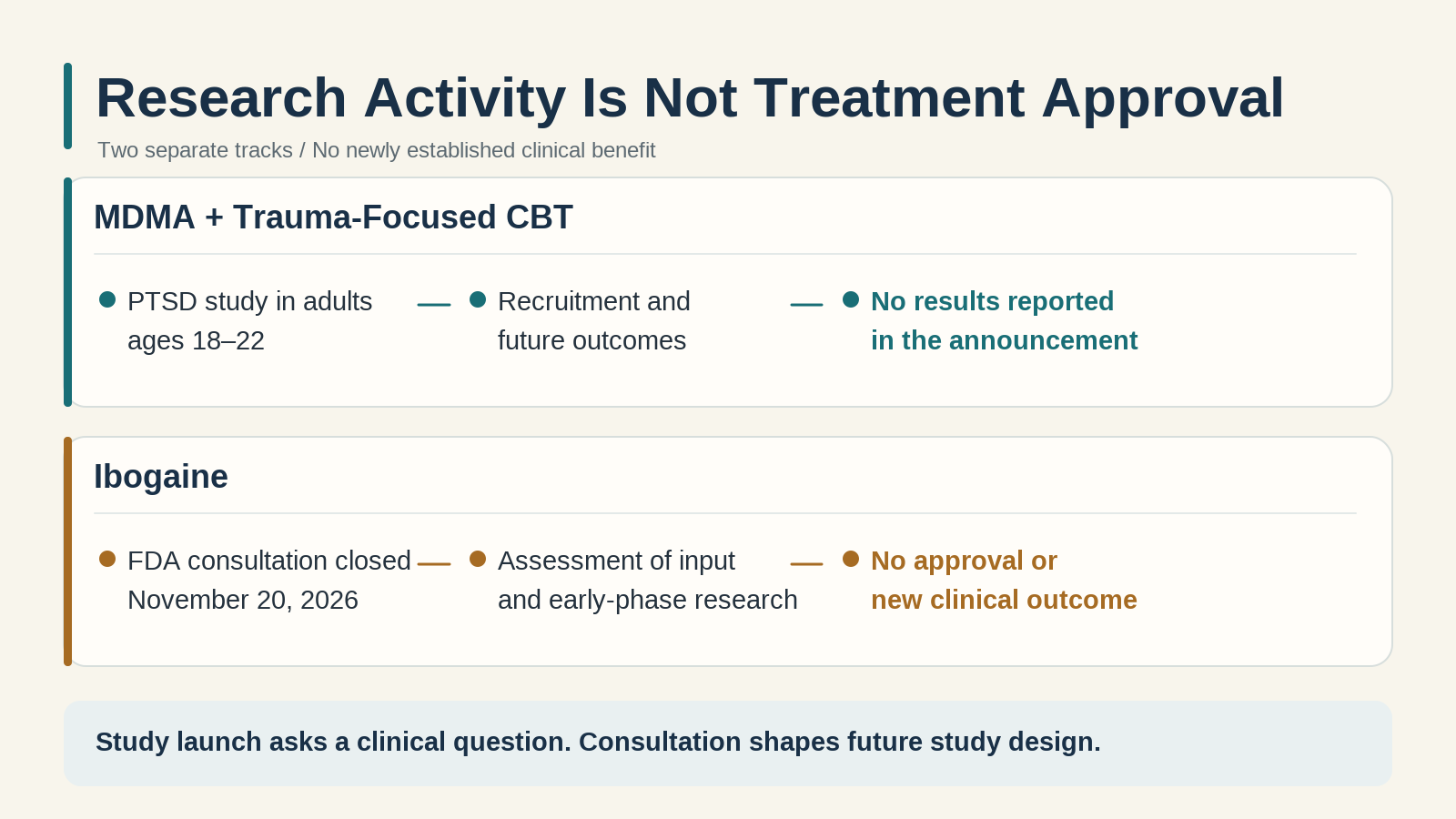
UCLA Health announced on November 19 that it would soon begin enrolling young adults aged 18–22 with treatment-resistant PTSD in a two-year study combining MDMA and trauma-focused cognitive behavioral therapy. The announcement describes the proposed research, not its efficacy or safety results. The reported 2028 completion is a plan, not a date on which clinical evidence is guaranteed.
The psychotherapy component matters. The research question concerns a combined intervention delivered in a study setting; it should not be generalized to MDMA alone. Recruitment, protocol execution and published outcomes will determine what the project can eventually add. As of this announcement, it has not demonstrated benefit or safety in this age group.
Ibogaine: designing studies is not validating treatment
The FDA's ibogaine request for information closed to public comment on November 20. It sought input on early-phase trial design: patient selection, dose escalation, clinical setting, cardiac and neurological monitoring, stopping rules, informed consent and independent oversight. The agency identified adults with opioid use disorder and PTSD as initial populations of interest for federally supported research.
That activity addresses how to investigate a potentially risky intervention. It does not announce a treatment result or confer approval. The same FDA release separately mentions an early-phase study of noribogaine hydrochloride for alcohol use disorder; noribogaine is a derivative and that study should not be conflated with ibogaine evidence for PTSD or opioid use disorder. Serious safety questions, particularly cardiac and neurological ones, are part of the reason for careful trial design.
What this changes for practice now
For acute mania, the lumateperone results justify following the FDA review and complete trial reports. The submitted indication is not currently approved. For treatment-resistant bipolar depression, the ketamine extension offers a relevant question for a small group who improved with induction, while leaving comparative maintenance efficacy, long-term safety and a repeatable protocol unresolved. Clinical monitoring remains essential in any applicable, supervised setting.
For PTSD, UCLA's MDMA protocol is a research announcement. The ibogaine consultation is a research-governance milestone. Neither is a reason to infer a newly established routine treatment. Across all four stories, the useful next step is to name the population, study design, endpoint and regulatory status before changing a care plan.
Editorial scope: This article reviews selected primary research, institutional statements and regulatory material available by November 23, 2026. Sponsor-reported trial figures are identified as such. It does not replace individualized assessment, local regulation or current product labeling. No treatment should be started or stopped on this article alone.