
Market Calls / South Korea
Market Call — Korea’s Chip Selloff Meets a Crisis of Confidence
Record exports and enormous cash balances are colliding with doubts about AI earnings, memory pricing, and what comes next for Korea’s two largest chipmakers.
Market date
Sunday, November 22, 2026
1. Summary
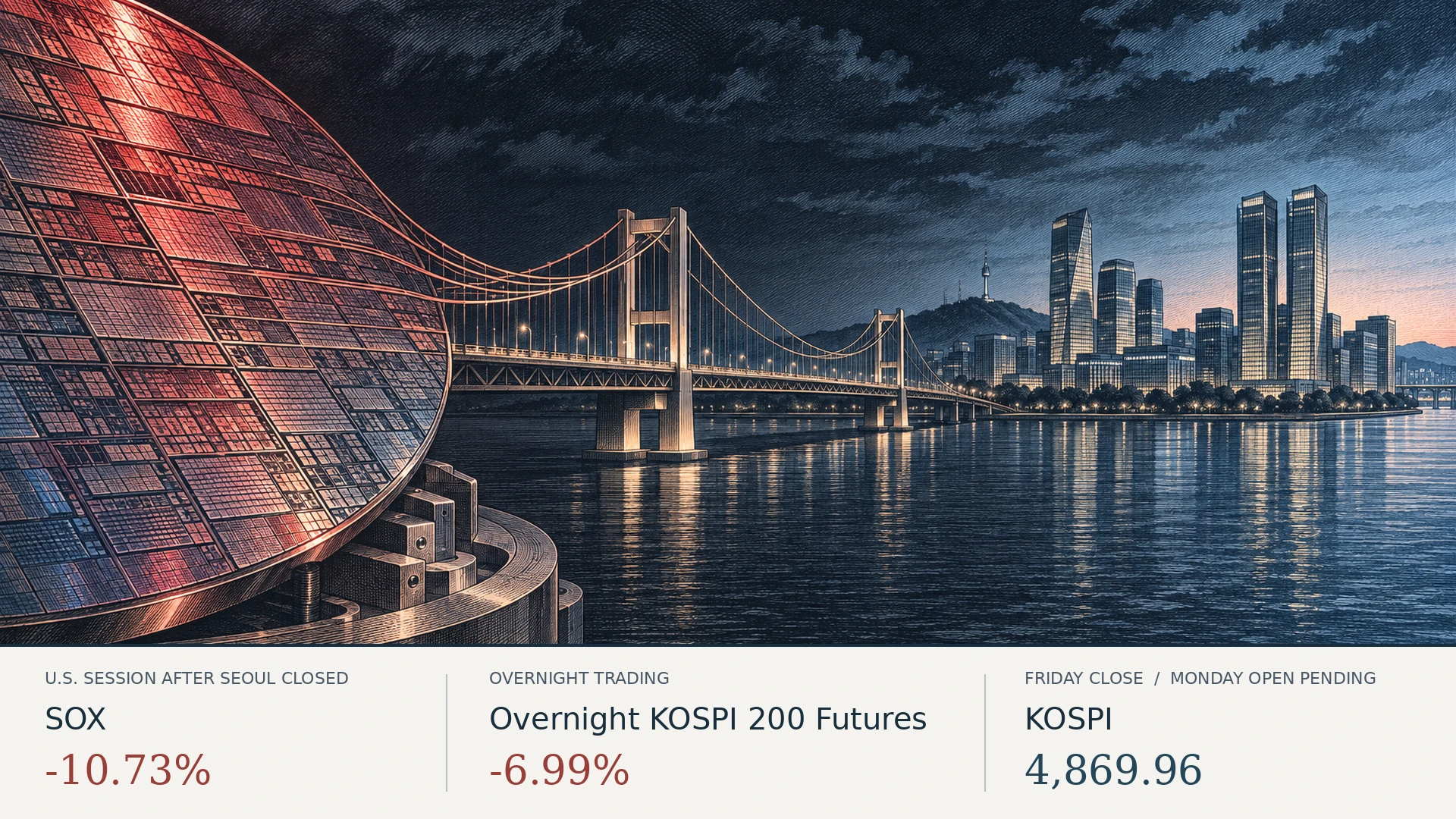
Korean equities ended the week under heavy pressure. The KOSPI closed at 4,869.96, down 5.21% on Friday and 7.95% for the week. The KOSDAQ finished at 645.68, losing 5.71% on the day and 7.72% for the week. Sell-side sidecars were triggered in both markets.
The KOSPI is back below 5,000 and roughly 48% below its June 19 peak. Samsung Electronics fell 7.01% to ₩183,100, while SK hynix dropped 5.92% to ₩1,113,000.
But the most consequential development for Monday, November 23, came after Seoul had closed.
The Philadelphia Semiconductor Index, or SOX, plunged 10.73% on Friday. Nvidia lost 14.0%, Micron 13.9%, AMD 13.3%, and Broadcom 12.2%. The iShares MSCI South Korea ETF, EWY, fell 8.42%; SK hynix’s ADR dropped 13.11%; and overnight KOSPI 200 futures sank 6.99%.
That leaves Monday’s session exposed to a substantial gap lower. Korean press coverage is already discussing a test of 4,800.
The tension running through this market is stark: Korea’s export engine is delivering extraordinary numbers, yet investors are becoming less willing to capitalize those earnings as though they will last.
2. Dashboard — Friday, November 20
Equity markets and positioning
- KOSPI: 4,869.96, down 267.93 points, or 5.21%. For the week, the index lost 420.57 points, or 7.95%.
- KOSDAQ: 645.68, down 5.71%. The weekly decline was 53.98 points, or 7.72%.
- Trading controls: sell-side sidecars were triggered in both the KOSPI and KOSDAQ markets.
- Foreign investors, daily: the draft’s headline KOSPI figure is approximately ₩1.13 trillion in net selling; its more detailed main-board figure is ₩1.141 trillion. Foreign investors also sold ₩171 billion on the KOSDAQ.
- Institutional investors, daily: net selling of ₩951 billion.
- Retail investors, daily: net buying of ₩1.595 trillion. Individual investors were buyers again.
- Foreign investors, weekly: net selling of ₩4.52 trillion, including ₩1.79 trillion in Samsung Electronics and ₩940 billion in SK hynix. Together, the two chipmakers accounted for approximately 60% of the total.
- Other corporations, weekly: net buying of ₩2.39 trillion, largely attributable to SK hynix’s own share repurchases.
- KOSPI short-selling turnover, November 20: ₩1.13 trillion, up 29.7%. SK hynix short-selling turnover rose 143.7% to ₩159.7 billion; Samsung’s increased 75.8% to ₩133.8 billion.
Currency, rates, and overseas signals
- USD/KRW: 1,336.2, with the won weakening by ₩6.2. The intraday high was 1,340.3. The won traded at ₩839.30 per 100 yen.
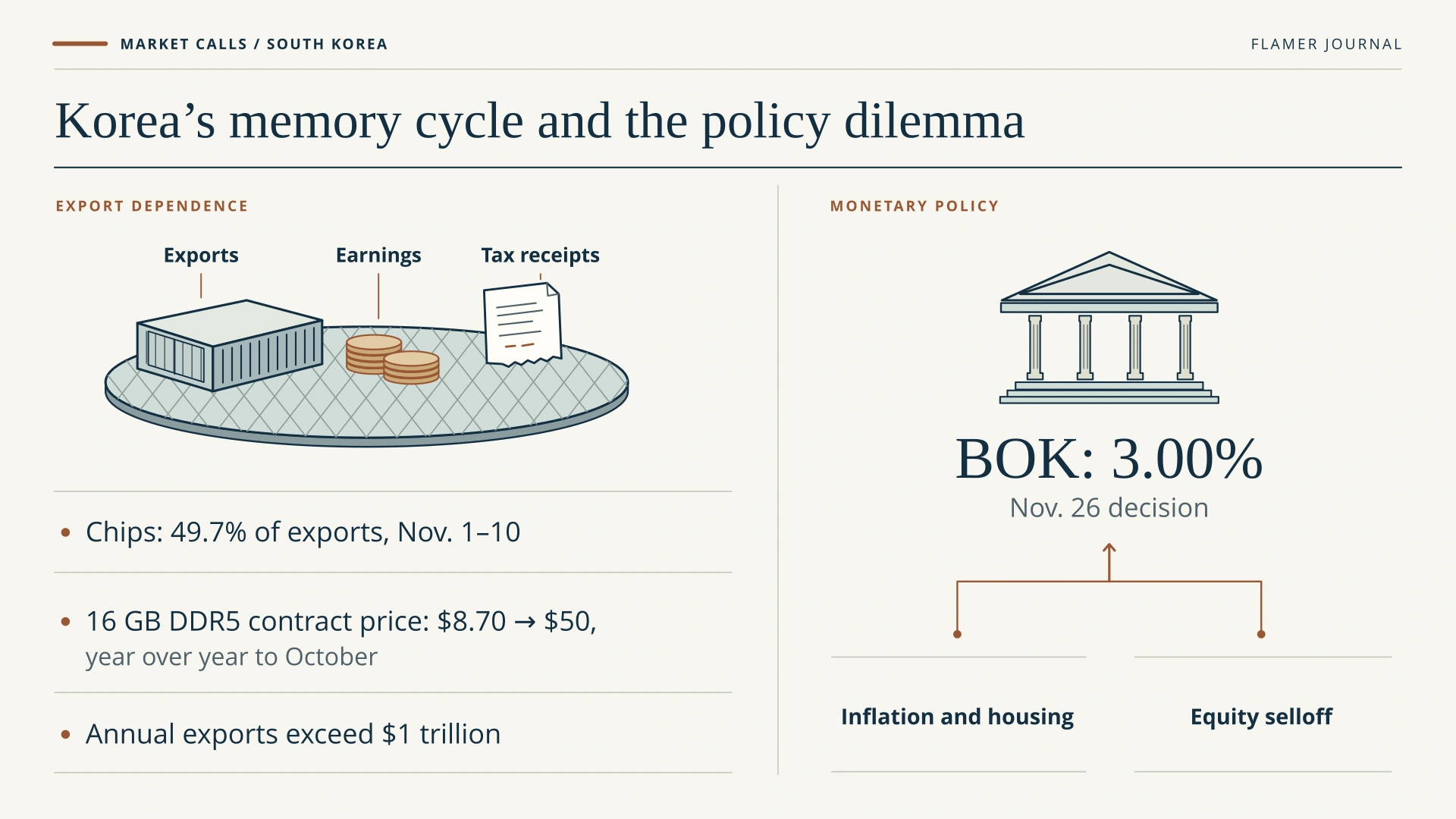
- Bank of Korea policy rate: 3.00%. The next decision is Thursday, November 26.
- Three- and 10-year Korean government bond yields: unavailable for this edition.
- SOX, November 20: down 10.73%.
- Nasdaq: down 5.28%, erasing its year-to-date gains.
- Overnight KOSPI 200 futures: down 6.99%, signaling pressure on Monday’s opening.
- Anthropic, second trading session: down 8.50%. Its IPO was priced at $83 and raised $81.3 billion.
3. Why the Market Moved
Korean press reports attributed Friday’s decline in Seoul to money rotating out of chip stocks following Anthropic’s November 19 debut, concerns about Chinese demand, and a Financial Times report that Samsung and TSMC had suspended some shipments to Chinese customers under new U.S. export controls.
JPMorgan and Morgan Stanley were among the largest sellers of Samsung and SK hynix shares.
The earnings backdrop makes the selloff harder to dismiss as a simple growth scare. Nvidia had reported third-quarter revenue of $116 billion—more than double the year-earlier level—and raised its guidance. Semiconductor stocks fell anyway.
For the U.S. session, the Seoul Economic Daily attributed the SOX collapse to several overlapping pressures: questions about Nvidia’s accounting, including reports of SEC scrutiny and a document request from California’s attorney general; monthly options expiration; and Senate passage of legislation shifting electricity and grid costs toward large data centers.
The scope of the reported regulatory scrutiny remains unconfirmed in this edition. Those reports should not be treated as established findings of wrongdoing.
A separate claim requires even greater caution. Disruption Banking reported that Jensen Huang had left Nvidia’s CEO role around November 12. No independent confirmation was identified for this edition. It remains an unverified, single-source claim—not an established management change.
My read is that three possible mechanisms deserve attention.
First, Anthropic’s IPO may have acted as a liquidity drain on existing AI positions rather than a catalyst for the sector. A successful new listing does not necessarily bring fresh money into every related stock.
Second, the market’s concern may be shifting from AI demand to the credibility of AI earnings and financing. That is a more uncomfortable debate for companies whose cyclical profits are already exceptionally high.
Third, overnight futures down roughly 7% raise the possibility of a disorderly Monday opening. A move of that magnitude puts the market near the cited 8% circuit-breaker threshold, although futures losses do not by themselves establish that a cash-market halt will occur. Retail buying and SK hynix’s repurchases have provided support, but their ability to absorb another wave of selling remains uncertain.
4. Exports, Semiconductors, and Interest Rates
The export figures remain extraordinary.
For November 1–10, exports totaled $33.5 billion, or 2.1 times the year-earlier level. Semiconductor exports rose 331.2% to $16.6 billion, accounting for 49.7% of the total. Exports to China increased 148%, while shipments to the United States rose 163.6%. The trade surplus reached $8.8 billion.
On November 19, annual exports crossed $1 trillion for the first time, making Korea the fourth country to reach that mark after Germany, the United States, and China.
Semiconductor exports totaled $396.8 billion in January–October, compared with $135.4 billion a year earlier. Chips accounted for 74.5% of the increase in total exports. The government projects full-year exports of $1.17 trillion and a trade surplus of $390 billion.
Memory pricing explains much of that strength. The contract price for 16 GB DDR5 stood at $50 in October, compared with $8.70 a year earlier.
The November 1–20 export release was not located for this edition.
These figures suggest an economy unusually dependent on one product cycle. Memory prices at roughly five to six times their year-earlier level are supporting exports, corporate profits, and tax receipts. They also make the durability of those prices central to the outlook.
The Bank of Korea’s uncomfortable decision
The BOK meets on November 26. DBS and Hana Securities expect a 25-basis-point increase to 3.25%. The full consensus and October inflation figures were not verified for this edition.
A rate increase is still conceivable even after an almost 8% weekly equity decline and a weaker won: inflation and housing conditions remain part of the central bank’s calculus.
Still, Friday’s shock complicates the decision. My interpretation is that it increases the possibility of a pause—or, if the BOK does hike, a more cautious accompanying message.
5. Foreign Flows
Foreign investors sold a net ₩4.52 trillion during the week, with approximately 60% concentrated in Samsung and SK hynix.
Foreign short-selling turnover totaled ₩16.2 trillion from November 2 through November 19, representing 75.1% of total short-selling turnover over the period.
Positioning within the two chipmakers diverged sharply. SK hynix’s net short position rose from 9,000 shares on November 2 to 378,262 on November 17—roughly 42 times the starting level. Samsung’s net short position fell 31.8%.
The calendar may make those positions more consequential. U.S. markets will be closed for Thanksgiving on November 26 and will trade a shortened session on November 27.
My expectation is that thinner foreign participation could amplify moves in either direction. Heavier short positioning adds downside pressure while the selling continues, but it can also provide fuel for brief, violent rebounds if positions are covered.
6. Stocks in Focus — Prices, Valuations, and Catalysts
Samsung Electronics — 005930
- November 20 close: ₩183,100, down 7.01%.
- Market capitalization: ₩1,162.9 trillion.
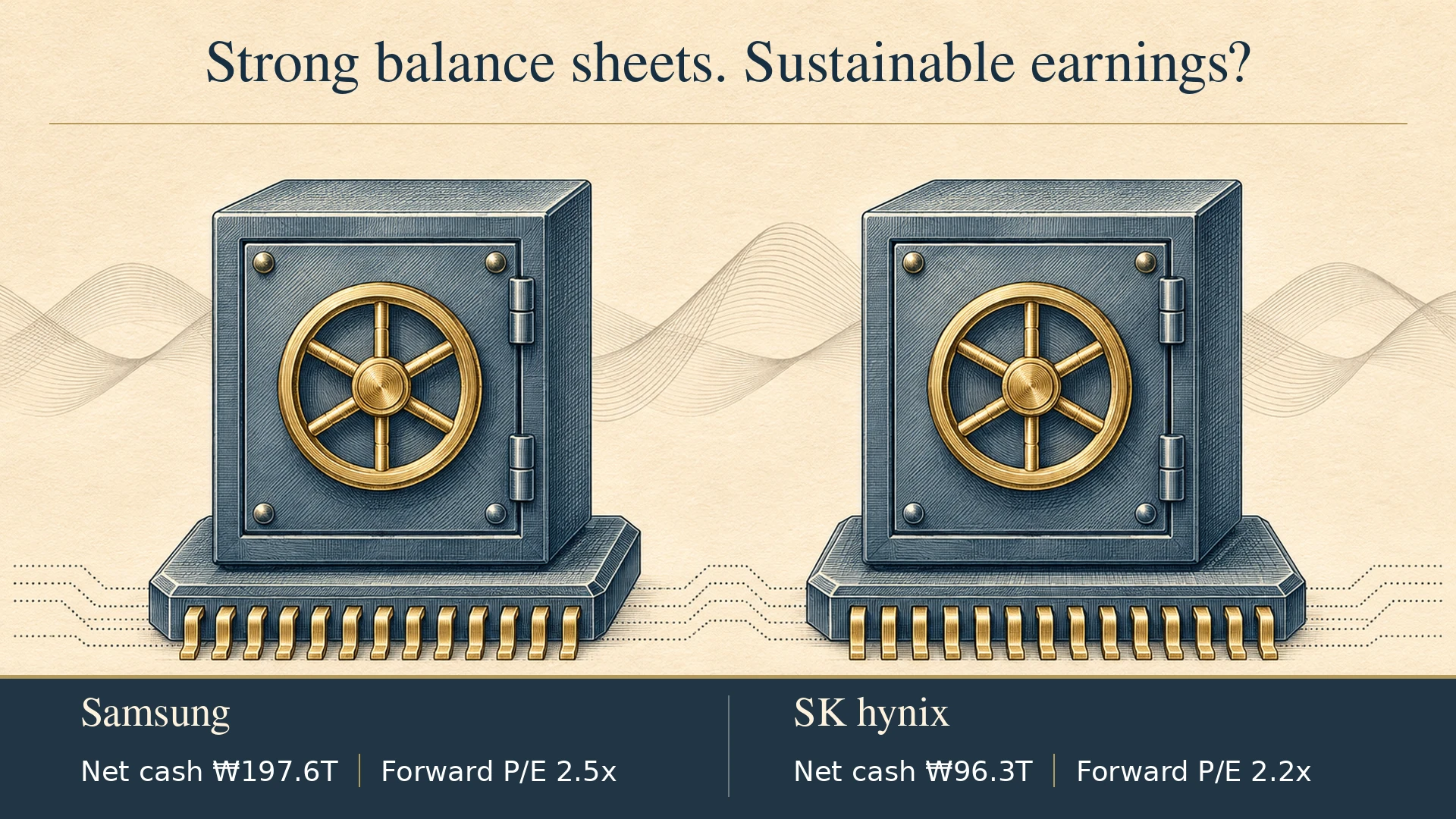
- Valuation: 5.7 times trailing earnings, 2.5 times forward earnings, and 1.9 times book value.
- Drawdown: approximately 51% below its 52-week high of ₩374,500.
- Flow: the largest foreign net-selling position of the week.
SK hynix — 000660
- November 20 close: ₩1,113,000, down 5.92%.
- Market capitalization: ₩791.5 trillion.
- Valuation: 4.2 times trailing earnings, 2.2 times forward earnings, and 2.6 times book value.
- Drawdown: approximately 63% below its high of ₩2,987,000.
- Post-close signal: its ADR fell approximately 13.1%.
- Corporate support: an ongoing share-repurchase program.
- Dividend calendar: November 27 ex-dividend date for a ₩20,750 dividend.
Friday’s lists of the biggest gainers and most actively traded stocks were unavailable in the material used for this edition. BigGo reported that 716 of 933 KOSPI stocks declined between January 22 and November 18, a broader measure of market weakness rather than a reading of Friday’s breadth.
Updated prices were also unavailable for defense, nuclear, banking, and biotech stocks.
The memory debate
Analyst Lee Joo-wan maintains fair-value estimates of ₩70,000 for Samsung, approximately 62% below its current price, and ₩200,000 for SK hynix, approximately 82% below its current price. His argument is that earnings have risen because of higher prices, while volumes have remained stable.
KB Securities offered a different assessment in its November 20 report. It projects a 40% increase in average DRAM prices and a 30% increase in NAND prices in 2027, with DRAM demand rising 25% against supply growth of 18%. The firm argues that pessimism may be approaching a peak.
The pricing signals are not uniform. Over the past month, spot prices fell 5% for DRAM and 20% for NAND, while contract prices continued to rise.
That divergence is the substance of the debate. One view treats current earnings as an unsustainable price windfall. The other sees supply discipline and demand growth extending the cycle into 2027.
7. Potential Multibaggers — Initial Screen
Samsung and SK hynix figures are dated November 20. The remaining companies use older aggregator data, with dates specified below. This is a screening exercise, not a recommendation.
Samsung Electronics — 005930
Screening figures, November 20:
- Share price: ₩183,100.
- Market capitalization: ₩1,162.9 trillion.
- Trailing/forward P/E: 5.7x / 2.5x.
- Operating margin: 46.1%.
- Net cash: ₩197.6 trillion, approximately 17% of market capitalization.
- Return on equity: 41.6%.
Additional reported figures include trailing-12-month revenue of ₩594.5 trillion, up 88%; net income of ₩212.9 trillion, up 554%; free cash flow of ₩204.7 trillion; and a debt-to-equity ratio of 0.03.
The listed dividend is ₩5,347, with an ex-dividend date of December 29. The average price target among 36 analysts is ₩471,857.
The thesis is straightforward: a substantial net-cash balance and HBM/DRAM profits could support large capital returns, while the share price appears to discount a sharp earnings decline.
Potential catalysts include 2027 memory contracts, share repurchases, and HBM qualification milestones.
The risk is the classic cyclical trap. A stock trading at 2.5 times peak earnings is not necessarily cheap if those earnings cannot be repeated. Export restrictions affecting China and falling spot memory prices add to that uncertainty.
Samsung is not a conventional multibagger candidate. At a market capitalization of roughly ₩1.16 quadrillion, the potential asymmetry rests more on repricing than on a small company growing into a much larger one.
SK hynix — 000660
Screening figures, November 20:
- Share price: ₩1,113,000.
- Market capitalization: ₩791.5 trillion.
- Trailing/forward P/E: 4.2x / 2.2x.
- Operating margin: 74.5%.
- Net cash: ₩96.3 trillion, approximately 12% of market capitalization.
- Return on equity: 92.5%.
Trailing-12-month revenue totaled ₩269.3 trillion, up 220%, with net income of ₩188.9 trillion and free cash flow of ₩123.6 trillion. The company conducted substantial repurchases during the week. The average price target among 41 analysts is ₩3.06 million.
The thesis rests on HBM leadership, a net-cash balance sheet, and a forward P/E of 2.2x.
Potential catalysts include the November 27 ex-dividend date, HBM4 contracts, and continued repurchases. The dividend date is a calendar event, however, rather than evidence that the underlying earnings outlook has improved.
The exposure is concentrated. Among the names discussed here, SK hynix is the most directly tied to Nvidia. Its ADR fell roughly 13% after Seoul’s close, and its net short position increased about 42-fold in approximately two weeks.
Its reported beta is 2.47. An operating margin near 74% also leaves little room to dismiss the possibility that current profitability is close to a cyclical peak.
Wonik IPS — 240810
Screening figures, September 4:
- Share price: ₩114,800.
- Market capitalization: ₩5.59 trillion.
- Trailing/forward P/E: 32.3x / 25.7x.
- Operating margin: 8.0%.
- Net cash: ₩405 billion.
- Return on equity: 17.5%.
EO Technics — 039030
Screening figures, October 2:
- Share price: ₩532,000.
- Market capitalization: ₩6.55 trillion.
- Trailing/forward P/E: 60.4x / 45.7x.
- Operating margin: 24.6%.
- Net cash: ₩331 billion.
- Return on equity: 16.0%.
Both equipment companies have net cash and very little debt in the older data.
The investment hypothesis is that deposition and laser-equipment suppliers could benefit from memory capital spending in 2027. The difficulty is valuation: forward multiples of approximately 25–46 times still depend on the same memory cycle now under scrutiny.
Current share prices may be materially below the dated figures above, but that was not confirmed. Third-quarter results, expected in early and mid-November, were also not verified for this edition. These figures should therefore be treated as historical screening inputs, not current valuation snapshots.
Samsung E&A — 028050
Screening figures, October 27:
- Share price: ₩62,200.
- Market capitalization: ₩12.19 trillion.
- Trailing/forward P/E: 17.3x / 11.3x.
- Operating margin: 11.2%.
- Net cash: ₩3.77 trillion.
- Return on equity: 15.6%.
Net cash represented approximately 31% of market capitalization. The average analyst price target was ₩76,810.
The thesis is a value candidate with less direct exposure to AI. The reservations are negative trailing free cash flow of ₩238 billion and exposure to the Middle Eastern project cycle.
What the screen actually shows
On the figures presented here, Samsung and SK hynix combine large cash balances with unusually low earnings multiples. Their balance sheets comfortably meet a financial-strength screen.
But balance-sheet strength and earnings durability are different questions.
My concern is not primarily solvency. It is whether investors are valuing recurring earnings—or a temporary windfall from exceptional memory prices. Low multiples offer less protection when the denominator is the part of the equation being challenged.
8. Calendar
- Monday, November 23: Korean markets reopen after overnight KOSPI 200 futures fell roughly 7%; HPE earnings.
- Tuesday, November 24: Dell earnings.
- Wednesday, November 25, evening in Korea: U.S. October PCE inflation and the revised third-quarter GDP release.
- Thursday, November 26: BOK policy decision, with DBS and Hana Securities projecting an increase to 3.25%; U.S. markets closed for Thanksgiving.
- Friday, November 27: shortened U.S. trading session; SK hynix ex-dividend date.
- December 1: November export figures.
Also worth monitoring: further reporting on Nvidia’s accounting, U.S. export controls affecting China, and the legislation addressing data-center electricity and grid costs.
9. Facts vs. Hypotheses
Reported figures
The market and economic figures presented in this edition are:
- KOSPI at 4,869.96, down 5.21% on Friday and 7.95% for the week.
- KOSDAQ at 645.68, down 5.71% on Friday.
- USD/KRW at 1,336.2.
- BOK policy rate at 3.00%.
- Weekly foreign net selling of ₩4.52 trillion.
- SOX down 10.73% and overnight KOSPI 200 futures down 6.99% after Seoul’s close.
- Samsung Electronics at ₩183,100.
- SK hynix at ₩1,113,000.
- Annual exports above $1 trillion.
Unconfirmed claims and missing information
- The single-source claim that Jensen Huang left Nvidia’s CEO role.
- The scope of the reported SEC examination.
- Friday’s Korean government bond yields.
- November 1–20 export figures.
- Current prices for Wonik IPS, EO Technics, and Samsung E&A.
- Friday’s biggest gainers and most actively traded stocks.
Working hypotheses
- A substantial Monday gap lower, with the possibility of a circuit breaker if cash-market losses reach the applicable trigger.
- A liquidity drain from existing AI holdings following Anthropic’s IPO.
- A cyclical earnings trap behind forward P/E ratios of 2–3 times.
- A BOK decision made more difficult by the conflict between a possible rate increase and worsening market conditions.
The distinction matters this week. Strong exports and large cash balances are measurable. The persistence of today’s profits—and the market’s willingness to pay for them—is still being contested.
Editorial note: This publication is provided for informational and educational purposes only. It is not investment research, a recommendation, an offer or solicitation, or personalized financial advice. Market conditions and available information can change quickly, and the views expressed here may prove incomplete or incorrect. Readers should consult primary sources and seek qualified professional advice where appropriate.