
Market Calls / Europe
Market Call — Europe’s AI Selloff Meets an Inflation Problem
European stocks suffered their worst week since March as chipmakers led a broad retreat. Falling oil and lower Bund yields offer some relief, but Germany’s producer-price shock leaves the ECB with little room to soften its message.

Market date
Sunday, November 22, 2026
1. Headline
Europe finished its worst week since March with another broad selloff. The STOXX 600 fell 2.0% on Friday to 625.65, its fifth consecutive decline and a six-week low. Its weekly loss exceeded 5%. The Euro Stoxx 50 dropped 2.81% to 5,941.95, while the DAX lost 2.60% to 24,802.78. For the week, the DAX fell roughly 7%, the CAC about 5%, and the FTSE around 4%.
All nine indexes tracked in this call closed lower for the fourth straight session.
The immediate trigger was an unwind of the AI trade. Anthropic’s Nasdaq debut on Thursday, November 19—at a valuation of roughly $2 trillion following the largest IPO in history—gave way to profit-taking, with the stock down about 10% on Friday. Questions about Nvidia’s leadership and a short-seller report targeting AMD added to the pressure.
Asia had already delivered a warning: the Nikkei fell 5.1%, the Kospi 5.2%, and the Taiex 6.2%. Europe’s technology sector then lost 5.39%, with STMicroelectronics down roughly 11% and Infineon off 7.6%.
The inflation backdrop made the selloff harder to dismiss as a technology correction. German producer prices rose 8.1% year over year in October, above the 7.2% expected and the strongest increase since February 2023. Energy prices, up 18.7%, drove much of the acceleration.
My read is that two forces are overlapping: profit-taking in semiconductor stocks after substantial gains—STMicro was still up 90% over 12 months—and concern that persistent cost inflation will force another ECB rate increase in December.
Falling oil prices and lower Bund yields are the counterweights. They do not erase the pressure on equities, but they complicate the argument that Europe is entering a sustained inflation-driven repricing.

2. Indexes — November 20 Close
- STOXX 600: 625.65, down 2.00%. The weekly decline exceeded 5%, its worst since March. Before Friday’s session, the index was still up roughly 6% year to date.
- Euro Stoxx 50: 5,941.95, down 2.81%, closing below 6,000. Its weekly loss stood at 4.2% as of Friday morning; that is not a final weekly figure.
- DAX: 24,802.78, down 2.60%. The weekly decline was approximately 7%.
- CAC 40: 7,927.75, down 1.89%. The weekly decline was approximately 5%.
- FTSE 100: 10,346.34, down 1.02%, versus Thursday’s close of 10,452.68. The weekly decline was approximately 4%.
- FTSE MIB: 48,703.72, down 2.48%.
- IBEX 35: 18,873.10, down 1.63%.
- SMI: 14,572.14, down 1.02%.
- AEX: 1,066.15, down 2.36%, with its exposure to ASML, ASM International, and BESI weighing on performance.
The sector breakdown shows how far the selling spread beyond technology. Within the STOXX 600, technology fell 5.39%, basic resources 3.54%, banks 3.05%, autos 2.14%, oil and gas 1.87%, personal care 1.07%, telecoms 0.94%, and healthcare 0.16%.
There was some shelter at the individual-stock level. Nestlé, Unilever, and British American Tobacco each gained more than 1%. Fresenius Medical Care rose roughly 2.5%, Hannover Re 1.8%, and Deutsche Telekom 1.2%.
That looks more like selective defensive rotation than a market finding a broad floor.
3. Euro, Rates, Energy, and Commodities
EUR/USD traded at 1.0982, up 0.15% on the day but well below October’s level of roughly 1.12. GBP/USD stood at 1.3099, the dollar index at 103.73, and USD/JPY at 158.67.
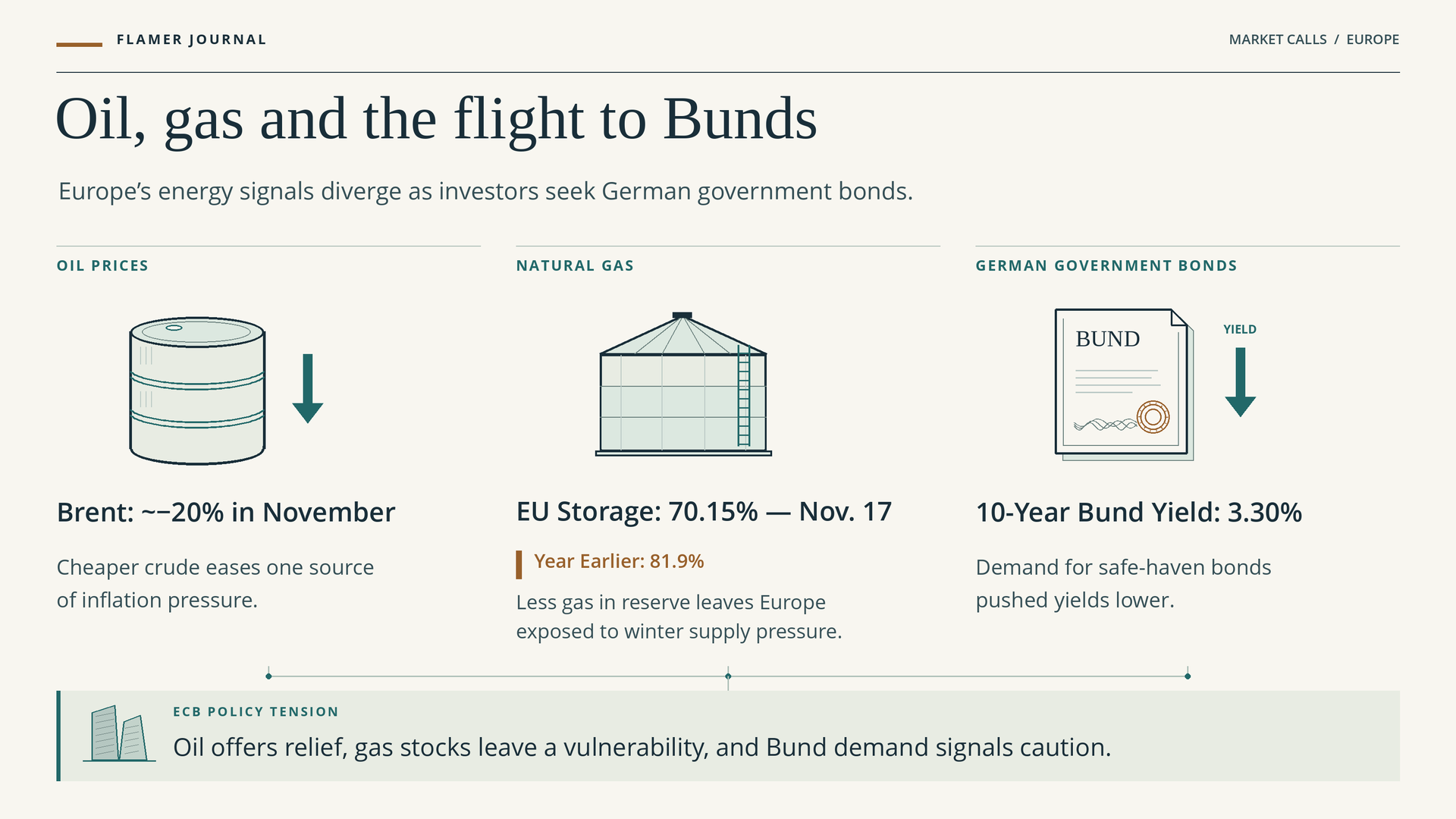
Germany’s 10-year Bund yield fell 11 basis points to 3.30% as investors sought protection. It had been around 3.40% on Thursday and reached a 17-year high of 3.65% in September. The two-year Bund yielded 3.06%.
France’s 10-year OAT yield was approximately 4.87%, and Italy’s 10-year BTP yield about 4.41%. These readings came from a table without a confirmed timestamp. Using those levels, the OAT–Bund spread was roughly 157 basis points, below the 178 basis points recorded on October 22.
Oil offered a different kind of relief. Brent traded around $91.6–$92.6 a barrel, heading for a third consecutive weekly decline and down roughly 20% in November. WTI was around $83.
The supply narrative has shifted: abundant availability, record flows through the Strait of Hormuz according to the U.S. energy secretary, an estimated quarterly surplus of roughly 2 million barrels a day from the IEA, and a Goldman Sachs warning about excess supply in 2027.
European gas remained a separate problem. TTF was quoted around €88/MWh, up 4.7%, although the date of that reading could not be confirmed. EU storage stood at 70.15% on November 17, versus 81.9% a year earlier. The winter began with the lowest storage level since 2013, while QatarEnergy extended force majeure until at least the end of December.
The distinction matters. Cheaper oil may soften the inflation outlook, but tight gas availability leaves Europe exposed to a more localized energy squeeze.
Gold and silver provided no shelter in this session. Gold fell 4.0% to $3,537 an ounce, while silver lost 7.3% to $41.12, selling off alongside risk assets.
4. ECB and Macro
The ECB’s deposit rate stands at 2.50%, with the main refinancing rate at 2.65%, following increases in June and September and an unchanged decision on October 29.
The next monetary-policy decision is December 17, accompanied by new projections. The November 25 meeting is not a monetary-policy meeting.
As of November 18, markets assigned roughly a 91% probability to a 25-basis-point increase in December. The economist survey in the draft also pointed to a 2.75% deposit rate. Most economists expected December to mark the final hike, while market pricing still implied two additional increases in 2027.
That gap is worth watching. A December hike is close to the prevailing expectation; the more consequential disagreement concerns what follows.
Final October inflation was 4.0%, with core inflation at 2.6% and energy inflation at 21%. On November 7, Christine Lagarde said inflation would remain high over the coming quarters. There was also a report of discussions about raising minimum reserve requirements from 1% to 2%, but the ECB had not confirmed it.
Friday’s data offered little comfort on costs, though the activity picture was uneven:
- Germany: Producer prices rose 8.1% year over year and 1.4% month over month.
- France: Business confidence fell to 95, below the 97 expected and its lowest level since June. Industrial confidence stood at 104.
- United Kingdom: Retail sales rose 0.7% month over month, against expectations for no change. GfK consumer confidence was −22. Public borrowing totaled £17.0 billion, below expectations.
The German PPI reading strengthens the case for December. But oil’s roughly 20% monthly decline and the tightening in financial conditions caused by falling equities could help make that increase the last of the cycle.
That is a working interpretation, not a settled policy path. The distinction between one more hike and a longer tightening cycle remains central to the market’s next move.
5. Corporate News
STMicroelectronics fell 10.8% to €36.72, the largest decline in the technology sector. No company-specific catalyst was identified in the available material. The move coincided with the global semiconductor selloff. Profit-taking after a 90% gain over 12 months is a plausible explanation, but it is not a confirmed cause.
Infineon lost 7.6%. The stock had already slipped below €50 on November 16 despite a record quarter and a revenue target of roughly €20 billion for 2027. Deutsche Bank cut its price target from €85 to €75 while retaining its buy rating. The shares were more than 40% below their June 22 high of €88.83.
ASML and ASM International were each down more than 5% in morning trading. Those are intraday readings, not confirmed closing changes.
Vallourec dropped 12.8%. Third-quarter EBITDA fell 26%, with the decline attributed to the Iran conflict and operational disruptions in the United States.
Ubisoft lost 11.6% after fiscal second-quarter net bookings missed expectations and the company issued a weaker outlook.
Selling also spread across industrial and technology-linked names: Siemens Energy fell roughly 6.5%, Scout24 about 7%, ArcelorMittal 5.9%, Legrand 4.7%, Schneider Electric approximately 3.3%, and Siemens 3.2%.
Banks declined 3.05% as a sector. Santander and BBVA each lost around 2%, while HSBC, Barclays, Standard Chartered, and NatWest also fell sharply. Earlier in the week, Deutsche Bank dropped 6% on Tuesday, November 17, following reports involving leaked internal documents.
Mining shares—including Rio Tinto, Glencore, Antofagasta, and Fresnillo—fell sharply alongside metals.
Separately, XTB lost 17.5% on Tuesday, November 17, after the Polish regulator discussed restrictions on contracts for difference, or CFDs.
6. Stocks in Focus and Candidates to Monitor
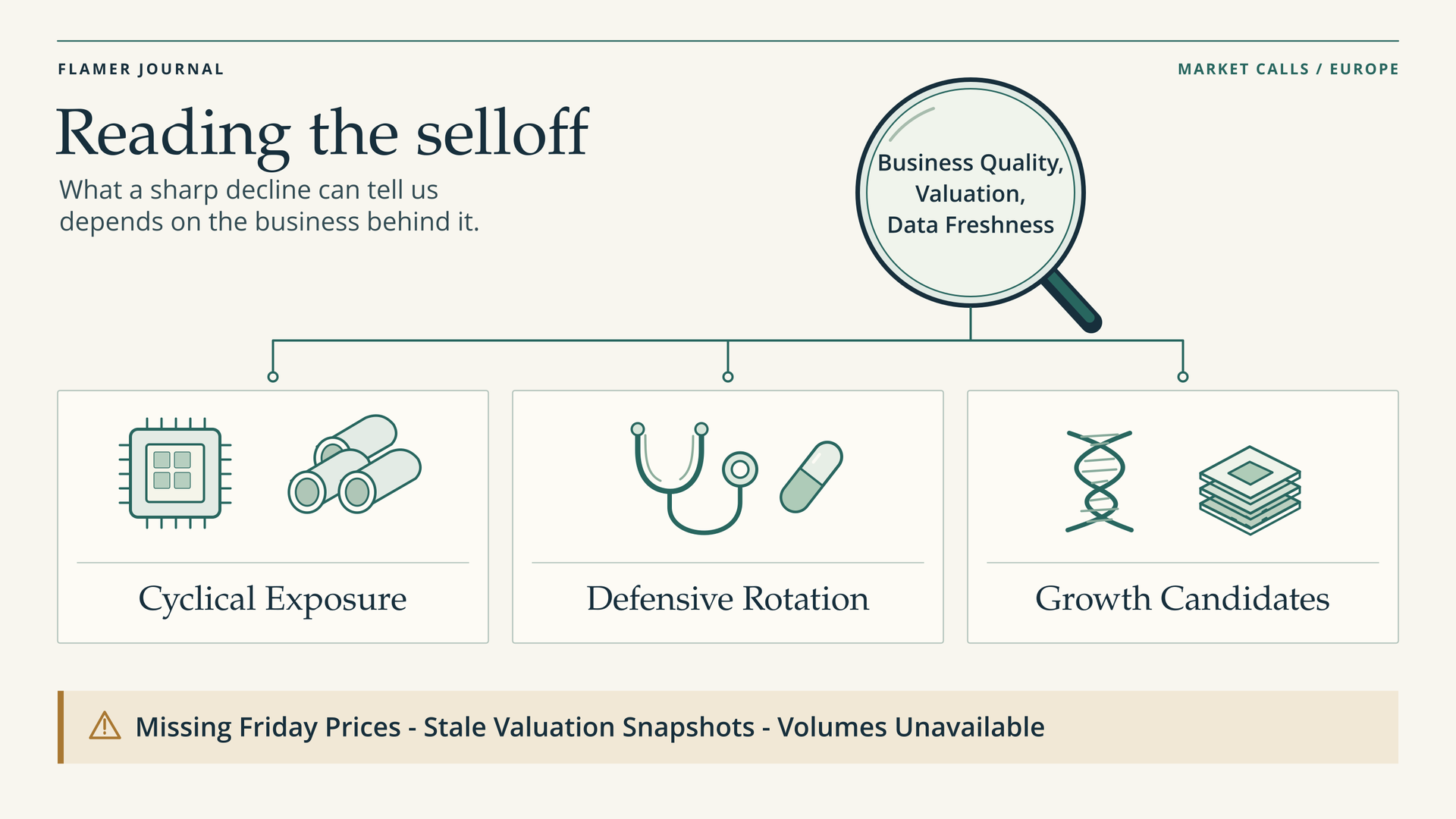
The available data do not support identifying a confirmed multibagger candidate. Three to five years of revenue and earnings history are missing, and several stock prices are stale. Trading volumes were unavailable.
The names below therefore belong in different categories: sharp daily movers, restructuring situations, defensive businesses, and longer-term growth candidates. Treating them as one uniform opportunity set would obscure more than it reveals.
Unless otherwise specified, the valuation and financial figures below are snapshots from the draft and should not be read as synchronized November 20 data.
STMicroelectronics — STMPA / Euronext Paris
Price: €36.72, down 10.8% on November 20. Market capitalization: €32.8 billion.
Valuation: 73.7 times trailing earnings, 16.8 times forward earnings, and 11.7 times EV/EBITDA.
Financial profile: €12.0 billion in trailing-12-month revenue, a 7.9% operating margin, €1.65 billion in net cash, and €462 million in free cash flow. The shares remained up 90% over 12 months.
The gap between trailing and forward P/E indicates that consensus expects a substantial earnings recovery. My working hypothesis is that Friday’s decline was driven more by positioning and flows than by a newly identified deterioration in the business.
That remains unproven. Margins are still low, automotive and industrial demand are weak, and sentiment toward AI-linked equities can overwhelm company-level distinctions.
Infineon — IFX / Xetra
Daily move: down 7.6%. A Friday closing price was unavailable; the shares had moved below €50 by November 16.
The market-cap snapshot was approximately €66 billion at a share price of €51 on October 20. Valuation figures from that date were 57 times trailing earnings, 20.0 times forward earnings, and 17.2 times EV/EBITDA.
Financial profile: a 16.3% operating margin, €5.6 billion in net debt, and €1.65 billion in free cash flow.
A record quarter and the roughly €20 billion revenue target for 2027 support the operating story. The growth hypothesis centers on power demand from data centers.
The constraints are leverage, the automotive cycle, and falling analyst price targets. A credible growth market does not automatically protect the stock from earnings-cycle or valuation pressure.
Vallourec — VK / Euronext Paris
Daily move: down 12.8%. Friday’s price was unavailable; the shares traded at €17.73 on October 22. Market capitalization was approximately €4.1 billion in October.
Valuation: 12.8 times trailing earnings, 11.6 times forward earnings, and 5.3 times EV/EBITDA.
Financial profile: a 16.2% operating margin, €138 million in net cash, and €439 million in free cash flow.
The valuation hypothesis rests on a modest multiple, net cash, and demand for oil-country tubular goods, or OCTG, under a structurally elevated oil-price scenario.
The latest results challenge that thesis: third-quarter EBITDA fell 26%, Brent is declining, and the business remains exposed to the United States and the Middle East. A low multiple alone does not resolve those pressures.
Ubisoft — UBI / Euronext Paris
Daily move: down 11.6%. Friday’s price was unavailable; the shares were €4.44 on November 6. Market capitalization was approximately €0.6 billion.
Valuation: no meaningful P/E because the company was loss-making; EV/EBITDA was 2.6 times.
Financial profile: an operating margin of −87% and net debt of €449 million.
This is a restructuring or M&A scenario, not a quality-growth candidate. Below-expectation bookings, a weaker outlook, and operating losses remain the defining facts.
Fresenius Medical Care — FME / Xetra
Daily move: up approximately 2.5%. Friday’s price was unavailable; the shares traded at €39.09 on September 4. Market capitalization was approximately €10.2 billion in September.
Valuation: 11.5 times trailing earnings, 9.2 times forward earnings, and 6.1 times EV/EBITDA.
Financial profile: a 10.3% operating margin, €9.9 billion in net debt, and €1.78 billion in free cash flow.
The hypothesis is a relatively inexpensive defensive business benefiting from a move away from risk. Its positive performance on Friday is consistent with that interpretation.
High debt and projected growth of roughly 2% limit the case. Defensive does not mean financially unconstrained.
argenx — ARGX / Euronext Brussels
Reference price: €782.20 on October 23. Market capitalization: €48.9 billion.
Valuation: 30.8 times trailing earnings, 26.7 times forward earnings, and 26.6 times EV/EBITDA.
Financial profile: €5.2 billion in revenue, a 31.9% operating margin, €4.5 billion in net cash, and €866 million in free cash flow.
Third-quarter product sales grew 54%. With projected growth of roughly 30% annually, argenx looks closer to a potential long-term growth compounder than the more cyclical names in this screen.
The limitations are concentration in Vyvgart, valuation, and an outdated share-price reference. This is a business to monitor, not a conclusion supported by a current entry valuation.
BE Semiconductor Industries — BESI / Euronext Amsterdam
Reference price: €147.25 on October 26. Market capitalization: €11.9 billion.
Valuation: 40.4 times trailing earnings, 24.3 times forward earnings, and 30.7 times EV/EBITDA.
Financial profile: a 40.5% operating margin, a 32.9% net margin, €237 million in net cash, and €288 million in free cash flow.
Third-quarter orders were approximately double their year-earlier level. The growth thesis centers on hybrid bonding for AI applications.
A selloff could make the valuation more interesting, but Friday’s closing price was unavailable. The AEX’s roughly 2.4% decline is not a substitute for a BESI quote. High multiples and semiconductor-equipment cyclicality remain material constraints.
UCB — UCB / Euronext Brussels
Reference price: €296.50 on November 13. Market capitalization: €56.5 billion.
Valuation: 26.2 times trailing earnings, 21.1 times forward earnings, and 18.9 times EV/EBITDA.
Financial profile: a 29.5% operating margin, a 25.7% net margin, €2.8 billion in net debt, and €1.55 billion in free cash flow. The shares were up 29% over 12 months.
UCB raised guidance twice in 2026. The growth hypothesis is that Bimzelx can sustain double-digit expansion.
Product concentration and the stock’s existing gains are the main reservations. The operating momentum is encouraging, but some of it may already be reflected in the valuation.
7. The Week Ahead
- Monday, November 23: Preliminary November PMIs. Germany at 08:30 GMT, the euro area at 09:00 GMT, and the United Kingdom at 09:30 GMT.
- Wednesday, November 25: ECB non-monetary-policy meeting.
- Tuesday, December 1, subject to confirmation: Preliminary November euro-area inflation.
- Thursday, December 17: ECB monetary-policy decision.
Weekend developments involving Iran and the Strait of Hormuz remain relevant. On Monday, Anthropic and Nvidia’s Nasdaq performance will provide an early test of whether the AI unwind is stabilizing or extending.
The PMIs will help frame the European side of that question: how much activity can withstand persistent price pressure and tighter financial conditions?
8. Facts vs. Hypotheses
The reported factual inputs are the November 20 index closes and sector moves, macroeconomic releases, Bund yields, oil and precious-metals prices, exchange rates, company developments, and the ECB pricing snapshot from November 18. These observations do not all share the same timestamp.
The interpretations are separate: that semiconductor selling reflects profit-taking rather than a fundamental break; that December could be the ECB’s final hike; and that the businesses discussed above could fit particular defensive, cyclical, restructuring, or growth theses.
Several gaps remain unresolved:
- No specific company-level explanation was identified for STMicroelectronics’ decline.
- Friday prices were unavailable for Infineon, Vallourec, Ubisoft, Fresenius Medical Care, argenx, BESI, and UCB.
- Trading volumes were unavailable.
- The TTF quote lacked a confirmed date.
- The underlying draft flagged discrepancies between Edge and dpa in reported index changes.
- Some sovereign-yield readings lacked timestamps, and several company valuations relied on older prices.
What stands out to me is the divergence between the immediate inflation data and the market’s forward-looking signals. German producer prices argue for another hike. Falling oil and a rally in Bunds suggest investors are also seeking protection against a less supportive growth backdrop.
Europe is not trading a single story. It is repricing the collision between expensive growth expectations, persistent energy costs, and the possibility that monetary restraint is already doing more work than the latest inflation release reveals.
Editorial note: This publication is provided for informational and educational purposes only. It is not investment research, a recommendation, an offer or solicitation, or personalized financial advice. Market conditions and available information can change quickly, and the views expressed here may prove incomplete or incorrect. Readers should consult primary sources and seek qualified professional advice where appropriate.