
Market Calls / Crypto
Crypto Market Call: Capitulation Signals, but No All-Clear
Bitcoin rebounds from $55,000 as ETF redemptions, a hawkish Fed, and pressure on corporate treasuries keep the recovery on fragile ground.

Market date
Sunday, November 22, 2026
Executive Summary
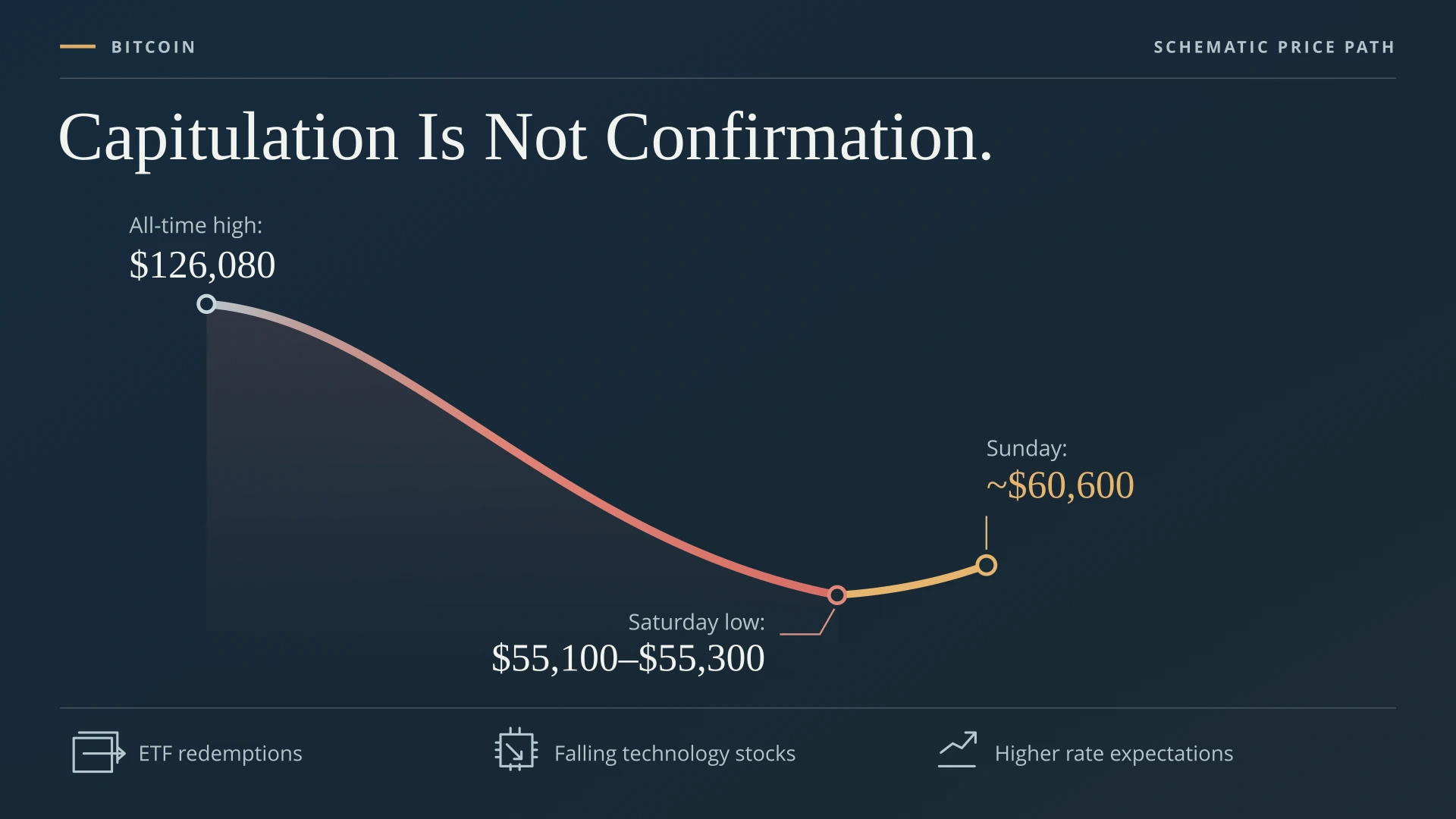
Crypto has just endured its worst week of the current cycle. Bitcoin touched $55,100–$55,300 on Saturday, November 21—its lowest level since September 2024—before recovering to roughly $60,600 this morning.
November’s decline stands at 21.6%, according to CryptoRank figures reported by U.Today, putting it on track for its worst month since June 2022, when BTC fell 37.9%. Bitcoin is now approximately 52% below its October 6, 2025, all-time high of $126,080.
The selloff did not begin and end with crypto. The Nasdaq lost 10% for the week, including a 5.3% drop on Friday, as AI stocks sold off following Anthropic’s IPO. Meanwhile, markets are pricing roughly a 91% probability of a Fed rate increase on December 9, according to Kalshi, and spot Bitcoin ETFs are facing record redemptions. Gold and silver also fell—a pattern Goldman described, in commentary reported by Stocktwits, as a “dash for cash.”
The stress is visible across several measures:
- Reported liquidations reached $1.8 billion–$2.7 billion over 24 hours; sources differ.
- Fear & Greed readings ranged from 6 to 20, with several sources reporting an all-time low.
- Spot Bitcoin ETFs lost $1.25 billion over the week and approximately $3.5 billion–$3.6 billion in November.
- IBIT recorded a $541.1 million outflow on November 19, its largest daily withdrawal since launch.
- Strategy shares fell 30.3% for the week to $77.80. The company is scheduled to leave MSCI indexes after November 30.
- Strategy’s average Bitcoin acquisition cost is $75,452, roughly 20% above the current BTC price.
- JPMorgan estimates average Bitcoin mining costs at $86,000, while older mining equipment is already operating below its shutdown threshold.
My read is that the combination of short-term-holder capitulation, negative Binance funding, extreme fear, and the highest trading volume since February looks like a capitulation phase. Those conditions can appear near market lows. They do not confirm one.
The macro backdrop remains hostile: a Fed moving toward higher rates, a stronger dollar, and falling technology shares. This week brings PCE inflation on Wednesday, Thanksgiving on Thursday with ETF markets closed, and approximately $6.6 billion in options expirations on Friday.
1. Market Overview
Prices and performance below reflect the snapshot in this call. Trading volumes are Binance figures unless otherwise indicated.
- Bitcoin (BTC): $60,615; +0.9% over 24 hours, −5.4% over seven days, and −25.5% over 30 days. Market capitalization: $1.219 trillion. Daily volume: $10.0 billion.
- Ethereum (ETH): $1,712; +1.8% over 24 hours, −3.1% over seven days, and −28.3% over 30 days. Market capitalization: $209.3 billion. Daily volume: $3.36 billion.
- XRP: $0.927; −0.3% over 24 hours, +1.5% over seven days, and −29.1% over 30 days. Market capitalization: $58.9 billion. Daily volume: $542 million.
- BNB: $555.20; +1.4% over 24 hours, −4.5% over seven days, and −24.0% over 30 days. Market capitalization: $73.0 billion. Daily volume: $164 million.
- Solana (SOL): $70.17; unchanged over 24 hours, −0.1% over seven days, and −32.2% over 30 days. Market capitalization: $41.5 billion. Daily volume: $800 million.
- TRON (TRX): $0.305; +0.1% over 24 hours, −0.5% over seven days, and −7.1% over 30 days. Market capitalization: $29.0 billion. Daily volume: $97 million.
- Zcash (ZEC): $786.65; +1.1% over 24 hours, −8.8% over seven days, and −35.4% over 30 days. Market capitalization: $13.4 billion. Daily volume: $263 million.
- Dogecoin (DOGE): $0.0550; −0.3% over 24 hours, −4.0% over seven days, and −30.2% over 30 days. Market capitalization: $8.6 billion. Daily volume: $161 million.
TradingView puts total crypto market capitalization at $2.06 trillion: up 0.8% over 24 hours, but down 4.1% over seven days and 23.7% over 30 days. The market excluding Bitcoin, tracked by TOTAL2, stands at $839 billion.
Aggregate 24-hour volume is approximately $132 billion. On Saturday, it reached $156.7 billion, up 72%, according to 24/7 Wall St.
Derived from these figures, Bitcoin dominance is approximately 59.2%, while Ethereum accounts for roughly 10.2%. ETH/BTC stands near 0.0282, down from 0.0294 on October 23.
There is a small but meaningful distinction beneath the broad selloff: altcoins excluding Bitcoin have fallen about 21% over 30 days, versus Bitcoin’s 25.5% decline. Ethereum, however, has performed worse than BTC.
USDT’s market capitalization remains stable at $174.6 billion.
Bitcoin’s Levels and Third-Party Scenarios
Reported Saturday lows differ slightly: $55,106 from 24/7 Wall St. and $55,081 from U.Today. Bitcoin closed November 20 at $58,818, its lowest close in 90 days.
The moving averages sit well above the current price:
- 20-day: $71,034.
- 50-day: $77,647.
- 200-day: $72,539.
A daily close below $58,566—the June 30 low—had been identified as a bearish trigger. Short-term holders’ average cost basis is approximately $75,700. CoinDesk cited a $60,000–$82,800 range; Bitcoin is now testing its lower boundary.
Published scenarios remain widely dispersed. These are third-party projections, not my targets:
- Arthur Hayes sees a possible test of $50,000 if the Nasdaq continues falling.
- Wintermute sees a move into the $50,000s without a recovery in ETF inflows.
- Peter Brandt says a historical 75% drawdown framework would imply approximately $37,600.
- 21Shares projects a new all-time high in 2027.
Separately, Kraken experienced a Bitcoin flash crash to a reported $17,000 on its CAD pair and allowed the trades to stand.
2. Rates, the Fed, and Macro
The Fed’s target range stands at 3.75%–4.00%. At its October meeting, under Chair Kevin Warsh, the committee held rates unchanged in a 10–2 vote. Cook and Hammack favored a 25-basis-point increase.
The minutes released on November 18 showed two participants open to an increase larger than 25 basis points. Waller has argued for 50 basis points in December unless there is a signal that another increase will follow in January.
The next FOMC decision is due December 9 at 2 p.m. ET. As of November 19, Kalshi implied approximately a 91% probability of a 25-basis-point increase.
September CPI came in at 3.7% year over year. October PCE is due Wednesday, November 25, with core inflation projected at 3.2%, an increase.
The cross-asset picture, using TradingView figures:
- U.S. 10-year Treasury yield: 4.95%, down 2.0% on the day and 3.5% for the week.
- U.S. two-year Treasury yield: 4.65%.
- Dollar index: 103.84, up 2.1% over 30 days, with the dollar near a 20-month high.
- Gold: $3,538, down 8.7% for the week and 14.6% over 30 days.
The Nasdaq fell 10% over the week. MSCI World recorded seven consecutive declines. Taiwan lost 6.2%, the Kospi 5.2%, and the Nikkei approximately 5%. Anthropic’s stock-market debut, priced at $83, failed to stabilize the AI sector.
My interpretation is straightforward: with high real rates and a Fed tightening cycle, Bitcoin is trading as a high-beta risk asset, not a hedge.
This week’s decline in Treasury yields offers some relief and could support a technical rebound. But a hotter-than-expected PCE report would strengthen the case for a 50-basis-point increase, potentially undermining that relief.
3. ETFs, Corporate Treasuries, and On-Chain Activity
ETF Redemptions Keep Removing Demand
According to Farside figures reported by crypto.news, spot Bitcoin ETFs lost $1.25 billion during November 16–20. It was the third consecutive week with more than $1 billion in outflows.
The daily figures available in the draft show:
- Monday: $7.9 million in net inflows across the funds.
- Tuesday: IBIT outflows of $209.5 million.
- Wednesday: IBIT outflows of $148.7 million.
- Thursday: $582.3 million in aggregate outflows, including a record $541.1 million from IBIT.
- Friday: $124.5 million in aggregate outflows.
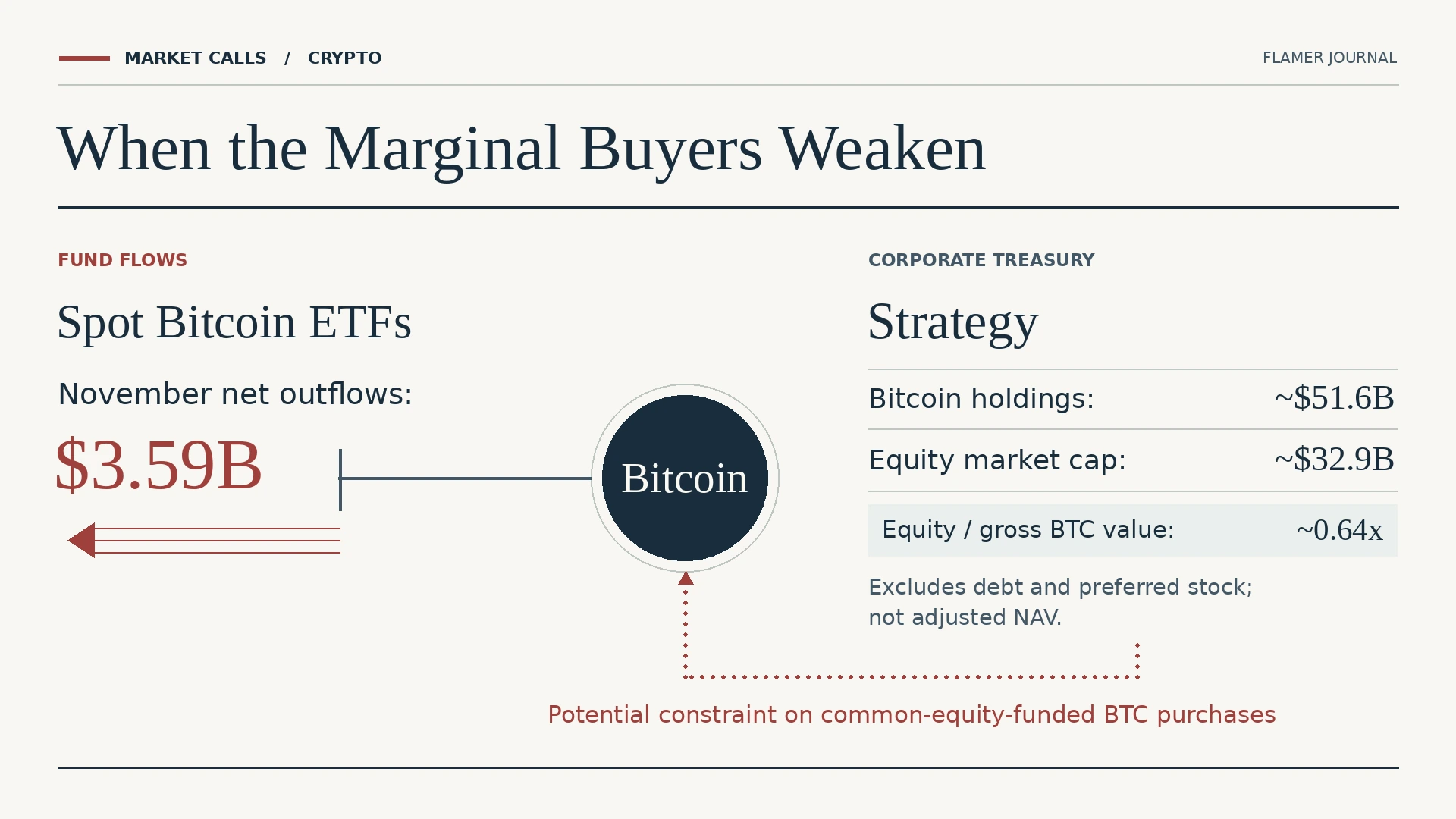
November outflows total $3.59 billion, with only two positive sessions. Assets under management fell from $104.9 billion on October 28 to $76.6 billion on November 19. Cumulative net inflows stand at $53.5 billion, compared with $57.3 billion on October 23.
Ethereum ETFs lost $221.7 million over the week and $985.8 million in November. They have now recorded seven consecutive weeks of outflows, totaling approximately $2.35 billion.
XRP ETFs lost $11.2 million. Solana ETF flows were mixed: BSOL took in $10.8 million on Monday and lost $4.7 million on Friday.
JPMorgan attributes most of the redemptions to retail investors.
Strategy’s Financing Model Is Under Pressure
Strategy holds 850,849 BTC at an average cost of $75,452 and is scheduled to leave MSCI indexes after November 30. Michael Saylor has again posted the company’s “tracker,” suggesting another purchase may be forthcoming, though that is not confirmation.
Elsewhere, MARA sold 13,597 BTC, worth approximately $1.1 billion, to repay debt and finance its move into AI. Abraxas Capital bought 10,356 BTC for approximately $607 million on November 21, at an average price near $58,651. Bitmine shares fell 26.2% over the week.
At the prices in this call, Strategy’s Bitcoin holdings are worth approximately $51.6 billion, versus an equity market capitalization of $32.9 billion. That produces an equity-market-cap-to-Bitcoin-value ratio of roughly 0.64x.
That calculation excludes debt and preferred stock. Including those claims would produce a higher enterprise-value-based mNAV ratio.
The distinction matters. An equity discount to gross Bitcoin holdings is not the same as a fully adjusted net asset value calculation. My working hypothesis is that, if Strategy’s relevant issuance economics remain below 1x NAV, selling common shares to buy more BTC becomes value-destructive. Its purchasing capacity would then depend more heavily on preferred stock and debt.
That would weaken an important marginal buyer precisely when ETF demand is retreating.
On-Chain Stress Looks Like Capitulation
Short-term holders sent approximately 706,000 BTC to exchanges over 30 days, with only 2.5% of those coins in profit. Binance Bitcoin funding turned negative, and trading volume reached its highest level since February.
Mining difficulty fell 9.1% on November 14. Older mining equipment is operating below its shutdown threshold.
Those observations support the capitulation hypothesis. They do not resolve the missing pieces: open interest, options skew, MVRV, SOPR, and a time series of exchange reserves are not available in this call.
4. Token Unlocks: November 23–30
The upcoming supply calendar is substantial, though several estimates conflict.
- MON — Monad, November 24: approximately 16.6 billion tokens, worth roughly $219 million–$236 million. PANews puts the unlock at 32.4% of circulating supply; KuCoin cites more than 130%. That discrepancy remains unresolved.
- FF — Falcon Finance, November 29: approximately 209 million–211 million tokens, worth $21 million–$22 million, or 6.2% of circulating supply.
- XPL — Plasma, November 25: approximately 228 million tokens, worth $6.5 million–$10.4 million, or 4.8% of circulating supply.
- SOSO, November 24: approximately 23.5 million tokens, worth $6.1 million, or 5.3% of circulating supply.
- SOON, November 23: approximately 20.2 million tokens, worth $5.3 million, or 3.4% of circulating supply.
- HUMA, November 26: approximately 459 million tokens, worth $3.9 million, or 14.3% of circulating supply.
- H — Humanity, November 25: approximately 266 million tokens, worth $3 million–$14.8 million, or 6.4% of circulating supply.
MON stands out as the week’s most consequential supply event. My concern is the combination of a large unlock, weak liquidity, and limited risk appetite. That creates a substantial risk of selling pressure both before and after the release, though an unlock is not itself proof that all released tokens will be sold.
Other scheduled catalysts include:
- XLM: Protocol 30 vote on November 23, covering smart accounts and quantum-resistant signatures.
- INJ: Veyra upgrade on November 24.
- ZRO: Zero Mainnet launch on November 30.
- ZEC: governance voting through November 30 on 50,000 ZEC from the grants treasury.
- SEI: the REX-Osprey ETF registration has been effective since November 20.
5. Regulation, Security, and Other Developments
Following the CLARITY Act’s defeat in the Senate, the SEC and CFTC have moved ahead independently. Developments described by Paul Hastings and FIA include an exemption for tokenized equities and no-action relief for passive software.
The GENIUS Act and the OCC rule are scheduled to take effect on January 18, 2027. The MiCA deadline concerning stablecoin exposure is January 8, 2027.
In South Korea, the FSC is presenting the government’s digital-asset legislation this week, while the Bank of Korea is also due to decide interest rates.
On security, Chainflip lost 122.9 BTC, reportedly worth approximately $12 million, and offered the hacker a bounty. The quantum-risk debate has also resurfaced, with roughly 6 million BTC associated with public keys exposed on-chain.
Separately, Hashi went live on Sui mainnet, allowing BTC to be used as loan collateral.
6. Coins in Focus
Bitcoin — BTC
At $60,615, Bitcoin is up 0.9% over 24 hours but down 25.5% over 30 days. Market capitalization is $1.219 trillion. Estimated fully diluted valuation, using the 21 million maximum supply, is approximately $1.27 trillion.
The thesis is a reserve asset undergoing a cycle correction, trading roughly 30% below JPMorgan’s estimated mining cost. The supply-compression argument is that sustained pressure at those levels may force miners to curtail production.
The immediate catalysts are PCE on November 25, the December 9 FOMC decision, a recovery in ETF flows, and purchases by Strategy or large buyers such as Abraxas.
The bearish scenario remains a close below $55,000 that could expose $50,000, alongside forced miner sales, Strategy’s MSCI removal on November 30, and a possible 50-basis-point Fed increase.
Ethereum — ETH
ETH trades at $1,712, up 1.8% over 24 hours and down 28.3% over 30 days. Market capitalization and fully diluted valuation are both approximately $209 billion.
The underlying thesis remains Ethereum’s role as a base layer for DeFi and stablecoins. The price action is less encouraging: ETH/BTC has fallen to 0.0282.
An end to ETF outflows would be a meaningful catalyst. Seven consecutive weeks of redemptions and pressure on ETH treasury companies—Bitmine fell approximately 26% for the week—remain the immediate obstacles.
XRP
XRP trades at $0.927, down 0.3% over 24 hours but up 1.5% over seven days, making it one of the few weekly gainers.
Market capitalization is $58.9 billion. Estimated fully diluted valuation is $92.7 billion, using a maximum supply of 100 billion tokens.
The relative strength is notable. ETF outflows and the gap between circulating market capitalization and fully diluted valuation are the main concerns identified here.
BNB
BNB trades near $555, up 1.4% over 24 hours, with a market capitalization of $73.0 billion.
Its 24% decline over 30 days is slightly smaller than Bitcoin’s 25.5% drop, though it remains a substantial drawdown.
Solana — SOL
SOL trades at $70.17, nearly unchanged over the week at −0.1%, but down approximately 32% over 30 days.
Market capitalization is $41.5 billion, with $800 million in Binance daily volume. Occasional inflows into Solana ETFs support the thesis, but its high-beta profile leaves it exposed to another leg lower in risk assets.
TRON — TRX
TRX trades at $0.305, down 7.1% over 30 days, with a market capitalization of $29.0 billion. It has been the most defensive of the major assets in this snapshot.
My hypothesis is that revenue associated with its role as a USDT transfer network helps explain that resilience.
Bittensor — TAO
TAO trades near $190.50 and is up 3.6% over seven days, showing relative strength. A reliable market-cap figure is missing, and the Binance quote carries low volume.
The thesis is decentralized AI. The immediate tension is that listed AI companies are experiencing a sharp selloff. A more reliable price check is also needed before drawing firm valuation conclusions.
Zcash — ZEC
ZEC trades at $786.65, down approximately 35% over 30 days. Market capitalization is $13.4 billion, estimated fully diluted valuation is $16.5 billion, and daily Binance volume is $263 million.
The treasury vote running through November 30 is the near-term catalyst. Valuation remains a concern after the 2025–26 rally.
NEAR
NEAR trades at $2.98, up 3.2% over 24 hours. Market capitalization is $3.9 billion, with daily volume of $219 million—substantial relative to its size.
Its inclusion in REX-Osprey’s ETF batch is a catalyst. The token is nevertheless down 39% over 30 days, and the intellectual-property dispute with DFINITY remains a risk.
Pieverse — Ticker Unconfirmed
Bloomingbit reports that Pieverse gained 83.6% over the week and reached an all-time high after launching security capabilities for AI agents.
It may be the week’s momentum standout, but liquidity is thin and reversal risk is high. The draft tentatively identifies the ticker as “FORM?”; neither the ticker nor market capitalization is confirmed.
7. Multibagger Candidates: Hypotheses Requiring Due Diligence
These are speculative long-term cases, not recommendations or return forecasts.
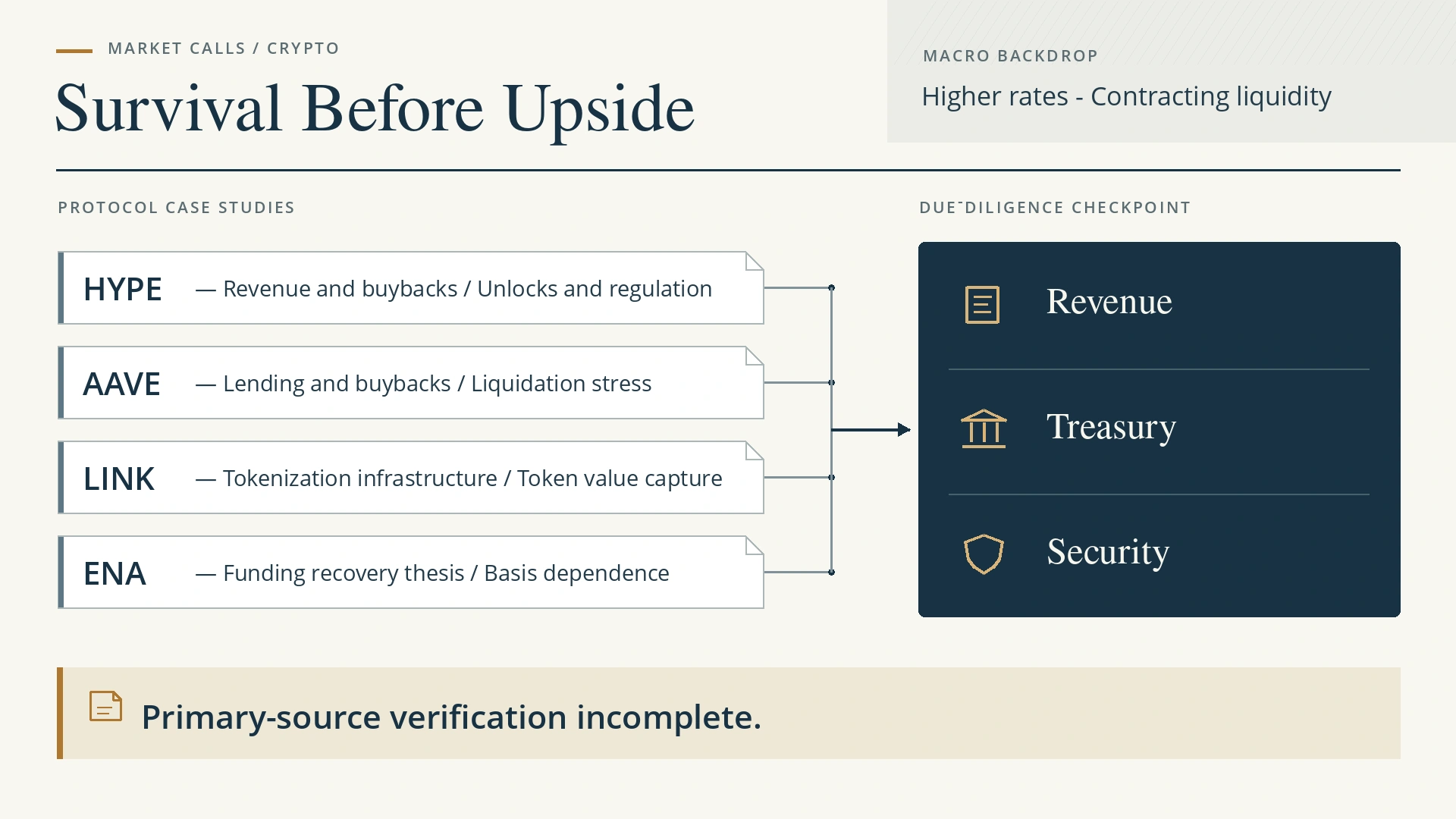
There is also a shared research limitation: protocol TVL, revenue, and audits were not confirmed against primary sources such as DefiLlama and Token Terminal for this call. Market capitalizations come from TradingView, and fully diluted valuations are estimates.
Hyperliquid — HYPE
An October headline put cumulative revenue above $1.4 billion and buybacks above $1.26 billion, with 50.7 million HYPE burned.
A reliable current price is missing. Binance shows $62.41 with negligible volume, while recent headlines discuss a test of $76. Those observations are not a consistent pricing basis.
The thesis is a perpetual-futures protocol generating revenue and buying back its own token. Elevated volatility may support trading activity.
Risks include team unlocks, competition, and perpetuals regulation. Paradigm’s withdrawal of $224 million from staking is another supply-related development to monitor.
Aave — AAVE
AAVE trades at $98.17, with a market capitalization of $1.52 billion and estimated fully diluted valuation of $1.57 billion, using 16 million tokens.
The thesis rests on its lending position, revenue generation, and the resumption of buybacks under Aavenomics 3.0.
The token is down 33% over 30 days. Cascading liquidations are a direct test of protocol solvency.
Chainlink — LINK
LINK trades at $8.78, with a market capitalization of $6.57 billion and estimated fully diluted valuation of $8.8 billion.
It has fallen only 1% over the week, another instance of relative strength. The thesis is oracle infrastructure for tokenization, including the opening for tokenized equities described in the SEC developments above.
The unresolved issue is how much of that activity translates into value captured by the token.
Ethena — ENA
ENA trades at $0.1007, with a market capitalization of $1.36 billion, after a 49% decline over 30 days.
The contrarian case is tied to funding: negative funding weighs on USDe yields and sentiment toward the token, while a reversal could become a catalyst.
The concern is structural dependence on a positive basis. A recovery in price without an improvement in those economics would leave the thesis incomplete.
A little realism is warranted across this list. With the Fed raising rates, Bitcoin 52% below its peak, and liquidity contracting, near-term multibagger outcomes are low-probability scenarios.
What these names may offer is optionality for a future cycle. Survival—revenue, treasury strength, and security—matters more than simply having the highest beta.
8. Facts, Hypotheses, and Open Questions
Reported Facts and Data
Bitcoin is trading near $60,600 after a low around $55,100. Total crypto market capitalization is approximately $2.06 trillion, with Bitcoin dominance near 59%.
Bitcoin ETFs have lost roughly $3.6 billion in November, including IBIT’s record daily outflow. Reported liquidations range from $1.8 billion to $2.7 billion, while several sources describe Fear & Greed readings as historic lows.
The Fed’s target range is 3.75%–4.00%, with approximately 91% odds of a December 9 increase in the cited Kalshi snapshot. Strategy is scheduled to leave MSCI indexes, and MON faces an approximately $219 million unlock on November 24, using the lower end of the reported value range.
Working Hypotheses
The market may be in a capitulation phase near a local low, but that is not a confirmed bottom.
A sub-1x NAV issuance framework could constrain Strategy’s ability to fund additional BTC purchases through common equity. Its simple equity-to-Bitcoin-value ratio alone does not settle the adjusted valuation question.
TRX, XRP, TAO, and LINK show pockets of relative resilience. A hot PCE report could strengthen the case for a 50-basis-point Fed increase.
What Is Still Missing
The main gaps are open interest and options skew; protocol-level TVL, revenue, and audit verification; MVRV, SOPR, and exchange-reserve trends; reliable HYPE and TAO pricing; Pieverse’s ticker and market capitalization; and a reconciliation of MON’s unlock as a percentage of circulating supply.
Calendar
- November 23: XLM Protocol 30 vote; SOON unlock.
- November 24: MON unlock, approximately $219 million at the lower reported estimate; SOSO unlock; INJ Veyra upgrade.
- November 25: October PCE; XPL and H unlocks.
- November 26: Thanksgiving; ETF markets closed; HUMA unlock.
- November 27: approximately $6.6 billion in options expire at 08:00 UTC; NYSE closes at 1 p.m. ET.
- November 29: FF unlock.
- November 30: Strategy’s MSCI removal; ZRO Zero Mainnet launch; ZEC governance-vote deadline.
- December 9: FOMC decision.
- December 10: November CPI.
Editorial note: This publication is provided for informational and educational purposes only. It is not investment research, a recommendation, an offer or solicitation, or personalized financial advice. Market conditions and available information can change quickly, and the views expressed here may prove incomplete or incorrect. Readers should consult primary sources and seek qualified professional advice where appropriate.