
Market Calls / United States
U.S. Market Call: Nvidia Ignites a Historic Rally. The Fed Hasn't Budged.
Nvidia's leadership reversal ignited a historic U.S. equity rally, but a stronger dollar, restrictive Treasury yields and Wednesday's PCE report leave the monetary-policy test unresolved.
Market date
Wall Street's rebound was spectacular, broad and unusually concentrated in one story. Nvidia's decision to restore Jensen Huang as chief executive sent the stock up 31.48% and pulled semiconductors, AI infrastructure and the major U.S. indexes sharply higher. Yet the dollar strengthened and short-term Treasury yields remained restrictive. Monday changed the market's positioning. It did not settle the inflation or policy debate.
Reporting cut-off: Monday, November 23, 2026, after the U.S. cash close. Market levels can change before the next session. This is market commentary, not a trade instruction.
One catalyst, several layers of buying
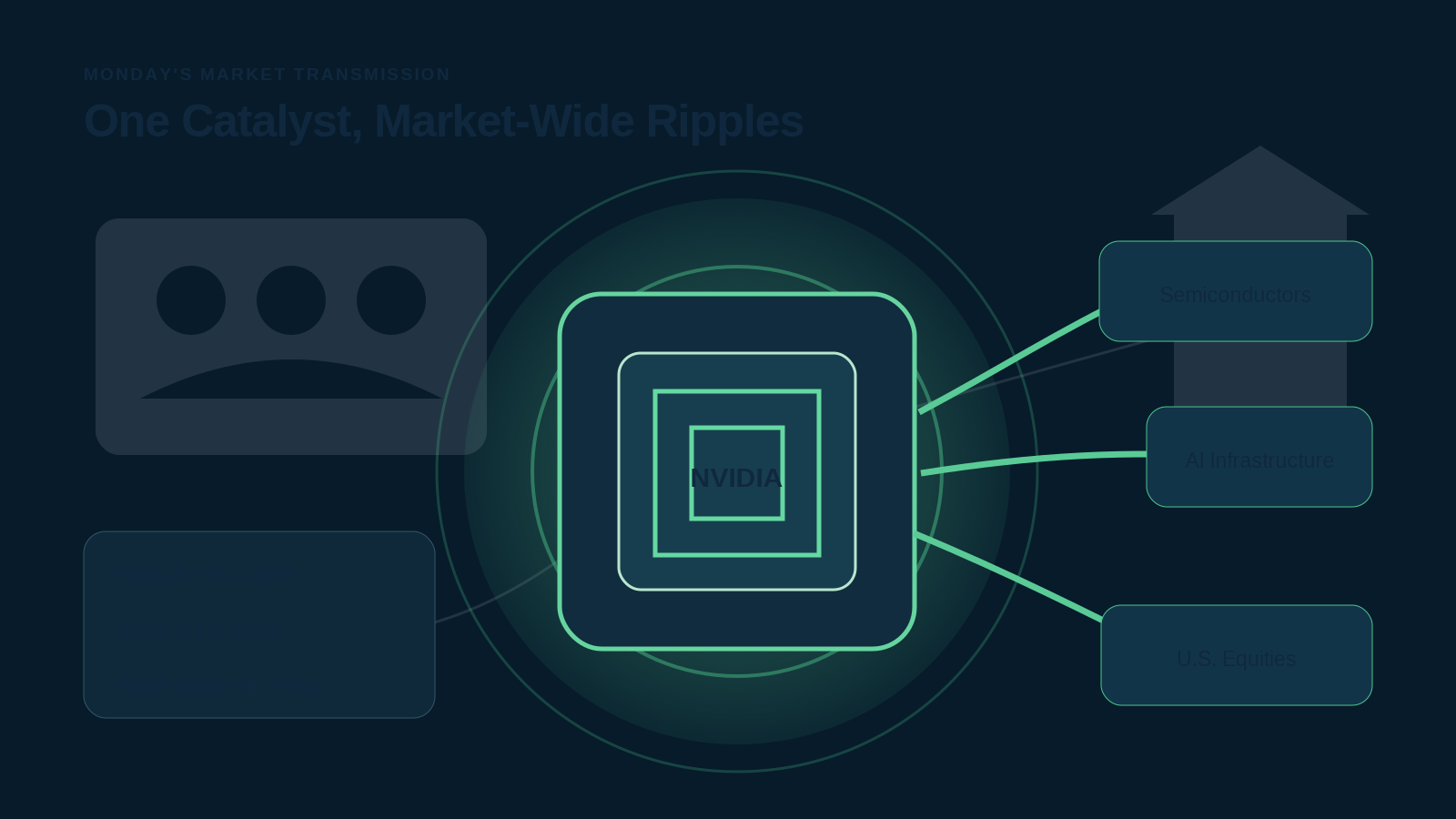
Reuters reported that the S&P 500 gained about 4.7%, the Nasdaq Composite 6.5% and the Dow 3.0%. Nvidia finished 31.48% higher at $165.05, its largest daily percentage advance since May 2003. The Philadelphia semiconductor index rose about 14%. Closing percentages differ by a few basis points across data vendors; the accompanying graphic uses the source snapshot supplied for this edition: S&P 500 +4.74% and SOX +13.65%.
The breadth was real. Reuters counted almost four advancing stocks for every decliner on Nasdaq and more than four on the NYSE. Information technology led, but the move did not stop at a handful of chipmakers. A session can therefore be both catalyst-driven and market-wide.
The catalyst itself requires careful wording. In an official release, Nvidia said its board unanimously reinstated Huang as president, chief executive and a director, effective immediately. It also said the independent board committee investigating reports of a foreign-intelligence effort would continue its work. The company is adding national-security and export-control oversight and searching for a chief compliance officer.
Those are two separate facts: Huang returned, and the inquiry is not finished. The market priced the first with extraordinary speed. It cannot price the final findings of an unfinished process with the same certainty.
What Monday proved — and what it did not
Monday demonstrated how much index exposure had become tied to Nvidia and the broader AI complex. It also exposed the force of positioning after the previous week's selloff. Reuters noted that both the S&P 500 and the Dow had entered corrections on Friday as doubts about AI investment intensified. When a heavily owned theme reverses after a sharp liquidation, fundamental buyers, short covering and systematic re-risking can reinforce one another.
That is a plausible explanation, not a trade-by-trade diagnosis. The useful distinction is simpler:
- The observed facts are the board announcement, Nvidia's price jump, the semiconductor surge and broad positive market breadth.
- The interpretation is that short covering and repositioning amplified the response.
- The unresolved question is whether earnings, cash generation and customer returns on AI capital spending will justify the new prices after the first session.
The rebound recovered a meaningful portion of the preceding decline. It did not erase the conditions that produced that decline.
Equity relief is not monetary easing
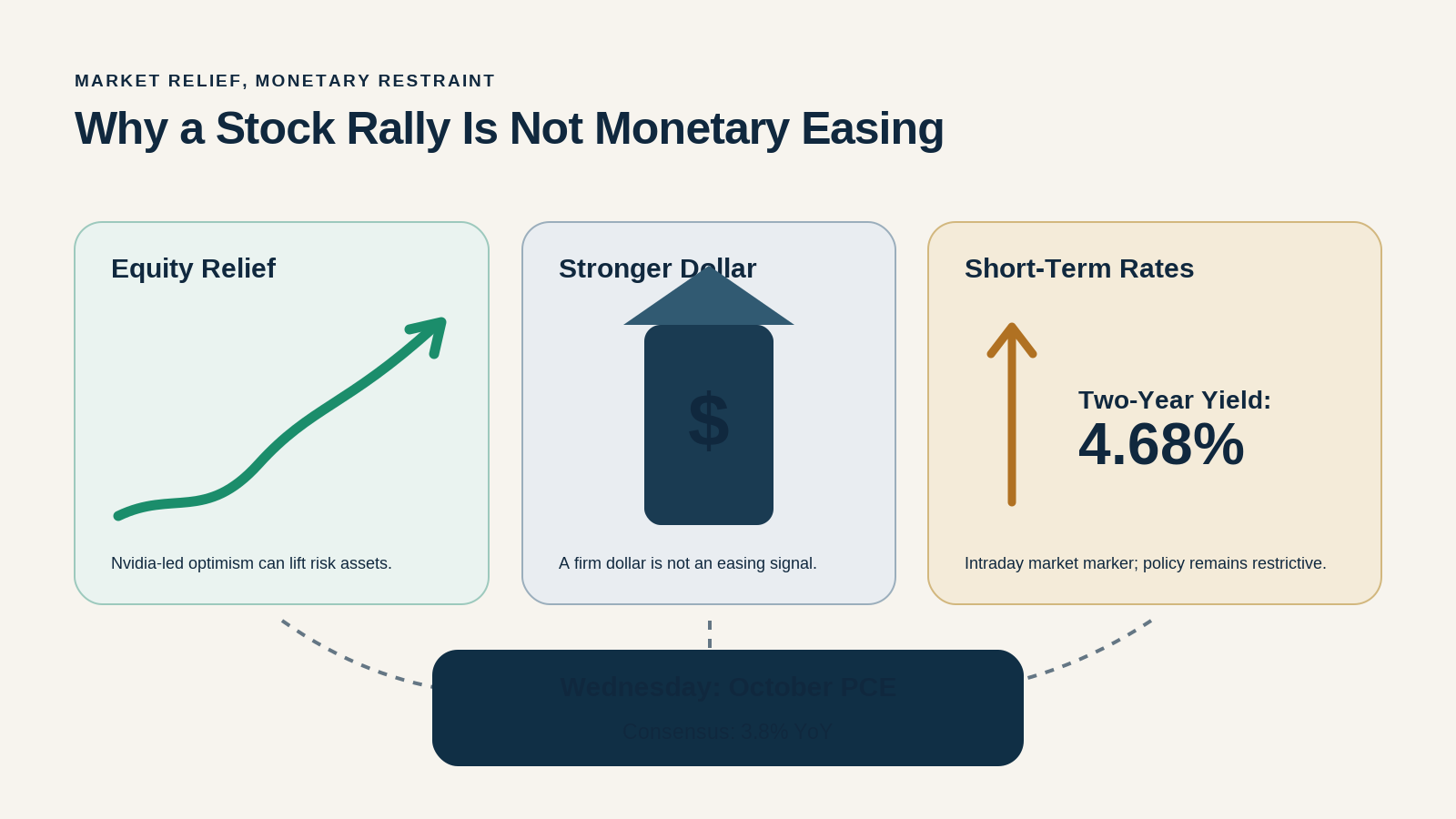
The cross-asset message was less exuberant than the stock indexes. The dollar reached its strongest level against the euro in more than 19 months, according to a separate Reuters currency report. Shorter-dated Treasury yields also moved higher during the session as investors leaned toward a firmer Federal Reserve path.
The 4.68% two-year yield in the accompanying illustration is an intraday market marker from the article's data snapshot. The U.S. Treasury's official daily par-yield table records the November 23 two-year close at 4.63%, up from 4.63% on November 20 only after rounding. The distinction is worth keeping: intraday quotes and official end-of-day series are not interchangeable.
Neither measure resembles an easing shock. The dollar was firm, the two-year yield stayed high, and the 10-year Treasury remained close to 5%. The equity market celebrated a change at Nvidia while the rates market continued to demand a restrictive price for money.
The Federal Reserve's October minutes confirm that the Committee left the federal-funds target at 3.75%–4.00%. The next scheduled decision is December 8–9. Futures probabilities may move sharply, but they are prices, not decisions.
Wednesday's PCE is the next macro checkpoint
The Bureau of Economic Analysis calendar schedules October personal income and outlays, including PCE inflation, for Wednesday, November 25 at 8:30 a.m. ET. The second estimate of third-quarter GDP and corporate profits are due at the same time.
The headline PCE consensus used in this edition is 3.8% year over year; a market calendar compiled by Econoday also showed a 3.8% median forecast, while estimates for core PCE clustered lower. A consensus is a pre-release expectation, not a reported result.
That makes the timing important. Monday's relief did not include the inflation print. A higher-than-expected result could reinforce restrictive rate expectations; a softer print could reduce them. Either reaction would be a new piece of evidence. It should not be embedded in advance as a forecast chart.
A rally with an uneven fundamental burden
Semiconductor and infrastructure shares naturally led because Nvidia's leadership reversal reduced a company-specific uncertainty at the center of the AI trade. The same event did not improve every company's balance sheet, backlog or margins by an equal amount.
That is why the second-day test matters. A durable move should show evidence beyond one catalyst: stable breadth, continued demand for the companies supplying AI systems, and operating results that support the market's spending assumptions. A reversal would suggest that positioning contributed more than fundamentals. Neither conclusion can be established from Monday alone.
The governance dimension also remains relevant. Nvidia said the independent investigation will proceed to conclusion and that it will continue cooperating with government inquiries. That statement does not establish wrongdoing. It does establish that the matter is unfinished.
Three stock screens, three different questions
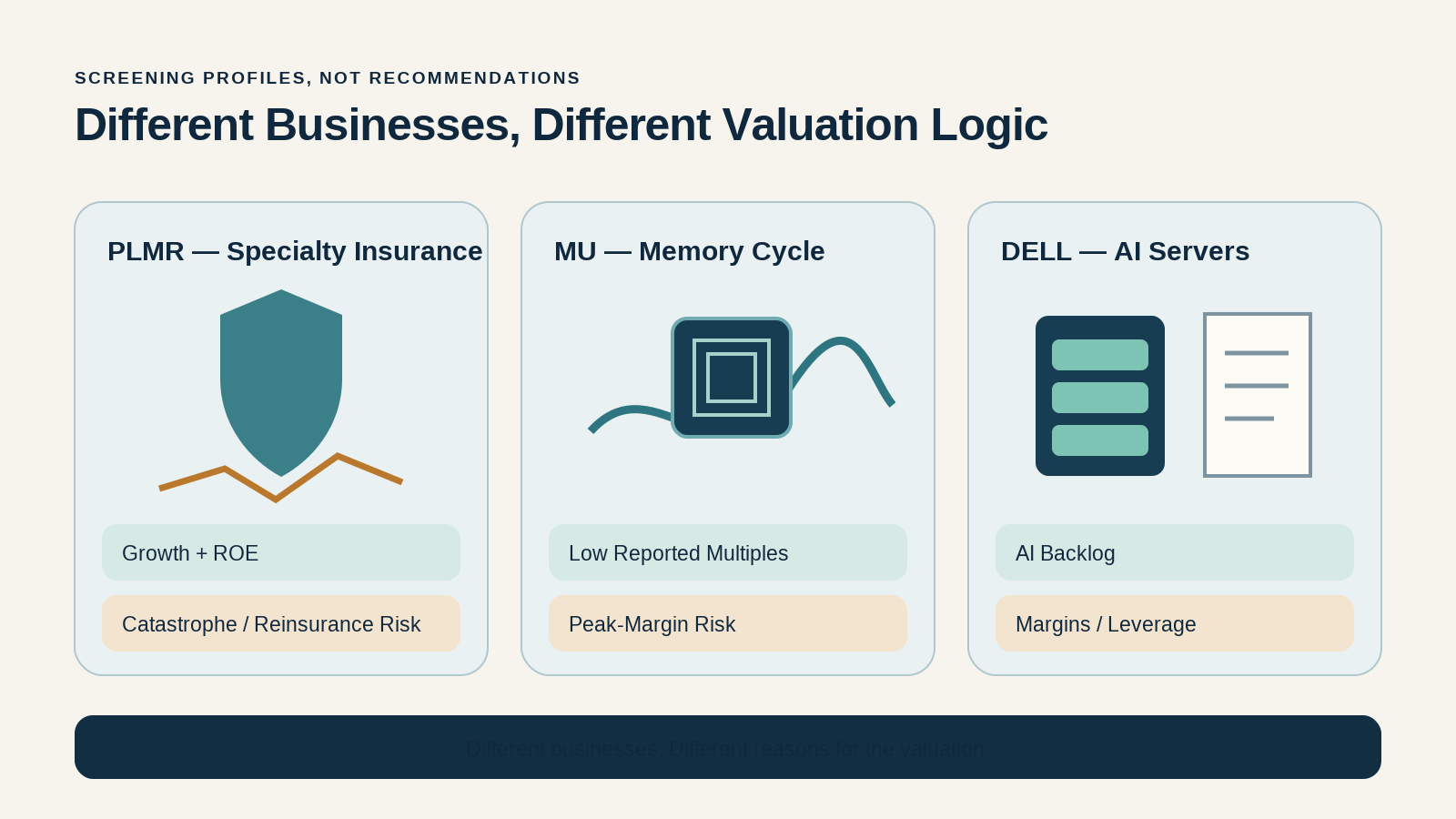
The strongest part of a market call is not a ranking. It is identifying which variable actually carries the thesis. Palomar, Micron and Dell belong to different industries and deserve different valuation tests.
PLMR — specialty insurance
Palomar combines premium growth with high reported returns on equity. Its third-quarter release showed gross written premiums up 28.4%, adjusted net income up 47.4% and annualized adjusted ROE of 33.1%. These are company-reported measures, and adjusted figures require the reconciliation in the release.
The attraction is not AI beta. It is underwriting growth across specialty lines. The risk is equally specific: catastrophe exposure, the reliability of loss models and the cost and availability of reinsurance. Palomar's own SEC filing describes reinsurance as central to its risk-transfer strategy. A low-catastrophe period should not be mistaken for the permanent economics of the business.
MU — the memory cycle
Micron's reported earnings have accelerated dramatically with AI-driven demand for memory and storage. Its fiscal 2026 release shows unusually high revenue growth and margins, while its annual filing says demand has grown faster than industry supply.
That creates an apparent valuation paradox: reported multiples can look low precisely when cyclical earnings are strongest. The key question is not whether the latest profits are real. It is how much of the margin structure survives when supply responds, customer commitments change or the memory cycle turns. “Cheap” and “at peak earnings” can be true at the same time.
DELL — AI servers
Dell enters Tuesday's results with a large AI-server opportunity. Its investor site schedules fiscal third-quarter results for November 24. In the prior quarter, Dell reported rapid growth in AI-optimized server revenue. Its 10-Q also warned that a mix shift toward AI servers could pressure margin rates and that component inflation could persist.
Backlog establishes demand, not automatically attractive economics. Investors still need evidence on conversion, gross margin, cash generation and leverage. The immediate earnings event makes Dell a test of operating delivery, not merely an extension of Nvidia's rally.
What to monitor next
- Market breadth after the opening gap. Does demand persist outside Nvidia and the largest technology stocks?
- Nvidia's independent review. The board's leadership decision and the investigation's conclusion are separate events.
- Dell's November 24 results. Backlog, margins, cash conversion and management's component-cost commentary matter more than a one-day sympathy move.
- Wednesday's PCE and GDP releases. The inflation result will test whether equity relief can coexist with expectations for tighter policy.
- The December 8–9 Fed meeting. The central bank's statement and press conference, not a probability gauge, will establish the next policy decision.
Editorial judgment: Monday's rally was important because it revealed how tightly the U.S. market is connected to Nvidia and AI infrastructure. It was incomplete because a leadership catalyst does not answer the macro question, conclude an investigation or guarantee returns on AI investment. The next evidence comes from persistence, disclosures, earnings and inflation.
Disclosure and limits: This article is general market commentary based on dated public sources. Market prices and yields are time-sensitive. It contains no price target, personalized advice, or buy or sell recommendation.
Sources and references
- Nvidia — Board reinstates Jensen Huang
- Reuters — Wall Street rebounds as Huang returns
- U.S. Treasury — Daily Treasury par yield curve rates
- BEA — Release schedule
- Federal Reserve — December 2026 calendar
- Palomar Holdings — Q3 2026 results
- Micron — Fiscal Q4 and full-year 2026 results
- Dell — Investor relations and upcoming results