
Market Calls / South Korea
Korea’s KOSPI Rallies 4.34% as Seoul Weighs a Larger Backstop
Foreign buyers returned, the KOSDAQ gained 8.13%, and chip exports set a record. A bigger stabilization fund remained under discussion as Korea’s central bank raised rates.

Market date
Foreign investors returned to Seoul on Friday. They bought about ₩1.13 trillion of KOSPI shares, according to Yonhap, as traders weighed a bigger government backstop for the stock market. The KOSPI gained 4.34% to 4,915.68. The smaller-company KOSDAQ jumped 8.13% to 708.99, with a temporary halt in program buying during the session.
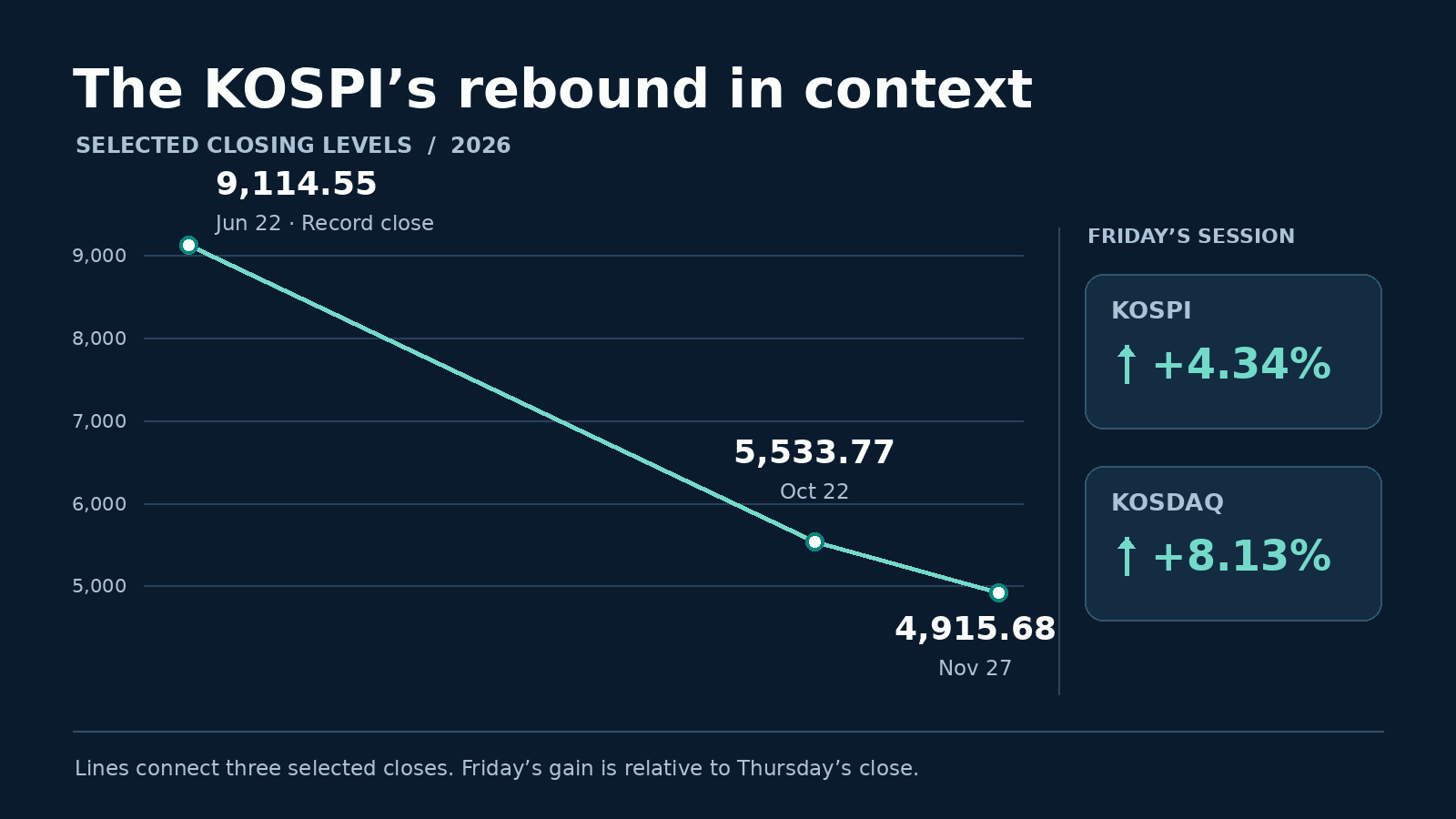
The gains were large even by November’s standards. They came two days after the KOSPI fell 6.16%, and one day after the Bank of Korea raised rates. At Friday’s close, the KOSPI was still 46.1% below its June 22 record close and 11.2% below its October 22 close. Those comparisons put the bounce in perspective without assigning the whole selloff to one cause.
Friday’s market dashboard
| Measure | Nov. 27 reading | Session change |
|---|---|---|
| KOSPI | 4,915.68 | +4.34% |
| KOSDAQ | 708.99 | +8.13% |
| USD/KRW, 3:30 p.m. Seoul | 1,337.9 | Won stronger by 4.8 per dollar |
| Korean 3-year Treasury yield | 3.685% | +6.3 bp |
| Korean 10-year Treasury yield | 3.832% | +4.2 bp |
| Bank of Korea base rate | 3.25% | +25 bp on Nov. 26 |
Yonhap reported institutional net buying of roughly ₩239 billion and individual net selling of ₩1.78 trillion in the main market. Korean outlets reported different investor-flow totals. The figures here use Yonhap’s KOSPI session breakdown, and the earlier foreign selling is best compared on the same venue and time basis.
Chipmakers, brokerages and smaller growth stocks recovered. Samsung Electronics rose 4.55% to ₩179,100 and SK hynix rose 5.41% to ₩1.11 million. KOSDAQ gains included Alteogen (+9.40%), while robotics and battery shares also rallied. In the U.S., Thanksgiving had left Seoul without a fresh Wall Street cash close to trade against.
What the stabilization fund can buy
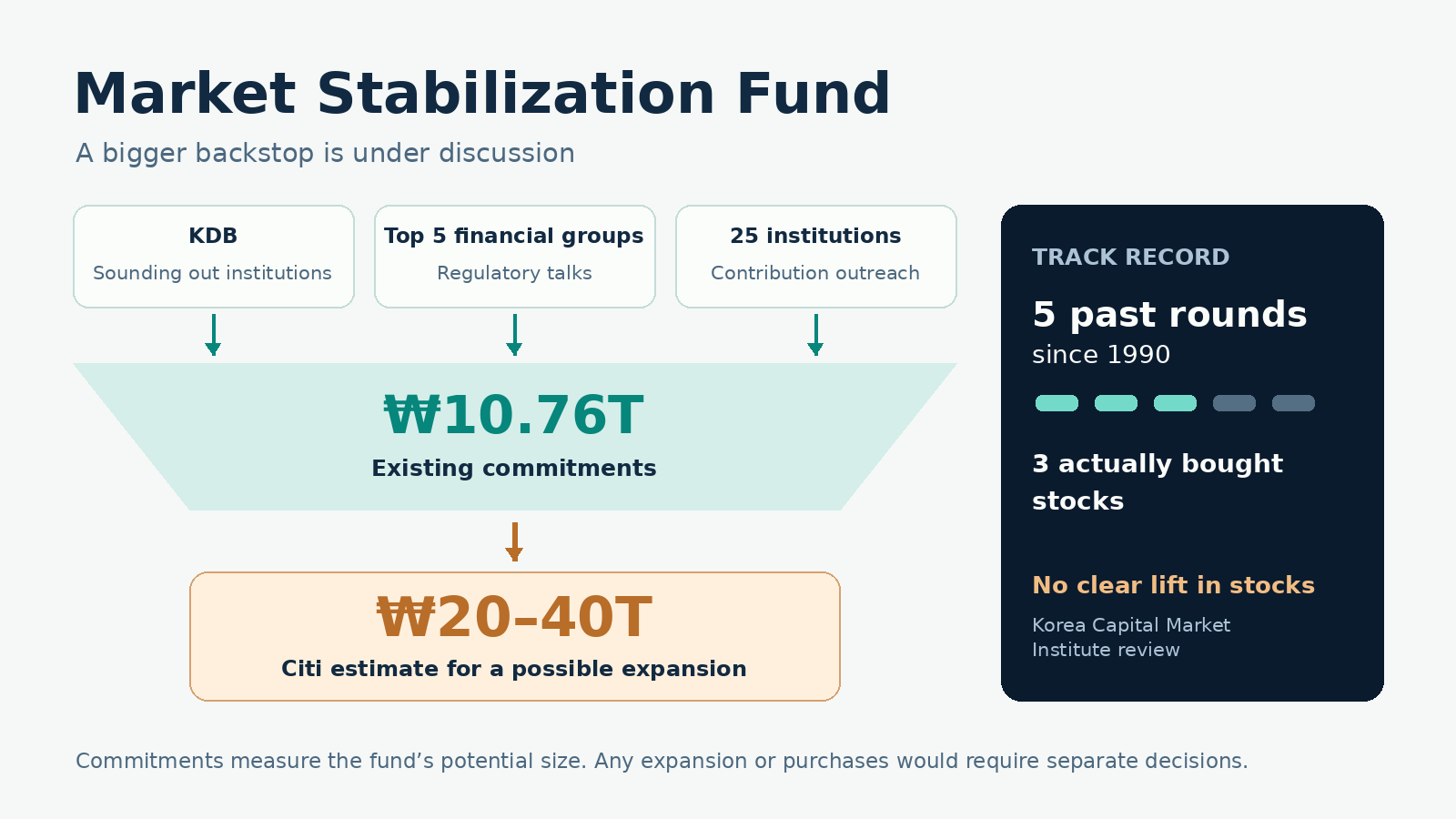
The main domestic catalyst was the prospect of enlarging and activating the stock-market stabilization fund. The existing ₩10.76 trillion is a commitment figure. Citi estimated that commitments could reach ₩20–40 trillion if the fund expands. Korea Development Bank was reportedly sounding out 25 financial institutions, and reports pointed to November 30 talks with the five largest financial groups. The Financial Services Commission separately relaxed listed companies’ daily buyback limit for three months beginning November 24.
Korea Capital Market Institute counted five attempts to form or reactivate a fund since 1990. Purchases took place in three of them. The institute found no clear empirical evidence that the announcements or interventions lifted share prices. It also noted that foreigners had sold roughly ₩10.4 trillion of KOSPI shares from November 2 to 6, nearly equal to the fund’s existing commitments. That gives a sense of the scale of selling the backstop might face.
My read is that a fund could help when investors need a buyer in a disorderly market. Friday showed demand at lower prices. Sustained foreign buying through a few normal sessions would give more weight to the case for a recovery.
The central bank is tightening into an export boom
The Bank of Korea raised its base rate from 3.00% to 3.25% on November 26. Two board members voted to hold. The bank raised its growth forecast to 3.9% for 2026 and 4.1% for 2027, with projected inflation of 2.7% and 2.4%, respectively. The three-year government yield rose more than the ten-year on Friday, leaving the spread at about 15 basis points. That leaves a narrow gap between short and long borrowing costs, even as the bank’s growth outlook has strengthened.
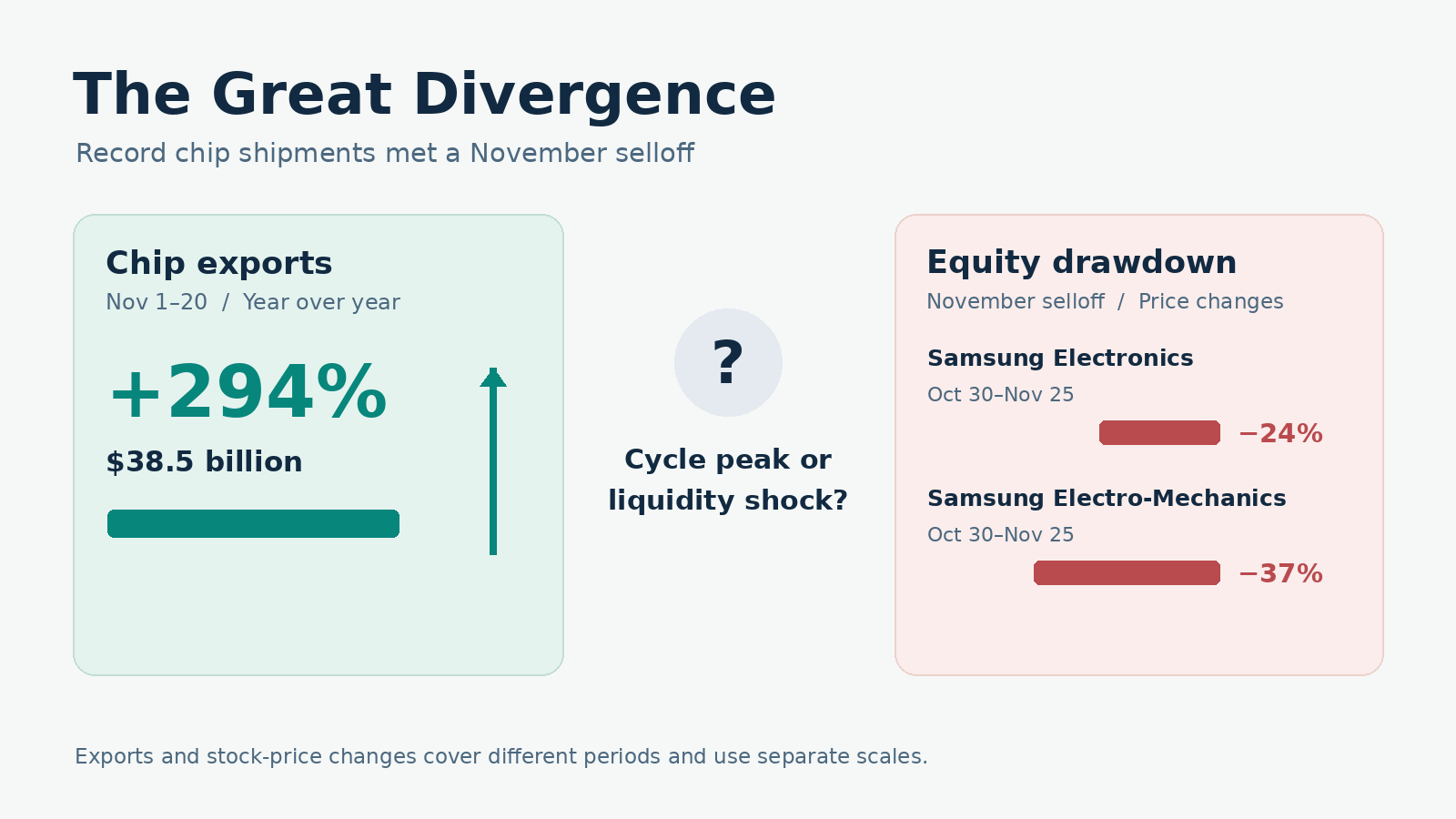
The trade data help explain that outlook. In the first 20 days of November, Korea Customs recorded $77.4 billion of exports, up 101.5% year over year. Average daily exports rose 95.2% after accounting for the extra half working day. Semiconductor shipments nearly quadrupled to $38.5 billion (+294.4%), about half the total. Passenger-car exports slipped 5.6%. Imports reached $50.3 billion, leaving a $27.1 billion surplus on preliminary figures.
In the U.S., October headline PCE inflation was 3.8%, with core at 3.3%. Seoul also faces potential new U.S. duties. USTR released proposed actions after determinations in 14 Section 301 investigations, including proposed rates up to 15% for South Korea. The final scope and rates remained open. A weaker outlook for U.S. demand or further tightening could offset some of the support from strong chip shipments.
Exports tell us what shipped. Stocks price the next cycle.
Between October 30 and November 25, Samsung Electronics dropped from ₩225,000 to ₩170,700, about 24%. Samsung Electro-Mechanics fell from ₩1,196,000 to ₩755,000, about 37%, over the same dates. Those are closing-price comparisons through Wednesday, before Friday’s rebound.
The export spike and the share declines answer different questions. Shipments record orders that went out the door. Share prices depend on how long scarcity and pricing power last, what customers spend on new capacity, and how much investors are willing to pay for that earnings stream today. Two plausible explanations are that investors are discounting a weaker memory cycle in 2027 or that forced selling and risk reduction have temporarily pushed prices below what the earnings outlook would justify. Both can be true. I’d watch pricing and 2027 capex plans to see which is doing more work.
Five names with different earnings tests
The screen uses financial snapshots from September to November and prices from October 16 to November 6. These multiples describe the earlier research snapshots. Updating them requires November prices on the same share basis and the latest filings.
| Company | Case in the screen | Question for the next filing |
|---|---|---|
| Wonik IPS | ALD and CVD equipment, net cash and about 22× reference forward earnings | Can new memory orders lift an operating margin around 8% and convert into free cash flow? |
| EO Technics | Lasers and advanced packaging, with a reference operating margin around 25% | Can demand sustain the growth embedded in a roughly 36× reference forward multiple? |
| HANMI Semiconductor | HBM bonding equipment, strong margins and about 39× reference forward earnings | Do HBM4 orders and a broader customer base counter falling reference revenue and rising competition? |
| Samsung E&A | Industrial engineering and construction, with net cash and about 11× reference forward earnings | Can new contracts turn operating earnings into cash after working-capital needs? |
| Mirae Asset Securities | Brokerage exposure at about 5× reference earnings | How much profit holds up when trading volumes normalize? |
A better balance sheet buys time for an equipment maker. The question is whether demand lasts long enough for that advantage to translate into earnings. For Samsung E&A the issue is cash conversion through the contracting cycle. For Mirae it is the durability of turnover and fee income. The same selloff has left each company with a different hurdle.
What to watch next
- November 30: Reported date for regulators’ discussions with major financial groups on the backstop.
- December 1: Full November export figures, a check on whether the surge held through month-end.
- Early December: November Korean CPI after the Bank of Korea’s rate increase.
- December 8–9: Federal Reserve meeting.
- December 17: Micron earnings, with memory pricing, inventories and capex the key read-throughs for Seoul.
Several days of foreign buying would be a better test of the equity rebound than Friday’s headline gain. For the chip names, the harder test comes when suppliers and customers lay out their 2027 spending plans.
Editorial note: This publication is for informational and educational purposes. It does not provide personalized investment advice, recommendations or solicitations. Market conditions and available information can change.
Sources and references
- Yonhap · November 27 main market close and investor flow
- Yonhap Infomax · KOSDAQ close and equity movers
- Yonhap · June 22 KOSPI record close
- Yonhap · October 22 KOSPI close
- Yonhap · Korean Treasury yields on November 27
- Korea Capital Market Institute · Fund commitments and historical interventions
- Chosun · Citi’s range for an expanded fund
- NewsRoad · KDB outreach to financial institutions
- Edaily · Reported November 30 regulator meeting
- Financial Services Commission · Temporary change to daily buyback limits
- Bank of Korea · November 26 rate decision and votes
- Bank of Korea · November economic outlook
- Korea Customs Service · November 1–20 provisional trade data
- BEA · October U.S. headline and core PCE
- USTR · Section 301 determinations and proposed measures
- Investing.com · Samsung Electronics historical prices
- Investing.com · Samsung Electro-Mechanics historical prices
- DART · Korean corporate filings
- Federal Reserve · FOMC calendar
- Micron · December 17 earnings schedule