
Market Calls / China
Beijing’s Market-Support Signal Sends Hang Seng Tech Up 6.45%
Shenzhen jumped 7.24% and Hong Kong tech rose 6.45% after Beijing’s signal. A margin rule change and Meituan’s mixed results give investors two tests on Monday.

Market date
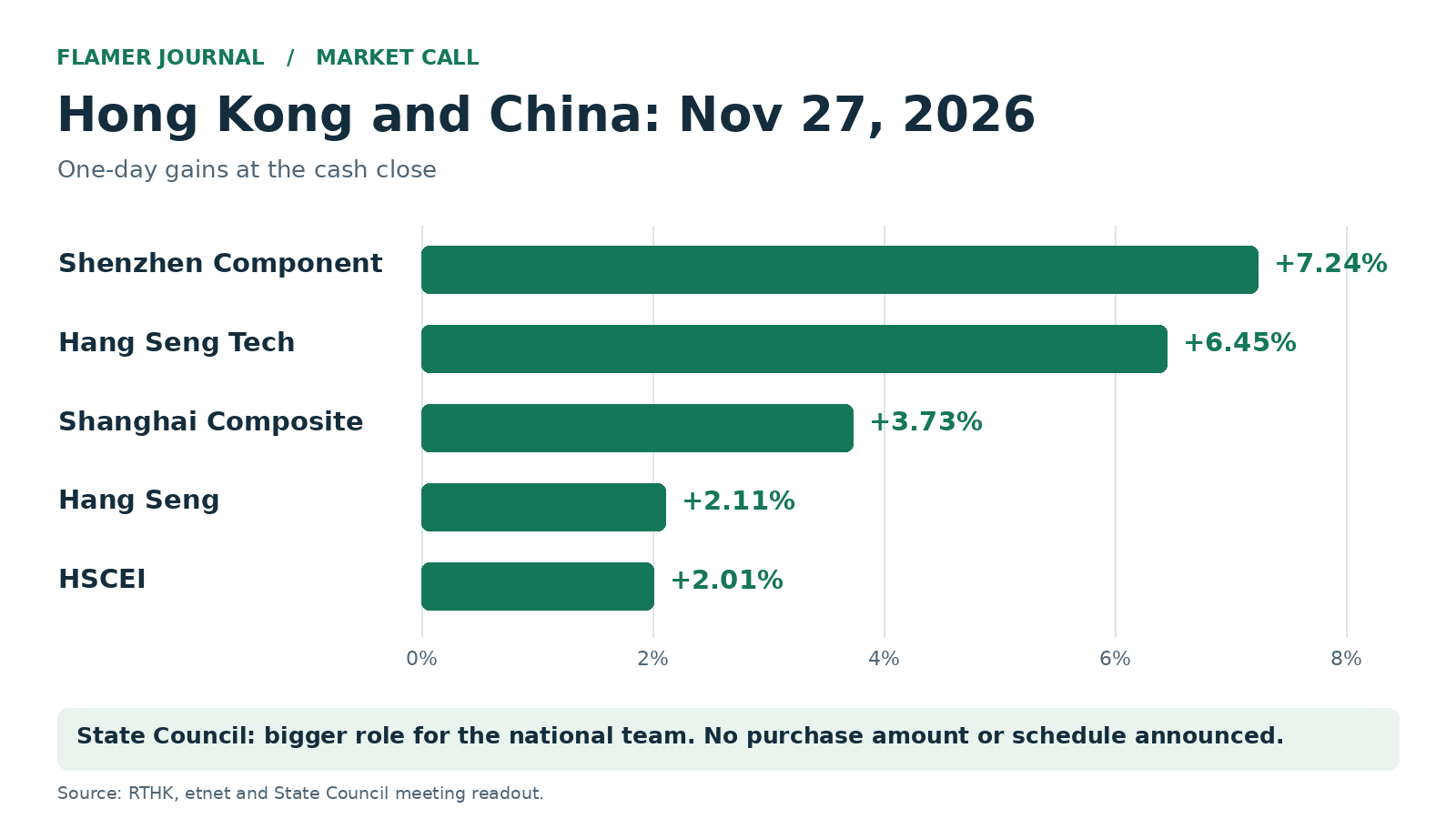
The biggest moves on Friday were in the parts of the market that had been under the most pressure. The Shenzhen Component rose 7.24%, the Hang Seng Tech gained 6.45%, and Hong Kong chip stocks jumped by double digits. Shanghai’s 3.73% gain was its strongest session in more than two years, according to RTHK.
Beijing gave investors a reason to reconsider how much downside policymakers would tolerate. The State Council called for a bigger role for state-backed investors in stabilizing the market. Its readout left the size and timing of any purchases open. Monday offers two observable tests: a lower minimum margin requirement takes effect on the mainland, and Hong Kong gets its first cash session after Meituan’s results.
| Index | November 27 close | Daily move |
|---|---|---|
| Shenzhen Component | 10,814.02 | +7.24% |
| Hang Seng Tech | 3,637.88 | +6.45% |
| Shanghai Composite | 3,606.49 | +3.73% |
| Hang Seng | 22,694.77 | +2.11% |
| Hang Seng China Enterprises | 7,644.18 | +2.01% |
Hong Kong turnover reached HK$257.14 billion. Combined Shanghai and Shenzhen turnover was about CNY 2.0 trillion. In the mainland growth benchmarks, the ChiNext Index rose 11.61% and STAR 50 gained 15.07%. Confirming the index name matters on a day when several technology-heavy benchmarks recorded very different gains.
What the policy signal changes
The council called for strengthening the role of the state-backed “national team” and refining Central Huijin’s market stabilization function. It also encouraged dividends and repurchases, continued work to bring long-term capital from insurers, enterprise annuities and the social security fund into equities, and called for stronger enforcement against financial misconduct.
A separate exchange rule has a start date. The Shanghai, Shenzhen and Beijing exchanges lowered the minimum margin ratio for financed securities purchases from 100% to 80%, effective November 30. It gives eligible investors more room to borrow against their capital. Broker controls and investors’ willingness to take on leverage still determine how much of that capacity gets used.
Friday’s turnover shows that trading accelerated. Trade value includes buyers and sellers, so it gives no reliable estimate of how much Central Huijin or other state-backed accounts bought. Short covering is also a plausible contribution to such large moves in previously weak shares. The flow and positioning data available here cannot establish its share of the rally.
Industrial profits point to an uneven recovery. The National Bureau of Statistics reported CNY 6.74 trillion of January–October profit at industrial enterprises above the designated size threshold, up 16.0% on a comparable basis. Electronics industry profit doubled and supplied 9.7 percentage points of overall growth. Auto manufacturing profits fell 26.0%. The aggregate is strong, but its composition matters when applying it to an individual company.
Where the money went
A Southbound market report put net buying at about HK$4.59 billion. It identified Alibaba (+HK$1.27 billion), China Shenhua (+HK$1.11 billion) and SMIC (+HK$511 million) among the largest net buys. These are reported Hong Kong dollar figures. The session total comes from a market data report and should be read on that basis.
Hong Kong chip and AI shares led. Hua Hong rose 20.69%, Z.AI 18.57%, MiniMax 17.19%, SMIC 16.39% and Zhongji Innolight 16.02% in the closing snapshot. Alibaba gained 7.03% and Tencent 3.23%. The difference is consistent with a day when buyers reached for higher exposure to semiconductor and AI sentiment. It takes more than one session to tell whether they have increased their long-term allocations.
China Shenhua was a notable exception, down 5.28% to HK$39.10. The company disclosed a best-efforts placing agreement for up to 177 million new H shares at HK$38.10, implying gross proceeds of up to about HK$6.74 billion. The Stock Connect figure covers secondary-market activity. It gives no evidence about who subscribed to the new shares.
The currency and tariff backdrop
The yuan strengthened, with USD/CNY around 6.65. A firmer currency can help the foreign-currency return on local assets over time. Friday’s move alone gives little indication of how the renminbi will respond to the next trade announcement.
The top U.S. tariff figure in the draft referred to a proposal. On November 25, the U.S. Trade Representative announced findings covering 14 economies, including China, and proposed product-specific tariff treatment. For China it describes up to 20% on certain goods, with other rates, offsets and exemptions depending on the product. Written comments are due January 5, 2027, and hearings are scheduled to begin January 25.
China’s finance ministry separately announced a two-month continuation of its suspension of the 24% additional tariff rate on U.S. imports starting November 10, while retaining a 10% additional rate. January 10 is therefore a reference for that particular suspension. Other parts of the bilateral relationship have their own terms.
In the United States, October core PCE inflation was 3.3% year over year and third-quarter real GDP growth was revised to 4.3% annualized. That leaves U.S. rates relevant to Hong Kong valuations even after a rally driven by Chinese policy news.
Meituan’s local business came back into profit
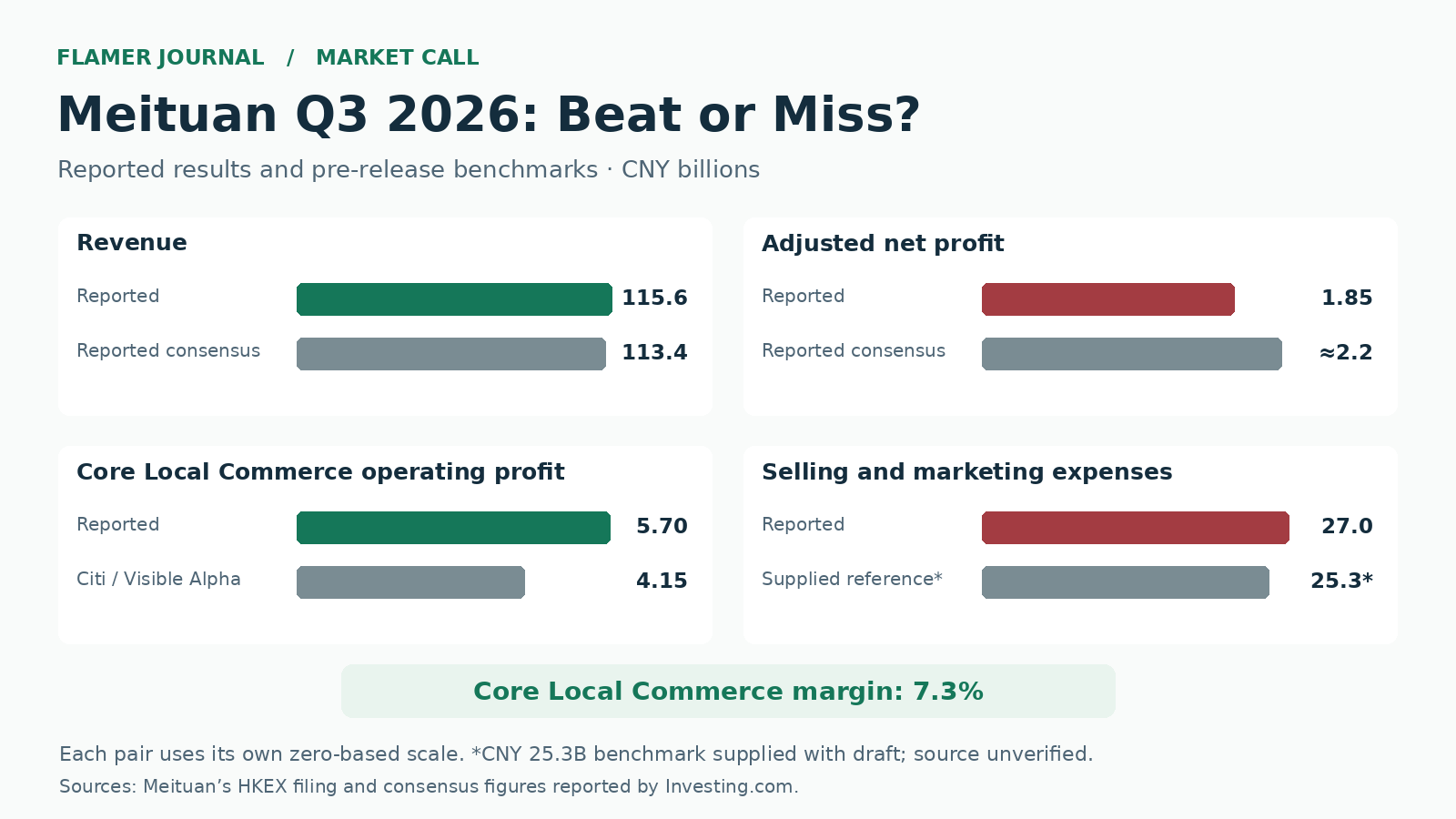
Meituan gained 8.21% to HK$67.85 in the cash session, before releasing the numbers. The quarterly filing showed CNY 115.56 billion in revenue, up 21.6%, and CNY 2.07 billion of reported net profit, compared with a loss of CNY 18.63 billion a year earlier. Adjusted net profit came in at CNY 1.85 billion against reported consensus of about CNY 2.2 billion.
The strongest result was Core Local Commerce. Revenue reached CNY 78.28 billion, and operating profit of CNY 5.70 billion exceeded the CNY 4.15 billion benchmark reported for Citi and Visible Alpha. The 7.3% margin marks a meaningful recovery from the prior-year operating loss. New Initiatives registered an operating loss of CNY 1.31 billion.
| Metric | Reported, CNY bn | Pre-release reference, CNY bn |
|---|---|---|
| Revenue | 115.56 | 113.37 |
| Adjusted net profit | 1.85 | ≈2.20 |
| Core Local Commerce operating profit | 5.70 | 4.15 |
| Selling and marketing expenses | 27.02 | 25.3* |
The CNY 25.3 billion expense benchmark came with the supplied market notes and could not be independently verified. The reported expense is from the filing. Three other benchmarks are from published reporting.
Selling and marketing expenses fell from CNY 33.84 billion a year earlier. That comparison is firmer than the expense estimate. Management described an improvement in average basket size and more disciplined subsidies after summer promotions. Citi suggested higher losses in unallocated items may have contributed to the adjusted earnings miss. Segment profitability and group cash generation still need to be tracked together.
The question for Monday is how investors value the local commerce recovery against the adjusted miss. For the next few quarters, the useful test is whether the company can preserve those margins if competitors resume spending aggressively.
The rebound leaves distinct valuation cases
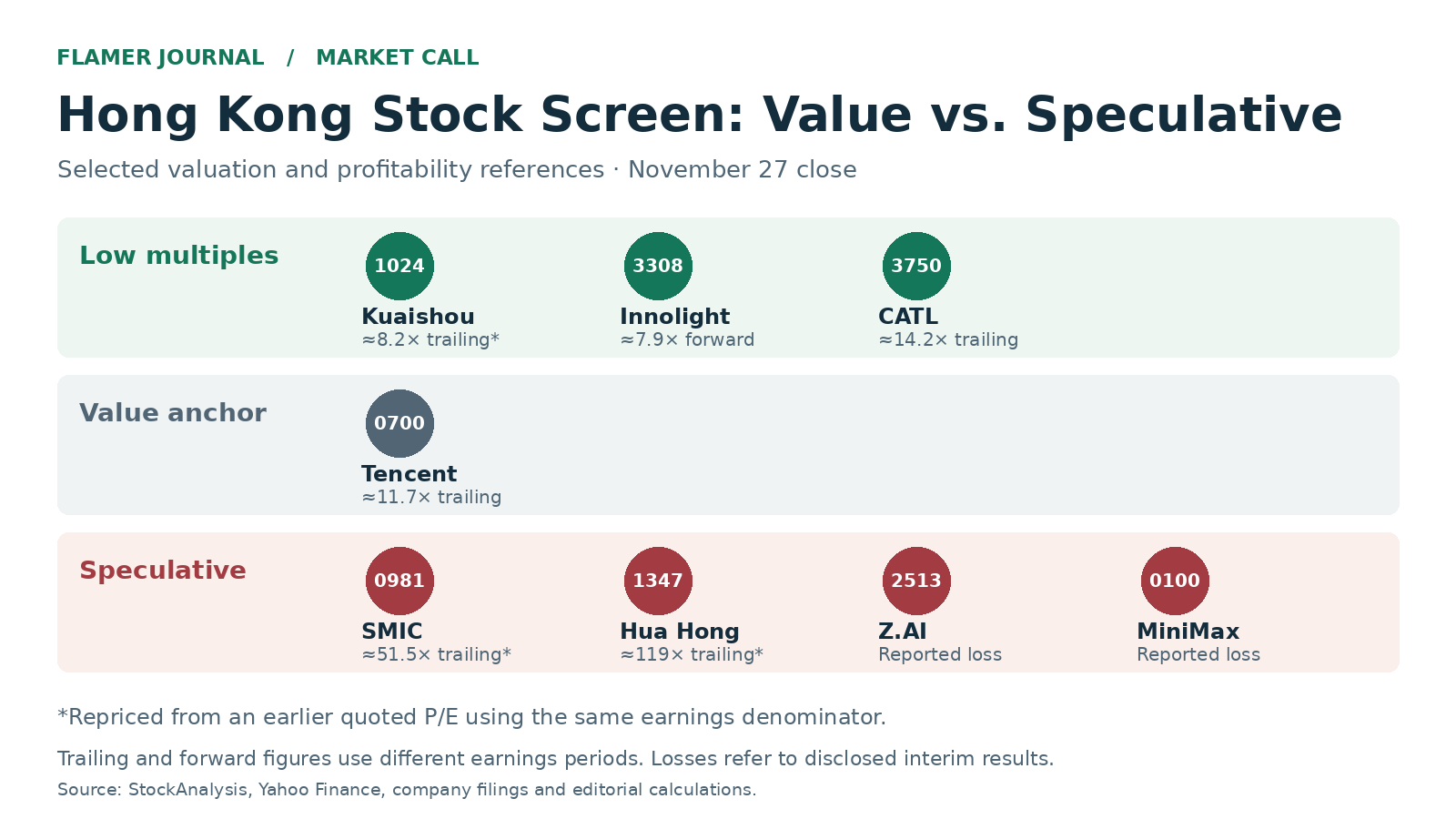
A low multiple only helps when the earnings behind it hold up. This screen keeps the price basis visible. Trailing multiples refer to reported historical earnings. Forward multiples depend on forecasts. Where a data provider’s trailing quote used an earlier price, the estimate below scales that multiple to the November 27 close with the same earnings denominator.
| Company | November 27 close | Valuation reference | What to check |
|---|---|---|---|
| Kuaishou (1024) | HK$20.96 | ≈8.2× trailing, repriced | The September quarter recorded a CNY 959 million reported loss and CNY 790 million adjusted net profit. Check whether advertising recovers and Kling’s revenue covers the additional compute and development costs. |
| Zhongji Innolight (3308) | HK$597.50 | ≈7.9× forward, vendor estimate | The optical transceiver thesis depends on AI infrastructure orders, customer concentration and execution at higher speeds. The forecast measure deserves a fresh check against the filings and share count. |
| CATL (3750) | HK$314.20 | ≈14.2× trailing, quoted | The battery and storage case turns on unit economics, competitive pricing and overseas expansion. The supplied ≈10.1× forward estimate could not be independently reproduced. |
| Tencent (0700) | HK$352.00 | ≈11.7× trailing, quoted | September-quarter revenue rose 8%, while non-IFRS operating profit fell 6%. The investment case depends on how much cash games, advertising and payments generate after AI investment. |
| SMIC (0981) | HK$53.40 | ≈51.5× trailing, repriced | Domestic substitution can support demand. The multiple already requires a view on utilization, depreciation and returns on new capacity. |
| Hua Hong (1347) | HK$78.15 | ≈119× trailing, repriced | The earlier ≈99× reference used a lower share price. A stronger operating result and better use of capacity would matter more than one day’s gain. |
| Z.AI (2513) and MiniMax (0100) | HK$347.40 and HK$110.10 | Reported interim losses | Revenue growth needs to be assessed alongside inference costs, operating losses and funding requirements. |
Meituan belongs in a separate turnaround bucket. The earnings question is how much of its local commerce margin survives when promotions and competitive pressure normalize. For Kuaishou, the latest reported quarterly loss complicates the apparent trailing discount. The measure worth following is the durable earnings base each business can generate.
What to watch next
- November 30. Watch cash turnover and financed purchases on the mainland as the margin rule takes effect. Hong Kong’s reaction to Meituan will be the first session to incorporate the published results.
- December. Watch the Fed decision and releases from China’s economic policy meetings as dates and details are confirmed.
- January. Follow the USTR comment deadline and hearings, and look for an official update on China’s temporary tariff suspension.
The two quickest checks on Friday’s rally are whether buying stays broad after the new rule starts, and whether company earnings estimates improve alongside share prices. Meituan’s results already show why the second check matters.
Editorial note. This publication provides market commentary for information and education. Readers should assess valuation assumptions against company filings and their own circumstances.
Sources and references
- Hong Kong and mainland daily market close, RTHK
- Hong Kong and mainland market levels, etnet
- State Council meeting readout, China Securities Regulatory Commission
- Exchange margin financing rule change, Shanghai Stock Exchange
- January–October industrial profit data, National Bureau of Statistics
- Industrial profit components, National Bureau of Statistics
- Southbound flow and leading net purchases, HSTong
- Reported November 27 Southbound total, market data table
- China Shenhua proposed H-share placing, HKEX filing
- Section 301 determinations, proposals and dates, USTR
- China’s temporary suspension of additional U.S. import tariffs, Ministry of Finance
- October PCE, U.S. Bureau of Economic Analysis
- Third-quarter U.S. GDP second estimate, U.S. Bureau of Economic Analysis
- Meituan Q3 2026 filing, HKEX
- Meituan pre-release benchmarks as reported by Investing.com
- Kuaishou Q3 2026 filing, HKEX
- Kuaishou valuation inputs, StockAnalysis
- Zhongji Innolight price and valuation, StockAnalysis
- CATL Hong Kong price and trailing P/E, Yahoo Finance
- Tencent Q3 2026 company release
- Tencent valuation reference, StockAnalysis
- SMIC valuation inputs, StockAnalysis
- Hua Hong valuation inputs, StockAnalysis
- Z.AI interim results, HKEX
- MiniMax interim report, filing reproduction