
Market Calls / Crypto
Bitcoin Stalls Near $60,000 as ETF Outflows Deepen
Bitcoin lagged the rally in Nasdaq futures. U.S. spot ETF outflows reached $5.39 billion through November 25, even as a large-address cohort grew and Strategy disclosed another purchase.

Market date
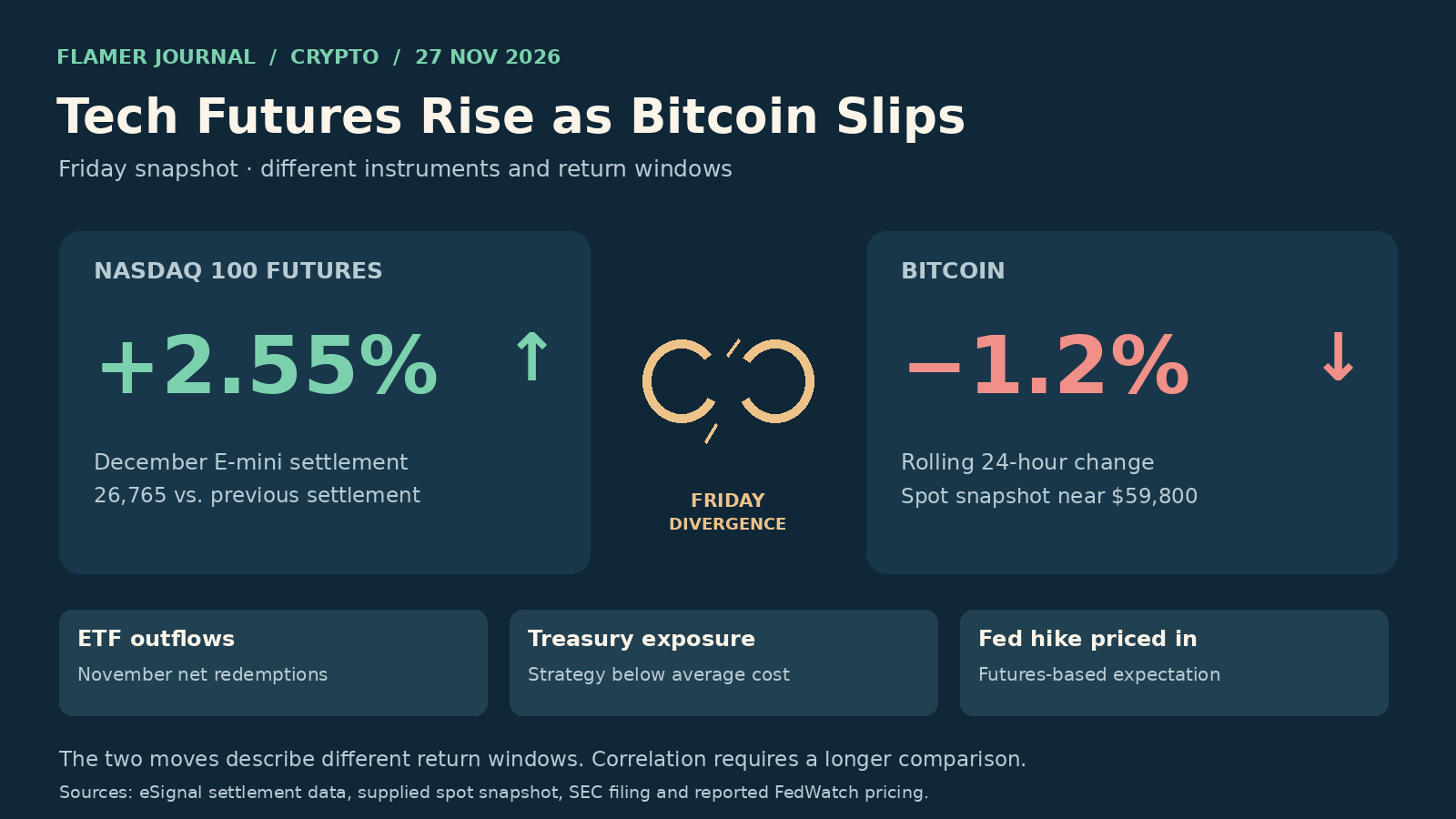
Bitcoin was near $59,800 on Friday, about 1.2% lower over 24 hours in the market snapshot for this edition. U.S. technology futures rose during the holiday-shortened session. Bitcoin’s response to that move was muted, with the price finishing the snapshot close to the $60,000 area after trading on both sides of it.
U.S. spot Bitcoin ETFs had recorded about $5.39 billion in November outflows through November 25, based on the daily Farside series. At the same time, a CryptoQuant study found a larger balance in a group of large Bitcoin addresses, and Strategy disclosed another purchase. Each measure tells us something about demand. Together they leave a crucial question open: whether buying is strong enough to absorb persistent selling at higher prices.
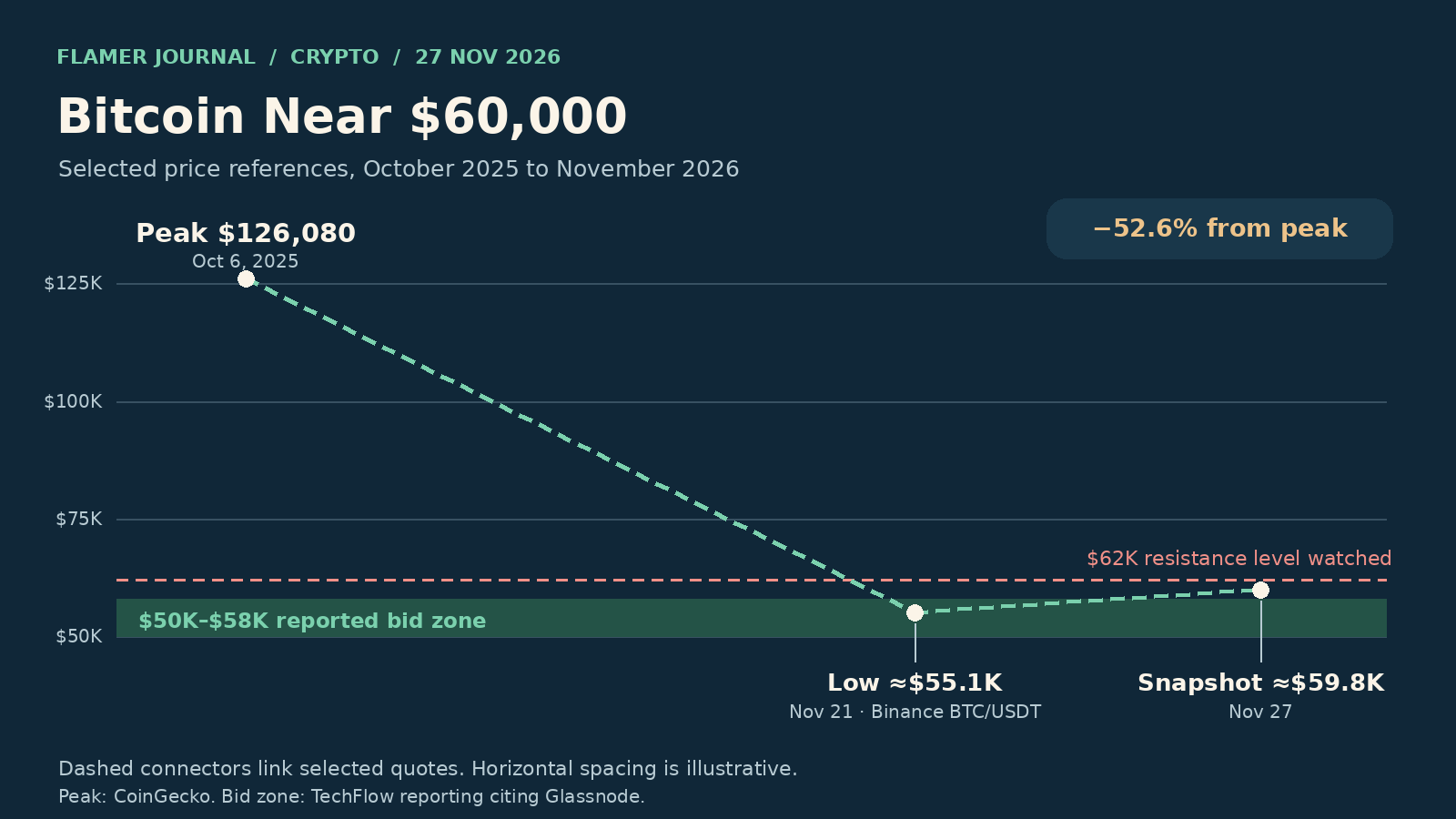
Bitcoin is above the weekend low and below $62,000
The draft’s price snapshot put Bitcoin at $59,781, with a rolling range of roughly $58,750–$62,130. Other November 27 feeds showed slightly different values. The Binance BTC/USDT pair touched $55,130 on November 21, while Reuters reported a low of $55,251.60 from its reference. Against CoinGecko’s $126,080 record on October 6, 2025, the snapshot is 52.6% lower.
TechFlow, citing Glassnode, reported a concentration of buy orders between $50,000 and $58,000 after the recent dip. That is an indication of where buyers had shown interest. Orders can move or be canceled. The $62,000 level is useful because the latest range briefly reached it and the price returned below it. A weekly close above that area would give more evidence of follow-through than another brief test.
| Asset | Supplied November 27 snapshot | 24-hour move | 30-day move |
|---|---|---|---|
| Bitcoin | $59,781 | −1.2% | −26.0% |
| Ether | $1,666.44 | −1.3% | −29.0% |
| Solana | $71.97 | +1.4% | −28.9% |
| XRP | $0.9492 | +0.7% | −28.6% |
| Chainlink | $9.375 | +1.2% | −18.9% |
| Zcash | $738.82 | +8.4% | −43.5% |
| Monero | $405.43 | −11.3% | −33.2% |
| Hyperliquid | $64.16 | +3.0% | −21.1% |
The supplied TradingView broad market indices imply roughly $2.04 trillion in aggregate capitalization and 58.9% Bitcoin dominance by subtraction of the total excluding Bitcoin. Those measures depend on index coverage and observation time. The supplied spot prices imply ETH/BTC of 0.0279. Zcash and Monero moved sharply in opposite directions, which limits what Friday’s prices can tell us about demand across privacy assets as a group.
Equities rose while Bitcoin lagged
The December E-mini Nasdaq 100 contract settled at 26,765, up 664.75 points, or 2.55%, from its prior settlement. Bitcoin’s −1.2% figure is measured over a rolling 24-hour window. The contrast is visible, while establishing a change in correlation would require aligned returns over a longer period.
The Fed last held its range at 3.75%–4.00% on October 28. The official decision was 10–2, with Lisa Cook and Beth Hammack preferring a quarter-point increase. October PCE data had already been released on November 25: headline inflation was 3.8% year over year and core inflation 3.3%. The BEA’s second estimate put real third-quarter GDP growth at 4.3% annualized.
Friday reporting put CME FedWatch pricing near 99% for a quarter-point December increase at its observation time. The FOMC meets December 8–9. With a quarter-point move heavily reflected in prices, the policy statement and the expected path after December deserve attention alongside the rate decision.
Trade policy adds another source of uncertainty. USTR’s November 25 announcement made Section 301 determinations involving 14 economies, following investigations into 16. The accompanying tariff actions were proposed. The rates and exemptions vary by product and jurisdiction.
ETF selling and accumulation can coexist
Bloomberg’s $4.94 billion estimate covered November through the 24th. Adding up Farside’s full November daily series gives $4.938 billion through the 24th and $5.391 billion through the 25th, when the funds lost another $453 million. IBIT accounted for $329.7 million of that day’s outflow. Thanksgiving had no U.S. ETF session. The November 27 row showed $41 million in reported outflows when reviewed, with several issuers still blank. The November 25 total is the last complete series used here.
On-chain, CryptoQuant reported a net increase of 121,117 BTC between September 30 and November 21 across addresses with 1,000–10,000 BTC. An address can change cohorts as its balance crosses a threshold, or its coins can move between addresses under common control. The same study found realized losses among large addresses during the period. An increase in the cohort balance and losses in the group can coexist.
Strategy’s latest filing showed a purchase of 457 BTC for $29.6 million from November 16–22, taking holdings to 851,305 BTC. The reported four-week total was 2,789 BTC. The filing lists an average cost of $75,446 per coin. At the article’s snapshot price, the holdings would be worth about $50.9 billion, versus $64.23 billion in aggregate purchase cost. That difference is an illustrative comparison to original cost. The company’s funding access, debt, preferred dividends and reserves matter to whether a drawdown causes any cash pressure.
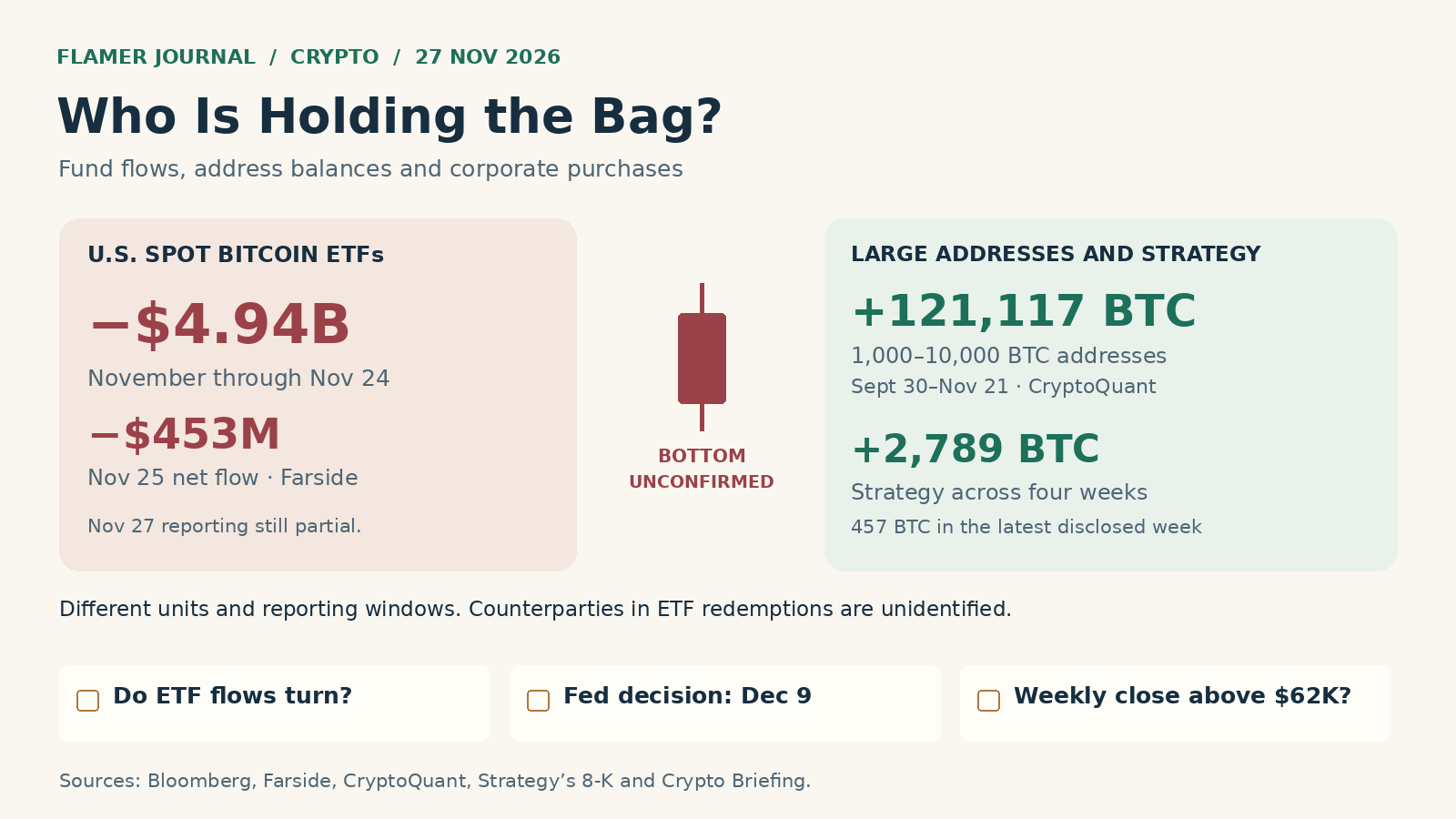
A partial capitulation is one way to read the sharp price moves and reported losses. It would become more convincing as a bottoming process if fund redemptions ease, bids hold under renewed pressure, and the price begins closing above levels it has repeatedly failed to hold.
Unlocks and regulation
DefiLlama’s schedule lists two Falcon Finance unlocks on November 28 and 29, totaling approximately 203 million FF. The December 2 calendar also shows a MemeCore cliff. Its displayed token and dollar estimates vary with the schedule view and price reference, so the date is more useful here than a single dollar total. An unlock changes the amount available to holders. Trading impact depends on how much becomes liquid and whether recipients sell.
The U.S. Senate’s September 15 vote on the CLARITY Act failed to invoke cloture on the motion to proceed. That vote stalled the bill’s advance at that stage. The SEC separately granted temporary, conditional relief covering certain venues for secondary trading of tokenized NMS stocks. The scope of that order matters when evaluating tokenization projects or inferring demand for a particular public token.
What to check in the next few sessions
Ether and the larger alternatives. At around $1,666 and 0.0279 BTC per ETH in the snapshot, Ether remains weak over the month. Stablecoin settlement and tokenization are longer-run theses. The near-term evidence to track is activity, relative price performance and flows.
HYPE, LINK and AAVE. With Hyperliquid, check recent trading volume, fee collection, buybacks and future supply releases together. With Chainlink, participation in tokenization projects and economic value flowing to LINK require separate evidence. With Aave, monitor active lending, collateral quality and the implementation of buyback proposals. This edition does not establish current protocol revenue or buyback execution for the whole group.
NEAR and new supply. House of Stake ratified HSP-029, which sets a gradual 24-month reduction in maximum annual issuance from 2.5% toward 1.6%. A slower increase in supply is measurable. Its effect on token returns depends on demand, validator economics and implementation.
The calendar starts with the November 28–29 unlocks, November 30 monthly close and December 2 MemeCore cliff. The Fed decision follows on December 9. Among those dates, the cleanest near-term Bitcoin check is whether a stretch of improved ETF flows accompanies a weekly close above $62,000.
Editorial note. This market call provides information and analysis. The price table is a supplied snapshot, and reported fund totals carry their stated cutoffs. Readers should consult original disclosures and assess risks independently.
Sources and references
- Bitcoin all-time high reference, CoinGecko
- Bitcoin Real-Time Index daily range, Investing.com
- November 21 selloff, Reuters
- Reported Bitcoin bid zone citing Glassnode, TechFlow
- November 27 crypto market comparison snapshot
- U.S. spot Bitcoin ETF outflows through November 24, Bloomberg via BusinessMirror
- Daily U.S. spot Bitcoin ETF flows, Farside Investors
- December E-mini Nasdaq 100 settlement, eSignal
- October 28 FOMC decision and vote, Federal Reserve
- FOMC calendar, Federal Reserve
- November 27 reported CME FedWatch pricing, Investing.com
- October personal income and outlays, BEA
- Third-quarter 2026 GDP second estimate, BEA
- NYSE holiday schedule
- Section 301 determinations and proposals, USTR
- Q4 address cohort research, CryptoQuant
- Address cohort figures and reported Binance low, crypto.news
- Strategy’s November 23 Form 8-K, SEC EDGAR
- Strategy’s four-week purchase total, Crypto Briefing via TradingView
- Falcon Finance unlock schedule, DefiLlama
- MemeCore unlock schedule, DefiLlama
- September 15 Congressional Record, U.S. Senate
- Tokenized NMS stock exemption, SEC
- NEAR House of Stake issuance decision, NEAR Protocol