
Market Calls / South Korea
Korea’s 6% Rebound Is Not Yet a Recovery
Foreign buying helped the KOSPI reclaim 5,000. Record exports strengthen the economic story, but the next memory cycle, the Bank of Korea and six distinct company risks still need scrutiny.

Market date
The KOSPI reclaimed 5,000 on Tuesday. What it has not reclaimed is a convincing case for a lasting recovery.
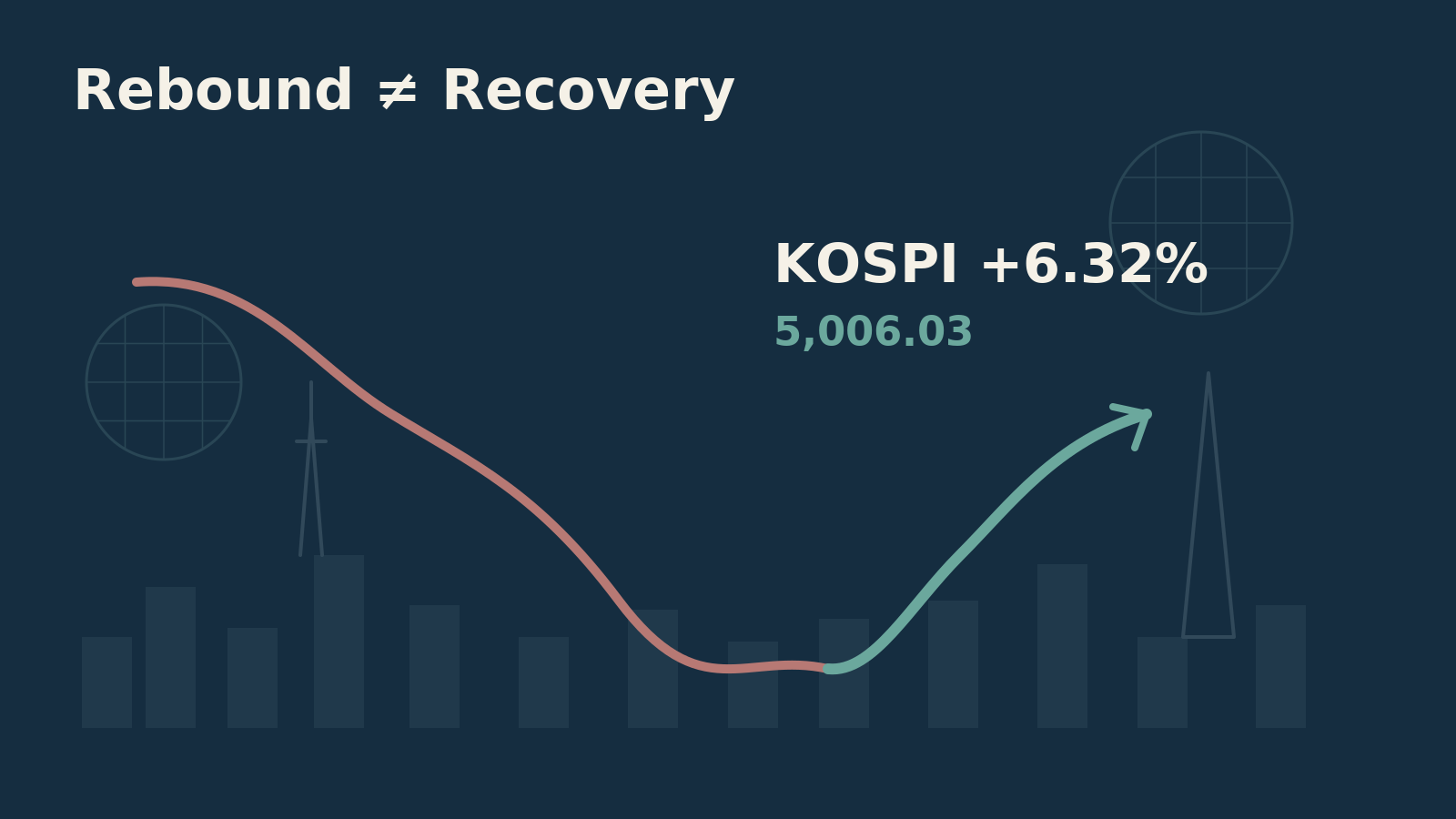
South Korea’s benchmark closed November 24 at 5,006.03, up 6.32%, after foreign buyers returned to a market battered by doubts about the semiconductor cycle. The KOSDAQ rose 4.79% to 665.88. A powerful rebound in U.S. technology helped change the mood, but the questions behind Korea’s selloff—future memory prices, AI investment and the price investors should pay for current earnings—survived the session.
There is substantial economic activity behind the Korean chip story. Exports are setting records. The harder question is how much of that strength will survive into 2027, and how much is already embedded in company valuations.
The session in perspective
The index gained 297.49 points from Monday’s 4,708.54 close. It opened at 4,880.16 and reached 5,065.74 before surrendering part of its intraday advance. A buy-side sidecar temporarily restricted program buying early in the session, illustrating the speed of the move rather than providing a judgment on its durability.
| Market observation | November 24 |
|---|---|
| KOSPI close | 5,006.03; +6.32% |
| KOSDAQ close | 665.88; +4.79% |
| KOSPI opening level | 4,880.16 |
| KOSPI session high | 5,065.74 |
| Foreign investors, KOSPI | Net buying of ₩725.5 billion |
| Institutions, KOSPI | Net buying of ₩869.2 billion |
| Individuals, KOSPI | Net selling of approximately ₩2.04 trillion |
These are the closing figures reported by SBS and News1. Investor-flow snapshots can differ by collection time and subsequent revision; the three categories above are not a complete accounting of every participant group.
The change in foreign participation matters. SBS reported that buying followed seven consecutive selling sessions. It does not, by itself, establish why investors bought. Net purchases can reflect fresh allocations, position adjustments or covering of existing exposures. Nor does aggregate retail selling prove that those sellers realized profits.
For the recovery argument, follow-through is the next test: whether buying persists once the immediate catalyst fades, whether market breadth holds, and whether earnings expectations stop deteriorating. A single large percentage gain cannot settle those questions.
A reported catalyst, with limits to what it explains
Korean market reports attributed the rally to news of Jensen Huang’s return to Nvidia’s leadership and the preceding surge in U.S. semiconductor shares. That attribution describes the explanation circulating during the session. The underlying corporate-governance episode was not independently established from a primary company statement for this article; allegations about wrongdoing are therefore not part of the analysis.
The economic transmission is plausible. Samsung Electronics and SK hynix give Korea substantial exposure to memory demand and AI infrastructure spending. Better sentiment toward a major customer ecosystem can quickly affect those shares and the equipment, materials and component businesses around them.
But a change in sentiment is faster than a change in orders. Short covering and repositioning are possible explanations for the rally, not conclusions established by the flow data. The distinction matters especially after a deep drawdown, when modest shifts in positioning can produce unusually large price moves.
Samsung Electronics finished at ₩189,400, up 6.70%, and SK hynix at ₩1,158,000, up 6.73%, according to SBS. Their participation supports the semiconductor-led interpretation of the day. It does not make every company connected to AI equally attractive.
Record shipments, uncertain future margins
Customs figures reported by Yonhap and AJP show $77.4 billion of total exports during November 1–20, an increase of 101.5% from a year earlier. AJP reported semiconductor shipments of approximately $38.5 billion, up 294.4%, accounting for nearly half of the total. Average daily exports rose 95.2%, so the improvement was not simply a consequence of additional working time.
Imports of approximately $50.3 billion left a trade surplus of roughly $27.1 billion. Those are period-specific trade observations, not full-month totals or company revenue figures.
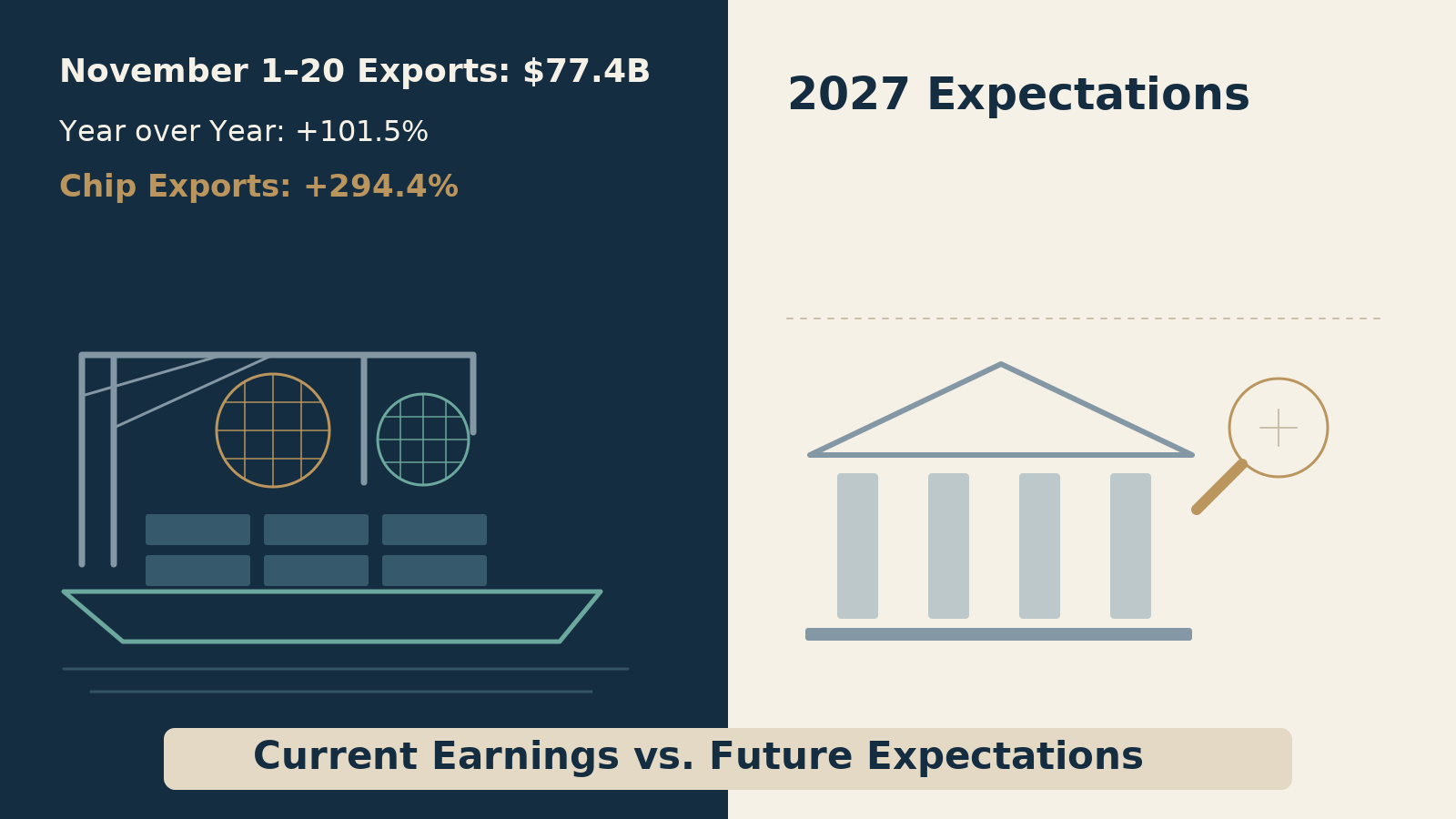
Strong shipments and weak share prices can coexist because they answer different questions. Trade data describe business already being transacted. An equity valuation depends on the profits and cash distributions investors expect over many years.
Our working interpretation is that investors are questioning how long unusually favorable memory conditions can last. A peak in DRAM or high-bandwidth-memory pricing, slower customer investment, or additional supply could weaken future margins even while current exports remain strong. These are risks to examine, not evidence that such a downturn has already occurred.
Conversely, sustained pricing and resilient customer orders would challenge an excessively pessimistic view. That argument needs company guidance, order conversion and cash flow alongside aggregate exports. A record national shipment figure cannot resolve the outlook for every supplier.
The Bank of Korea is a separate test
The next policy decision is November 26, with the base rate at 3.00%. Expectations favor an increase, but the degree of agreement depends on whom the survey asks.
A Korea Financial Investment Association survey of 100 bond-market professionals found 54% expecting a hike and 46% expecting a hold. A separate Reuters poll of economists was much more one-sided: 32 of 34 expected a quarter-point increase to 3.25%. These are different samples, collected over different periods; neither percentage is a calibrated probability of the decision.
The policy tension is straightforward. Strong exports and inflation pressure can favor tighter monetary conditions. Falling equity wealth can weigh on confidence and spending. The central bank must assess both, rather than treat either a stock-market slump or a one-day rebound as a complete description of the economy.
For equities, the statement and revised outlook may be as consequential as the immediate rate decision. A rally driven by overseas technology sentiment can still face a more demanding domestic discount rate. Any expectation about subsequent increases remains a forecast until the Bank acts.
Six businesses, six different research problems
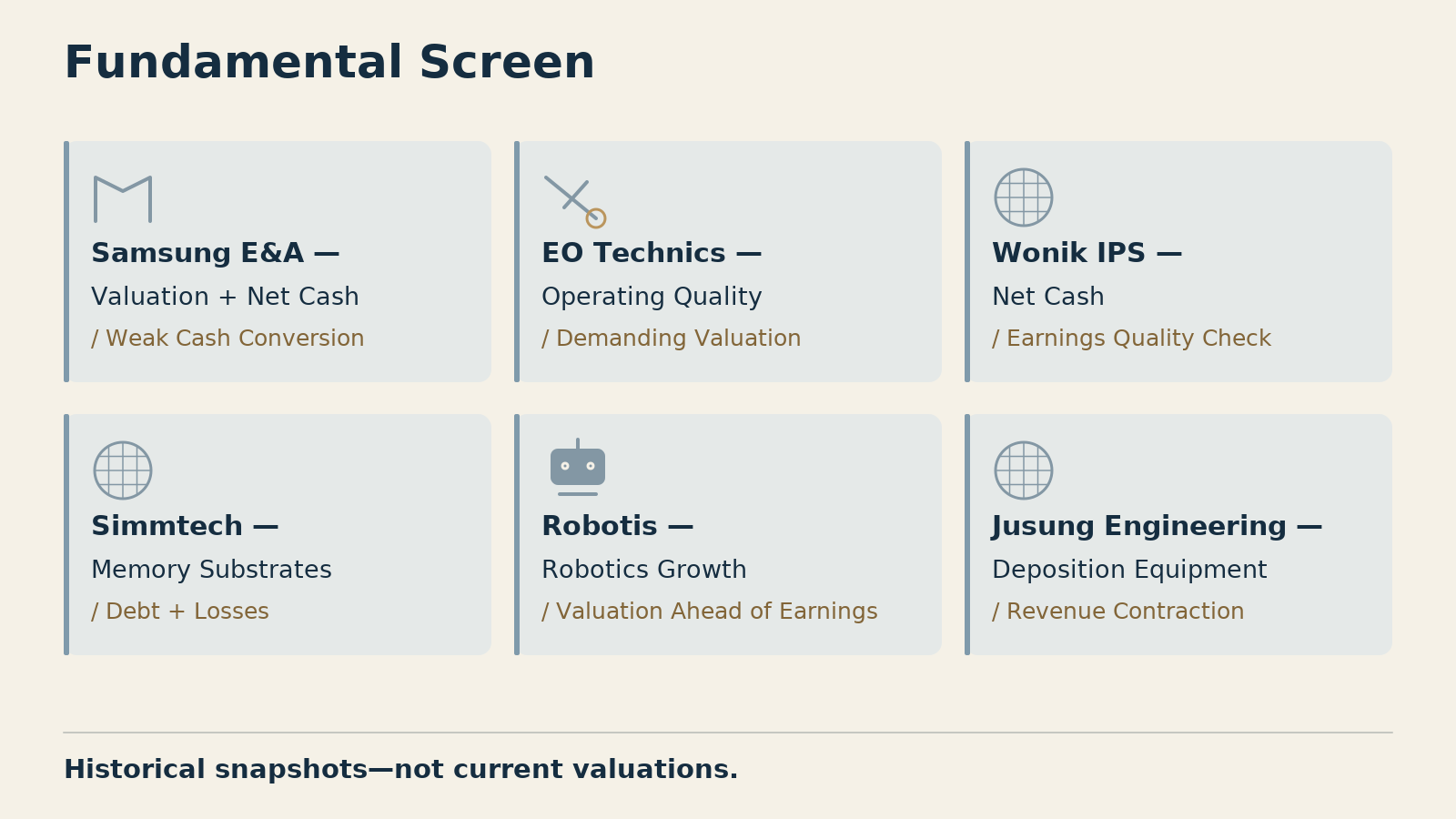
The company screen below uses historical observations supplied with the underlying research notes, mainly from October 16–27. The aggregate financial figures have not all been independently reconciled to current filings. They are retained as dated research inputs, not as current valuations or a ranking of prospective returns. Forward multiples also depend on estimates that can change.
An index decline does not establish that each stock is now cheaper. Share prices, earnings forecasts, share counts and balance sheets can all change between observations. Before drawing a present-day valuation conclusion, both the numerator and denominator need updating.
Samsung E&A: check whether earnings become cash
The October 27 snapshot paired a forward P/E of 11.3 times with approximately ₩3.77 trillion of net cash. It also recorded negative trailing operating cash flow of ₩188 billion and negative free cash flow of ₩238 billion. Those inputs make cash conversion the central question, rather than an incidental qualification to an apparently inexpensive multiple.
There is a separately verifiable operating development: Samsung E&A’s October 22 release reported third-quarter revenue of ₩2.9105 trillion and operating profit of ₩500.6 billion, up 183.6% year over year. The company also described a shareholder-return program involving repurchases and cancellations.
For an engineering and construction business, project billing, working capital and execution can create large differences between accounting profit and cash generation. The research task is to determine whether weak conversion reflects timing that can reverse or a more persistent constraint. Net cash provides flexibility; it does not answer that question.
EO Technics: operating quality still has a price
The October 16 notes reported a 24.6% operating margin, approximately ₩331 billion of net cash and a forward P/E of 36.3 times. That combination points toward a different issue: how much future growth was already priced into a profitable equipment business.
Its semiconductor laser-processing exposure connects the investment case to advanced packaging and memory investment. The useful checks are customer orders, the durability of margins and the conversion of spending plans into delivered equipment. High business quality can coexist with demanding valuation, especially if the next capital-spending cycle disappoints.
Wonik IPS: reconcile the earnings components
The October 16 snapshot showed approximately ₩405 billion of net cash, an 8.0% operating margin and an 18.7% net margin. The gap calls for a reconciliation of operating profit, financial income, taxes and other items in the filings.
It does not prove that the difference consists of nonrecurring gains. Nor is there enough evidence here to assert that a normalized P/E must be higher. The screen identifies an earnings-quality question that needs answering before the headline multiple becomes useful.
Simmtech: growth with financial constraints
The supplied October 16 observations combined 34.1% trailing revenue growth with a net loss of ₩50.6 billion and net debt of approximately ₩647 billion. Memory-substrate demand may support the business, but stronger sales alone do not establish a durable improvement in equity value.
The key questions are whether operating improvement reaches free cash flow, how much funding the business requires, and whether debt can be reduced without weakening its competitive position. This is a financially constrained cyclical case in the historical screen, rather than a substitute for the net-cash equipment companies.
Robotis: a growth narrative ahead of earnings
The October 23 notes recorded revenue growth of 51.5%, a trailing net loss and an estimated forward P/E near 200 times. Such a forward multiple is especially sensitive to small changes in the profit estimate and should not be read with false precision.
The robotics opportunity is a starting point for research. Commercial adoption, repeat orders, gross margins and the cost of scaling determine how much of that opportunity reaches shareholders. Net cash in the snapshot supports runway, but does not validate the price paid for eventual earnings.
Jusung Engineering: establish the recovery before valuing it
The October 16 observations showed trailing revenue down 50.4%, sharply lower net income and an operating loss. A very large trailing P/E calculated on a small remaining profit base conveys little about normalized earning power.
For deposition equipment, the investigation should begin with orders, delivery timing, customer investment and the reasons for the contraction. A higher share price during a sector rally supplies none of those answers by itself.
What would make the rebound more convincing?
The next sessions will test whether Tuesday attracted lasting allocations or merely a burst of relief. Continued foreign buying would help, but it should be assessed alongside breadth and company fundamentals rather than used as a standalone signal.
The November 26 Bank of Korea meeting supplies the nearest policy checkpoint. Full-month export data will provide a broader trade picture than the first-20-day release. Beyond those events, the most useful evidence will come from memory pricing, customer capital budgets, equipment orders and cash conversion.
Samsung E&A and EO Technics illustrate why the same rally can create very different research questions: one calls for closer scrutiny of cash generation; the other of the price attached to operating quality. Wonik needs an earnings reconciliation, while Simmtech, Robotis and Jusung require separate judgments about leverage, commercialization and recovery.
Tuesday changed the market’s direction. Establishing a recovery requires evidence that survives the next difficult session.
Editorial note: Market observations refer to November 24, 2026 unless otherwise specified. Company-screen inputs are historical and are not current quotes. This article provides general market commentary, not personalized investment advice or a recommendation to trade.
Sources and references
- SBS — November 24 closing market report
- News1 — KOSPI close and investor flows, November 24
- Yonhap — Korea Customs Service export figures, November 1–20
- AJP — Export totals and semiconductor breakdown, November 23
- Yonhap — KOFIA bond-manager rate survey, November 24
- Reuters — November Bank of Korea economist poll
- Samsung E&A — Official third-quarter 2026 results