
Market Calls / South Korea
KOSPI Gives Back Most of Its Rally as Korea’s Export Boom Meets Higher Rates
The KOSPI closed just 0.29% higher after reaching +2.56%. Updated export figures, a 5–2 Bank of Korea rate decision and three company profiles show why a rebound is not yet a recovery.

Market date
The KOSPI managed a positive close on Thursday. It did not manage to hold its rebound.
The index opened at 4,745.10, reached 4,817.77, and finished at 4,711.21, up 0.29%. The retreat from the high was 106.56 points. Measured against Wednesday’s close, roughly 89% of the maximum intraday gain had disappeared by the end of trading.
That is a small recovery after Wednesday’s 6.16% fall. It also captures the question hanging over Korean equities: how much should investors pay for an exceptional semiconductor cycle when they are increasingly unsure about what follows it?
A rebound with little room for celebration
| November 26 observation | Reading |
|---|---|
| KOSPI open | 4,745.10 (+1.01%) |
| KOSPI intraday high | 4,817.77 (+2.56%) |
| KOSPI close | 4,711.21 (+0.29%) |
| KOSDAQ close | 655.71 (+0.78%) |
| KOSDAQ intraday high | 673.57 |
| KOSPI regular-session turnover | Approximately ₩12.28 trillion |
| USD/KRW, 3:30 p.m. Seoul reference | 1,342.7 |
SBS reported that KOSPI regular-session turnover was the lowest since December 24, 2025. That is evidence of subdued trading on this measure. Calling it capitulation would go further: a low-turnover rebound does not, by itself, establish that sellers have exhausted themselves.
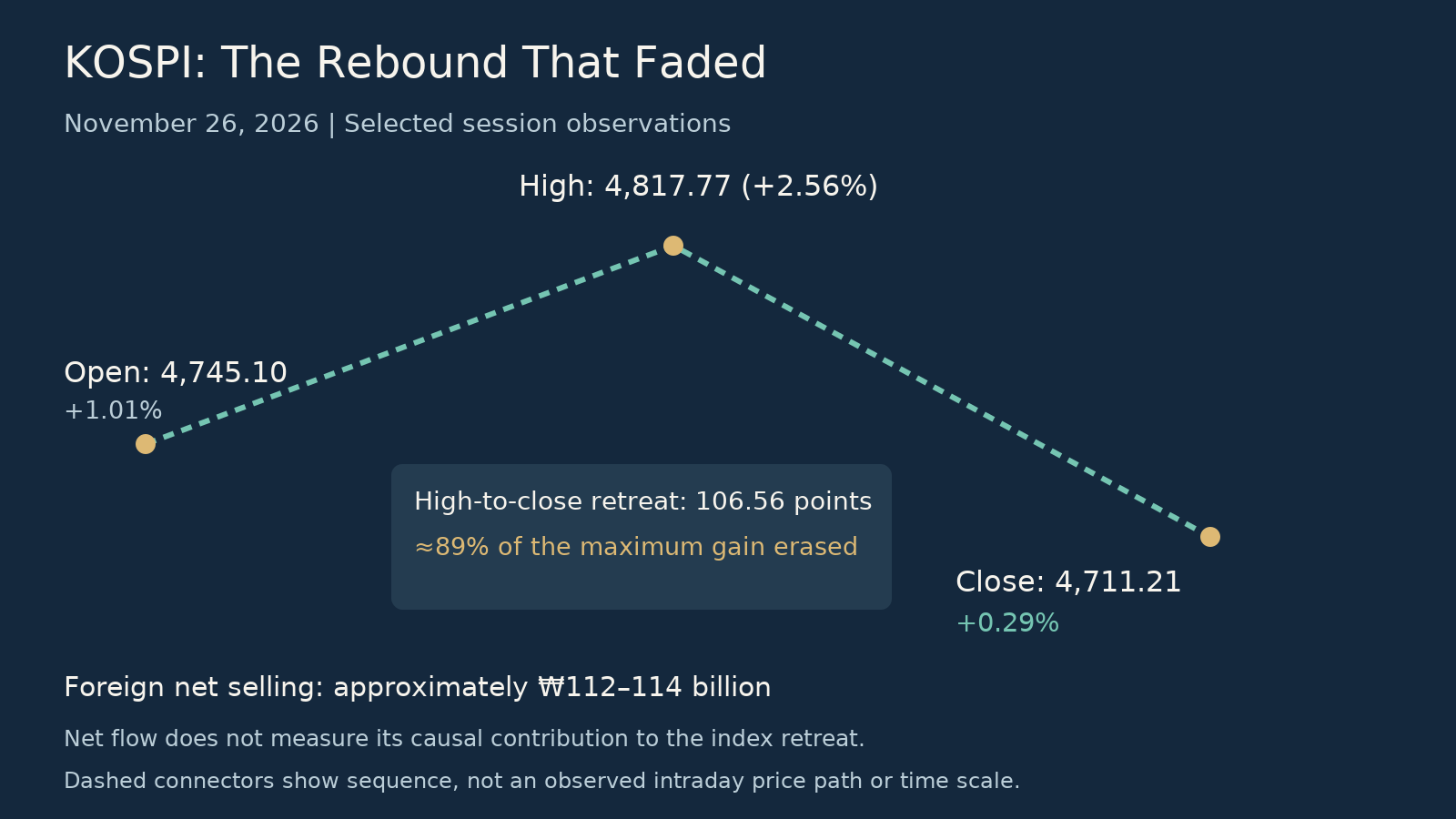
Foreign investors were net sellers, while institutions were net buyers. Closing reports differ slightly as observations were updated: foreign selling was approximately ₩112–114 billion, institutional buying approximately ₩751–753 billion, and retail selling approximately ₩1.04 trillion. SBS also reported ₩406.6 billion of net buying in the “other corporations” category.
That last category can include corporate share repurchases. It should not be treated as a verified total of buybacks alone. Nor do the flow totals identify exactly which trades moved the index off its high. The price retreat and foreign net selling occurred in the same session; a shaded chart area cannot quantify a causal connection between them.
On the KOSDAQ, institutions bought roughly ₩233 billion, while retail and foreign investors sold approximately ₩135–136 billion and ₩104–106 billion, respectively. Domestic institutional demand offered a counterweight, but it did not turn either index’s early strength into a convincing finish.
The Bank of Korea tightened despite the equity slump
The Bank of Korea raised its base rate from 3.00% to 3.25%, its third increase of the year. The official statement resolves a gap in the original notes: the vote was 5–2, with two members preferring to keep the rate at 3.00%.
The bank raised its growth forecasts to 3.9% for 2026 and 4.1% for 2027, from 3.3% and 2.9%. Its inflation forecasts were 2.7% and 2.4%, respectively. These are forecasts, not recorded economic outcomes.
Its explanation combined strong exports and investment with inflation expected to remain above target and continuing financial-stability concerns. It also acknowledged the equity correction and uncertainty around AI investment. Future tightening depends on incoming conditions; no fixed number of additional increases was announced.
The investment implication is uncomfortable but not contradictory. Exporters can be delivering strong results while higher discount rates reduce what investors will pay for those results. A central bank can also be concerned about inflation and household borrowing while stock prices fall.
I would not infer from this decision that the bank has declared the market decline harmless to the real economy. The statement describes several competing risks. Likewise, the highest dot in a policy projection is not a promise, a consensus forecast or a market-implied probability.
Record exports: the missing update was already available
The first ten days of November were extraordinary. Korea Customs Service reported total exports of $33.5 billion, up 111.9% year over year, and semiconductor exports of roughly $16.6 billion, up 331.2%. The trade surplus was $8.8 billion.
But those were no longer the latest figures on November 26. The provisional November 1–20 release, published on November 23, showed:
| November 1–20 | Value | Year-over-year change |
|---|---|---|
| Total exports | $77.4 billion | +101.5% |
| Semiconductor exports | $38.5 billion | +294.4% |
| Imports | $50.3 billion | +39.4% |
| Trade surplus | $27.1 billion | — |
Cumulative exports had reached approximately $1.0076 trillion. The earlier November 1–10 release had put the country on the approach to $1 trillion; the subsequent release established that the milestone had been passed.
These are overlapping reporting windows, not two independent samples. The change from +331.2% to +294.4% does not, by itself, establish a month-on-month deterioration in chip demand. Year-earlier comparison bases, working days, prices and shipment timing all matter.
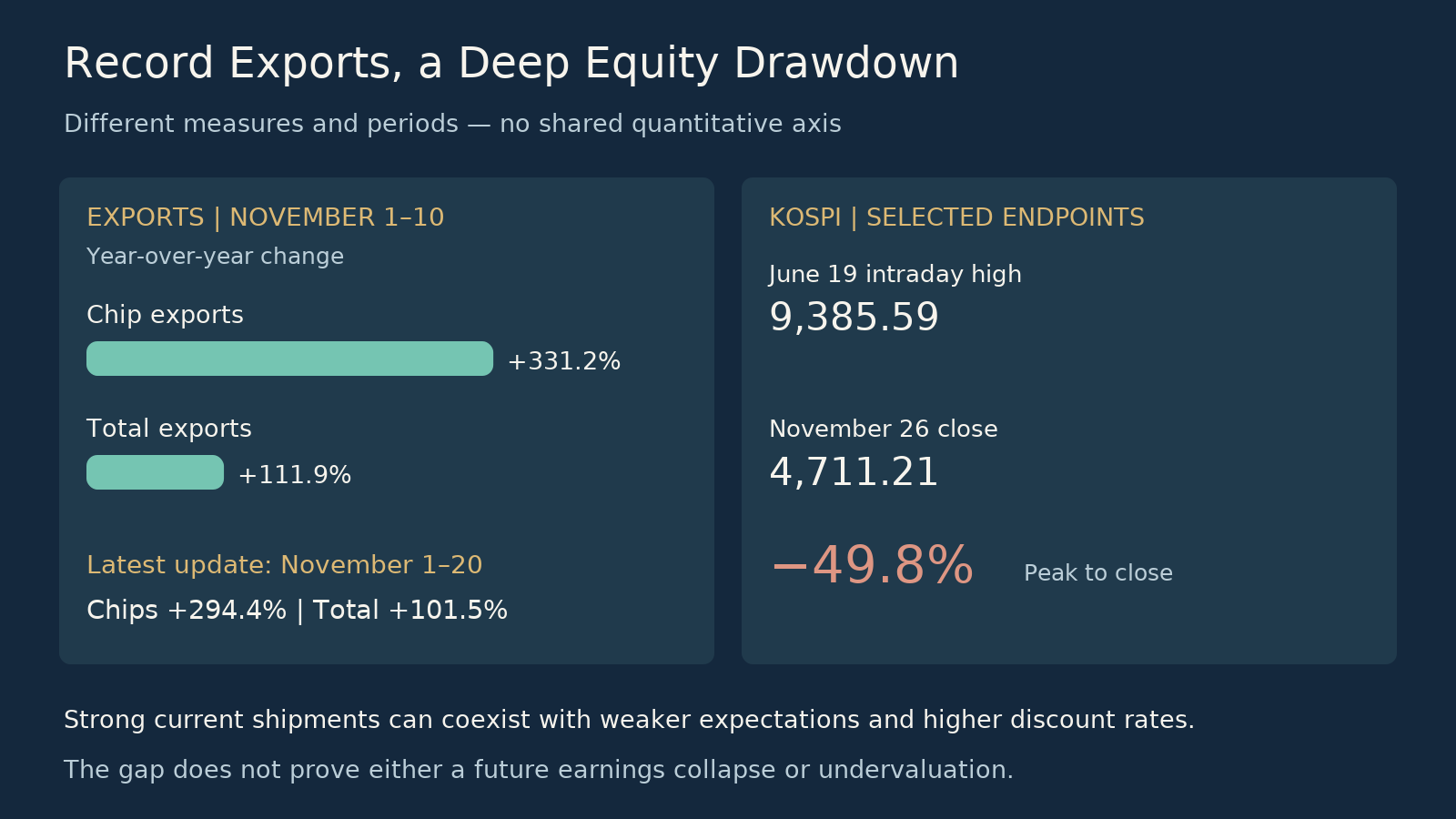
The KOSPI’s June intraday high of 9,385.59 and Thursday’s close imply a decline of 49.8%. This is a peak-to-close comparison, not a decline from a June closing price. It describes a very large repricing, but it does not show that every constituent is half as expensive on unchanged earnings.
The gap between exports and equities has more than two possible resolutions. Future profits could weaken; discount rates or required risk premia could rise; today’s export revenue could contain price effects that are difficult to sustain; capital spending could absorb more cash. Several of these can happen together. It is too narrow to conclude that either profits must collapse or the market must be cheap.
Keep the U.S. sessions and tariff stages separate
The source draft mixed U.S. trading dates and closing readings. The Nasdaq’s November 25 close was 23,585.80, down 0.62%, after a much larger intraday decline. Earlier semiconductor losses should not be relabeled as that session’s final returns without checking the instrument and date.
U.S. cash equities were closed on November 26 for Thanksgiving. That removes a fresh U.S. cash-session close from Thursday’s information set; it does not mean there were no overseas prices, futures or news to influence Friday in Seoul. November 27 has a shortened U.S. equity session.
The trade-policy count also has a straightforward explanation. USTR initiated investigations into 16 economies, then made the November 25 determinations concerning 14. Korea was among those 14. The proposed action refers to tariffs of up to 15%, net of most-favored-nation rates and existing Section 301 tariffs, with exemptions for certain goods. It remains a proposal, not a newly implemented universal surcharge. Comments are due January 5, with hearings starting January 25, 2027.
Neither the tariff wording nor a recovery in U.S. technology shares removes Korea’s exposure to the AI capital-spending cycle. They change parts of the risk assessment, not the entire investment case.
Stock moves were uneven
Samsung Electronics finished at ₩171,300, up 0.35%, and SK hynix at ₩1,053,000, up 2.23%. Both recovered only part of the previous day’s losses. Samsung Electro-Mechanics gained 3.84% in the supplied closing snapshot.
Autos were weaker: Hyundai Motor fell 3.9% and Hyundai Mobis 5.7%. Battery names also declined in the session notes, including Ecopro BM, Ecopro and LG Energy Solution. Jusung Engineering rose 3.39%, while Samchundang Pharm gained 9.62%; this review did not establish a specific catalyst for the latter move.
The original aggregate-earnings discussion contained conflicting absolute values for the KOSDAQ. Those unreconciled totals are excluded from the valuation conclusions here. Strong results at a few large semiconductor companies can be important without being representative of the median listed business.
Three candidates, three different questions
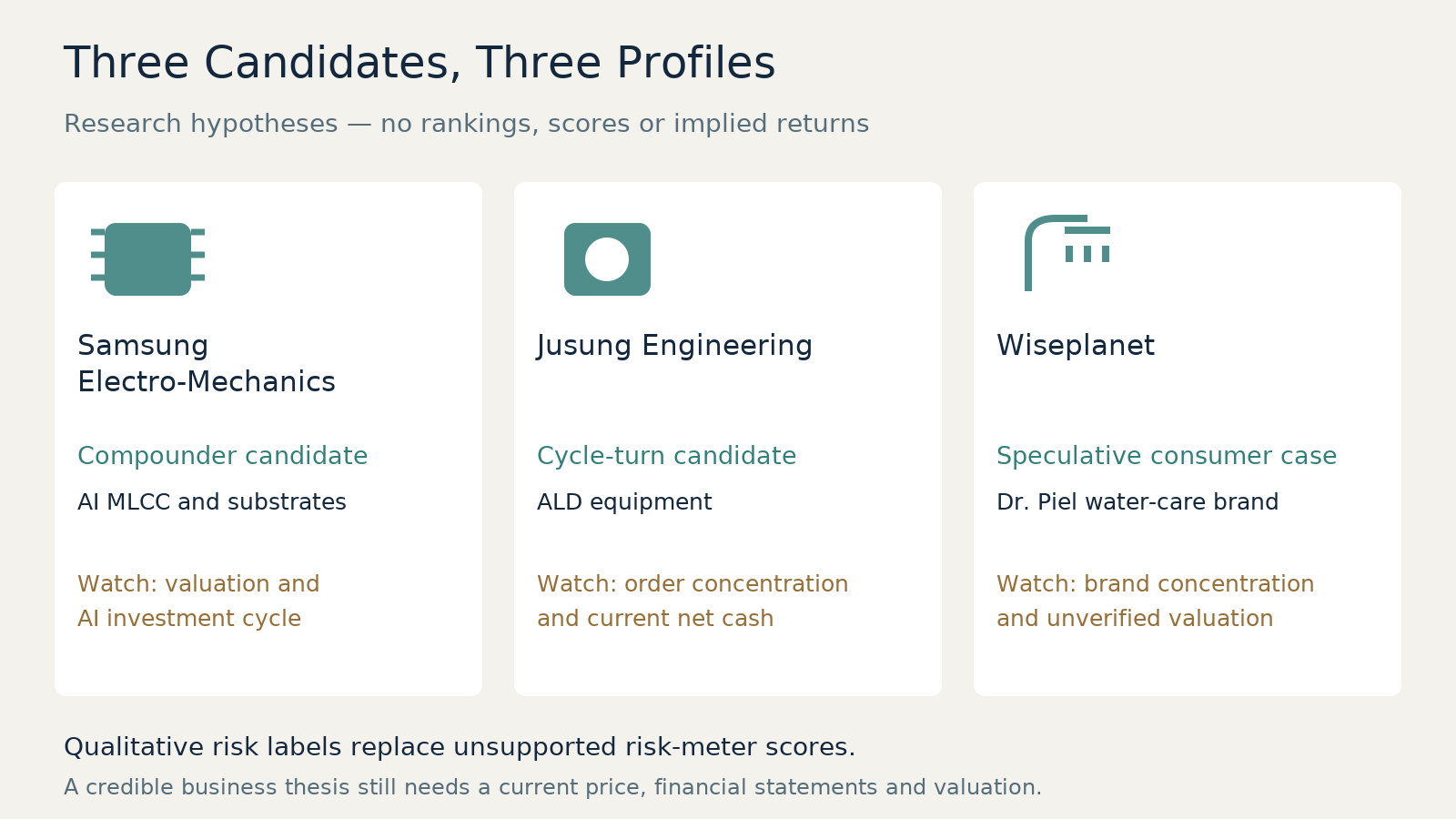
The screen asks for growing sales and earnings, durable margins, a manageable balance sheet and a price that leaves room for disappointment. No candidate is established here as passing all of those tests at a verified current valuation.
Samsung Electro-Mechanics: operating strength still needs a price discipline
The company’s official third-quarter presentation reports revenue of ₩3.7633 trillion, operating profit of ₩691.0 billion and an 18.4% operating margin. Net income attributable to owners of the parent was ₩468.7 billion; the original note’s ₩485 billion is not used for that measure.
The same presentation lists cash of ₩4.1137 trillion and debt of ₩3.4263 trillion, implying about ₩687.4 billion more cash than debt under those presentation definitions. This updates the original “cash and debt not verified” limitation. It does not replace a full review of liquidity restrictions, leases and other obligations.
Using the supplied ₩784,000 share price and an unrefreshed estimate of 74.7 million common shares gives an illustrative common-equity value of about ₩58.6 trillion. Four times quarterly parent-attributable earnings is roughly ₩1.875 trillion, producing a rough ratio of 31.2x. This is neither a verified TTM P/E nor a forward consensus multiple. Share classes and earnings allocation also require reconciliation.
The research thesis concerns MLCCs and advanced substrates used in AI systems. Those exposures differ from spot DRAM, but still depend on customer investment. A compounder case requires repeatable returns on new capacity, pricing power and cash conversion—not simply extrapolation of one strong quarter.
Jusung Engineering: a quarterly recovery inside a weaker year
A reproduction of Jusung’s November 4 preliminary filing shows third-quarter revenue of ₩78.076 billion, operating profit of ₩17.667 billion and net profit of ₩28.048 billion. Revenue rose 32.8% year over year and operating profit 426.4%. The operating margin was about 22.6%.
The cumulative picture was different: nine-month revenue was down 25.4% and operating profit down 72.5%. Net profit exceeded pre-tax profit in the quarterly release, so the tax and other reconciliation deserves attention before treating net income as a recurring operating run rate. Direct access to the DART page failed during this review; the reproduced filing and Yonhap’s reporting were used instead.
The case is a recovery in deposition-equipment orders, including ALD, rather than a proven return to sustained growth. Older backlog, cash and customer-concentration figures in the supplied notes were not refreshed to the latest balance-sheet date. In particular, an earlier net-cash position should not be presented as a current verified fact.
The next tests are order conversion, customer concentration, China-related restrictions and working-capital demands. Without an aligned current share price, share count and earnings base, this edition cannot establish that the stock is inexpensive.
Wiseplanet: a consumer business with its own concentration risk
Wise Planet Company’s reported KOSDAQ ticker is 0010S0. Its portfolio combines marketing services and consumer brands. Dr. Piel is a water-care brand, including filtered shower products; a skincare bottle would misrepresent the business discussed here.
Herald’s November 17 report, citing the company, put nine-month revenue at ₩51.3 billion, up 5.0%, and operating profit at ₩5.0 billion, up 33.9%. Operating cash flow was ₩5.5 billion. Dr. Piel represented about 65.6% of sales. The September listing raised approximately ₩16.2 billion, while a North American product launch was planned for the first half of 2027.
This is a speculative consumer-growth hypothesis, not a substitute for checking valuation. Dependence on one brand, modest revenue growth, acquisition costs and the short listed history deserve scrutiny. IPO proceeds are financing, not recurring operating cash flow. A business outside semiconductors also does not automatically diversify a portfolio under every market condition. Current market capitalization, lock-up details and valuation were not verified here.
What would make the next rebound more persuasive?
I would look for gains that survive the afternoon, foreign flows that improve over more than one session, and earnings evidence that supports the next year rather than merely celebrating the last quarter. Memory contract prices, equipment orders and investment budgets will be more useful than assuming that a deep drawdown has already discounted every risk.
The original 4,700 support reference is close to the latest observed price. That does not give it predictive force. This edition does not turn the untested 4,500 reference into a downside target.
The immediate calendar includes the shortened U.S. session on November 27 and the full-November Korean export release expected around the usual beginning-of-December schedule. Monitor the official release calendar for confirmation. Nvidia-related congressional appearances and Micron’s December results also remain watch items; the conflicting hearing dates in the source notes are not treated here as a confirmed schedule.
The rebound was real. So were the record shipments and the rate increase. A market floor requires more evidence than the coexistence of those three facts.
Method note: November 26 closing reports are used for the market snapshot, with ranges where reported flow readings differ. Official BOK and customs releases update the supplied draft. Company results, historical observations, estimates and investment hypotheses are identified separately. No complete intraday series, risk scores, target prices or projected returns have been invented.
Editorial note: This publication is for information and education only. It is not personalized financial advice, an offer or a solicitation to transact. Market information and interpretations can change. Consult original disclosures and assess risks independently.
Sources and references
- Korean closing report — Seoul Economic Daily, November 26
- Closing prices and stock moves — MoneyToday
- Turnover, other-corporation flows and closing session — SBS
- Korean market closing snapshot — Sisa Journal
- Policy decision and 5–2 vote — Bank of Korea, November 26
- November 1–10 exports — Korea Customs Service via KDI
- November 1–20 exports — Korea Customs Service via KDI
- June 19 intraday high — The Korea Times
- Nasdaq historical session observations — Yahoo Finance
- U.S. holiday trading calendar — NYSE
- Proposed Section 301 actions — USTR
- Samsung Electro-Mechanics official Q3 2026 presentation
- Jusung preliminary results — reproduced DART filing
- Jusung November 4 results — Yonhap
- Jusung official listing information
- Wiseplanet nine-month operating results — Herald
- Wise Planet Company business profile and ticker — StockAnalysis