
Market Calls / South Korea
Korea’s Chip Rally Unwinds: KOSPI Falls 6.16% Before the BOK Decision
Samsung and SK hynix led a reversal of Tuesday’s rebound. Record chip exports contrast with fragile earnings expectations as investors await the Bank of Korea.

Market date
Market Call — South Korea | November 25, 2026
Market observations refer to the Seoul session. Company fundamentals below are supplied historical snapshots, not refreshed valuations or recommendations.
The KOSPI wiped out Tuesday's rally in a single session. It closed at 4,697.51, down 6.16% (-308.52 points), its lowest close since January 13 (4,692.64). The day before, the index had jumped 6.32% to 5,006.03 on news that Jensen Huang was returning to Nvidia. That move reversed when the Philadelphia Semiconductor Index (SOX) fell 7.88% in New York overnight. The KOSDAQ held up better, losing 2.29% to 650.64.
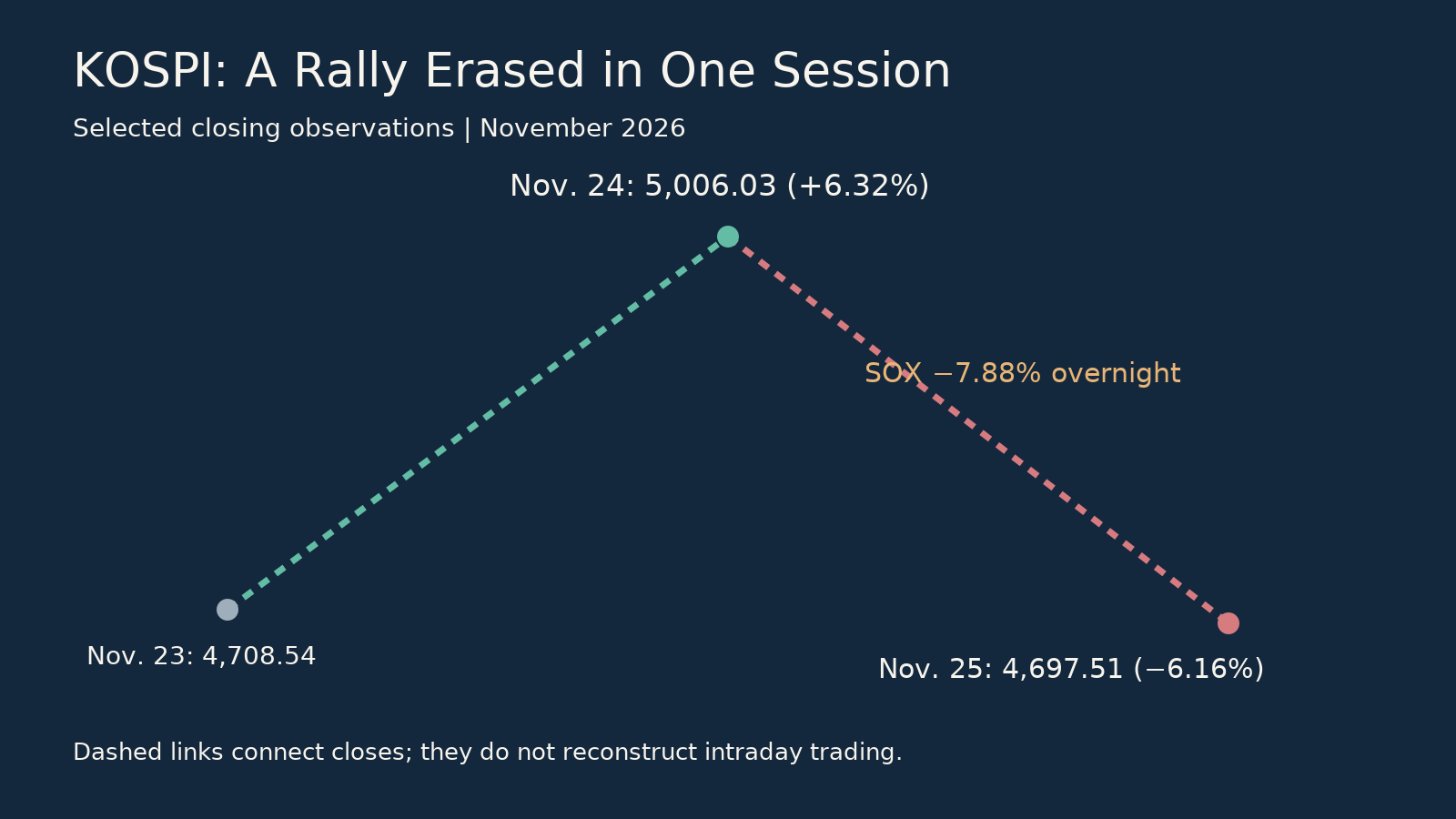
Foreigners sold a net ₩1.95 trillion of KOSPI shares, ₩1.01 trillion of it in Samsung Electronics alone. Samsung closed at ₩170,700 (-9.87%) and SK hynix at ₩1,030,000 (-11.05%). A sell-side sidecar was triggered shortly after the open; reports differ between 9:08 and 9:09 a.m. Since the October 22 close (5,533.77), the KOSPI has dropped about 15%. Tomorrow the Bank of Korea decides on rates, and 32 of 34 economists expect a hike to 3.25%.
The scoreboard: closes and separately timed observations
- KOSPI: 4,697.51, down 308.52 points (-6.16%). It opened at 4,809.00 (-3.94%). Lowest close since Jan. 13.
- KOSPI on Nov. 24: 5,006.03, up 6.32%, with a buy-side sidecar.
- KOSDAQ: 650.64, down 15.24 points (-2.29%).
- KOSPI flows: foreigners -₩1.95 trillion (Samsung -₩1.01 trillion, SK hynix -₩559.6 billion), retail +₩1.42 trillion, institutions +₩53 billion.
- KOSDAQ flows: foreigners -₩16.2 billion, retail -₩31.8 billion, institutions +₩41.6 billion.
- USD/KRW: 1,343.2, up 0.8 won (a slightly weaker won) from 1,342.4 the day before. This quote was published before Seoul's close, so it may be intraday.
- KTB 3-year yield: 3.640% (Nov. 24), up 1.7 bp.
- KTB 10-year yield: 3.785% (Nov. 25, 11 a.m.), down 3.8 bp. The 10s-3s spread was 17.9 bp on Nov. 24, the narrowest in over a year and a half.
- BOK base rate: 3.00%. Decision tomorrow, Nov. 26, at 9:40 a.m. KST.
- Wall Street (Nov. 24): Nasdaq -1.48%, S&P 500 -0.50%, Dow +0.85%. SOX -7.88%, Nvidia -5.86%, Micron -11.0%, AMD -8.86%.
- Asia (Nov. 25): TAIEX -4.80%, Nikkei -2.78% (57,011.62).
Source check: Yonhap reports foreign selling of about ₩1.9 trillion, while Seoul Economic Daily reports ₩1.95 trillion. Institutional totals also differ, so the flow figures below retain their attribution rather than claiming a reconciled official total. A few numbers conflict across sources. One Herald Business headline, cited by Admirals, put foreign selling at ₩3.39 trillion. Its date and scope are unconfirmed, so I used the Seoul Economic Daily figure of ₩1.95 trillion. Admirals also cites a record close of 9,114.55 (June 22), while earlier editions cited a 9,385.59 high that was probably intraday. Those record-level comparisons remain unverified and are not used to establish the drawdown. The count of 2026 sidecars also differs by source (60 or 62).
Why it moved
The trigger was a chip sell-off on Wall Street. Micron fell 11% after a BNP Paribas downgrade, and BNP projects memory prices falling 20% through 2028. Doubts about Nvidia's management after Huang's return added to the pressure, with a U.S. congressional hearing set for December 3. Tariffs are a third worry. The draft flags the USTR overcapacity investigations as a tariff risk for Korea. The timing, scope and implementation of any proposed action must be checked against the official notice; an investigation or proposal is not an enacted tariff. Lee Kyoung-min of Daishin blamed part of the drop on Trump's remarks and the tariff uncertainty.
Reports of Goldman Sachs target-price cuts and an unused stabilization fund were not verified at their original sources and are excluded from the investment case.
The editorial reading is that this is an all-or-nothing market in semiconductors. Two sessions of roughly ±6% are consistent with fragile positioning in a concentrated index. Price action alone does not measure leverage or rule out changes in earnings expectations.
The central tension is the contrast with the trade data. Chip exports are nearly quadrupling while the stocks fall. One plausible interpretation is concern about a peak in memory profitability and AI investment; that remains a hypothesis rather than an observed turning point. Single-digit P/Es can reflect unusually high cyclical earnings. They do not establish that a peak has occurred, nor do they establish cheapness.
Rates, exports and chips
The BOK. The decision comes tomorrow at 9:40 a.m. KST, with revised projections at 1:30 p.m. In Reuters' survey (Nov. 17–23), 32 of 34 economists expect a 25 bp hike to 3.25%. All 10 local brokerages in the previews cited by AJP expect the same. The median sees one more hike in Q1 2027, taking the terminal rate to 3.50%, and some analysts expect a dissenting vote to hold.
Foreigners bought more than 13,000 10-year KTB futures contracts on Nov. 24. That was the largest volume since June and the fifth straight day of buying (25,808 contracts over five days). AJP reads it as a bet that this will be the last hike. October CPI came in at 2.8% year over year (core also 2.8%), and Q3 GDP grew 1.0% quarter on quarter.
The policy scenario is that a dovish hike, with a signal that the cycle is ending, would be mildly positive for equities and the long end of the curve. A more hawkish outlook could support the won and pressure some exporters, although the response would depend on what investors had already priced in.
Exports, Nov. 1–20 (Korea Customs Service, preliminary).
- Total: $77.4 billion, up 101.5% year over year, a record for the first 20 days of any month. The daily average was $4.84 billion (+95.2%), with 16 working days against 15.5.
- Chips: $38.5 billion (+294.4%), or 49.7% of the total. FourWeekMBA calculates that chips account for about 74% of the annual gain.
- Other categories: petroleum products $4.13 billion (+91.9%), computer peripherals $3.67 billion (+330%), autos $3.59 billion (-5.6%), ships +85.1%, steel +27.0%.
- By destination: China $20.05 billion (+145.6%), U.S. $16.44 billion (+142.7%), Taiwan +149.7%.
- Imports were $50.3 billion (+39.4%), leaving a record surplus of $27.1 billion for the period.
- Full-year exports passed $1 trillion on Nov. 19 and reached $1.0076 trillion by Nov. 20 (+63.2%).
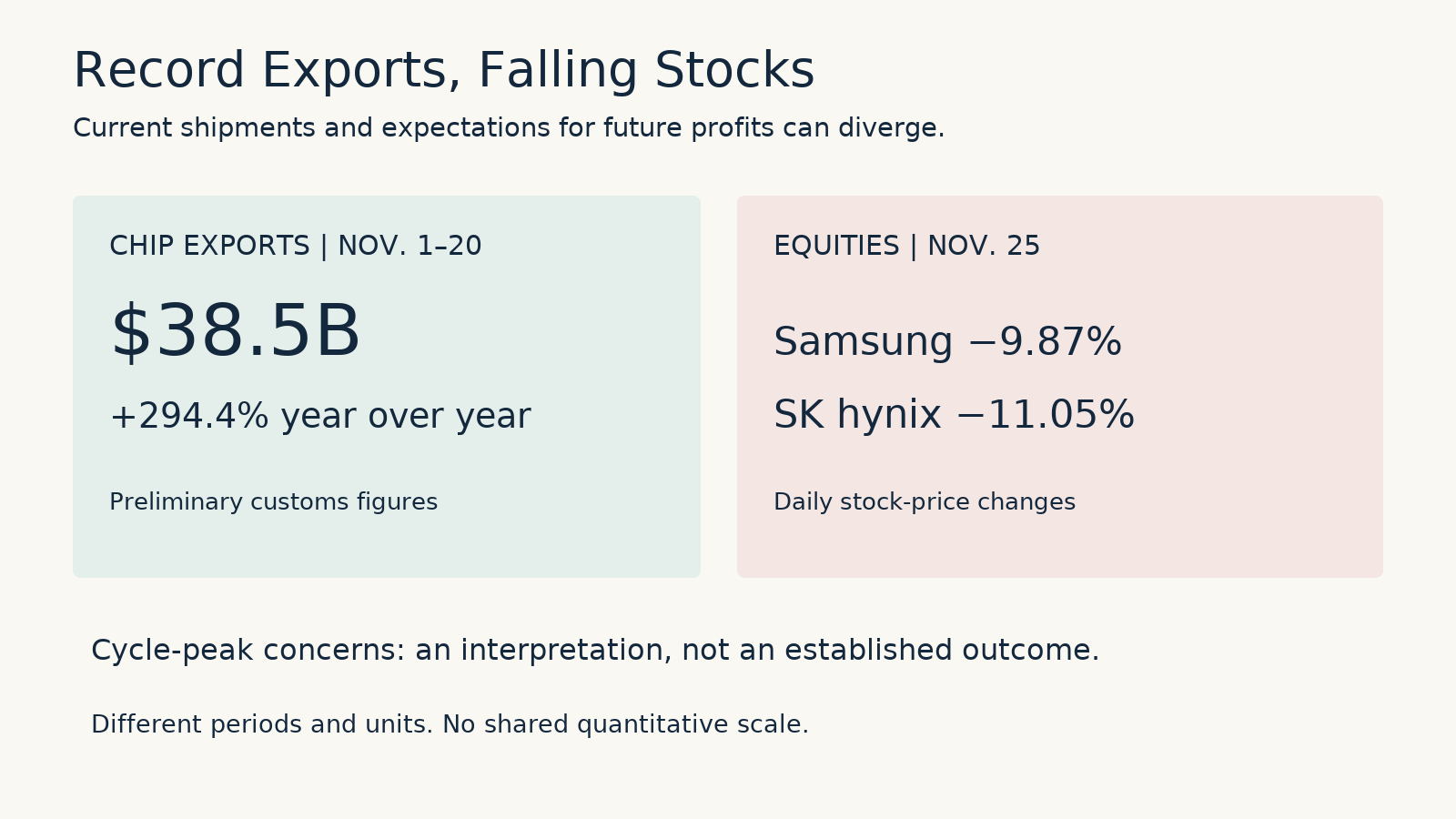
Strip out chips and exports still grow about 36%, which is strong, but autos are already shrinking. The surplus may support the won, but exchange rates also depend on capital flows and relative rates. Currency appreciation can reduce the won value of overseas earnings. Kyunghyang reported on Nov. 18 that KOSPI companies' Q3 net income fell 30% quarter on quarter on currency losses.
Q3 earnings (Kyunghyang, Nov. 18). KOSPI revenue was ₩1,070 trillion (+2.3% q/q), operating profit ₩253.8 trillion (+10.6%) and net income ₩169.6 trillion (-30.4%). The KOSDAQ posted a net loss of ₩1.29 trillion, and 58% of its companies finished in the red.
Foreign flows
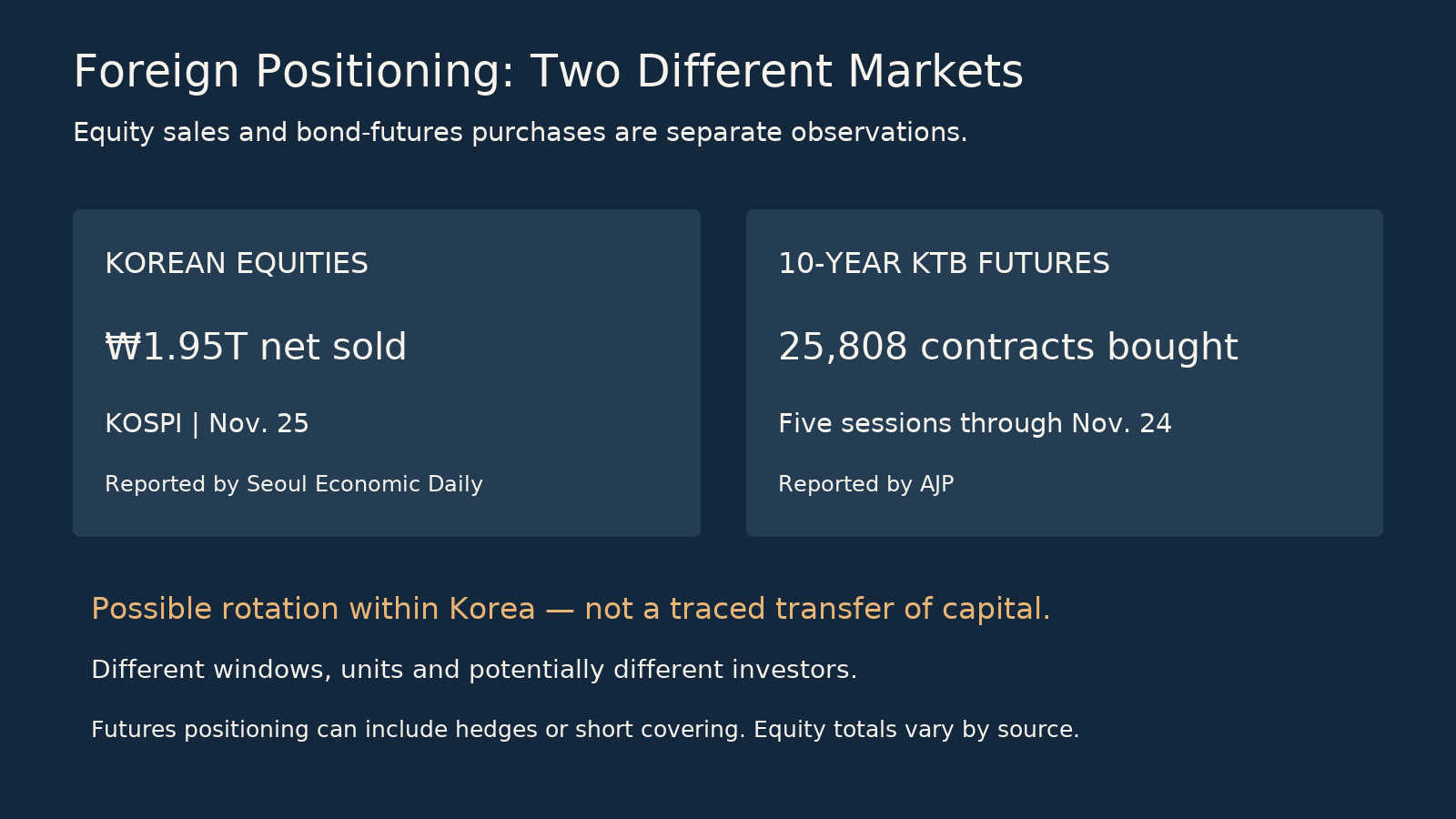
Foreigners sold ₩1.95 trillion of KOSPI today, with Samsung and SK hynix together accounting for ₩1.57 trillion. On Nov. 10, when the KOSPI rose 4.39% to 5,239.13, they had made their first net purchase after eight sessions (₩353.2 billion). In the rates market the picture is the opposite, with heavy foreign buying of KTB futures.
One possible interpretation is foreigners cutting exposure to Korean equities, which are essentially a leveraged bet on memory, while betting on lower long-term yields in Korea. That is consistent with a rotation hypothesis, but it does not prove one. The equity and futures observations cover different windows and may involve different investors. Futures purchases can reflect hedging or short covering; contract counts are not cash inflows. These figures cannot establish that money stayed in Korea or that proceeds from share sales funded the futures positions.
Stocks in focus (Nov. 25): chips under pressure
- Samsung Electronics (005930): ₩170,700, -9.87%. Lowest close since Mar. 31, and market cap of ₩997.96 trillion, below ₩1,000 trillion.
- SK hynix (000660): ₩1,030,000, -11.05%. Lowest close since Apr. 10. Foreigners sold ₩559.6 billion.
- SK Square (402340): -11.19%. Holding company of SK hynix.
- Samsung Electronics preferred (005935): -10.19%.
- Jusung Engineering (036930): -11.42%. Chip equipment, KOSDAQ.
- Wonik IPS (240810): -10.89%. Deposition equipment, KOSDAQ.
- EO Technics (039030): -8.89%. Laser and marking, KOSDAQ.
- Samsung Electro-Mechanics (009150): ₩755,000, -12.00%. It was ₩1.15 million on Oct. 22.
Company moves from the low-reliability secondary source—including Doosan and the cited biotech gainers—are omitted pending confirmation. A defensive-rotation thesis requires reliable sector evidence; it cannot be inferred from unverified winners.
Fundamental watchlist: historical snapshots
Fundamentals come from StockAnalysis and carry different dates, noted for each name. Today's prices are unconfirmed for HD Hyundai Electric, Samsung E&A and LS Electric. Revenue and profit are TTM. Year-over-year growth wasn't available on the pages I read this round, so the growth figures below come from the Oct. 22 edition.
HD Hyundai Electric (267260)
- Price: ₩366,500 (Nov. 6). Market cap: ₩13.19 trillion.
- P/E: 15.7x trailing, 11.7x forward. EV/EBITDA: 10.1x.
- Operating margin: 25.5%. ROE: 41.2%.
- Reported net cash: ₩800.7 billion; gross debt requires separate verification. TTM FCF: +₩670.6 billion.
It makes transformers and power-grid equipment. It rose 10.67% in the Nov. 10 risk rally, and the power-equipment sector is expanding capacity in the U.S. (Korea Times, Oct. 28). My thesis is that this is the healthiest profile on the list. It grows with the U.S. grid and with data centers, which is infrastructure demand rather than memory demand, and the valuation has already compressed. Catalysts are U.S. transformer orders, capacity expansion and long delivery times.
The risks start with the page showing a 57.8% decline over 52 weeks. A sharp share-price decline can coexist with strong earnings. Before interpreting this return, check DART for corporate actions and verify whether the price history is adjusted. U.S. tariffs (the USTR probe), a strong won and copper also weigh.
Samsung E&A (028050)
- Price: ₩62,200 (Oct. 27). Market cap: ₩12.19 trillion.
- P/E: 17.3x trailing, 11.3x forward. EV/EBITDA: 6.5x.
- Operating margin: 11.2%. ROE: 15.6%.
- Reported net cash: ₩3.77 trillion, about 31% of market cap. TTM FCF: -₩237.6 billion.
Q3 operating profit nearly tripled, and there's a buyback with share cancellation (Oct. 22 edition). Revenue grew about 5% year over year as of Oct. 22. This screen suggests a value profile with optionality, not a classic multibagger. Catalysts are new plant contracts in the Middle East and the U.S., plus the buyback. Risks are negative FCF, thin EPC margins, execution and Middle East geopolitics.
Wonik IPS (240810)
- Price: ₩114,800 (Sept. 4); today it fell 10.89%. Market cap: ₩5.59 trillion (Sept. 4).
- P/E: 32.3x trailing, 25.7x forward. EV/EBITDA: 45.8x.
- Operating margin: 8.0%. ROE: 17.5%.
- Net cash: +₩405.2 billion. TTM FCF: +₩37.0 billion.
EO Technics (039030)
- Price: ₩532,000 (Oct. 2); today it fell 8.89%. Market cap: ₩6.55 trillion (Oct. 2).
- P/E: 60.4x trailing, 45.7x forward. EV/EBITDA: 55.3x.
- Operating margin: 24.6%. ROE: 16.0%.
- Net cash: +₩330.8 billion. TTM FCF: +₩74.9 billion.
The supplied snapshots show net cash for both; net cash alone does not establish the absence of gross debt. As of Oct. 22, profits were growing 184–193% year over year. This screen suggests them as leveraged bets on 2027 memory capex. Forward multiples of 26–46x rest on September and October prices, and Wonik's operating margin is only 8%. If BNP is right about memory prices, capex revisions will hit equipment suppliers first.
LS Electric (010120)
- Price: ₩209,500 (Oct. 2). Market cap: ₩31.18 trillion.
- P/E: 80.3x trailing, 49.0x forward. EV/EBITDA: 47.5x.
- Operating margin: 9.4%. ROE: 18.5%.
- Reported net debt: ₩778.0 billion. TTM FCF: -₩186.8 billion.
It follows the same power-grid thesis as HD Hyundai Electric, but with an 80x P/E, net debt and negative FCF, it fails the health filter.
SK hynix (000660), reference only
- Price: ₩1,030,000 (Nov. 25). Market cap: about ₩732 trillion. That's my estimate, adjusting the ₩791.5 trillion on Nov. 20 for today's price.
- P/E: 4.2x trailing, 2.2x forward (Nov. 20 price). EV/EBITDA: 3.2x.
- Operating margin: 74.5%. ROE: 92.5%.
- Net cash: +₩96.3 trillion. TTM FCF: +₩123.6 trillion.
These unusually strong supplied earnings metrics need confirmation against filings. A low cyclical multiple may reflect profits that investors expect to normalize. Neither the multiple nor company size establishes future returns.
By the criteria requested (revenue, profit, margins, debt, cash and valuation), HD Hyundai Electric is the cleanest candidate, but I still need its current price and an explanation for the 52-week drop. Samsung E&A merits a separate value assessment, with cash conversion as a central constraint. Neither is confirmed as a multibagger, and the data are stale.
Calendar
- Nov. 26 (tomorrow): BOK decision at 9:40 a.m. KST, projections at 1:30 p.m. A hike to 3.25% is expected.
- U.S. October PCE: November 25; the original draft’s calendar entry should not be read as a future undated event.
- USTR: monitor official notices for scope, comments, hearings and implementation; distinguish proposals from effective duties.
- Dec. 1: full November exports, with the date estimated from the monthly pattern.
- Reported December 3 Nvidia hearing: verify the congressional committee schedule before treating the date as confirmed.
- December: FOMC. AJP, citing CME, says a Fed hike is fully priced in.
Evidence, estimates and unresolved questions
Reported observations
- Indices: KOSPI at 4,697.51 (-6.16%) after 5,006.03 (+6.32%) on Tuesday. KOSDAQ at 650.64 (-2.29%).
- Flows: foreigners sold ₩1.95 trillion and retail bought ₩1.42 trillion.
- Stocks: Samsung at ₩170,700 (-9.87%), SK hynix at ₩1.03 million (-11.05%).
- U.S.: SOX fell 7.88%.
- Exports, Nov. 1–20: $77.4 billion (+101.5%), chips +294.4%, and full-year exports passed $1 trillion.
- BOK: rate at 3.00%, with 32 of 34 economists expecting 3.25% tomorrow.
- Rates: 10-year KTB at 3.785% (11 a.m.).
Unconfirmed
- The closing USD/KRW (1,343.2 may be intraday).
- Goldman's target-price cuts.
- Today's prices for HD Hyundai Electric, Samsung E&A and LS Electric.
- HD Hyundai Electric's 52-week drop.
- Gainers from the low-reliability source.
Hypotheses
- A binary-volatility market driven by U.S. chips.
- A memory-cycle peak being priced in despite record exports.
- Foreigners rotating from equities into KTBs.
- A "final" BOK hike.
Editorial note: This publication is provided for informational and educational purposes only. It is not investment research, a recommendation, an offer or solicitation, or personalized financial advice. Market conditions and available information can change quickly, and the views expressed here may prove incomplete or incorrect. Readers should consult primary sources and seek qualified professional advice where appropriate.