
Market Calls / South Korea
Korea's AI Reckoning: Export Boom, Equity Bust
South Korea's KOSPI extended a two-day selloff as a concentrated semiconductor index repriced the AI cycle, even while early-November chip exports surged 331.2% and a ₩10.76 trillion stabilization fund remained on standby.
Market date
South Korea's equity market is pricing a semiconductor downturn that has not yet appeared in the country's export data. The KOSPI lost 3.31% on Monday after falling 5.21% on Friday, while chip shipments for the first ten days of November were more than four times their year-earlier level.
Both observations can be true. Customs data describe what has already shipped. Share prices discount what investors believe will happen to orders, margins and capital spending over the next several quarters.
That gap is the market call. Korea is not showing clear evidence of a banking or credit crisis. It is experiencing an unusually violent repricing of the AI and memory cycle inside an index dominated by Samsung Electronics and SK hynix.
Reporting cut-off: Monday, November 23, 2026, after the Korea Exchange close. Prices, flows and policy statements can change quickly. This is market commentary, not a trade instruction.
The close understates the stress
The KOSPI finished at 4,708.54, down 161.42 points or 3.31%. It had fallen as low as 4,586.80, a 5.81% intraday decline, before buyers absorbed part of the selling. The KOSDAQ lost 1.58% to close at 635.45.
At 11:33 a.m. KST, a sell-side sidecar halted program sell orders for five minutes after KOSPI 200 futures breached the relevant threshold. It was the second consecutive trading day with such an interruption. No full circuit breaker was triggered.
The two-session fall reached 8.36%. Monday's close was the lowest since January 13 and stood 48.34% below the KOSPI's June 22 record close of 9,114.55, according to KBS World.
Foreign investors sold a net ₩247.2 billion on the main board, individuals sold ₩366.9 billion and institutions bought ₩187.2 billion, based on one consolidated market report. Other provisional sources published different totals. Using one internally consistent set is more useful than combining incompatible snapshots.
The close therefore showed two things at once: selling remained broad—824 KOSPI stocks declined—but domestic institutional demand was strong enough to pull the index above its intraday low.
Concentration turns a sector shock into an index shock
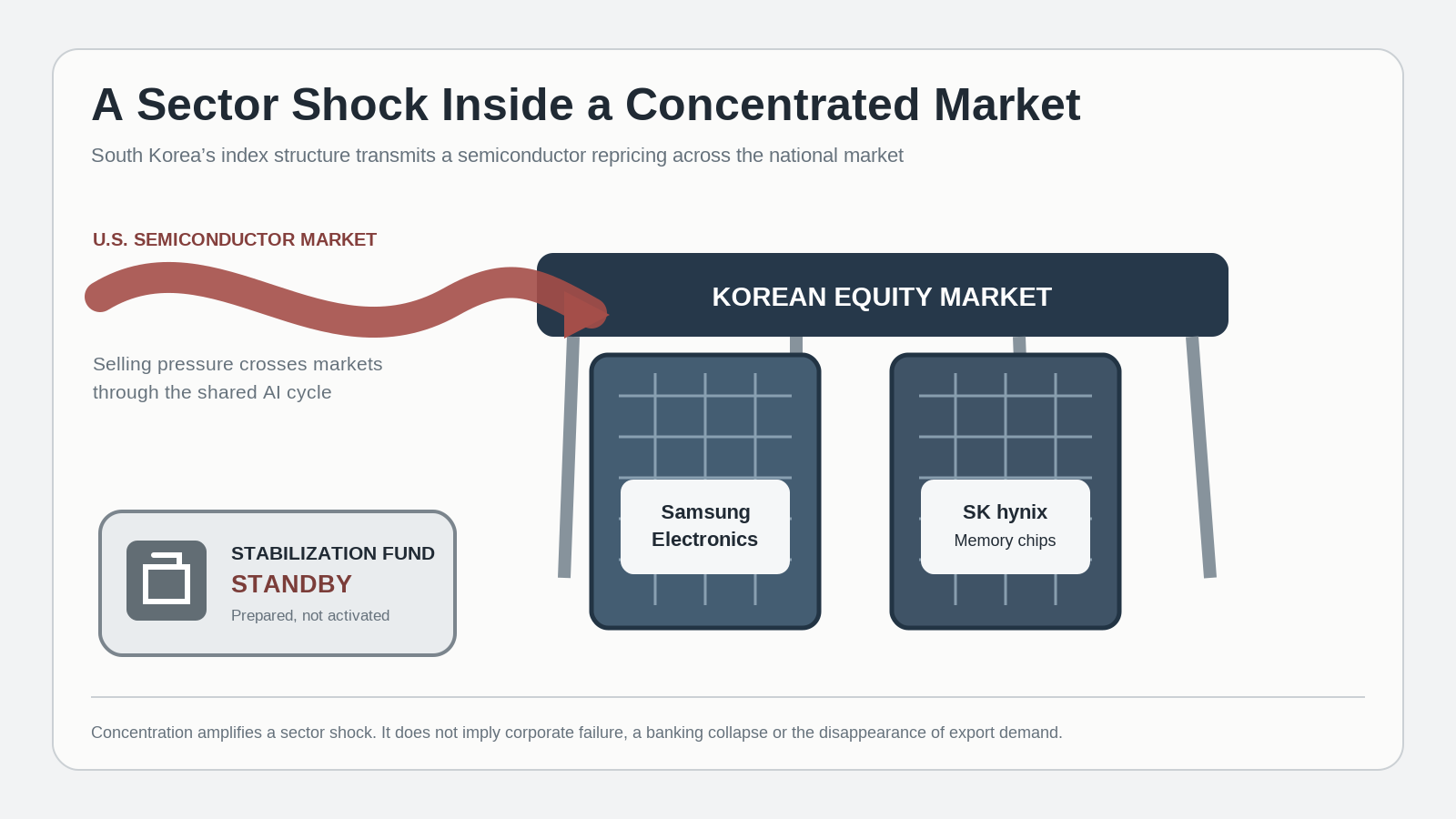
Samsung Electronics and SK hynix together accounted for roughly 46.5% of KOSPI market value in a November 20 snapshot. A shock to the memory and AI complex therefore has consequences far beyond two stocks.
Samsung Electronics closed Monday at ₩177,500, down 3.06%. SK hynix ended at ₩1,085,000, down 2.52%. Their daily moves were smaller than the index's worst intraday decline, but their weight makes every change consequential for the national benchmark.
The immediate pressure arrived from the United States. The Philadelphia Semiconductor Index had fallen 10.7% on Friday, while broader U.S. technology selling revived doubts about the amount of debt-financed AI investment and the timetable for returns.
That transmission does not mean Samsung or SK hynix is failing. It means the same earnings narrative supports a very large share of Korea's market value. When investors mark down the future value of the AI cycle, the KOSPI has fewer unrelated sectors large enough to offset the move.
The stabilization fund is a backstop, not an earnings forecast
The government has prepared a ₩10.76 trillion stock-market stabilization fund for possible activation. The Ministry of Finance and Economy said authorities would establish activation procedures and improve the fund's effectiveness so it could be deployed if market conditions warranted.
It remained on standby at Monday's close. Officials did not provide a deployment date, and the finance minister said the amount could be reviewed if activation became necessary.
Korea last used a stabilization fund to buy equities in 2008. A separate fund assembled during the 2020 pandemic was not deployed. That history gives the announcement symbolic force: the state is signalling that it is willing to interrupt disorderly selling.
An activation could produce a powerful short-term rebound. It would not determine memory prices, AI-capital-spending budgets or the margins Samsung and SK hynix can earn in 2027. Policy can change the market's liquidity and risk tolerance more quickly than it can change corporate cash flows.
The correct distinction is therefore between a market backstop and a valuation anchor. The fund may provide the first. Earnings and discount rates must provide the second.
Exports are booming while equities anticipate a weaker future
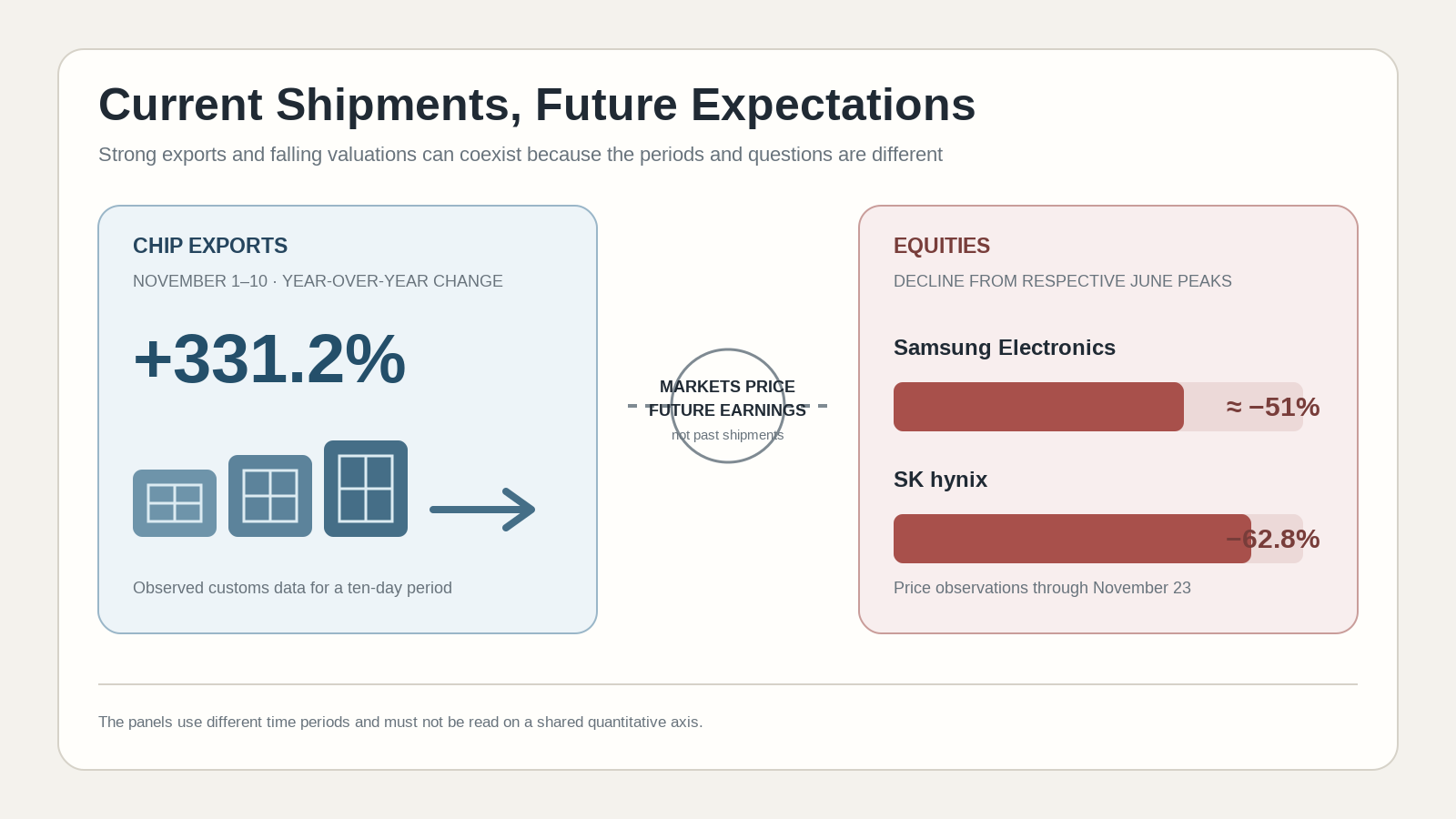
Korea's trade numbers make the selloff look counterintuitive. Exports reached $33.5 billion from November 1 through November 10, up 111.9% from a year earlier, according to customs data reported by Yonhap.
Semiconductor exports rose 331.2% to $16.6 billion and represented 49.7% of all outbound shipments during the period.
The equity market is looking beyond those shipments. Samsung Electronics was approximately 51% below its June high, while SK hynix was 62.8% below its own June peak. The dates and measurement windows are different; the export increase and the price declines should not be placed on one quantitative axis.
What they show together is a conflict between current activity and future expectations. There are at least three possible explanations:
- Investors expect extraordinary memory prices and margins to normalise after an unusually profitable period.
- The market has become too pessimistic about the durability of AI demand and long-term supply contracts.
- Both forces are operating: earnings can remain high while the valuation multiple falls because uncertainty and required returns increase.
Strong shipments alone cannot decide among those explanations. The next useful evidence will come from order visibility, inventory, realised memory pricing, customer capital expenditure and company guidance—not from the export headline in isolation.
The Bank of Korea adds a second constraint
The Bank of Korea's base rate is 3.00%, and the next policy decision is scheduled for November 26. At its October meeting, the board kept the rate unchanged after two earlier increases, citing strong export-led growth, inflation around 3% and financial-stability risks.
The draft supplied for this edition included an expectation of a 25-basis-point increase. A sufficiently current consensus was not verified, so this article does not present that outcome as the base case.
The market selloff complicates the decision but does not determine it. A central bank can pause because financial conditions have tightened, or it can continue tightening because currency and inflation risks remain dominant. The relevant evidence will be the policy statement and updated projections, not speculation about how the equity market “needs” the bank to respond.
Balance sheets matter more after a valuation shock
The selloff encourages comparisons among companies exposed to grid investment, semiconductor equipment, defence and shipbuilding. They should not be treated as one homogeneous multibagger basket.
The latest available balance-sheet snapshots also differ from some older figures in the original draft.
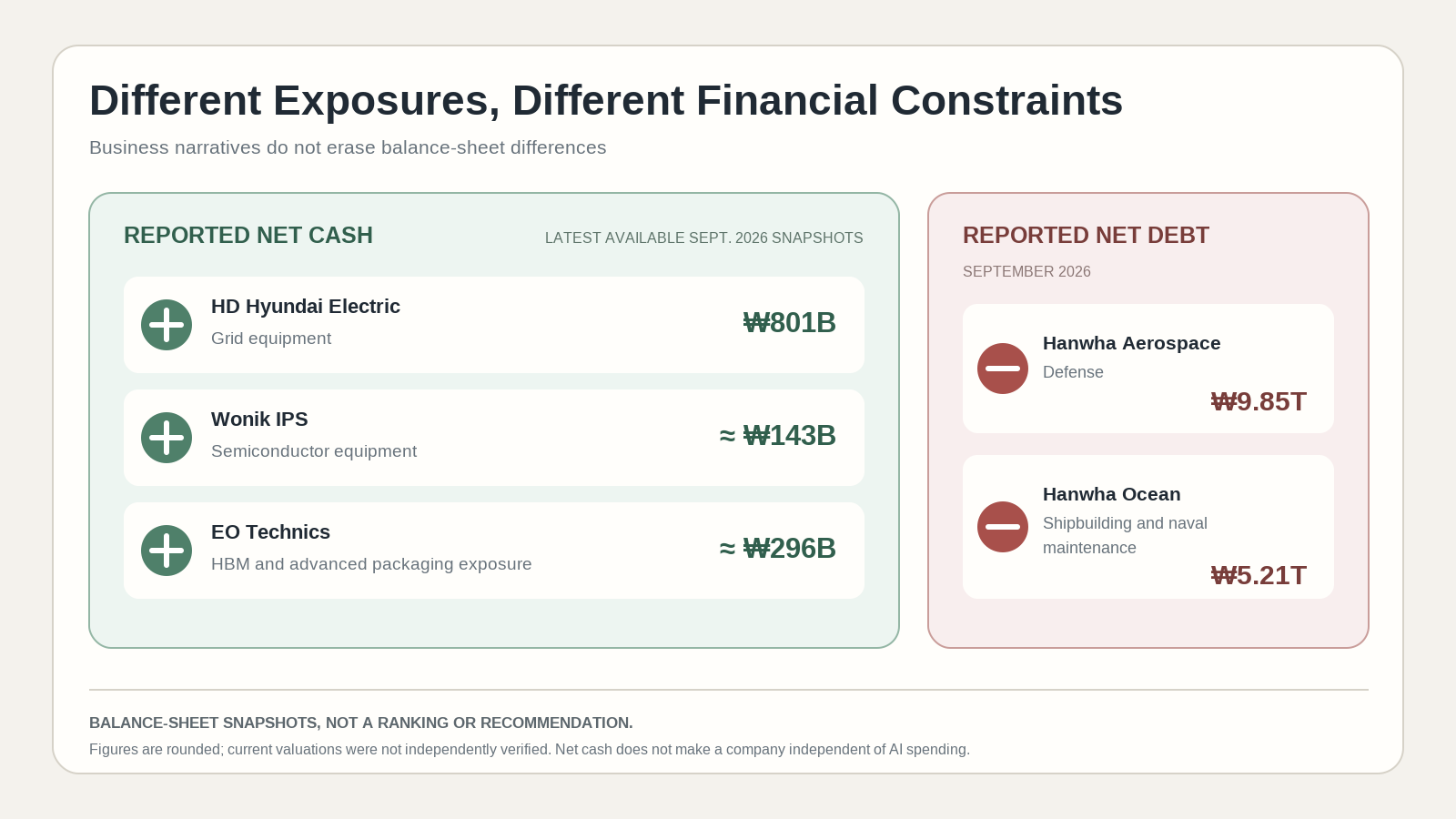
HD Hyundai Electric reported roughly ₩801 billion in net cash at the end of September. Its thesis rests on transformers, grid equipment and power-distribution investment. Data-centre demand can support the order book, but tariffs, project timing and margin normalisation remain risks.
Wonik IPS had approximately ₩143 billion in net cash in its September snapshot. The company is directly exposed to semiconductor-equipment spending. A strong balance sheet improves resilience; it does not prevent revenue or valuation from falling when Samsung and SK hynix cut capital expenditure.
EO Technics showed approximately ₩296 billion in net cash at the end of September. HBM and advanced-packaging exposure provides a high-growth narrative, while customer concentration and a potentially demanding multiple remain the failure points.
The two Hanwha companies belong in a different financial category.
Hanwha Aerospace reported ₩9.85 trillion in net debt in its third-quarter presentation, not ₩6.7 trillion. The lower number in the original draft corresponded more closely to cash and short-term investments than to net debt. Defence exports may provide a secular growth thesis, but leverage makes execution and cash conversion more important.
Hanwha Ocean carried approximately ₩5.21 trillion in net debt at the end of September. Its shipbuilding and naval-maintenance exposure can benefit from order growth, while leverage, construction execution and currency sensitivity remain material constraints.
What to monitor next
- Stabilization-fund activation. Preparation is confirmed; deployment is not.
- The November 26 BOK decision. The statement will show whether inflation, the currency or tightening financial conditions carries the most weight.
- Foreign selling. A sustained reduction would be more informative than one session's smaller outflow.
- Samsung and SK hynix order commentary. Long-term contracts matter only alongside pricing, volume and margin visibility.
- The next full export release. It will test whether the extraordinary early-November pace persisted.
- Breadth beyond semiconductors. A durable recovery should not depend entirely on the two stocks that already dominate the index.
Editorial judgment: Korea's selloff is best understood as a concentrated equity-market repricing of the AI and memory cycle. The export boom argues against describing the move as proof of an immediate economic collapse. The depth of the price decline argues against assuming that strong present demand is sufficient to protect future valuations.
The market is capable of a sharp rebound, especially if the stabilization fund is activated. It has not yet completed the harder task: establishing where earnings and valuation multiples settle after the AI cycle's expectations are reset.
Disclosure and limits: This article is general market commentary based on dated public sources. It contains no price targets, personalised advice or buy and sell recommendations. Balance-sheet figures are rounded historical snapshots and should be checked against the latest company filings before any investment decision.
Sources and references
- KBS World — KOSPI close and distance from June record
- The Korea Herald — November 23 market close
- Ministry of Finance and Economy — Market stabilization measures
- Yonhap — November 1–10 export data
- Bank of Korea — October 2026 monetary-policy decision
- The Chosun Daily — Samsung and SK hynix declines from June peaks
- Hanwha Aerospace — Third-quarter 2026 investor presentation
- Hanwha Ocean — Balance-sheet statistics