
Market Calls / Japan
Japan Market Call: A Rebound Is in View. A Recovery Is Not Yet Proven.
Japan's November 20 selloff was broad, while selected AI-linked names took deeper losses. A powerful U.S. technology rally during Tokyo's holiday points toward opening relief, but durability, disclosure questions and the BoJ path remain unresolved.

Market date
Tokyo did not trade on Monday. That makes Tuesday's reopening a particularly sharp test: Japan's last cash session ended in a broad selloff, while U.S. technology shares rallied dramatically during the Japanese holiday. Futures point to a higher opening, but the first print will not settle the questions about AI spending, corporate disclosures or the Bank of Japan.
Reporting cut-off: Monday, November 23, 2026, after the U.S. cash close. Market levels can change before Tokyo reopens on November 24. Figures for Tokyo equities below refer to Friday, November 20, unless stated otherwise. This is an evidence-based market call, not a trade instruction.
The last Tokyo session: broad losses, concentrated damage
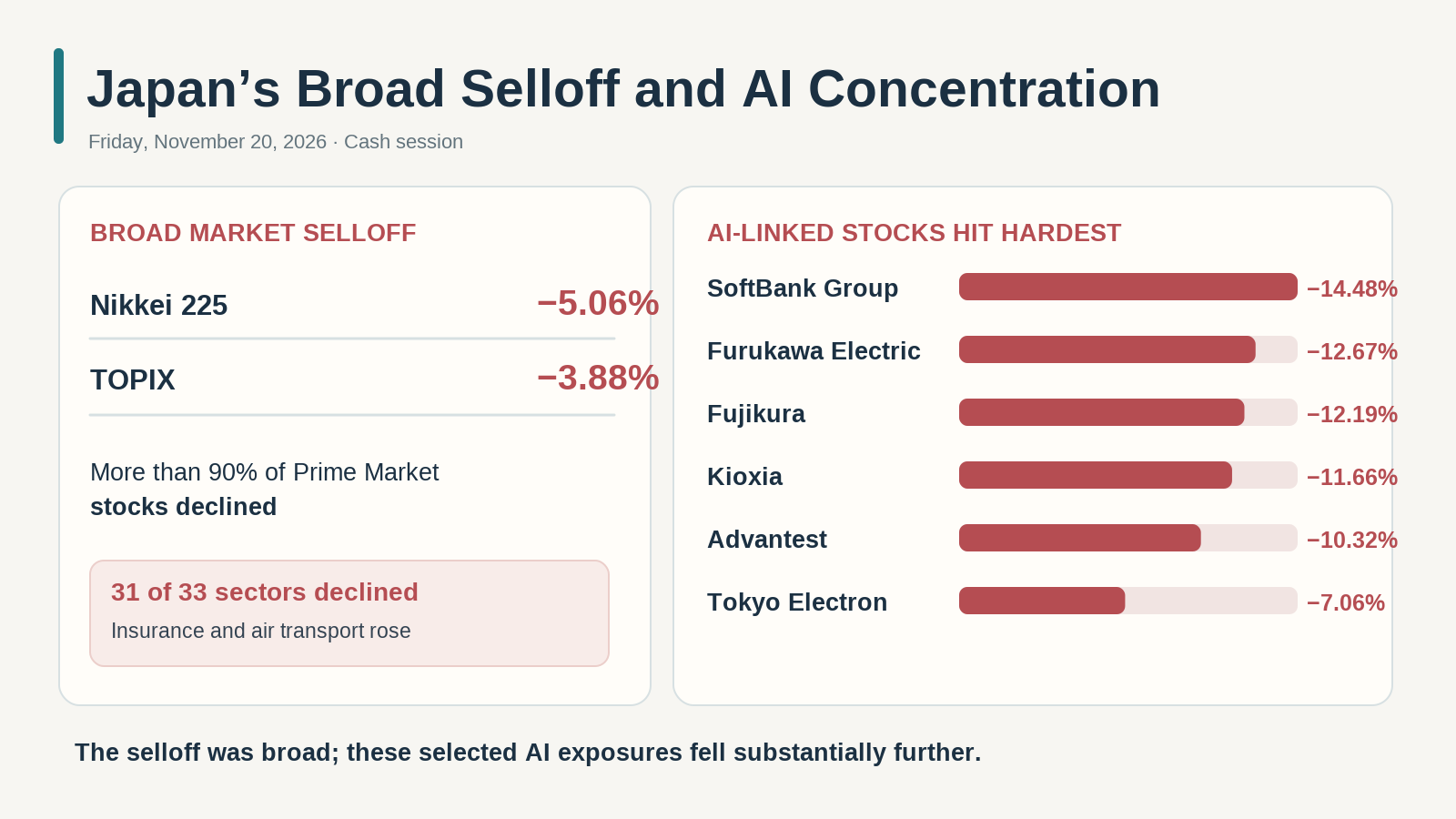
The Nikkei 225 closed at 56,436.65, down 5.06% or 3,007.56 points, at its session low. The TOPIX closed at 3,674.22, down 3.88%. Kabutan's closing report counted 1,443 declining Prime Market shares against 90 advancing, so the retreat was unmistakably market-wide.
The breadth deserves precision. The exchange's sector table shows 31 of 33 indices down, with insurance at +0.65% and air transportation at +0.33%. Those two exceptions do not change the market-wide character of the selloff.
The six AI-related names selected for the accompanying graphic fell much more than the broad index. Kabutan's November 20 price table records SoftBank Group −14.48%, Furukawa Electric −12.67%, Fujikura −12.19%, Kioxia −11.66%, Advantest −10.32% and Tokyo Electron −7.06%. These are closing-session changes, not a forecast of the next move.
The preceding U.S. technology rout, doubts about returns on AI investment and selling before Japan's holiday offer a plausible explanation for the intensity. Position unwinds are an interpretation, however, not something one can infer trade by trade from closing prices. The JPX calendar confirms that November 23 was a Japanese market holiday; domestic cash trading had no chance to incorporate Monday's U.S. reversal.
The U.S. reversal changes the setup, not the evidence
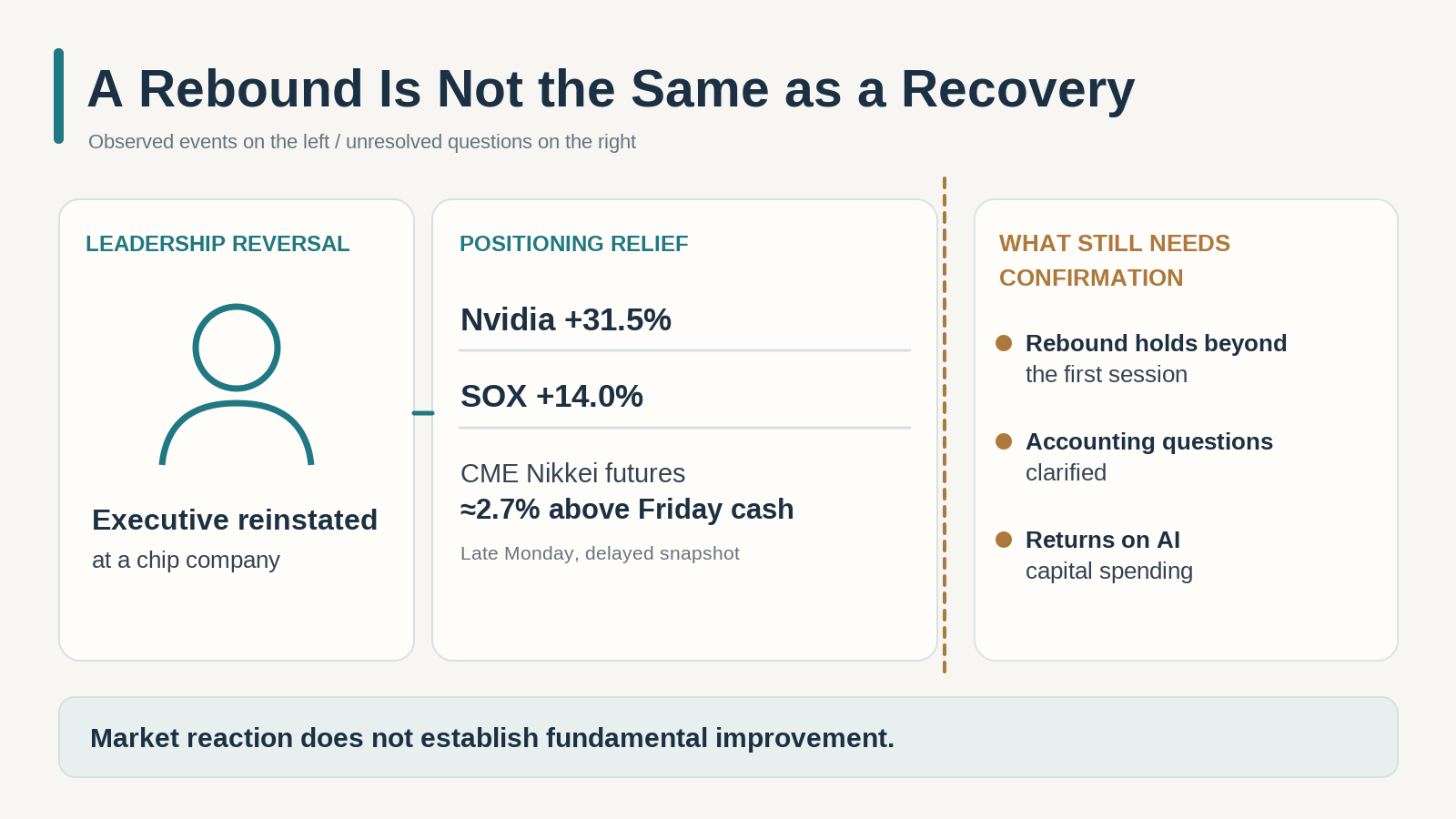
On Monday, Nvidia's board announced Jensen Huang's reinstatement as president, chief executive and a director. The board said its independent investigation related to a reported foreign-intelligence effort would continue. Its announcement is a leadership decision, not a resolution of every question facing the company.
The U.S. market response was forceful: Reuters reported Nvidia +31.5% and the Philadelphia semiconductor index (SOX) +14.0% at Monday's close. Reuters also reported an SEC inquiry into potential Nvidia accounting issues, citing people briefed on the matter. That report should be identified as a reported inquiry, not a settled finding of wrongdoing. The board's reinstatement does not itself answer the accounting question or prove returns on customers' AI capital spending.
Nikkei futures reacted while Tokyo cash equities were shut. A delayed CME futures quote put the December contract near 57,955 late Monday, roughly 2.7% above Friday's Nikkei cash close. These are different instruments and trading sessions. The futures premium is a directional reopening clue, not a guaranteed Nikkei opening or closing level. It can change before Tokyo trades.
My base case is an initial relief rally in the names punished hardest on Friday, particularly semiconductors, equipment, data-center cabling and SoftBank. The test is whether buying extends beyond a gap at the open and beyond one session. A violent reversal in crowded positions can happen without a corresponding change in orders, margins or cash flow.
The Bank of Japan's uncomfortable mix
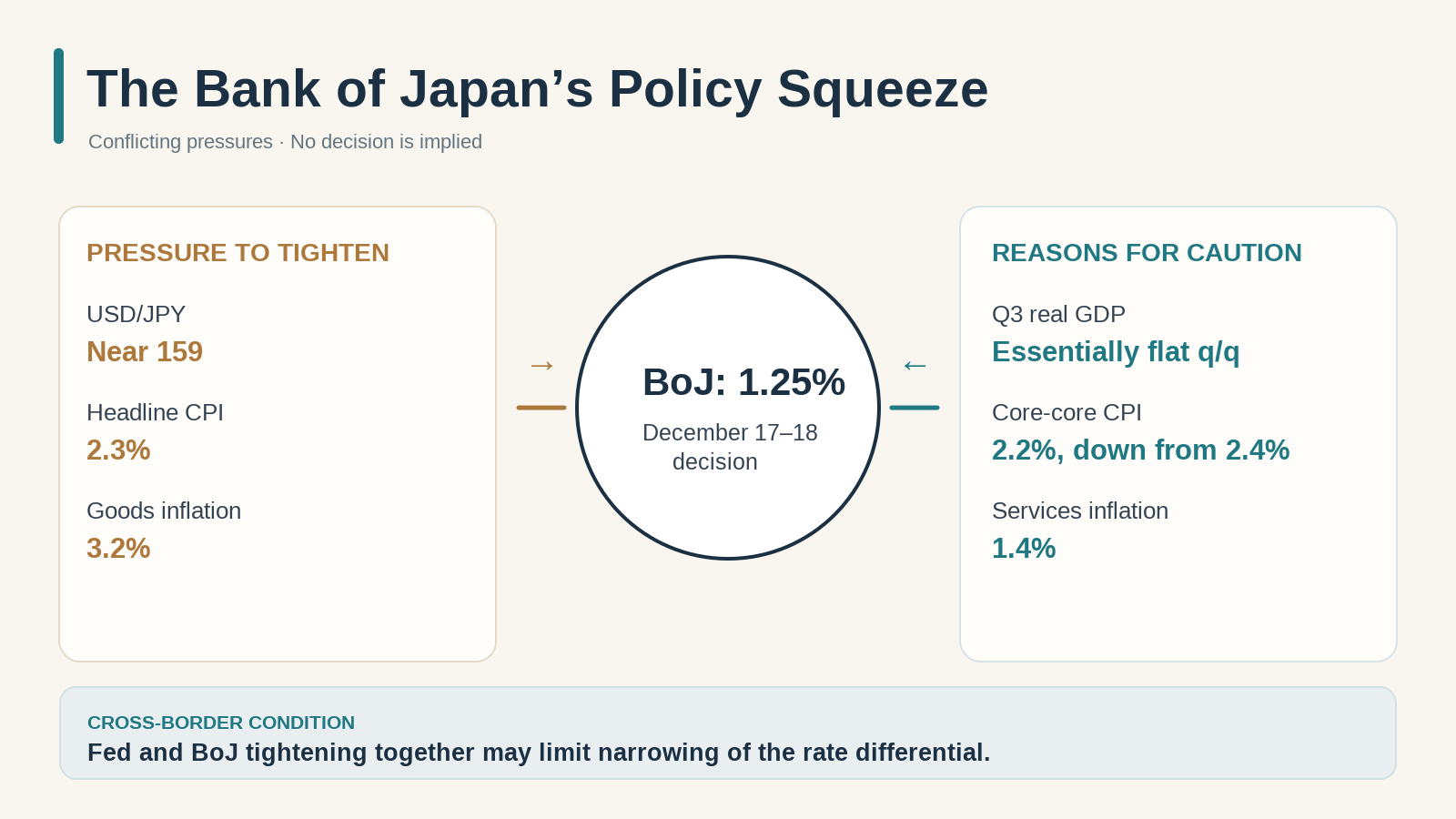
The BoJ's policy rate remains around 1.25%, with its next policy meeting scheduled for December 17–18. A Reuters survey conducted November 11–18 found 61 of 71 economists expected a 25-basis-point increase to 1.50% in December. That is a survey of expectations, not the bank's decision.
Japan's October CPI release showed 2.3% headline inflation and 2.2% for the measure excluding fresh food. The measure excluding fresh food and energy was 2.2%, down from 2.4% in September. Goods prices rose 3.2% year over year and services 1.4%. A dollar near ¥159 adds pressure through imported costs, but softer underlying inflation and services growth complicate a simple tightening story.
Growth adds another nuance. The Japanese Cabinet Office's first estimate describes third-quarter real GDP as −0.0% quarter on quarter, essentially flat after rounding, and −0.1% at an annualized rate. The unit matters when judging how much activity slowed.
Governor Ueda has said rates should continue to rise as economic and price conditions allow. At the same time, a fragile growth reading, subdued services inflation and sharp equity losses argue for care in timing. If the Federal Reserve and BoJ were both to tighten, the interest-rate differential might narrow more slowly than a BoJ hike alone suggests. That is a conditional cross-border interpretation, not a forecast of either central bank's decision.
Where to watch the reopening
| Exposure | Friday's signal | What would matter after the opening gap |
|---|---|---|
| Semiconductor test and equipment: Advantest, Tokyo Electron | Both fell far more than TOPIX. | Whether U.S. chip relief persists and companies' order outlooks justify valuations. |
| Memory and AI infrastructure: Kioxia, Furukawa Electric, Fujikura | Double-digit losses exposed sensitivity to AI capital-spending expectations. | Demand and pricing evidence, not simply a bounce from Friday's lows. |
| SoftBank Group | −14.48% made it an acute expression of risk aversion. | Financing, asset values and the economics of its AI exposure. |
| Banks and domestic businesses | Different earnings drivers than semiconductor shares. | The actual BoJ path, yields and domestic demand, rather than a one-day SOX move. |
This edition makes no market-capitalization or P/E ranking for the names above. A low multiple built from unreconciled share counts or cyclical earnings is not a reliable ranking. Current primary company filings are needed before making a valuation claim.
The leadership reversal and market reaction are observable. The durability of Tuesday's rebound, the status and substance of the reported accounting inquiry, and returns on AI spending remain separate checkpoints.
The next checks
- Tuesday, November 24: Tokyo reopens. Compare the breadth and persistence of the move with the AI leaders' opening gap.
- Wednesday, November 25: The U.S. BEA plans to release October personal income and outlays, including PCE inflation.
- December 8–9: The Federal Reserve meeting may reset the U.S. side of the rate differential.
- December 17–18: The BoJ meeting will test the survey's tightening expectation against the bank's actual decision.
Editorial judgment: A higher opening is plausible after Monday's U.S. surge. It is not evidence that Friday's market-wide repricing was mistaken or that AI earnings concerns have been resolved. The stronger claim needs subsequent prices, company disclosures and operating results.
Disclosure and limits: This is general market commentary based on dated public sources. Futures and exchange rates are time-sensitive; the article does not provide a price target, a buy or sell signal, or personalized investment advice. Readers should check primary releases and current market data before acting.