
Market Calls / Japan
Japan’s Chip Rebound Lifts the Nikkei 2.11% as AI Spending Risks Linger
Advantest led Tokyo’s rebound as the Nikkei closed near its high at 58,711.11. Tokyo inflation keeps December in focus, while Kioxia’s valuation depends on the next NAND cycle.

Market date
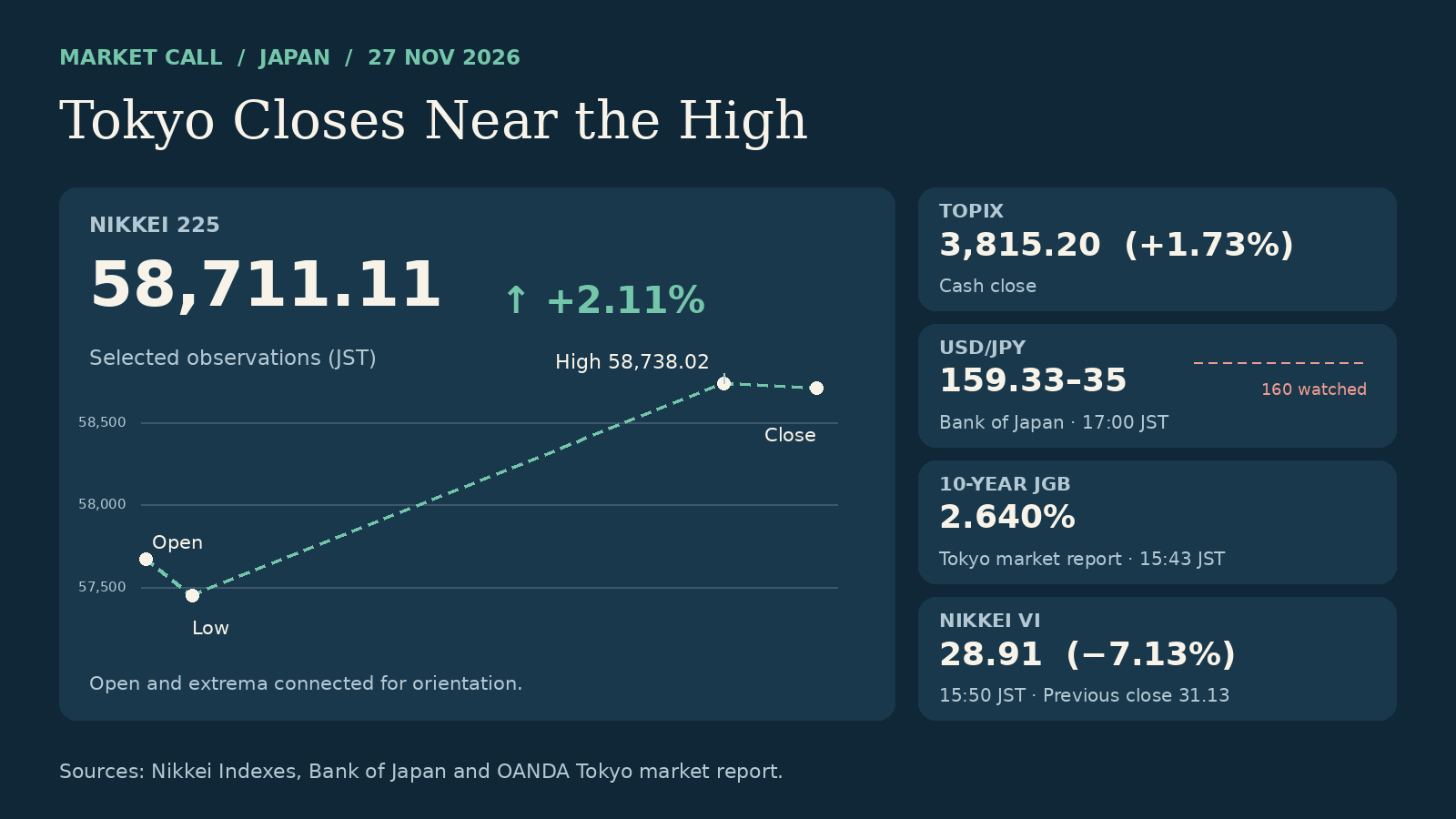
The Nikkei 225 gained 1,211.95 points on Friday and still finished below its late-October level. Both figures matter. The close of 58,711.11 (+2.11%) was only 26.91 points below the day’s high. The index gained 4.03% for the week and remained 6.35% below its October 23 close.
Chip stocks did much of the work. TOPIX still gained 1.73%, and 160 of the Nikkei’s 225 constituents advanced. Friday was broader than a rally in three names, even though three names accounted for roughly half the Nikkei’s gain. The U.S. cash market had been closed for Thanksgiving on Thursday, leaving Tokyo without a fresh Wall Street close to trade against.
Tokyo at the close
| Indicator | November 27 reading |
|---|---|
| Nikkei 225 | 58,711.11 (+2.11%) |
| Nikkei intraday range | 57,447.16–58,738.02 |
| TOPIX | 3,815.20 (+1.73%) |
| Nikkei breadth | 160 up, 64 down, 1 unchanged |
| Nikkei constituent trading value | ¥6.48 trillion |
| Nikkei VI | 28.91 (−7.13% at 15:50 JST) |
| USD/JPY | 159.33–35 (BoJ, 17:00 JST) |
| 10-year JGB yield | 2.640% (OANDA Tokyo report, 15:43 JST) |
The Nikkei VI ended Thursday at 31.13 and reached 42.35 intraday on Friday before falling to 28.91. The late drop in implied volatility gives an incomplete picture of how the session traded. The ¥6.48 trillion turnover figure covers the Nikkei’s constituents. A separate daily currency feed showed USD/JPY at 159.56. The Bank of Japan’s timed Tokyo quote is the basis for the comparison in the graphic.
Chip stocks led and banks joined in
Advantest added about 379 points to the Nikkei. Tokyo Electron contributed about 177 and SoftBank Group about 73. Together they accounted for roughly 52% of the gain, using changes in closing prices, the index’s price conversion factors and its divisor. TOPIX’s advance and the Nikkei breadth figures show that buying reached beyond those heavyweights.
Socionext gained 12.56%, Lasertec 9.98%, Kioxia 8.86% and Advantest 7.07%. Fujikura rose 5.90% and Tokyo Electron 4.43%. Banks advanced too, with MUFG up 2.37% and SMFG up 2.35%. Recruit, Capcom and Kikkoman fell around 3%.
A rebound after Wednesday’s selloff is a plausible reading of the session. Its durability depends on orders, earnings estimates and buyers returning after the holiday. Price action alone gives little evidence on any of the three.
How November changed the AI trade
- November 2. Kioxia fell 15.78% after its outlook for the December quarter disappointed investors. The company had guided for roughly ¥2 trillion in operating profit, near the September quarter’s level.
- November 4. Kioxia was down about 11.6% at the Tokyo morning break and SoftBank about 9% in the reported intraday snapshot. U.S. election results brought a Texas campaign pledge to pause new data centers into focus. The pledge’s scope, timing and implementation remained open.
- November 20. The Nikkei closed 5.06% lower, following an early reading of about −4.3%. Reuters reported SoftBank down around 15% in early trading.
- November 25. The Nikkei fell 2.78%, SoftBank about 14.8% and South Korea’s KOSPI 6.16%. The breadth of the regional selloff put the financing and profitability of AI investment back in focus for investors.
- November 27. Chip stocks led the rebound into the close. Kioxia’s close of ¥8,450 was still about 25.5% below its November 2 close of ¥11,345.
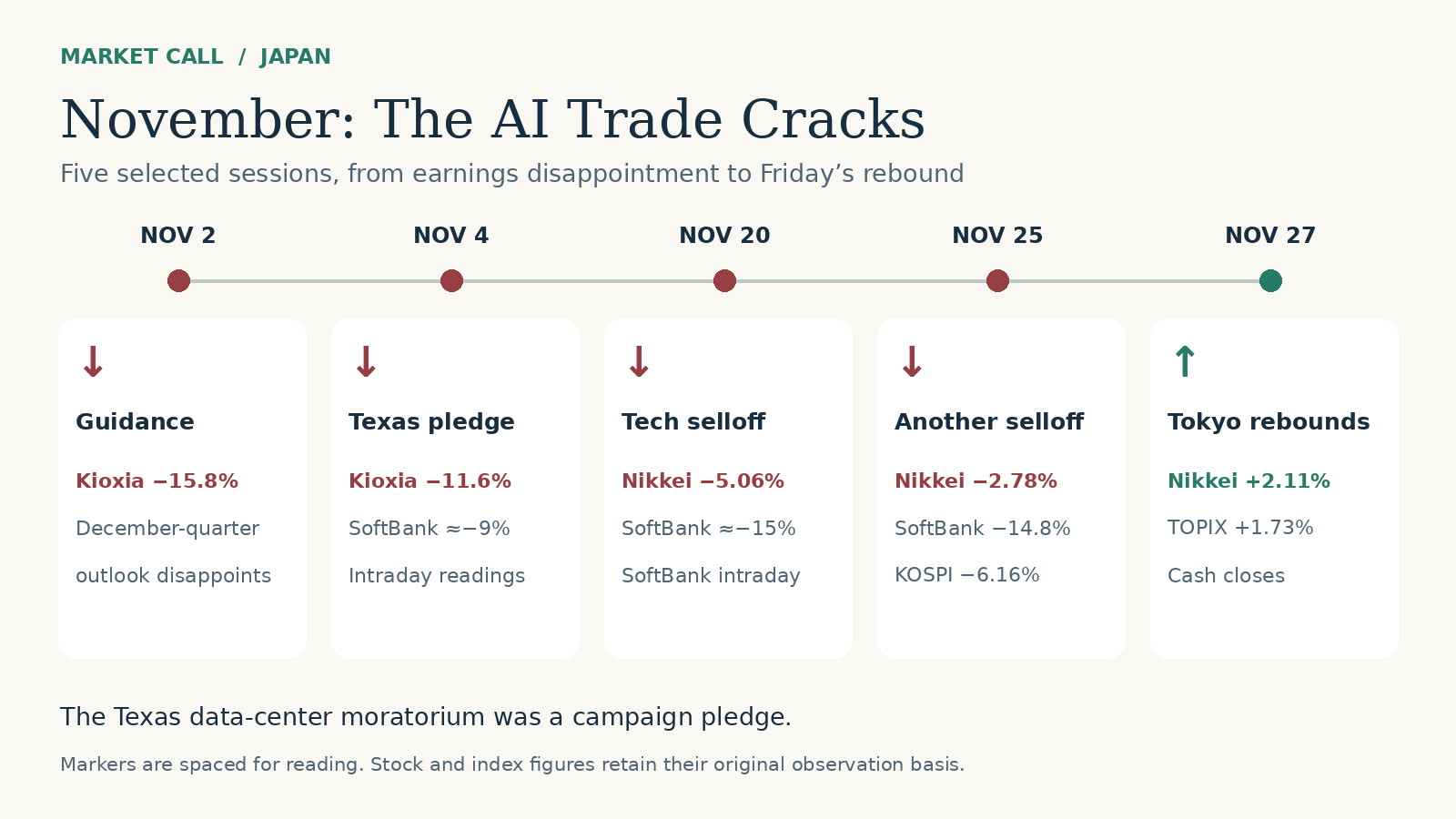
November put a higher burden of proof on companies whose share prices depend on continued growth in AI infrastructure spending. A Texas policy pledge and a hardware maker’s earnings guidance can both affect sentiment, through different channels. The company-specific question is whether an order book will become revenue and cash at the margins investors expect.
Tokyo inflation leaves a December hike in play
Tokyo’s preliminary November readings were 2.8% headline, 2.9% excluding fresh food, and 2.5% excluding fresh food and energy, year over year. The measure excluding fresh food rose from 2.6% in October. The measure excluding both fresh food and energy eased from 2.6%. OANDA attributed part of the acceleration to the end of electricity and gas subsidies. Reuters’ poll had put the fresh-food-excluded reading at 3.0%.
The Bank of Japan’s policy rate is 1.25%, and its next meeting is December 17–18. Board member Naoki Tamura argued on Thursday for reaching neutral sooner and responding promptly if inflation risks intensify. His remarks keep a December move in view. The decision belongs to the full board and will depend on the data that arrive before the meeting.
Near ¥160 per dollar, investors are watching the risk of intervention. The level is a market reference. Japanese authorities have discretion over the timing and scale of any operation. Meanwhile, the different directions in Tokyo’s two core measures make the composition of inflation at least as relevant as the headline increase.
Six stocks and the variables that matter
The reported results below use dated company reporting periods. The market moves refer to November 27. Valuation estimates are identified with their earnings basis where available.
| Stock | Friday close | What the financials say |
|---|---|---|
| Kioxia (285A) | ¥8,450 (+8.86%) | The October 30 filing shows ¥4.247 trillion of revenue and ¥3.265 trillion of IFRS operating profit for the six months through September. Its December-quarter IFRS operating-profit outlook was ¥1.995 trillion. |
| Advantest (6857) | ¥26,585 (+7.07%) | September half-year sales grew 60.5% to ¥845.2 billion, with operating profit of ¥456.8 billion. AI and high-performance chip testing are central to the outlook. Investment-security gains also contributed to financial income. |
| Tokyo Electron (8035) | ¥8,220 (+4.43%) | September half-year sales rose 41.3% to ¥1.667 trillion. The company forecast ¥381.69 of split-adjusted earnings per share for the year ending March 2027. Friday’s price was about 21.5× that forecast. Customer investment and China exposure matter to the outcome. |
| SoftBank Group (9984) | ¥2,984.50 (+3.13%) | The OpenAI exposure makes asset values, financing costs and liquidity central to the analysis. A discount to net asset value can persist if investors question realizable values or the cost of funding. |
| Lasertec (6920) | ¥33,600 (+9.98%) | September-quarter sales fell 25.5% and operating income 41.0% year over year. At the company’s ¥1,003.27 full-year EPS forecast, the close implies about 33.5×. The recovery case depends on inspection-system shipments and margins. |
| MUFG (8306) | ¥3,192 (+2.37%) | September half-year profit attributable to owners of the parent rose 26.1% to ¥1.631 trillion. Management’s March 2027 earnings target is ¥2.8 trillion. Japanese rate increases can help lending margins, while deposit costs and bond valuations can offset some of that benefit. |
For Kioxia, the six-month filing provides a clean comparison period. The draft’s trailing revenue and fiscal-year revenue cover different windows. Use the comparable six-month figures of ¥4.247 trillion versus ¥791.1 billion to see how sharp the earnings cycle has been.
Kioxia also adopted a medium-to-long-term policy of allocating excess funds to shareholder returns. What ultimately qualifies as excess depends on investment needs, financing and cash generation. Production allocations and long-term agreements can give visibility into volume. The realized selling price and margin are separate questions.
Kioxia’s low multiple depends on the earnings denominator
At Friday’s price, StockAnalysis displayed 1.89× forward earnings. A published account of Goldman Sachs’ November research cited about 1.5× for the fiscal year ending March 2028. These are separate estimates with different price dates or earnings bases. The screen alone gives little evidence about normalized earnings.
The same account described two Goldman scenarios for 2028 AI capital spending. If spending were flat year over year, Kioxia’s operating profit for the year ending March 2029 would be about 22% below Goldman’s base case. With spending down 10% year over year, operating profit would be about 52% below the base case. The original research note was unavailable for direct review. These figures come from the published account and describe conditional model outcomes.
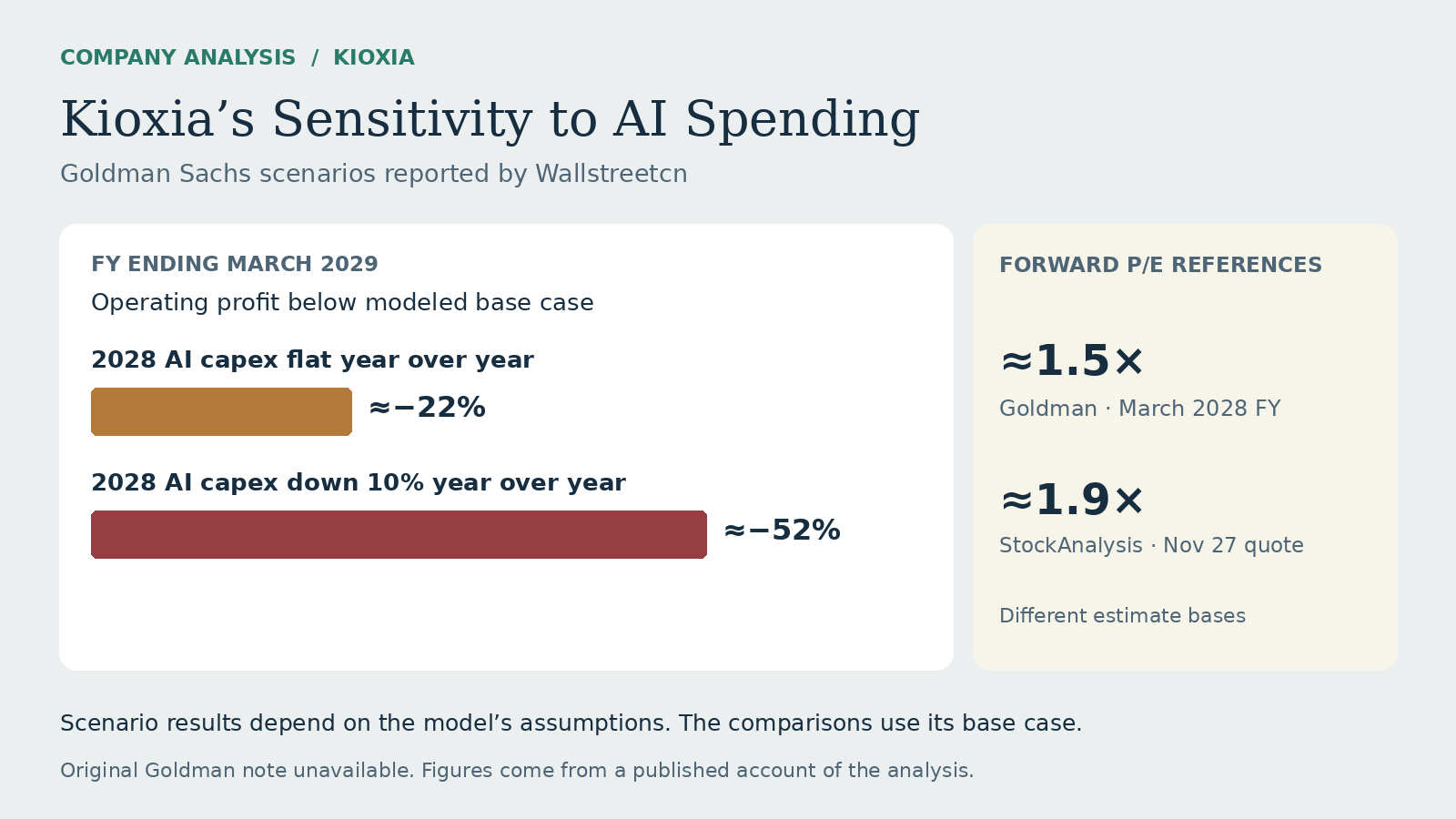
The figures put the valuation question in practical terms. At a fixed share price, a lower earnings denominator raises the multiple. The stress test measures operating profit, so its percentage changes cannot be applied mechanically to earnings per share. A fuller Kioxia case has to account for NAND prices, margins, capex, share count and cash available for distribution.
Advantest and Tokyo Electron pose a different question. Recent results give investors evidence of demand. The price still depends on how long customer orders and margins can hold up. MUFG’s sensitivity runs more through lending and funding costs. Friday’s gain tells us little about which of those earnings assumptions will hold.
Editorial note. This market call is for information and education. It provides market commentary and research questions. Readers should consult the original filings and assess investment risks independently.
Sources and references
- Nikkei 225 official daily summary, November 27
- Nikkei 225 official daily summary, November 20
- Nikkei 225 official daily summary, October 23
- Nikkei VI data, November 27
- Tokyo cash session and 10-year JGB, OANDA
- USD/JPY Tokyo observations, Bank of Japan
- Tokyo CPI official preliminary release, e-Stat
- Tokyo core CPI poll, Reuters via MarketScreener
- Tamura’s November 26 address, Bank of Japan
- Index contributions, Sōba no Wake
- Kioxia guidance and November 2 selloff, Reuters
- November 4 intraday observations and Texas pledge
- November 20 early session, Reuters via Business Recorder
- Kioxia’s IFRS half-year release, JPX
- Kioxia shareholder return policy
- Kioxia market close and valuation reference, StockAnalysis
- Goldman Sachs analysis as reported by Wallstreetcn via Longbridge
- Advantest September half-year financial review
- Tokyo Electron September half-year release
- SoftBank Group November 10 earnings materials
- Lasertec September quarterly report
- MUFG September half-year release
- Thanksgiving holiday trading hours, NYSE