
Market Calls / Japan
Japan’s AI Rebound Has Not Settled the Argument
The Nikkei rebounded 3.91% as Nvidia leadership relief spread through the AI supply chain. A weak yen, expected monetary tightening and unresolved earnings questions still shape Japan’s recovery.

Market date
Tokyo finally had its chance to react. After Monday’s market holiday, the Nikkei 225 jumped 3.91% on Tuesday to 58,644.63 as investors bought back semiconductor and AI infrastructure shares. Nvidia’s decision to reinstate Jensen Huang gave the trade an immediate catalyst. It did considerably less to answer the earnings questions behind November’s selloff.
The distinction matters for Japan. Chip-testing equipment, memory and data-center components have different profit cycles, even when their shares rise together. Banks face another set of forces altogether: a weak yen, an economy that contracted in the third quarter and a central bank still expected to raise borrowing costs.
Market date: November 24, 2026. Equity figures refer to the Asian cash session. Currency observations and policy expectations are dated snapshots.
A strong close, with leadership concentrated in AI
The Nikkei added 2,207.98 points, ending below its intraday high of 59,262.57. The broader TOPIX advanced 2.47% to 3,764.88. Relative to the 70,684 October peak cited in the original market record, the Nikkei remained about 17% lower; Friday’s close had been about 20% below that level.
Advantest gained 12.45%, Furukawa Electric 11.54% and Kioxia 9.95% in the supplied closing-price snapshot. Testing equipment, memory and the cables needed to connect data centers were all represented in the recovery. Toyota was essentially unchanged, while Nintendo declined.
The final breadth figures provide a useful correction to a purely index-based reading. On the Prime Market, 956 stocks rose, 558 fell and 37 were unchanged. Twenty-six of the 33 sectors advanced. Turnover reached approximately ¥8.07 trillion, according to Reuters’ Japanese closing report.
That was a broad positive session, although the larger Nikkei gain and the performance of semiconductor names show where the strongest buying occurred. The gap between the Nikkei and TOPIX alone would not establish weak breadth, particularly given their different construction and weighting.
The practical question is whether the rebound can extend into companies whose earnings do not rely on another year of exceptional AI investment. One session cannot establish that, but the closing breadth offers a better starting point than the intraday counts in early reports.
Leadership relief travels through the supply chain
Nvidia’s November 23 statement confirms that its board unanimously reinstated Huang as president, chief executive and a director. The board said it had received input from senior U.S. government officials and expressed confidence that his return posed no national-security risk.
Those are the board’s conclusions. The same statement says an independent committee’s investigation will continue. Nvidia also described a National Security and Export Control Committee and a search for a chief compliance officer. Reinstatement therefore resolves the immediate leadership decision while leaving investigative and compliance work in progress.
For Japanese suppliers, the immediate market effect was straightforward: less uncertainty about leadership at a pivotal customer encouraged investors to rebuild AI exposure. Whether that buying reflected short covering, new long-term positions or both cannot be established from the closing prices.
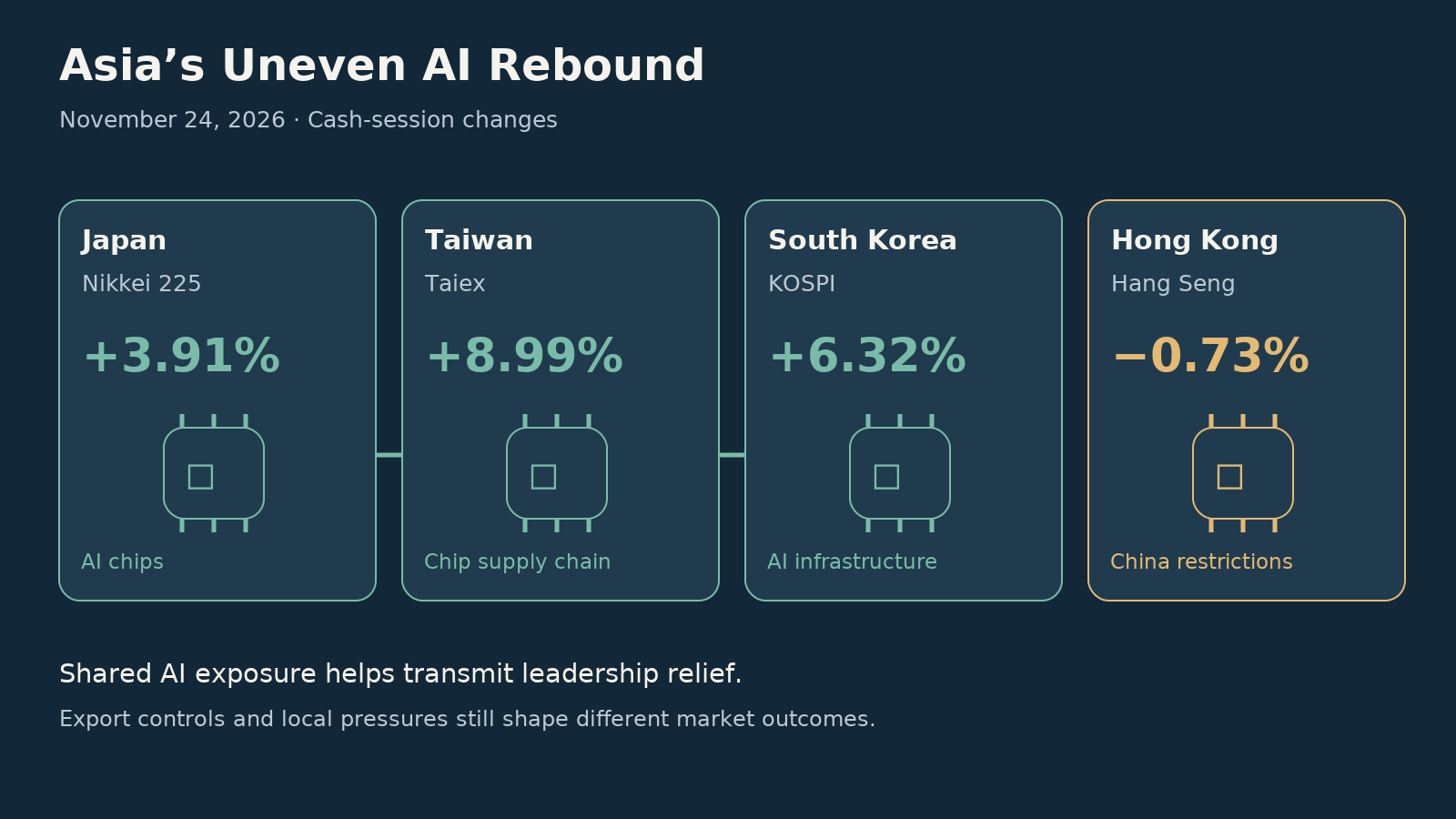
The regional response was substantial but uneven. Taiwan’s Taiex rose 8.99% and South Korea’s KOSPI gained 6.32% to 5,006.03. Hong Kong’s Hang Seng instead closed 0.73% lower at 22,219.65. The latter is the verified closing decline, replacing the approximate 0.8% in the draft.
Hong Kong’s weakness had its own mix of technology, resource and company-specific pressures. Reports of U.S. restrictions affecting an Alibaba Singapore subsidiary added to concerns about access to advanced chips. Nvidia-related relief did not remove those constraints, and it would be too simple to assign every Asian market the same driver.
The yen keeps policy in the foreground
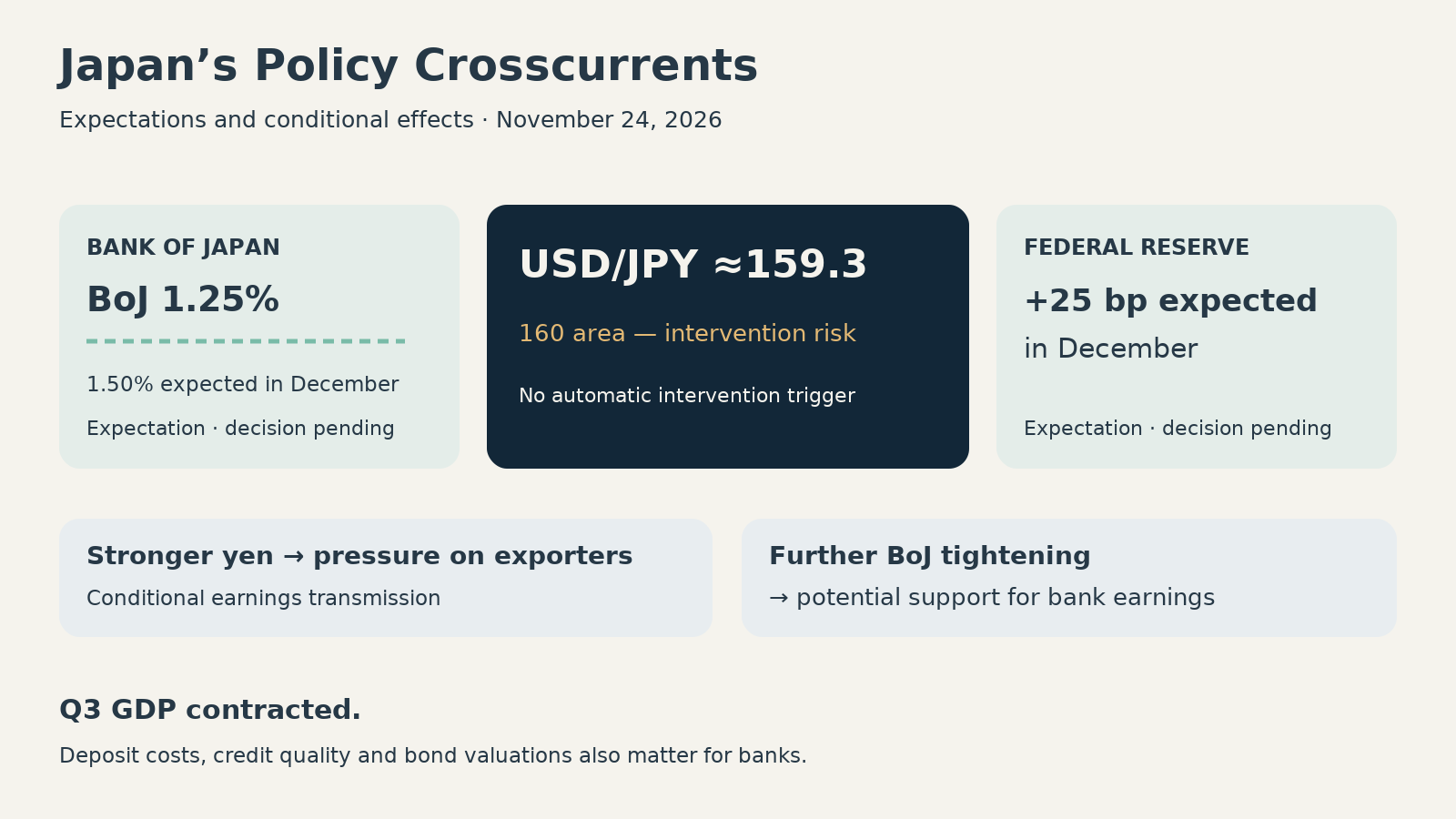
USD/JPY traded around 159.3 in the cited session snapshot. The area near 160 attracts attention because of intervention risk, but it is not an announced automatic trigger. Authorities can respond to the speed and disorderliness of currency moves as well as the exchange-rate level.
The Bank of Japan’s policy rate stood at 1.25%. In the Reuters survey conducted November 11–18, 61 of 71 economists expected a rise to 1.50% at the December 17–18 meeting. That consensus describes expectations, not a decision already taken.
Japan’s third-quarter contraction complicates the inflation and currency argument for further tightening. The outlook remains sensitive to household spending and the extent to which imported costs feed into prices. A stock-market rebound gives policymakers another observation; it does not settle that trade-off.
U.S. markets were also anticipating a 25-basis-point Federal Reserve increase in December. If both central banks tighten, a Japanese increase need not narrow the bilateral rate differential enough to produce sustained yen appreciation. Currency markets also respond to growth expectations, risk appetite and positioning, so the rate differential cannot supply a precise exchange-rate forecast.
A stronger yen could weigh on exporters’ translated profits and competitiveness. Further BoJ tightening could support bank interest income, but the benefit depends on deposit costs, loan demand and credit quality; rising yields can also hurt bond valuations. These are conditional channels, not guaranteed sector returns.
Four companies, four earnings questions
The rally makes it tempting to treat all AI-linked shares as variations on the same opportunity. Their economic exposures are less interchangeable than their daily price movements suggest.
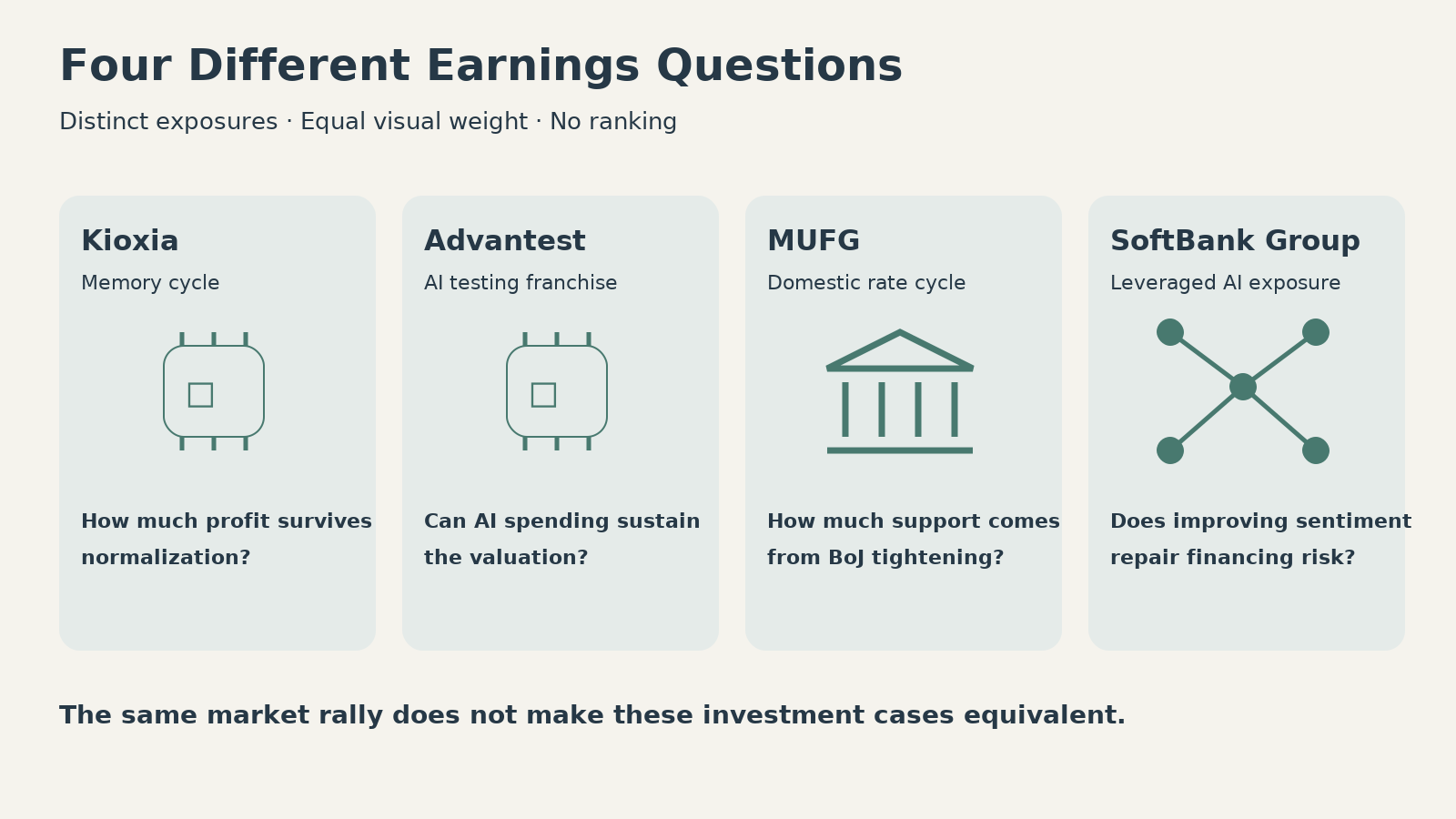
Kioxia: how much profit survives normalization? The central issue is the durability of NAND and SSD pricing. Exceptionally strong quarterly earnings can make a trailing or annualized P/E look low just as the cycle approaches its most profitable stage. A useful valuation requires a view on sustainable margins, volumes and capital expenditure across a weaker period. Annualizing one quarter is a scenario, not a full-year forecast.
Advantest: can AI spending sustain the valuation? Increasing chip complexity can create demand for more sophisticated testing. That supports a franchise argument, but investors still need to assess how much future growth the share price already assumes. Customer capital expenditure, testing intensity and the durability of margins matter more than the strength of a single rebound.
MUFG: how much support comes from BoJ tightening? Its earnings case is tied more closely to domestic interest rates than to memory pricing. Higher lending yields can help, subject to the pace of deposit repricing and the condition of borrowers. Japan’s weak growth and potential bond-portfolio losses remain relevant even if policy rates rise as expected.
SoftBank Group: does improving sentiment repair financing risk? The group reported a roughly ¥1.12 trillion July–September loss, with costs tied to U.S. data-center power equipment among the important pressures. A stronger market can improve investment valuations and financing conditions. It does not automatically recover advance payments or remove obligations associated with large projects. Cash commitments, asset liquidity and funding costs deserve attention alongside portfolio upside.
Tokyo Electron offers another equipment exposure, with advanced fabrication investment and restrictions on sales to China central to its outlook. It should not be assigned the same growth assumptions as a chip-testing specialist or a memory manufacturer.
The draft included estimated market capitalizations and earnings multiples scaled from older snapshots, some preceding late-October results. Those figures have been omitted here because they could imply more valuation precision than the evidence supports. The analytical questions remain useful without a numerical ranking.
What would make the recovery more convincing?
The next evidence should come from several places: continued participation beyond the strongest AI names, customer spending plans, memory-price and inventory trends, and clearer financing terms for large data-center projects. A rebound that survives disappointing headlines would tell investors more than one that depends on uninterrupted good news.
The immediate calendar correction is important. The BEA lists the next Personal Income and Outlays release, including October PCE inflation, for Wednesday, November 25, rather than November 26. That report will inform U.S. rate expectations before Japan’s December policy decision.
The editorial judgment is that Tuesday reduced an immediate source of uncertainty and restored some willingness to own the AI supply chain. It did not establish the sustainable earnings level for memory producers, the return on data-center spending or the future path of the yen. Those are the tests that will determine how much of this rebound lasts.
General market commentary. Prices and policy expectations are dated observations; company discussions are analytical frameworks, not recommendations or price targets.
Sources and references
- Reuters / Newsweek Japan — November 24 close and final breadth
- Nvidia — Board reinstatement announcement
- Reuters — November BoJ economist poll
- Reuters — BoJ policy and weak consumption
- FT market data — Hang Seng historical closes
- ET Net — Hong Kong closing report
- BNR Securities — Asian closing indices
- BEA — Personal Income and Outlays release schedule
- Kiplinger — November 25 PCE and Fed expectations
- SoftBank Group — September 2026 financial report