
Market Calls / Europe
Europe’s AI Rally Gives Way to a Defensive Turn
European chip stocks reversed sharply as Sanofi’s proposed $41 billion Insmed acquisition lifted healthcare. Cheaper oil offers conditional relief, while historical valuations demand a fresh look.

Market date
Europe’s rebound lasted just long enough to reveal where conviction was thin. Semiconductor shares retreated sharply on November 24, while healthcare found support from Sanofi’s proposed purchase of Insmed. The market was choosing between earnings stories, rather than marking every business down together.
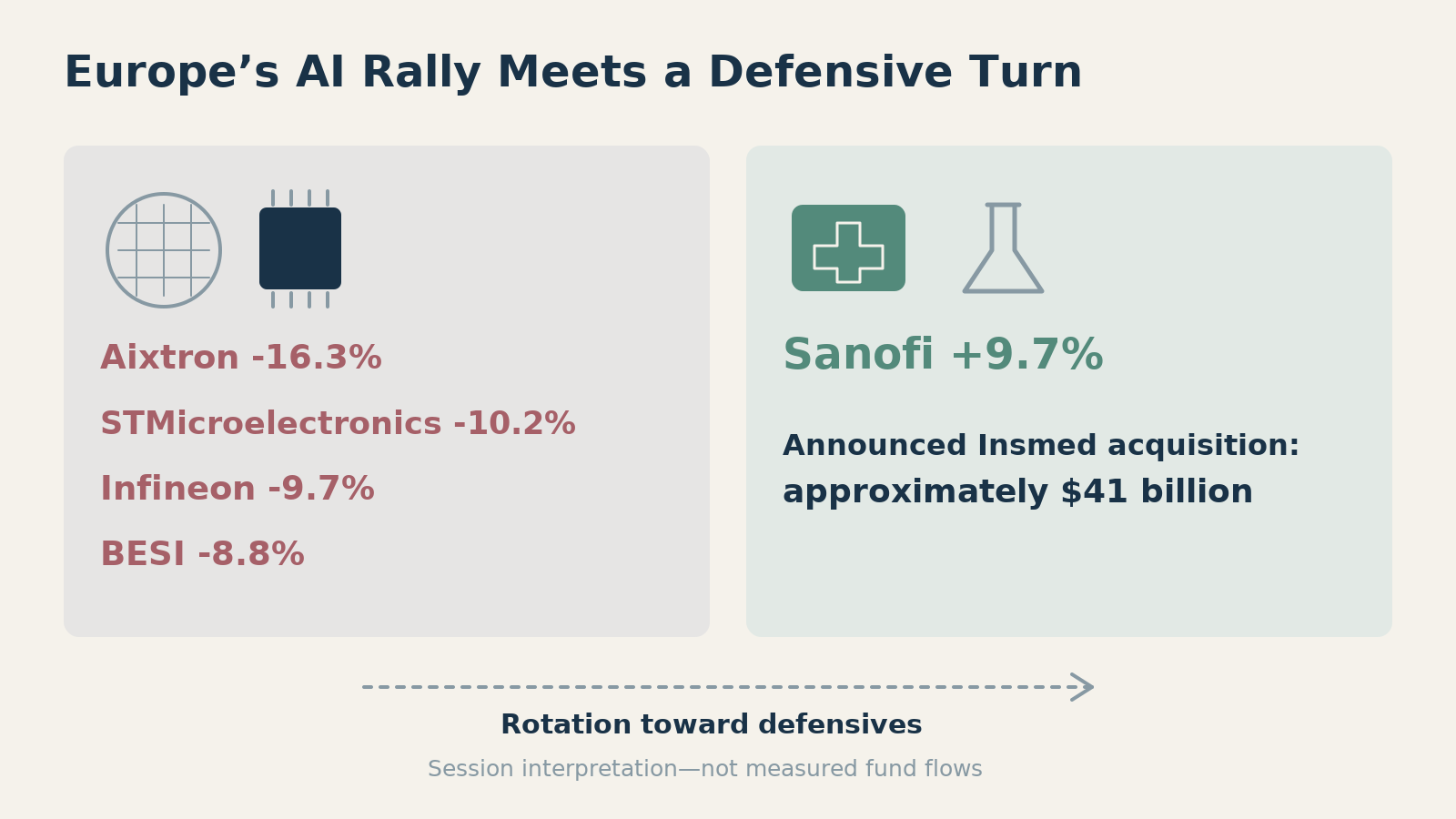
The STOXX 600 finished at 632.74, down 0.66%, in the MarketScreener closing record. That followed Monday’s 1.81% advance. The modest index decline concealed much larger losses among chip-related companies: Aixtron fell 16.3%, STMicroelectronics 10.2%, Infineon 9.7%, and BE Semiconductor Industries, or BESI, 8.8%, using the rounded session figures in the reporting reviewed for this call.
Sanofi went the other way, rising a reported 9.7%. Its announcement provided a concrete company event on a day when enthusiasm for the AI supply chain was fading.
“Rotation toward defensives” is a useful description of that contrast. It is an interpretation of relative prices, however, not evidence that a measured amount of money moved directly from semiconductor funds into healthcare funds. Sanofi also had an unusually large acquisition announcement; its performance cannot be attributed entirely to a change in sector preference.
A sector reversal with different company triggers
Monday’s rally had been associated in market reporting with developments around Nvidia and renewed appetite for AI exposure. Tuesday showed how quickly that enthusiasm could reverse. A change in sentiment toward a major U.S. customer or industry leader can alter the prices investors will pay across the supply chain, even before a European supplier changes its own earnings guidance.
Aixtron nevertheless deserves separate treatment. The reported UBS downgrade to Sell was an identifiable company-specific catalyst alongside the broader chip selloff. Its exposure to gallium nitride, silicon carbide, and optoelectronics is not interchangeable with BESI’s hybrid-bonding opportunity or Infineon’s combination of automotive and power-semiconductor demand.
The shared price direction does not establish a shared deterioration in orders. Equally, calling the decline “sentiment” does not prove that orders will hold up. The next useful evidence comes from customers’ capital budgets, equipment orders, delivery schedules, and changes to profit expectations.
Mining weakness added to the pressure on the broader market. But the exceptions matter: KGHM and Genmab advanced in the market snapshot even as other miners and technology companies fell. No verified company-specific explanation for those two gains was established in this review. Assigning every move to one macro narrative would create more certainty than the evidence allows.
Sanofi’s deal changes the investment question
Sanofi announced an agreement to acquire Insmed for $175 a share in cash, representing approximately $41 billion in equity value. The company says it will use cash and debt financing. Completion is expected in the first half of 2027, subject to shareholder and regulatory approvals and other closing conditions.
Sanofi expects the transaction to become accretive to business earnings per share by the end of 2028. That is a management expectation, not an earnings contribution already secured. Its stated intentions on dividends and credit quality also need to be assessed alongside the eventual financing and operating results.
For investors, the attraction is understandable: the proposed acquisition could strengthen the company’s respiratory-disease growth prospects. The price of obtaining that growth matters just as much. Integration, commercial execution, financing costs, and the acquired pipeline will determine whether the strategic rationale translates into shareholder value.
This also changes how the historical valuation screen should be read. An October forward earnings multiple cannot settle the valuation of the combined business. And the €17.2 billion reference net-debt figure supplied with the original analysis describes an earlier snapshot. It is not a forecast of debt after this acquisition.
Healthcare’s resilience was therefore informative, but it was not a blanket verdict that defensive companies had become cheap. A business with steadier underlying demand can still make a consequential capital-allocation decision.
Cheaper oil offers relief, with conditions attached
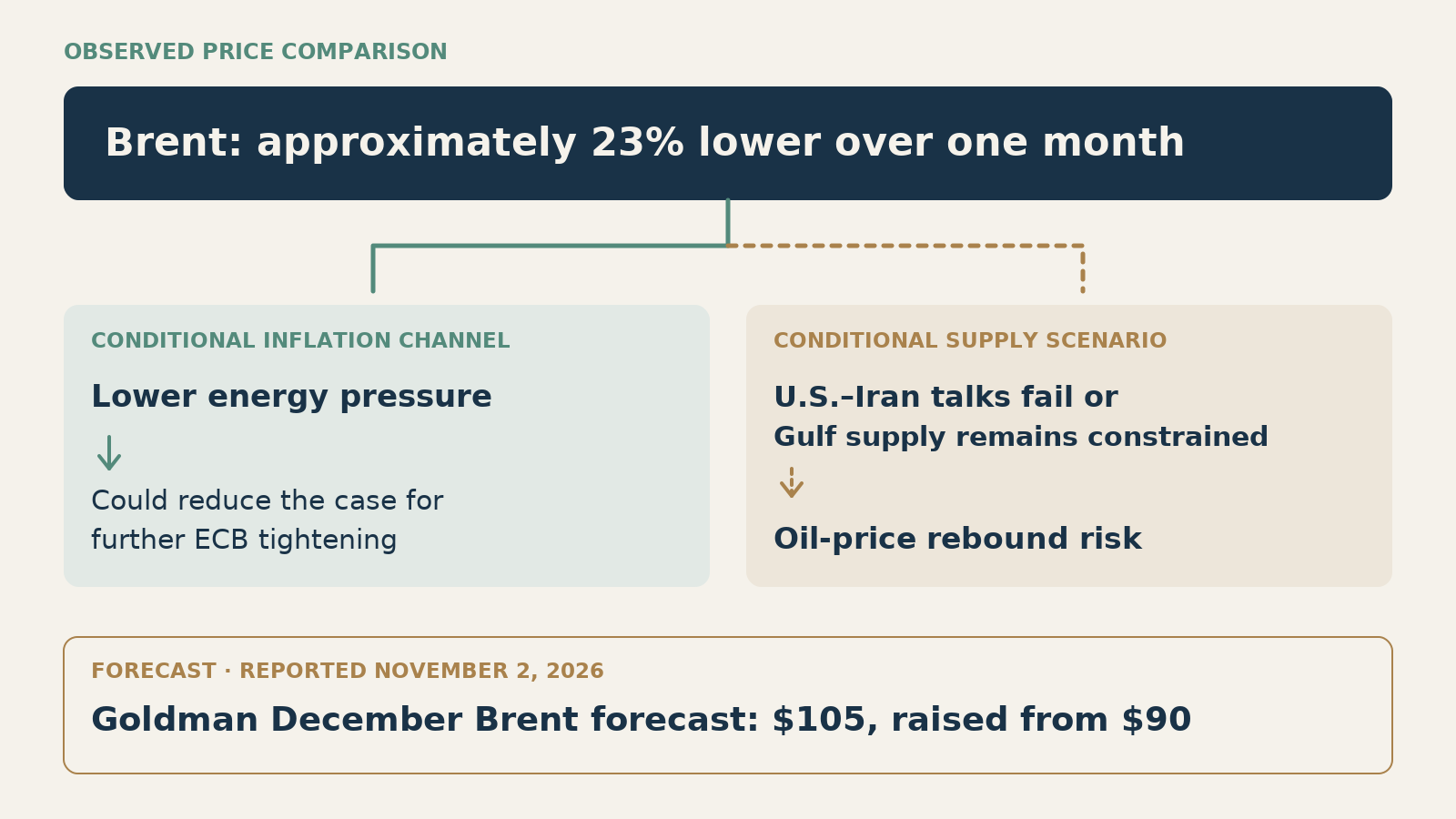
A November 24 morning price comparison put Brent approximately 23% below its level a month earlier. That is a snapshot comparison, not a synchronized month-end return or a reconstructed daily price series.
If sustained, lower oil prices can ease pressure on fuel costs, transport, and some industrial inputs. The benefit reaches consumer prices unevenly and with a delay. Taxes, exchange rates, contracts, refining margins, and companies’ pricing decisions affect how much is passed through.
For the European Central Bank, this could reduce one source of pressure for further tightening. It does not settle the policy decision. Services inflation, wages, inflation expectations, and the underlying demand picture still matter. Nor does cheaper oil establish that Europe’s gas and electricity costs are falling by the same amount.
There is a supply-side counterargument. If U.S.–Iran talks fail or Gulf supply remains constrained, some of the recent oil-price relief could unwind. This is a conditional risk, rather than a confirmed outcome or a probability forecast.
The timing of the Goldman Sachs forecast in the original briefing needs particular care. OilPrice reported on November 2 that Goldman had raised its December Brent forecast to $105 a barrel from $90. That report predates this session by more than three weeks. It is retained here as an earlier forecast illustrating the supply-risk argument, not presented as a new November 24 revision or verified as Goldman’s latest view.
The ECB calendar places its next monetary-policy decision and press conference on December 17. Between now and then, the useful question is whether energy relief survives long enough to affect the broader inflation outlook. One favorable commodity comparison is insufficient to establish the path of rates.
Three companies, three different valuation problems
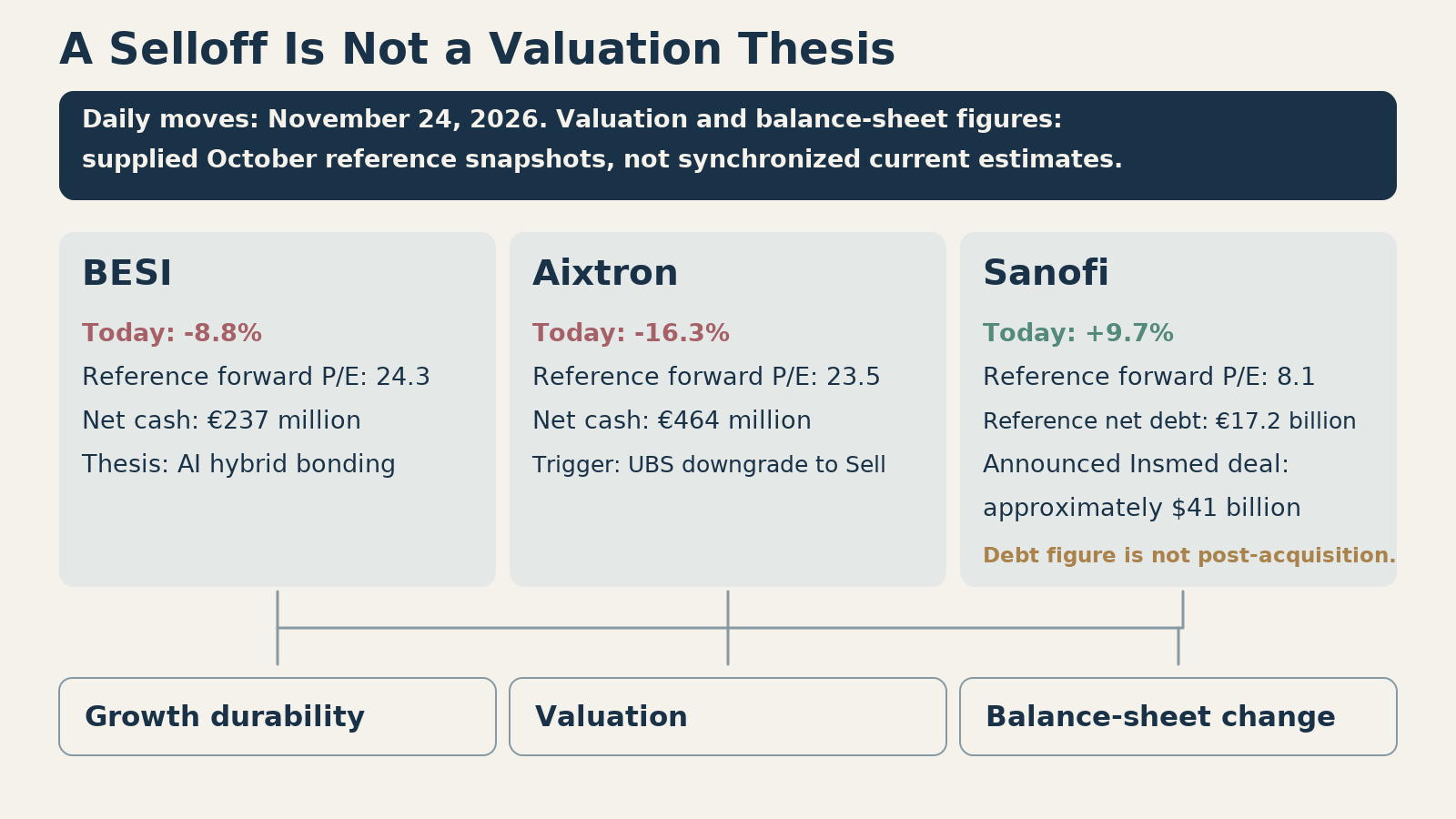
The research figures below are retained from the supplied October reference snapshots. They have not been independently reconstructed as current November 24 estimates. Forward multiples depend on forecast earnings; net cash and net debt reflect reporting dates and definitions. These observations are starting points for research, not a synchronized comparison of today’s valuations.
BESI: growth has to justify the multiple
BESI’s October 26 reference snapshot showed a forward P/E of 24.3 and net cash of €237 million. The supplied operating margin was 40.5%, with free cash flow of €288 million. Together, those figures describe a profitable equipment business with a balance-sheet cushion at that reference date.
The investment hypothesis centers on hybrid bonding and its role in advanced semiconductor packaging. Growing AI demand could support adoption, but an attractive end market is only the beginning of the analysis. Investors still need evidence on the timing of customer orders, competitive positioning, and the durability of margins as volumes change.
The 8.8% daily decline makes the stock worth revisiting; it does not establish that it is inexpensive. A lower share price can coincide with lower earnings expectations. The old forward multiple must therefore be refreshed on both sides: current price and current forecast earnings.
Aixtron: cash is a cushion, not an order book
Aixtron’s October 23 reference figures included a forward P/E of 23.5, net cash of €464 million, and free cash flow of €273 million. The sharp November 24 decline followed the reported UBS downgrade, adding a specific research event to the sector’s broader weakness.
Its growth case rests on equipment demand across several technologies and end markets. The relevant questions are where customers are adding capacity, how fully existing capacity is being used, and whether spending decisions are being delayed. A large addressable market does not guarantee a smooth order cycle.
Net cash offers flexibility when demand slows. It cannot, by itself, prevent a decline in earnings or make an earlier valuation attractive. Before concluding that the 16.3% fall creates an opportunity, the downgrade’s assumptions should be compared with company guidance and subsequent order evidence.
Sanofi: an acquisition makes the old snapshot less useful
Sanofi’s October 14 reference forward P/E was 8.1, with net debt of €17.2 billion and free cash flow of €10 billion in the supplied screen. That profile differs substantially from those of the equipment companies. Its lower reference multiple also reflects a different business mix, growth outlook, and set of risks.
The proposed Insmed transaction introduces another layer of analysis. Research now needs to bridge the standalone figures to a possible combined company: purchase consideration, financing, cash generation, integration spending, and the timetable for the expected earnings contribution.
The acquisition’s equity value cannot simply be added to the old net-debt number to produce a reliable post-deal balance sheet. Financing structure, cash used, acquired assets and liabilities, and the closing date all matter. The historical screen remains useful context, but it is no longer an adequate model of the investment case.
The wider watchlist needs the same discipline
Other companies in the original screen remain useful research candidates, but for different reasons:
- Infineon: Data-center power demand offers a growth avenue, while automotive exposure creates a separate cyclical constraint. A favorable AI narrative cannot stand in for an assessment of the whole business.
- Siemens Energy: Grid investment and turbines provide exposure to rising power needs. The supplied October cash figure does not answer the current valuation question, and the session’s decline has not been tied here to a verified company-specific catalyst.
- Genmab: Pipeline development, patents, royalties, and financing deserve direct examination. A healthcare acquisition elsewhere does not prove that another company’s earnings outlook has improved.
- KGHM: The supplied October screen combined relatively low earnings multiples with negative free cash flow. Copper exposure and a low P/E are insufficient without examining investment needs and cash conversion.
- Compass: Its full-year update provides a basis for reviewing operating momentum. The investment case still depends on growth, contract economics, and margins; a planned listing change is a separate consideration.
- Demant: Its November 24 update combined expectations near the top of its 2026 guidance ranges with a lower medium-term organic-growth ambition. Stronger near-term results and a more cautious longer-term target can both be true.
- Tomra: Its capital-markets update should be assessed against execution and returns on capital. A share-price decline on the same day does not establish which part of the presentation investors disliked.
None of these observations establishes a multibagger case. That would require current valuation work, a longer record of revenue and earnings, cash-flow analysis, and explicit assumptions about what could go wrong. A watchlist is a place to organize those questions.
What would make the next rally more convincing?
Europe’s next advance would carry more weight if it were accompanied by stable earnings expectations and evidence that customer spending plans are holding up. For chip equipment, orders and adoption milestones matter more than the speed of a one-day recovery. For Sanofi, transaction progress and financing detail matter more than the initial share-price response.
Oil supplies a different test. Sustained relief could improve the inflation backdrop, but that argument needs to survive supply developments and subsequent data. The observed price decline, the ECB policy interpretation, and a bank’s dated forecast should remain separate in the analysis.
Tuesday’s message was selective. Investors withdrew enthusiasm from parts of the AI supply chain while rewarding a major healthcare announcement. The practical research task is to determine which earnings assumptions changed, which valuations merely moved, and which balance sheets are about to become materially different.
Source and timing notes
The STOXX 600 closing level is taken from MarketScreener’s historical record; company moves are rounded from the session reporting and supplied briefing. Small provider differences should not be mistaken for different market events. Unreconciled national-index levels, untimed cross-market yields, and conflicting commodity snapshots from the original draft have been excluded from the headline comparisons.
Sanofi’s release is the primary source for the acquisition terms and company expectations. The ECB calendar supplies the December decision date. The oil forecast is explicitly dated. Historical company metrics originate in the supplied October screen and are not presented as independently verified current financial data.
This article is market commentary for informational purposes, not a recommendation to buy or sell securities or personalized investment advice.
Sources and references
- MarketScreener — STOXX Europe 600 historical prices and constituent moves
- Reuters — Europe’s November 24 session and company catalysts
- Sanofi — Insmed acquisition agreement, November 24, 2026
- Fortune — November 24 morning oil-price comparison
- OilPrice — Goldman December Brent forecast, reported November 2, 2026
- ECB — Governing Council meeting calendar
- Compass Group — Full-year results to September 30, 2026
- Demant — November 24 investor update, issuer release distributed by Ritzau
- Tomra — Capital Markets Day 2026