
Market Calls / United States
Wall Street’s Whiplash: A Nasdaq Recovery Leaves the Hard Questions Open
The Nasdaq clawed back most of a severe intraday loss. Inflation, Nvidia’s governance calendar and fresh results from Kanzhun and Li Auto show why relief is not resolution.

Market date
Market Call — United States | November 26, 2026. Cash-market observations refer to November 25 unless otherwise stated.
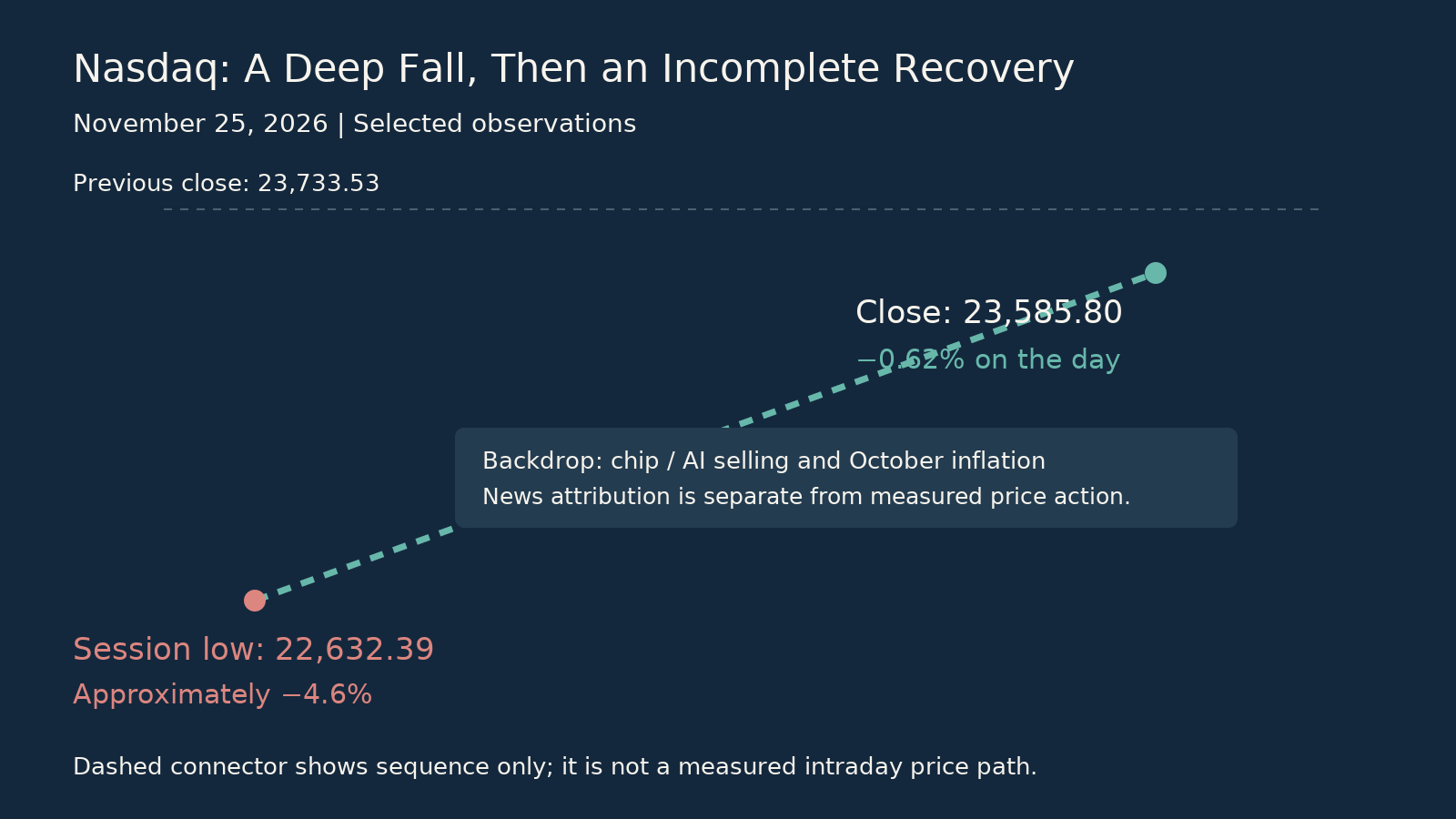
The closing numbers conceal the session. A 0.62% decline in the Nasdaq Composite looks ordinary until it is placed beside the day's low: 22,632.39, roughly 4.6% below the previous close. By the bell, the index had recovered to 23,585.80. That was substantial relief for anyone watching the morning selloff. It was not evidence that the questions hanging over the AI trade had been answered.
The broader market offered a different picture. The Dow and Russell 2000 finished higher while the S&P 500 remained slightly negative. This was a market separating businesses and exposures, rather than selling everything indiscriminately.
What the close actually showed
| Index | November 25 close | Daily change |
|---|---|---|
| S&P 500 | 7,182.78 | −0.25% |
| Nasdaq Composite | 23,585.80 | −0.62% |
| Dow Jones Industrial Average | 50,182.95 | +0.33% |
| Russell 2000 | 2,704.06 | +0.71% |
The Nasdaq low and close are separate observations, not a complete intraday series. The Nasdaq-100 is also a different index: references to its drawdown should not be attached to the Composite. An intraday touch of a 20% decline from a prior closing peak is not the same observation as a closing drawdown of 20%.
U.S. cash equities are closed on November 26 for Thanksgiving. Friday's shortened session ends at 1 p.m. Eastern, or 3 p.m. in Brasília. Overnight futures can offer an indication of positioning, but holiday trading is a poor test of whether a recovery has broad support.
Inflation remained a constraint
The Bureau of Economic Analysis reported October PCE inflation of 3.8% year over year and core inflation of 3.3%. Personal income rose 0.7% during the month, spending increased 0.3%, and the saving rate was 4.1%. Separately, the second estimate put third-quarter real GDP growth at a 4.3% annualized rate, revised from 3.4%.
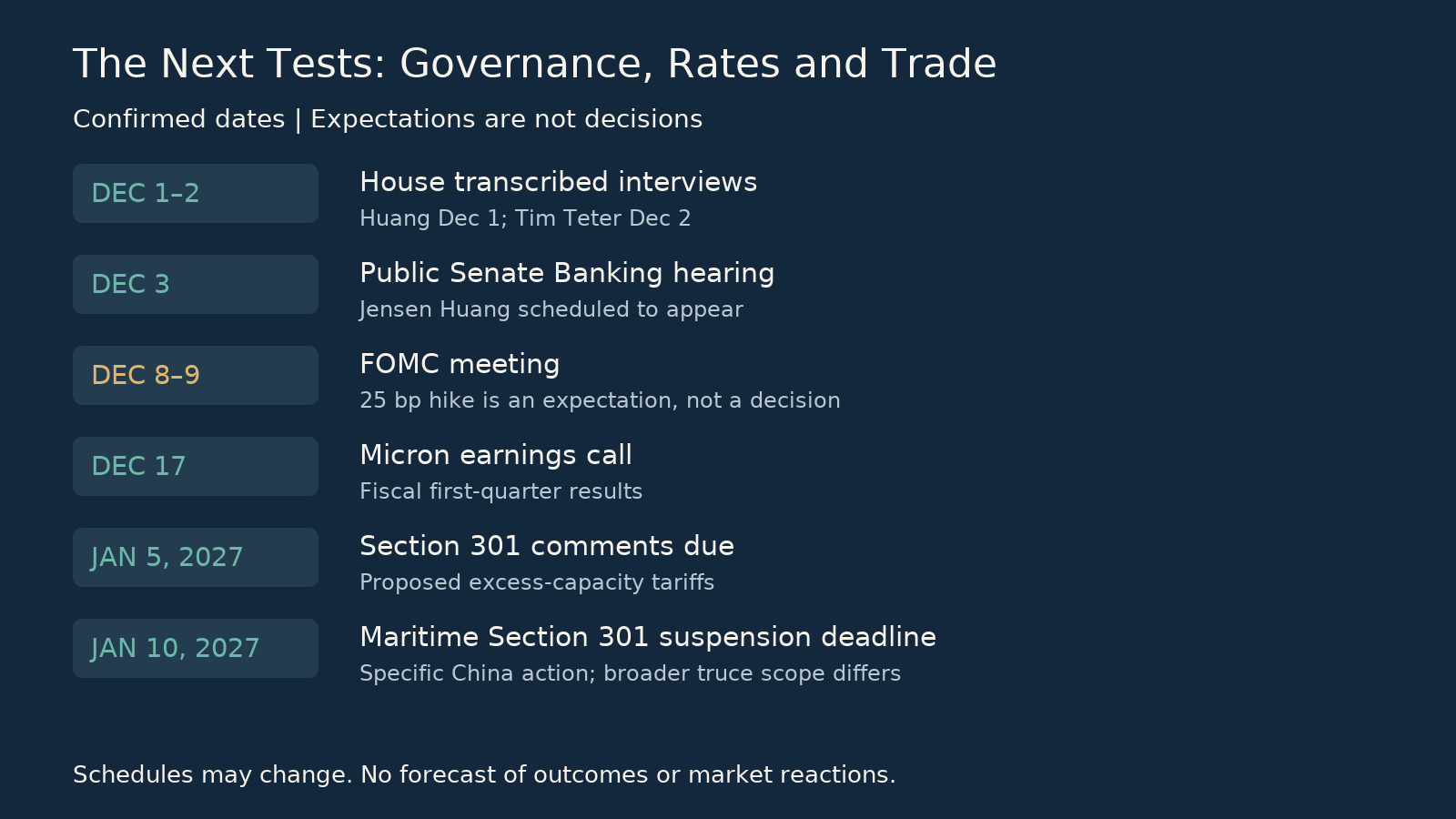
Those releases describe an economy with persistent price pressure and substantial recent growth. They do not guarantee the next policy decision. The supplied market notes put the probability of a quarter-point December hike around 98%; that is a reported, time-sensitive pricing estimate, not an independently reproduced FedWatch snapshot and certainly not a Federal Reserve commitment. The confirmed meeting dates are December 8–9.
The notes also place the ten-year Treasury yield around 4.85%–4.86%, lower on the day despite the inflation release. A demand for safety is one plausible explanation. A change in growth expectations, positioning and term premium could also contribute. A single day's yield move cannot identify which mechanism dominated, and it does not establish that easier policy is coming.
For equity valuations, the practical question is whether earnings can support prices while discount rates remain demanding. The afternoon rebound did not settle it.
Nvidia: a leadership reversal leaves governance work unfinished
Nvidia confirmed on November 23 that its board reinstated Jensen Huang as president, chief executive and a director. Its announcement also said the independent investigation would continue. Reinstatement and completion of that investigation are different milestones.
The supplied notes attribute some of Wednesday's recovery to reporting about a classified congressional briefing. This edition does not independently verify the briefing's contents or treat that explanation as established causation. Price action can be observed; the precise share of a rebound attributable to one headline cannot be inferred from it.
There is, however, a public schedule for scrutiny. House committees announced transcribed interviews with Huang on December 1 and general counsel Tim Teter on December 2. The Senate Banking Committee separately lists an open hearing with Huang on December 3. These are distinct proceedings, not a two-day public hearing with the same witness.
For investors, the questions extend beyond the next appearance: export-control compliance, board oversight, customer spending and the durability of returns on AI infrastructure. An investigation or political allegation is not itself proof of wrongdoing.
Tariff proposals, not a settled cost schedule
USTR announced determinations and proposed actions covering 14 economies. Written comments are due January 5, 2027, with hearings beginning January 25. Product exclusions, treatment of existing duties and economy-specific terms matter; a headline rate should not simply be added to every company's import bill.
One disagreement in the supplied notes can be resolved: the Vietnam proposal describes duties of up to 35%, while also discussing adjustments connected with a potential reciprocal agreement and a 20% rate. These are different provisions, not two interchangeable descriptions of a final tariff.
January 10 also needs a precise label. The primary notice reviewed here establishes a deadline for the suspension of specific China maritime, logistics and shipbuilding Section 301 actions. It does not, by itself, establish that every element of the broader U.S.–China trade relationship expires that day.
A cash screen is a starting point
The original screen sought revenue growth, sustainable profit, cash and a reasonable valuation, with a preference for companies below roughly $20 billion in market capitalization. That size ceiling is the author's research filter. It cannot establish that larger companies are incapable of multiplying in value, or that smaller companies are likely to do so.
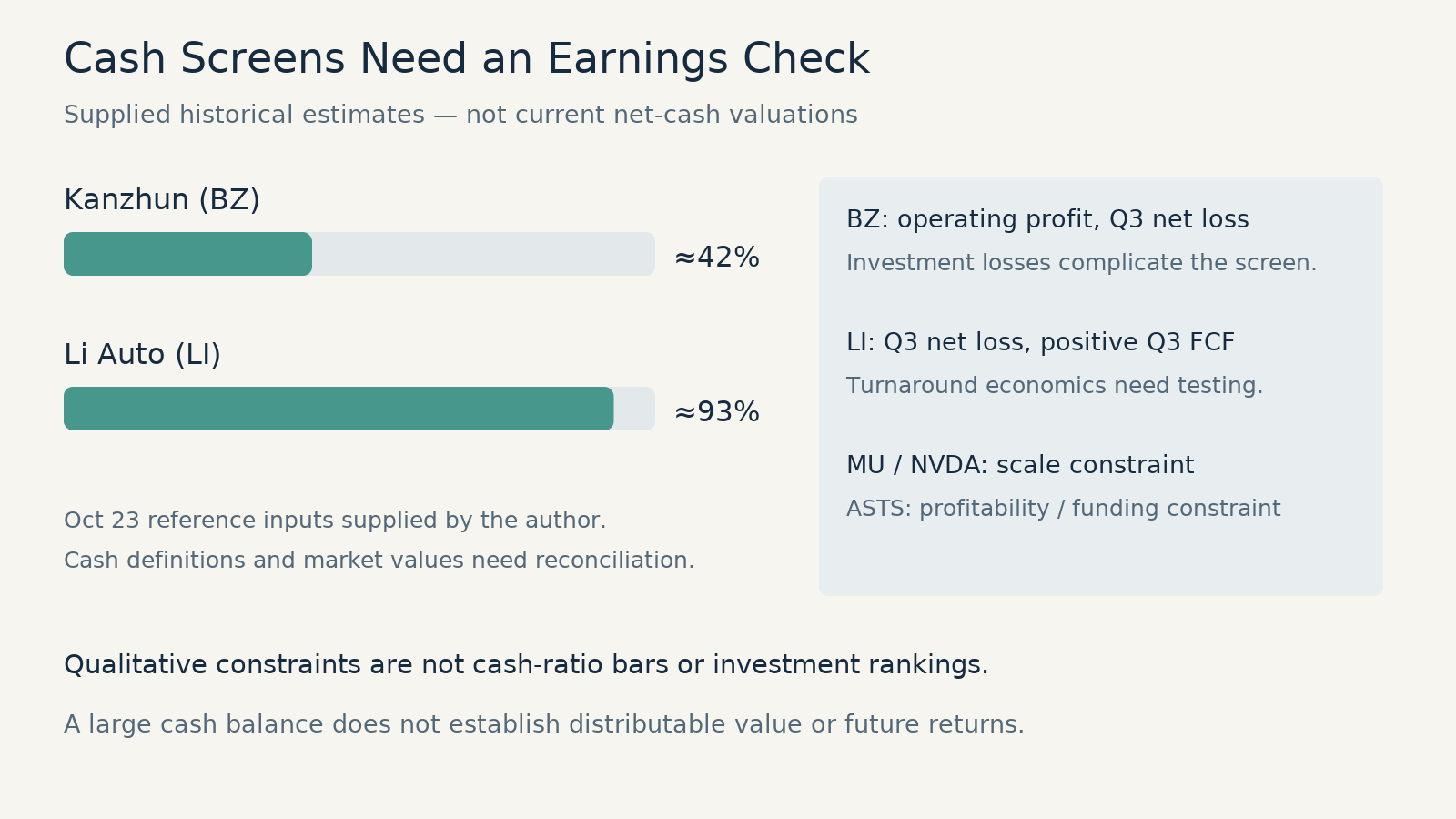
The supplied October 23 snapshots put Kanzhun's net cash near $3.06 billion against a $7.4 billion market value, and Li Auto's near $10.4 billion against $11.2 billion. Those inputs produce the approximate 42% and 93% ratios shown below. They have not been reconciled to November 25 prices, current share counts and a uniform definition of debt and available cash. They are historical screening inputs, not current enterprise-value calculations.
Kanzhun: distinguish the operating business from investment marks
Kanzhun's fresh release changes the interpretation. Third-quarter revenue rose 11.7% to RMB2.4162 billion and operating income reached RMB844.8 million. But GAAP net income was negative: a RMB249.2 million loss, substantially affected by investment losses. Adjusted net income was positive, and operating cash generation remained positive.
The company authorized a new buyback of up to $500 million; authorization is not completed repurchasing. Its reported cash position of about $2.924 billion has a specified definition and is not automatically the older screen's net-cash figure.
The recruiting platform remains a research candidate, but calling it a clean pass on every profitability criterion would miss the new results. The central task is to separate recurring operating earnings from investment marks and assess demand in China's hiring market.
Li Auto: a loss-making quarter with improving cash flow
Li Auto reported revenue of RMB28.8344 billion, up 5.4%, and a net loss of RMB309.7 million. Yet quarterly operating cash flow was positive at RMB3.2292 billion, and free cash flow was positive at RMB1.9619 billion. A negative trailing cash-flow figure from an older snapshot should not erase that quarterly improvement.
Its RMB88.2 billion cash-position measure includes restricted cash and specified deposits and investments. It is not a ready-made net-cash calculation or a promise of distributions to shareholders. The investment question is whether margins and cash generation can improve durably under competitive pressure, not simply whether a historical cash ratio looks large.
Micron, Nvidia and AST SpaceMobile: different reasons to investigate further
Micron and Nvidia sit outside the screen's preferred size range in the supplied estimates. Their research questions are nevertheless different: memory pricing and normalized earnings for Micron; returns on customer AI spending and governance for Nvidia. A low forward multiple offers little protection if its earnings denominator proves unsustainable.
AST SpaceMobile's supplied snapshot instead raises profitability, cash consumption and funding questions. Milestones in a capital-intensive deployment must be evaluated alongside financing needs and dilution. An attractive technical proposition does not settle the value of the equity.
This edition does not endorse the draft's stale multiples, analyst targets or rescaled market capitalizations as current estimates. All five names require a fresh reconciliation before an actionable valuation comparison.
The next tests
The calendar now has six distinct entries, including the separately confirmed Senate hearing. The FOMC marker identifies a policy expectation rather than a completed hike.
The next full sessions should test whether strength outside technology persists, whether semiconductor selling stabilizes and whether company disclosures support the earnings assumptions embedded in valuations. A second rebound would still need to be assessed against those questions.
My interpretation is that Wednesday demonstrated buyers' willingness to respond to a severe decline. It did not demonstrate that the AI spending cycle, governance issues or inflation outlook had improved by the close. Those require evidence beyond a reversal in prices.
Verification note: This edition prioritizes index closes, primary economic releases, company results and official calendars. Conflicting commodity quotes, unsupported corporate-news claims and unrefreshed valuation targets from the supplied notes have not been promoted to confirmed facts. Historical screening estimates remain explicitly labeled.
Editorial note: For information and education only; not a recommendation, solicitation or personalized investment advice. Estimates and interpretations may be incomplete or incorrect. Consult the underlying sources and assess risks independently.
Sources and references
- Index session: Investor’s Business Daily, November 25
- AP: U.S. index closes, November 25
- BEA: October personal income and PCE
- BEA: Q3 GDP second estimate
- NYSE holiday trading hours
- Federal Reserve: December calendar
- Nvidia: board reinstatement announcement
- House committees: December interviews
- Senate Banking: December 3 hearing
- Kanzhun: Q3 2026 financial results
- Li Auto: Q3 2026 financial results
- Micron: December 17 earnings call
- USTR: proposed actions covering 14 economies
- Federal Register: China maritime action suspension