
Market Calls / United States
A Split Tape on Thanksgiving Eve: Small Caps Rise as Technology Retreats
Wall Street recovered much of its early decline, but technology lagged the Dow and small caps. Firm inflation, stronger growth and Nvidia’s partial reversal sharpen the valuation questions.

Market date
Wall Street recovered much of its early decline on Thanksgiving eve, but the recovery did not lift every part of the market. The Dow and smaller companies finished higher while technology-heavy benchmarks remained lower. The closing picture was selective, rather than a broad vote of confidence in risk assets.
The later closing report put the S&P 500 at 7,182.78, down 0.25%; the Dow at 50,182.95, up 0.33%; and the Nasdaq Composite at 23,585.80, down approximately 0.62%. The Russell 2000 gained about 0.71% to 2,704.06. These readings differ slightly from the supplied TradingView snapshot. The Nasdaq-100’s supplied decline of 0.72% and VIX reading of 28.04 retain their snapshot status.
The modest net losses conceal a difficult session. Technology shares came under heavy pressure before an afternoon recovery. That sequence matters: a small closing decline does not mean investors experienced a quiet day, and an intraday drawdown should not be presented as a closing result.
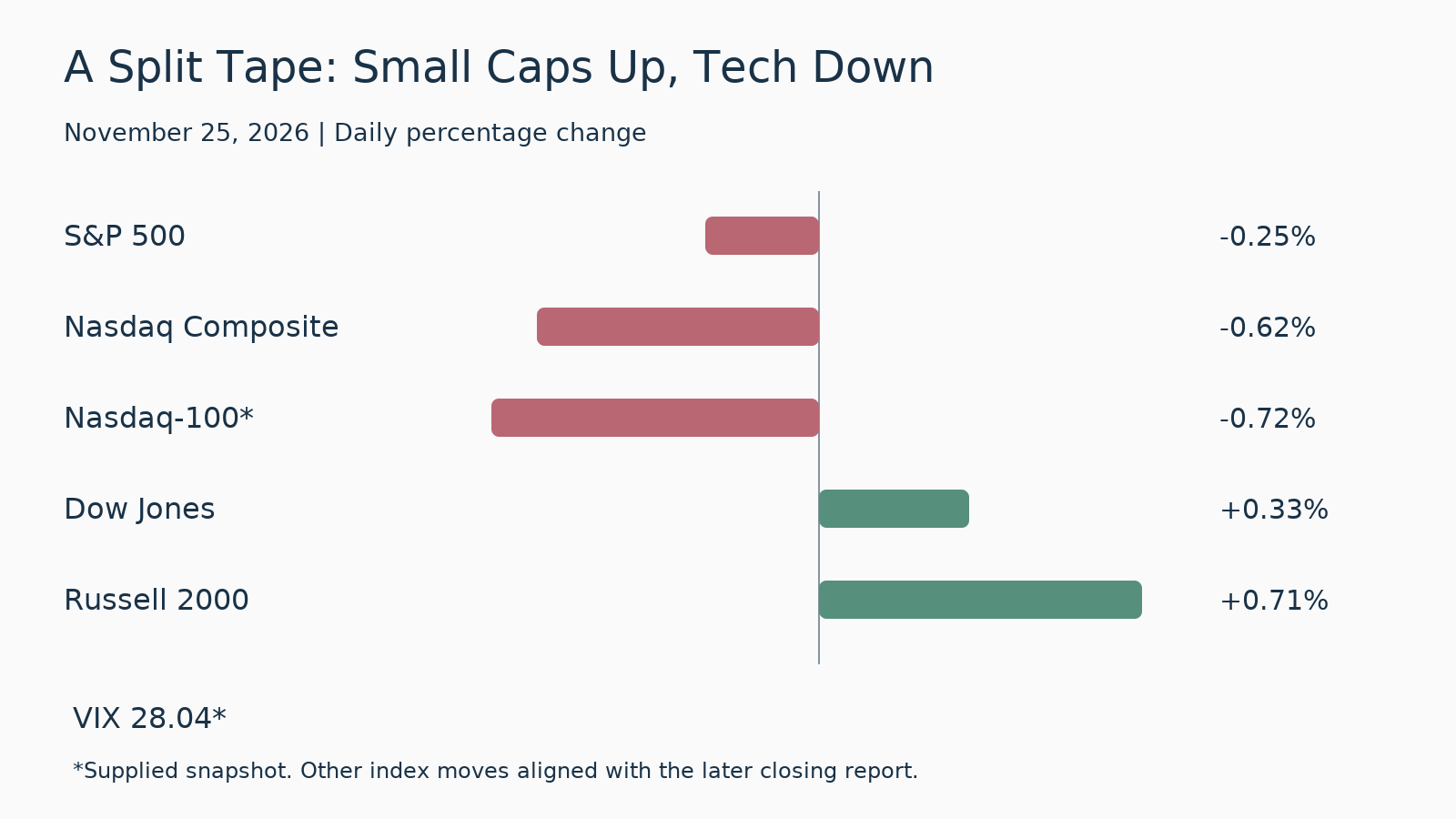
A rotation interpretation, not a measured flow
The relative strength of smaller companies and the Dow is consistent with investors looking beyond the AI trade. It does not establish that every defensive sector advanced or that an identifiable amount of money moved directly from technology funds into small-cap funds.
Index composition matters. The Dow is not a pure defensive portfolio, and the Russell 2000 includes companies sensitive to financing costs and economic growth. Their gains can coexist with restrictive policy expectations when positioning, valuation, and company news differ.
The strongest conclusion is therefore limited: Wednesday’s market was uneven. The evidence does not support treating all equities as one exposure, or interpreting a technology decline as a uniform deterioration in every company’s earnings outlook.
Inflation was firm, and growth was stronger than first estimated
BEA’s second estimate put third-quarter real GDP growth at 4.3% annualized, revised from 3.4%. The earlier 1.5% figure appearing in the draft is not the corresponding advance estimate. Investment and consumer spending revisions helped explain the upgrade.
October headline PCE inflation was 3.8% year over year. Core PCE was 3.3%, while both measures rose 0.3% over the month. Personal income increased 0.7% and nominal consumption spending 0.3%. Stronger income than spending is an observation; it does not, by itself, prove a lasting change in household confidence.
The Labor Department’s release reported 189,000 initial claims for the week ended November 21. The prior week was revised to 202,000 from 203,000. These official figures take precedence over conflicting secondary summaries.
Together, the releases do not justify describing the tightening debate as driven solely by oil. Energy can influence inflation directly and indirectly, but the GDP report also shows firm domestic activity. Neither supply pressures nor demand can be dismissed from the policy discussion on this evidence.
Why falling long yields do not contradict a hawkish Fed
The supplied Treasury observations put the two-year yield at 4.654%, the ten-year at 4.868%, and the thirty-year at 5.255%. The ten-year exceeded the two-year by approximately 21 basis points. These are source snapshots rather than independently synchronized official closing yields.
Reports in the briefing placed the probability of a December hike around 96%–98%. Those readings depend on timestamp and methodology. They express market expectations, not a Federal Reserve promise. The official calendar resolves one gap in the draft: the December meeting takes place on December 8–9.
A policy rate and a long-maturity bond yield respond to different combinations of expectations. Investors may expect near-term tightening while buying longer bonds because they anticipate slower future growth, lower inflation later, or a need for portfolio protection. Changes in term premia also matter.
That makes the draft’s proposed straight arrow from hotter PCE to falling long yields too strong. The two occurred alongside one another; this edition does not claim a mechanically established causal chain. Growth-stock valuations may face pressure from restrictive policy and changing earnings expectations, even when a particular long yield falls during the session.
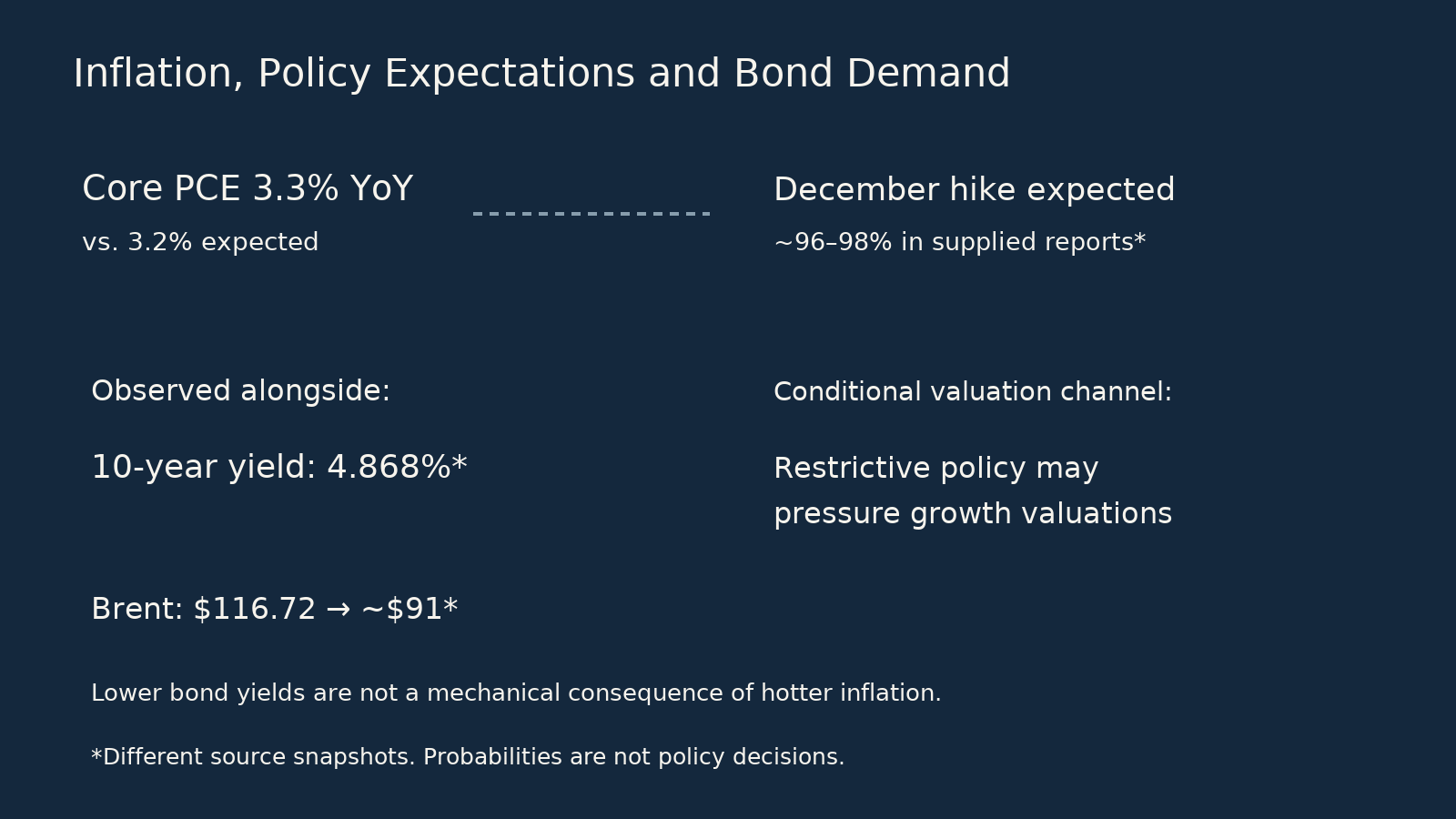
The supplied Brent comparison, from $116.72 in October to roughly $91, suggests potential future energy relief. It does not mean that later oil moves were already reflected in October’s inflation data. Nor does the direction of nominal yields alone establish the direction of real yields without information about inflation expectations.
Nvidia’s reversal needs the right denominator
Nvidia’s November 23 company release confirms Jensen Huang’s reinstatement as president, chief executive officer, and board director. The company also said an independent investigation would continue. Reinstatement should not be described as proof that every governance question had been resolved.
The supplied price observations put Monday’s close at $165.05 after a roughly 31.5% advance, followed by $142.38 at 11 a.m. Wednesday and $147.74 at 3:08 p.m. ET. Wednesday’s −8.4% and −4.9% readings are daily changes relative to Tuesday’s close, not percentage changes from Monday’s peak.
The 3:08 p.m. observation was about 10.5% below Monday’s closing price. It therefore represents a partial reversal of Monday’s jump, not proof that the entire gain had been erased. It is also not Wednesday’s official close. Connecting these selected points is illustrative; the missing intervening trades cannot be reconstructed from three observations.
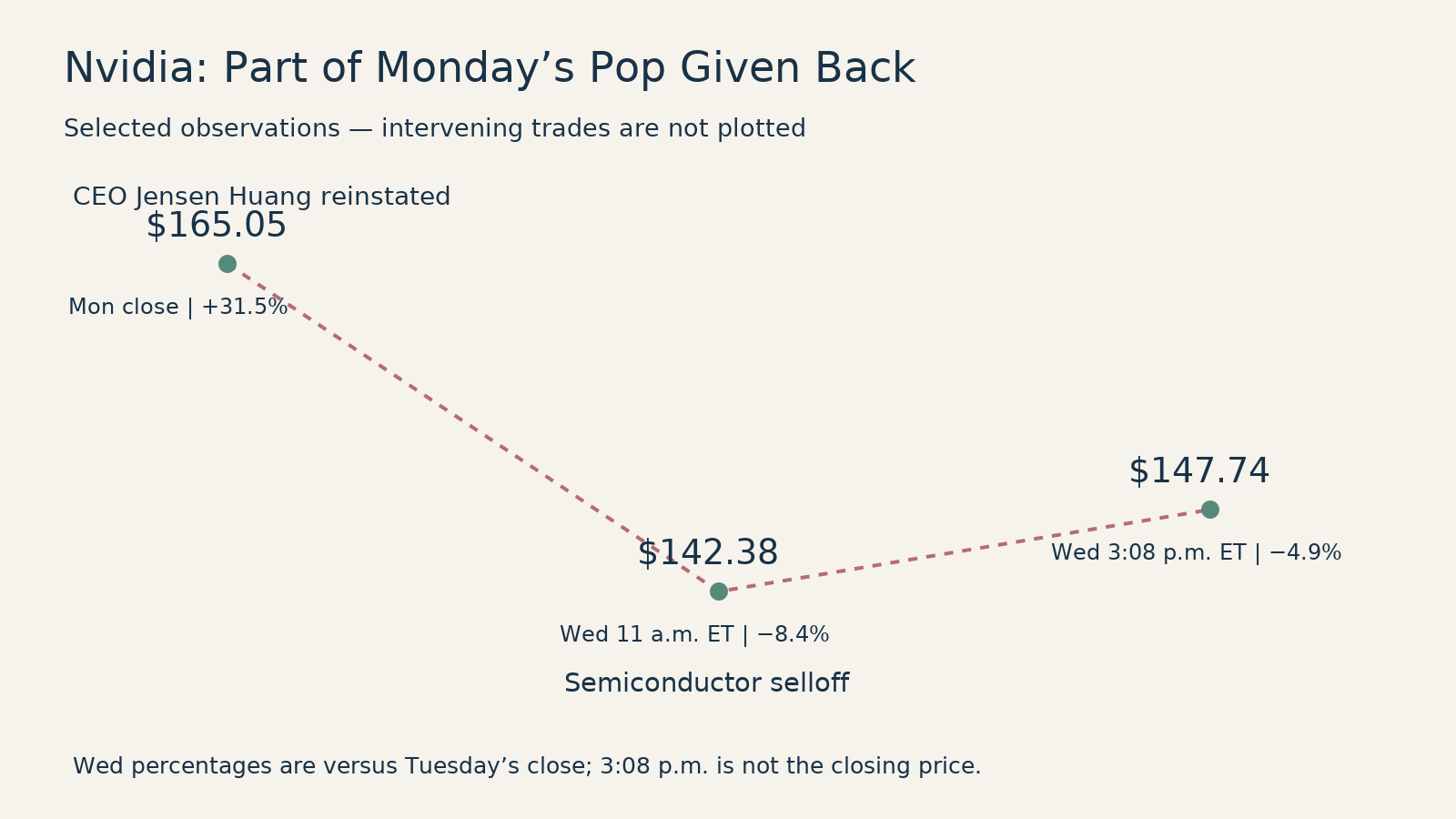
The broader semiconductor declines are consistent with reduced enthusiasm for AI spending exposure. They do not reveal, on their own, whether customer orders weakened, margins changed, or investors simply demanded lower valuations. Intraday losses in Micron, AMD, equipment makers, and hardware suppliers should remain labeled intraday until final closing data are available.
Dell: strong demand still leaves a cash-return question
Dell’s fiscal third-quarter 2027 release reported revenue of $54.9 billion, up 103%, diluted EPS of $8.82, and non-GAAP diluted EPS of $9.45. The company reported a $132.3 billion AI backlog and full-year revenue guidance of $202 billion. Guidance is management’s expectation, and backlog is not recognized revenue or cash already collected.
The supplied $272.57 share price was recorded at 11:01 a.m., when the stock was down about 7.7%. Calling that response “selling the news” is an interpretation, not a verified explanation of investors’ motives.
The investment question is how demand converts into profit and free cash flow. Customer concentration, component availability, margins, financing, working capital, and delivery timing can all alter that conversion. Rapid revenue growth and a large order book are relevant, but neither eliminates balance-sheet risk.
The draft’s rescaled P/E estimates combine a newer price with older earnings and share assumptions. They are not retained as verified current valuations, particularly after a major new results release.
The research screen needs current inputs
Kanzhun: Its November 25 filing confirms authorization for a new share-repurchase program of up to $500 million over twelve months. An authorization is not completed repurchasing. The recruiting business deserves research on hiring demand, operating earnings, cash availability, and capital allocation. The draft’s October margin, net-cash ratio, and valuation figures require updating before it can be called the only company meeting every criterion.
A high net margin should also be reconciled with operating profit and investment income. Country risk, the listing structure, regulation, and the employment cycle remain material. A low historical multiple is not sufficient evidence of an asymmetric investment.
Celestica: Data-center hardware demand provides a plausible growth thesis, but customer concentration, manufacturing margins, capital expenditure, and working-capital needs must be evaluated together. The supplied October cash position and ambitious growth forecast were not independently refreshed. They do not support a confirmed current valuation or guaranteed multibagger case.
Dell: The updated company release strengthens the demand evidence. The next step is a refreshed balance-sheet and cash-flow model, rather than multiplying an old earnings multiple by the percentage change in the share price.
Ambarella: The supplied guidance points to a sharp sequential revenue decline. That claim should be checked directly against the latest release before making an investment decision. Historical cash does not remove operating-loss or customer-demand risk. It remains a research question, not an automatically cheap recovery opportunity.
Other earnings movers in the draft—including HP, Workday, Deere, and Nutanix—are not ranked here using a mix of morning quotes and stale fundamentals. Unverified Anthropic listing claims, unnamed-volume assumptions, and alleged company-specific catalysts have also been excluded from the session’s factual foundation.
Trade and the holiday calendar
The USTR’s proposed Section 301 actions are distinct from enacted duties. Product coverage, final rates, effective dates, and interaction with existing measures must be read from the applicable documents. The January 5, 2027 comment deadline is a procedural milestone, not a tariff implementation date.
Regular U.S. equity trading is closed on November 26 for Thanksgiving and ends early on November 27. Reduced participation can make price moves less representative of broad conviction; it does not predict their direction. The next Fed decision arrives December 8–9, not on an unspecified December date.
Wednesday’s recovery leaves two questions open. Can technology stabilize as earnings expectations are refreshed? And can strength outside the largest AI names persist without requiring easier monetary policy? A market that finishes far above its intraday lows has absorbed some selling. It has not necessarily resolved the reasons investors wanted to sell.
Data and editorial note
Major index figures were aligned with later closing reporting where available. Nasdaq-100, VIX, yields, and selected company prices retain their supplied snapshot labels. GDP, PCE, claims, Nvidia’s announcement, Dell’s results, and Kanzhun’s buyback authorization were checked against primary releases. Historical valuations are not presented as current estimates or recommendations.
This publication is informational market commentary, not an offer, a recommendation to trade, or personalized investment advice.
Sources and references
- Associated Press — November 25 closing indexes
- BEA — Third-quarter GDP second estimate
- BEA — October personal income and outlays
- Labor Department — November 25 claims release
- Nvidia — CEO reinstatement announcement
- Dell — Fiscal Q3 2027 earnings filing
- Kanzhun — Results and repurchase authorization
- Federal Reserve — December meeting calendar
- USTR — Section 301 proposed actions