
Market Calls / Japan
Japan’s AI Rebound Is Narrow—and Implied Volatility Is Still Rising
Nikkei gains 0.86% while TOPIX barely advances. Advantest’s outsized contribution, rising implied volatility and uncertain earnings inputs complicate the recovery narrative.

Market date
Market Call — Japanese Market (Nikkei 225 / TOPIX)\ Thursday, November 26, 2026
1. Dashboard
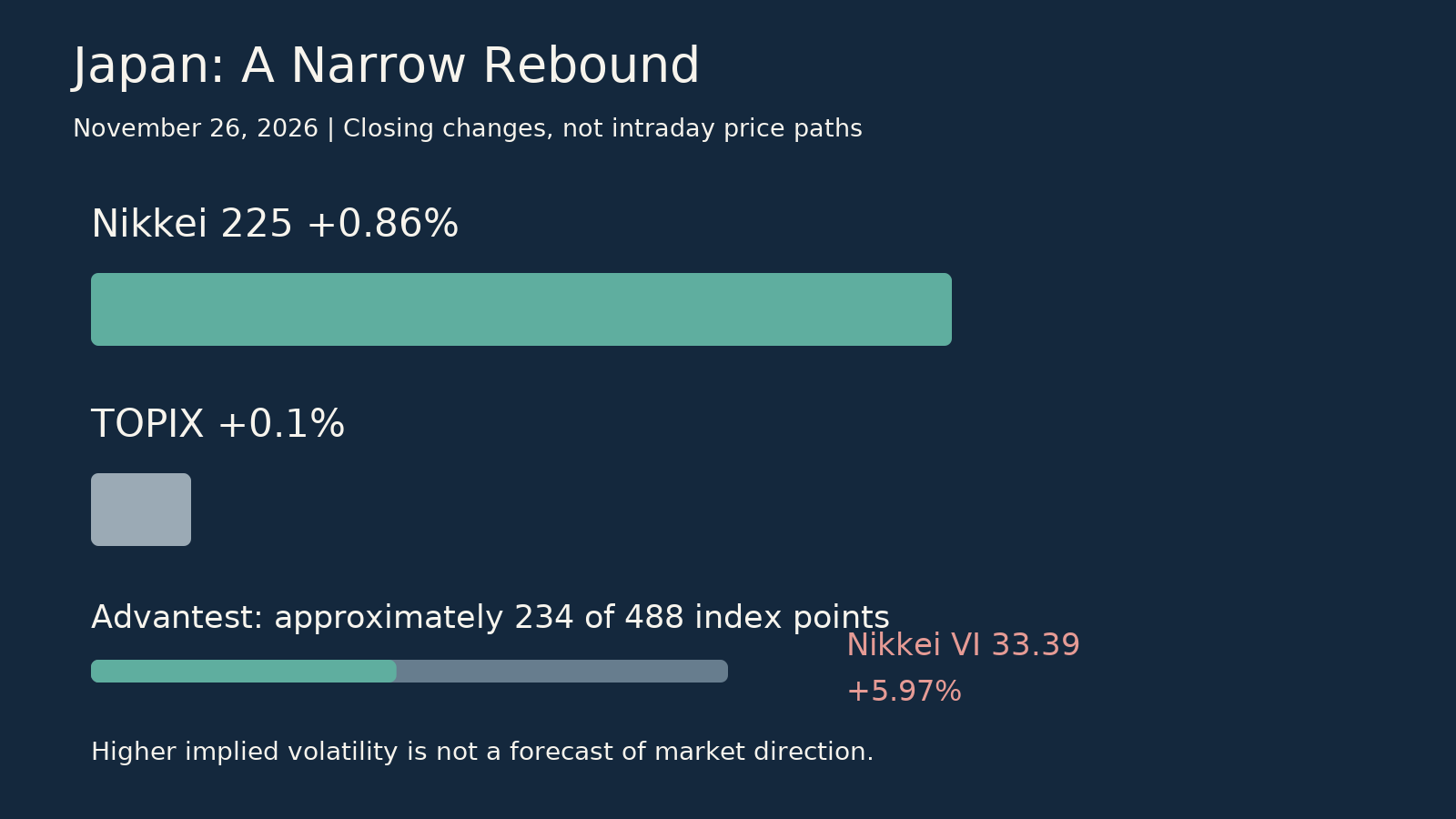
Nikkei 225: 57,499.16 (+0.86%, +487.54 points). High 58,251.93, low 57,288.10. It gave back a good part of a gain that had topped 2%.
- Context: −2.6% on the week, −8.1% over one month, +12.7% year to date. On Wednesday (Nov. 25) it fell 2.78% to 57,011.62.
TOPIX: 3,750.40 (+0.1%). That is far weaker than the Nikkei's gain. The rebound sat in a handful of AI names.
Breadth: Nikkei’s official constituent count was 110 advancers, 113 decliners and two unchanged. A broader TSE snapshot reported 2,066 advances, 1,393 declines and 274 unchanged; it covers a different universe and should not be confused with Nikkei breadth. Real estate, banks and textiles were among the stronger sectors.
Nikkei VI: 33.39 (+5.97%). Implied volatility rose even as the index did.
USD/JPY: about 159.2–159.3. That is close to 160, where the market expects intervention.
10-year JGB: 2.638%. This is a supplied yield snapshot; an independently checked weekly basis-point change is not available here.
BoJ: 1.25%. The meeting is Dec. 17–18, and The draft’s OIS snapshot implies about an 80% chance of a hike to 1.50%.
Brent / WTI: about $90.8–91.1 / about $84.1–84.5. The Hormuz risk persists.
Gold (Dec.): $3,568.70 (+0.93%).
Wall Street (Nov. 25): the supplied recap reports a lower S&P 500 and Nasdaq and a higher Dow. Conflicting intraday extremes and Nvidia closing figures are excluded from this comparison.
2. Session Recap
Buyers came back to AI stocks and the Nikkei clawed back part of Wednesday's drop. Late profit-taking then cut the gains roughly in half.
Tuesday’s rebound gave way to Wednesday’s selloff. Thursday recovered only part of that loss. The distinction matters: a strong percentage gain after a sharp fall is not, by itself, a return to the earlier price level.
Today's biggest gainers:
- Kioxia: +12.57% to ¥7,762
- SoftBank: +7.32% to ¥2,894
- Resonac: +6.61% to ¥11,620
Advantest rose 4.6% and on its own supplied about 234 of the index's 488 points of gain.
The biggest decliners:
- Taisei: −3.87% to ¥10,815
- Sharp: −3.16% to ¥459, a record low
- Japan Airlines: −2.93% to ¥3,507
The Kioxia catalyst was a project with Nvidia: a configuration of 144 Kioxia SSDs with about 1.1 PB of raw capacity. The company itself calls it a proof of concept.
Trade-related reporting described relief over the proposed tariff treatment. The exact interaction with existing duties depends on economy-specific notices and exemptions; proposed action should not be presented as a newly effective blanket tariff.
Nomura's Wataru Akiyama expects AI stocks to trade stop-and-go, with buying on dips and selling on rallies. Doubts about the sustainability of AI spending remain unresolved.
The editorial reading is that Nikkei +0.86% against TOPIX +0.1%, plus higher implied volatility, points to a concentrated technical bounce without establishing a trend reversal. TOPIX was nearly flat, although individual stocks and sectors moved in both directions.
3. Macro, the Yen and the BoJ
BoJ board member Naoki Tamura said today that the 1.25% rate is "still some distance" from neutral. He added that the BoJ should react quickly to inflation overshoots, including by speeding up the pace of hikes. The yen firmed after his remarks.
The draft’s OIS snapshot implies about an 80% chance of a hike on Dec. 18. In the Reuters poll (Nov. 11–18), 86% of economists (61 of 71) expect a move to 1.50%. It would be the third hike of the year, something not seen in 37 years. Almost 60% see 1.75% by the end of March.
Core CPI (ex-fresh food) rose to 2.2% y/y in October. November Tokyo CPI comes next, with a consensus of 3.0% (previous: 2.6%).
Japan's Q3 GDP contracted, the first contraction in a year. Expectations for the 2027 wage negotiations are for a rise of about 5.0%.
USD/JPY sits near 159.2, above its 100-day average of 158.7. The draft’s cumulative intervention figure was not verified against official intervention data and is excluded here. For the Fed, the supplied FedWatch snapshot indicates about a 98% probability of a hike in December.
Equal-sized BoJ and Fed hikes would leave the simple policy-rate differential unchanged, but exchange rates also respond to expected future paths, capital flows and risk appetite. The 160 area is a market watchpoint, not an official automatic intervention threshold. A strong Tokyo CPI reading could reinforce expectations of a hike without settling the decision. Banks’ earnings depend on the full yield curve, funding costs and credit conditions, not the policy rate alone.
The supplied 10-year JGB yield was near 2.64% despite the hawkish commentary. A safety bid is one interpretation; the yield alone does not identify investor motives.
4. Sectors
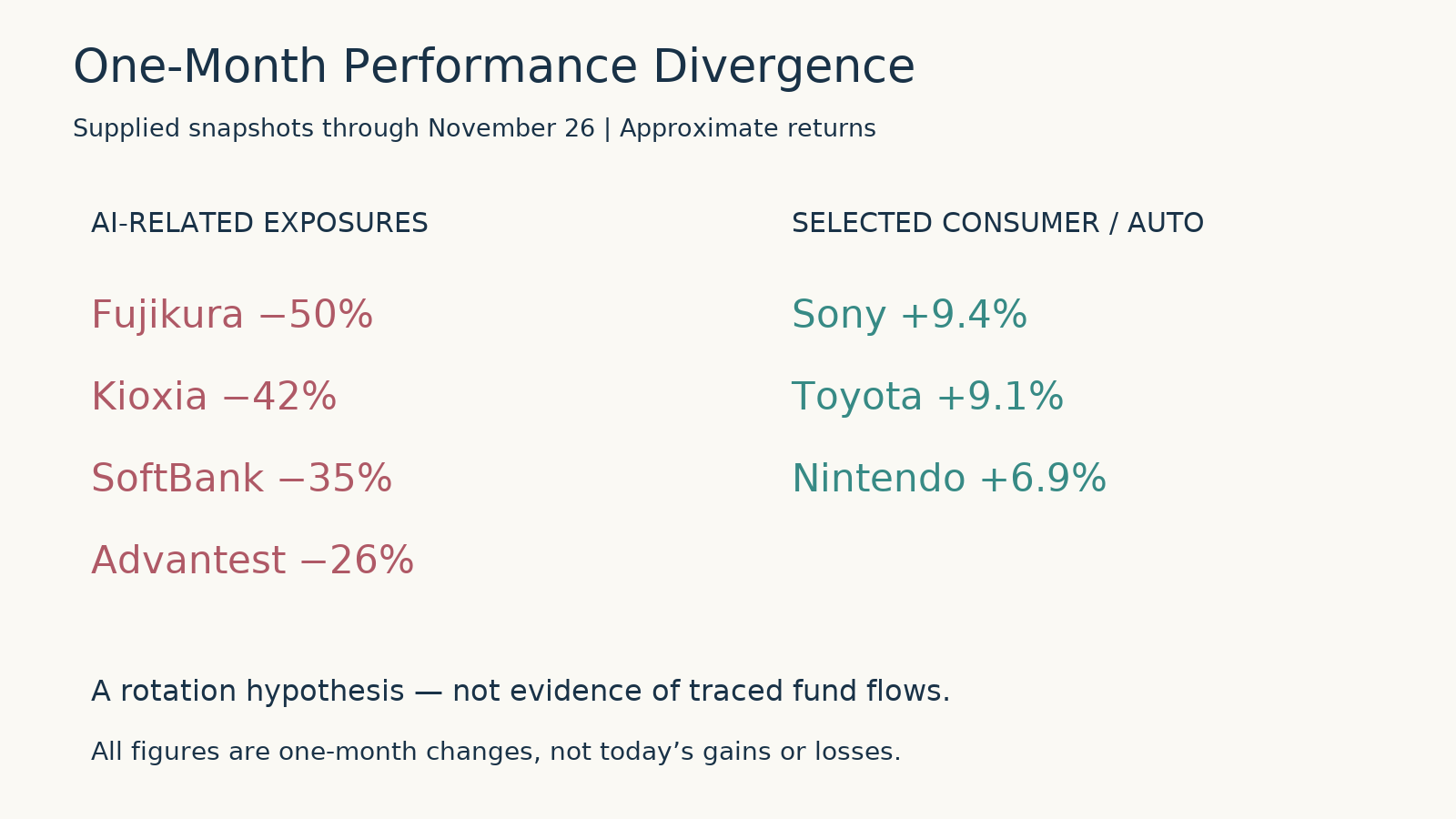
Semiconductors and the AI chain (Kioxia, Advantest, SoftBank, Resonac) led the rebound after a brutal month. Over one month:
- Fujikura: −50%
- Kioxia: −42%
- SoftBank: −35%
- Advantest: −26%
- Mitsubishi Heavy: −26%
- Lasertec: −22%
- Tokyo Electron: −16%
Real estate, banks and textiles were among the strongest sectors. Construction (Taisei), Sharp and airlines (JAL) fell.
Consumer and entertainment names are up over one month:
- Sony: +9.4%. Product-cycle claims require separate verification.
- Toyota: +9.1%
- Nintendo: +6.9%
The one-month divergence is consistent with a possible rotation from AI capex toward consumer, entertainment and financials. A weak yen can support the translated value of overseas earnings, although costs, hedges and production locations affect the outcome.
5. Stocks in Focus
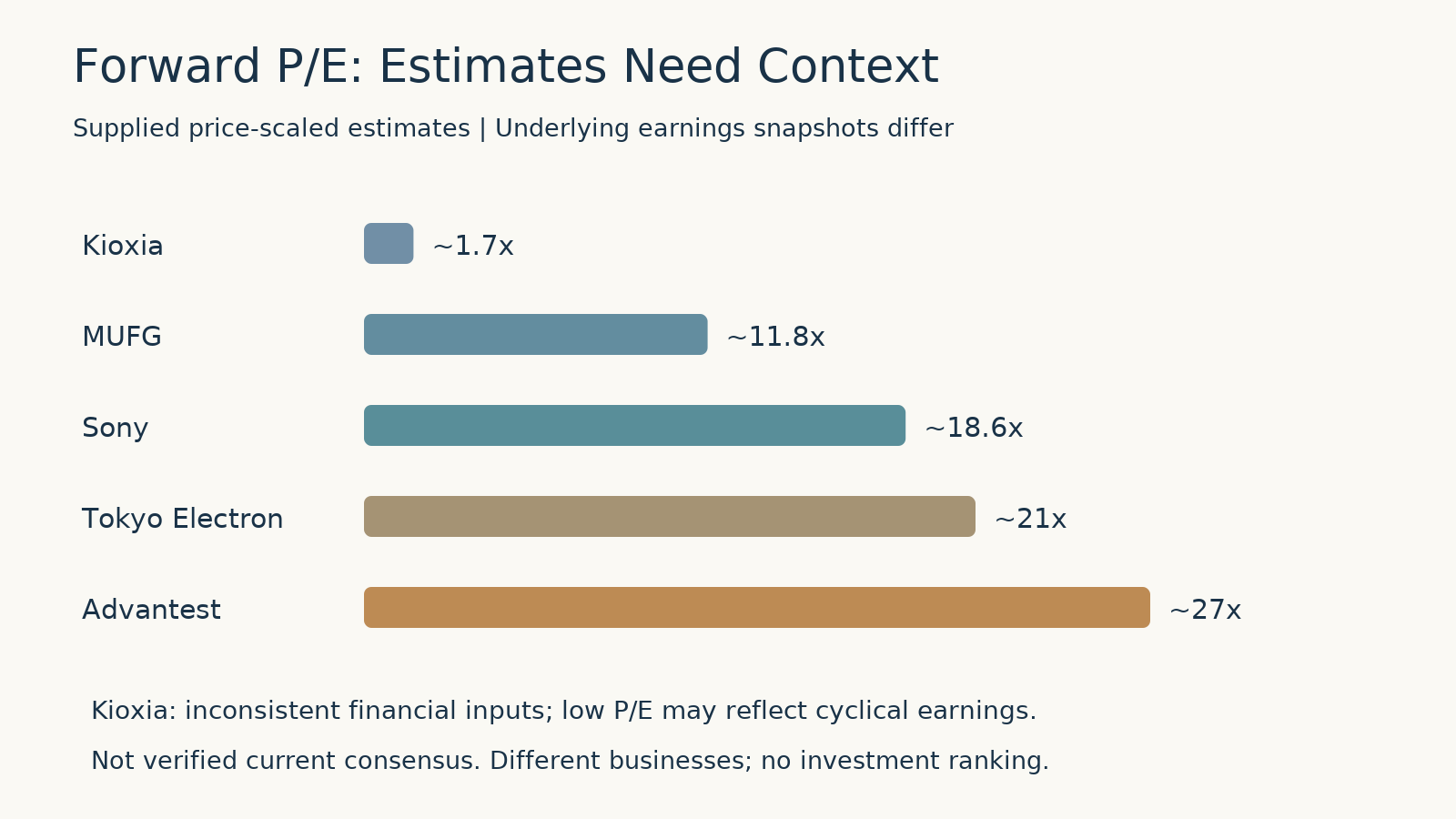
Prices and daily changes below are supplied November 26 snapshots, cross-checked where available. Market caps and multiples are the source draft’s price-scaled estimates from older StockAnalysis inputs, not independently verified current consensus. The draft does not provide every underlying snapshot date. Revenue and profit figures are retained as supplied TTM references; discrepancies require issuer-filings checks before use in valuation.
Kioxia (285A)
- Price: ¥7,762 (+12.57%) | week −1.4% | 1 month −42.3% | year +105%
- Market cap: about ¥12.4 trillion (estimate) | P/E: about 4.8x (forward about 1.7x)
- Revenue: ¥5.79 trillion (+265%) | Profit: ¥2.69 trillion (+1,634%). The site also shows a different set of figures (FY revenue ¥2.34 trillion, profit ¥554 billion). The fiscal data are inconsistent and need checking against a primary source.
- Catalysts: SSD proof of concept with Nvidia; materials partnership with Entegris; a possible US ADR listing (about $10 billion, per Reuters in September).
- Risks: the stock fell as much as 17% after weak guidance in the Oct. 30 earnings. A low multiple can reflect unusually high cyclical earnings; it does not prove that the cycle has peaked. Volatility is extreme (−14% Wednesday, +12.6% today).
SoftBank Group (9984)
- Price: ¥2,894 (+7.32%) | week −13.6% | 1 month −35.2% | year −36.0%
- Market cap: about ¥16.5 trillion (estimate) | P/E: about 12.7x (ttm, estimate)
- Revenue: ¥8.30 trillion (+10.5%) | Profit: ¥1.30 trillion (−57.4%). It posted a loss in fiscal Q2, reported Nov. 10; sources cite between ¥768 billion and about ¥1.1 trillion.
- Catalysts: OpenAI exposure (possible IPO); led Agile Robots' $500 million round; technical bounce after Wednesday's drop of roughly 10–15%.
- Risks: CDS at a four-year high (Reuters); leverage; circular AI financing; profit that depends on mark-to-market gains.
Advantest (6857)
- Price: ¥24,830 (+4.57%) | week −7.5% | 1 month −25.5% | year +21.7%
- Market cap: about ¥18.0 trillion (estimate) | P/E: about 39x (forward about 27x)
- Revenue: ¥1.23 trillion (+36.2%) | Profit: ¥460 billion (+102.2%)
- Catalysts: testers for AI and HPC chips; biggest point contributor to today's rebound.
- Risks: fell sharply Wednesday; the multiple is still high; depends on Nvidia and hyperscaler capex.
Tokyo Electron (8035)
- Price: ¥7,871 (+0.59%) | week −10.9% | 1 month −16.3% | year +9.1%
- Market cap: about ¥17.9 trillion (estimate) | P/E: about 29x (forward about 21x)
- Revenue: ¥2.63 trillion (+8.3%) | Profit: ¥621 billion (+15.9%). October data, before the Oct. 30 earnings.
- Catalysts: equipment for advanced chips; a lower supplied forward multiple than Advantest, without establishing superior value.
- Risks: barely joined the rebound (+0.6%); China; a trade-secrets case involving TSMC in Taiwan; modest growth.
MUFG (8306)
- Price: ¥3,118 (−0.13%) | week −1.0% | 1 month −7.1% | year +23.8%
- Market cap: about ¥35.1 trillion (estimate) | P/E: about 17.8x (forward about 11.8x)
- Revenue: ¥7.26 trillion (+33.4%) | Profit: ¥1.99 trillion (+58.5%)
- Catalysts: a possible BoJ hike in December (about 80–86%); Tamura's hawkish remarks.
- Risks: falling long yields can constrain reinvestment returns; margin effects depend on the asset and funding mix; global risk aversion.
Sony Group (6758)
- Price: ¥4,448 (−1.44%) | week +4.4% | 1 month +9.4% | year +10.0%
- Market cap: about ¥26.0 trillion (estimate) | P/E: n/a (trailing twelve-month net loss of ¥134 billion; forward about 18.6x)
- Revenue: ¥13.02 trillion (+6.5%) | Profit: −¥134 billion
- Research focus: games and entertainment earnings, capital returns and corporate transactions. The draft’s sales records, installed-base and legal-outcome claims were not independently checked and are excluded as established catalysts.
- Risks: the accounting loss needs explaining (possibly one-off write-downs, a hypothesis); yen sensitivity.
6. What Would Make the Lower Prices Attractive?
Japan is in the middle of an AI-theme correction. The Nikkei is down about 8% in November, and several of the year's leaders lost 25% to 50% in a month. For anyone hunting fundamentally grounded multiplication, the pullback opens two fronts.
The cyclical question is whether earnings survive normalization. Kioxia’s conflicting financial inputs make its very low supplied multiple especially unsuitable for a quick “cheap stock” conclusion. Advantest and Tokyo Electron require scrutiny of customer investment plans, order durability and margins. The historical estimates do not establish which stock offers the best risk-adjusted return.
Sony and MUFG pose different questions: the durability of entertainment earnings and cash generation in one case, and rates, funding costs and credit in the other. Their recent relative performance does not make them interchangeable alternatives to semiconductor exposure.
SoftBank adds financing and investment-valuation sensitivity to the AI theme. Its supplied quarterly loss and credit-risk claims need reconciliation against dated disclosures. A decline in share price creates a margin of safety only if a conservative estimate of business value remains above that price. None of the figures here establishes a multibagger outcome, a target price or a recommendation.
7. Agenda
- November Tokyo CPI (consensus 3.0%), Friday, Nov. 27
- Wall Street reopens Friday in a shortened session
- Fed decision in December (about 98% probability of a hike)
- BoJ, Dec. 17–18
- US tariffs on China, Japan and the EU
8. Facts vs. Hypotheses
Reported observations and dated estimates: Nikkei 57,499.16 (+0.86%); TOPIX 3,750.40 (+0.1%); Kioxia +12.57%; SoftBank +7.32%; Advantest +4.57%; Nikkei VI 33.39; USD/JPY about 159.2; 10-year JGB 2.638%; Tamura hawkish; OIS about 80% for a December hike; October core CPI 2.2%; Q3 GDP negative.
Hypotheses: concentrated technical rebound, not a reversal; rotation toward consumer and financials; intervention above 160; a December BoJ hike if Tokyo CPI is strong.
Still to verify: Kioxia fiscal data; the exact size of SoftBank's loss; official market cap and P/E at today's price (mine are estimates); the date of Tokyo CPI.
---
Editorial note: This publication is provided for informational and educational purposes only. It is not investment research, a recommendation, an offer or solicitation, or personalized financial advice. Market conditions and available information can change quickly, and the views expressed here may prove incomplete or incorrect. Readers should consult primary sources and seek qualified professional advice where appropriate.
Sources and references
- Nikkei Indexes — official November 26 daily summary and constituent breadth
- Kioxia — NVIDIA collaboration and SSD proof of concept, November 26
- Bank of Japan — Naoki Tamura speech, November 26
- Bank of Japan — policy rate and next meeting
- Reuters — Tamura’s policy comments
- Investing.com — stock moves, broad TSE breadth and Nikkei VI; Nikkei headline differs from official summary
- Advantest contribution history — third-party point attribution