
Market Calls / Japan
Japan’s AI Trade Cracks: Nikkei Sheds 2.78% While TOPIX Barely Moves
A concentrated semiconductor selloff hit the Nikkei while positive market breadth revealed a more resilient Japan. Rate expectations, tariff proposals, and stale valuations require separate treatment.

Market date
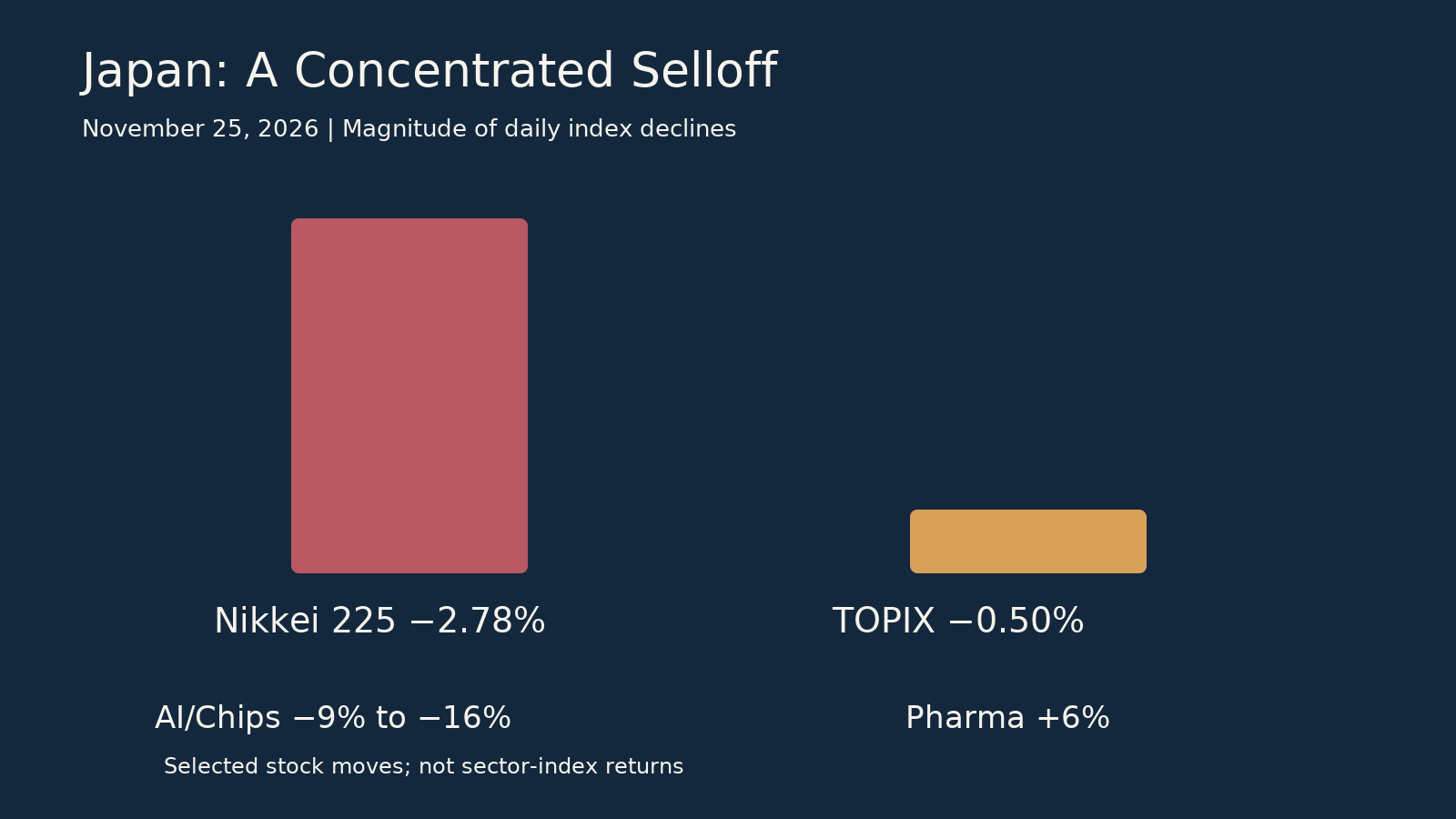
Japan’s headline index told a much darker story than the average stock on November 25. The Nikkei 225 fell 2.78% to 57,011.62, losing 1,633.01 points. TOPIX declined just 0.50% to 3,746.20. Reported Prime Market breadth was positive: 993 shares advanced and 537 declined.
That divergence is the starting point for this session. A price-weighted index can fall sharply when a few influential constituents sell off, even while much of the broader market holds up. The damage was concentrated in AI-linked and semiconductor exposures; it was not an indiscriminate retreat from Japanese equities.
Nikkei’s official record shows an intraday low of 56,502.97. It also corrects an important comparison in the original briefing: against Friday’s 56,436.65 close, Wednesday’s level was approximately 1.02% higher for the week, not 3.4% lower. Monday was a market holiday. Tuesday’s sharp recovery and Wednesday’s reversal should not be confused with a negative week-to-date return.
Where the pressure landed
The supplied session quotations show large declines in SoftBank Group, Advantest, Tokyo Electron, Kioxia, Ibiden, Fujikura, Murata, Lasertec, and Disco. The rounded losses ranged from roughly 9% to 16%. These are selected stock moves, not a calculated return for a uniform AI sector portfolio.
Healthcare held up much better. Otsuka, Astellas, and Chugai each gained around 6% in the supplied closing snapshot. Sony rose 4.4%, Nintendo 3.8%, and Toyota 2.9%. The contrast supports a defensive-rotation interpretation, although relative prices alone do not measure money moving from one group of investors to another.
U.S. technology weakness provided the immediate backdrop. But explanations involving AI profitability, regulation, positioning, and data-center spending are not interchangeable with a verified company announcement. A crowded trade unwinding is a plausible interpretation. It does not establish which investor sold, why they sold, or whether underlying orders have changed.
The distinction matters for research. Semiconductor testing, manufacturing equipment, NAND memory, optical components, and a leveraged investment holding company face different earnings and financing risks. Their shares can fall together without their businesses becoming equivalent.
The U.S. update introduces another risk
After Tokyo’s close, U.S. data reinforced the argument for restrictive monetary policy. Reuters reported October core PCE inflation of 3.3% year over year and revised third-quarter GDP growth of 4.3% annualized, up from 3.4%. These releases belong to the subsequent U.S. session; they should not be retroactively presented as information available throughout Tokyo trading.
The original briefing also included near-close U.S. equity readings. Those are omitted here rather than labeled final closes. A recovery during a U.S. session can affect sentiment toward the following Tokyo open, but it is not a reliable forecast of that opening or the eventual close.
USTR announced determinations and proposed action in 14 Section 301 investigations. Japan is among the economies covered. Written comments are due January 5, 2027, and hearings begin January 25. The process is still at the proposal stage. The original draft’s later description of a “confirmed tariff” was therefore misleading: a proposed measure is not an implemented duty.
The applicable rates, product coverage, implementation timetable, and interaction with existing duties need to be read from the final legal documents. Exporters’ exposure depends on those details as well as production geography and pricing power. A weak yen does not automatically offset a new trade barrier.
The yen depends on both sides of the rate gap
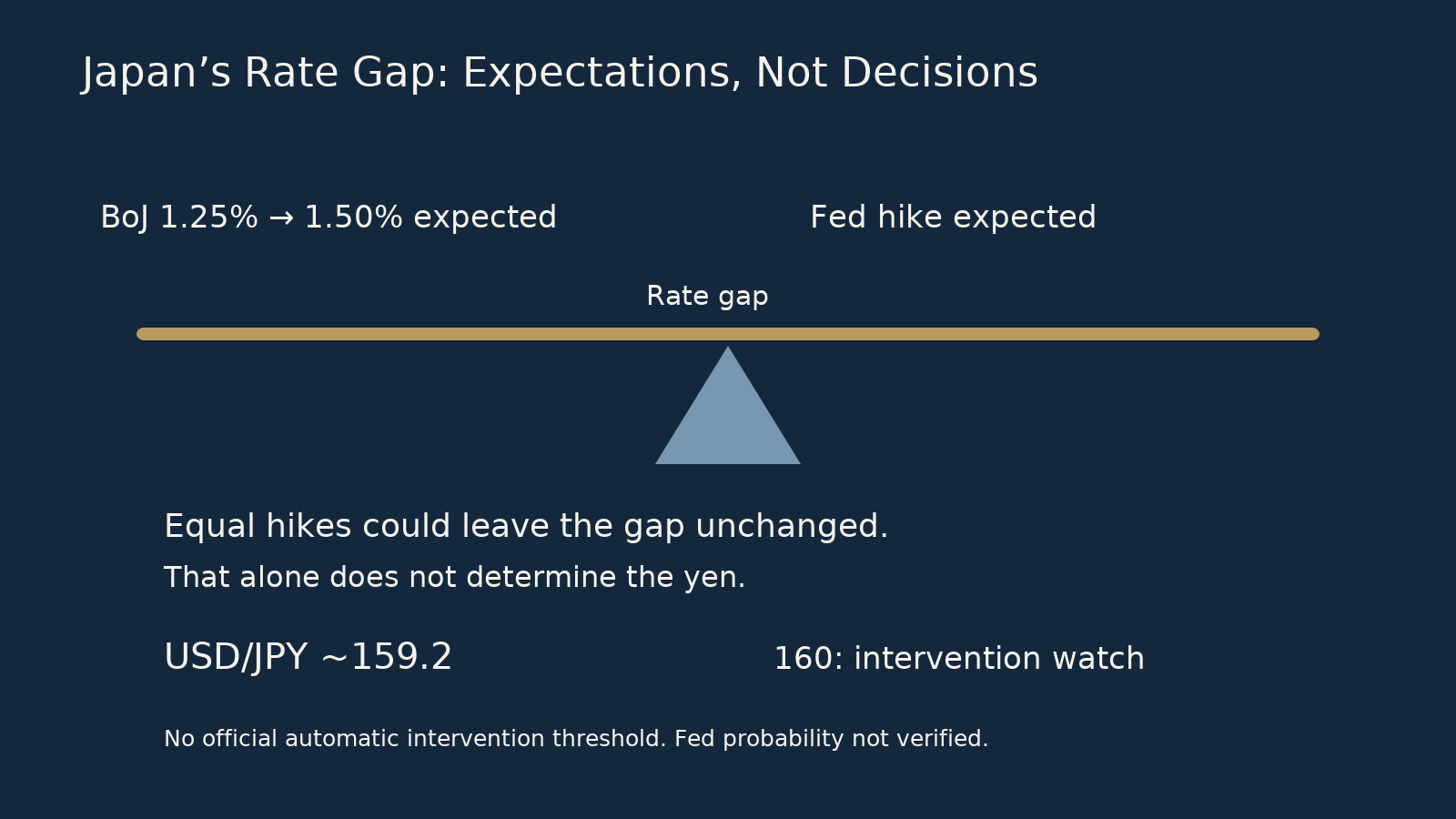
A Reuters survey conducted November 11–18 found that 61 of 71 economists expected the BoJ to raise its policy rate by 25 basis points to 1.50% at the December 17–18 meeting. That 86% is the share of surveyed economists holding a forecast. It is not a market-implied probability and not a BoJ commitment.
The supplied USD/JPY observation was around 159.2. The 160 area is useful as a market watch point, but it is not an official automatic intervention threshold. Authorities’ decisions depend on conditions, including the speed and disorderliness of currency moves.
If both central banks raise rates by the same amount, the immediate policy-rate differential would remain unchanged. That is an arithmetic scenario, not a complete exchange-rate model. Expectations for subsequent meetings, bond yields, capital flows, risk appetite, and intervention can all move the yen. The claim that the gap “never closes” and the yen “cannot recover” goes beyond what the evidence supports.
For banks, higher policy rates can support earnings in some circumstances, while deposit costs, the yield curve, credit losses, and securities valuations complicate the picture. For exporters, a weaker currency may improve translated earnings, but input costs and trade restrictions can offset that benefit. Neither group offers a mechanical trade on a single currency quotation.
Research candidates: refresh the denominator first
The original screen estimated current market capitalizations and P/E ratios by scaling older figures with the latest share price. That shortcut holds share counts and earnings assumptions constant. It can become misleading after a stock split, new results, a forecast revision, or a change in shares outstanding.
Several reference dates preceded earnings releases. Those estimates are therefore not reproduced as verified current valuations. A falling share price only improves an earnings multiple if the relevant earnings denominator holds up.
Advantest provides exposure to semiconductor testing and AI-related chip demand. The research question is how much recent earnings growth survives a slower customer spending cycle. Its supplied forward multiple needs fresh estimates before it can support a valuation conclusion. Historical analyst targets are not evidence of current upside.
Tokyo Electron offers a different equipment exposure. Customer budgets, order timing, export restrictions, and the memory-versus-logic mix need to be assessed directly. The original claim that it offered the best quality-price balance cannot be established from a scaled historical multiple alone.
Kioxia requires particular caution. The original draft explicitly identified conflicting revenue figures. Until fiscal periods, accounting definitions, and share bases are reconciled, the proposed roughly 4x earnings multiple is not a dependable valuation input. Peak earnings are a risk hypothesis, not a verified explanation for every part of the decline.
SoftBank Group requires an assessment of holding-company debt, liquidity, asset valuations, funding commitments, and investment concentration. A consolidated P/E is not sufficient to evaluate those constraints. Its exposure is materially different from that of an operating semiconductor supplier.
Sony adds games and other businesses to the discussion. The supplied trailing loss should be reconciled with reported results before being dismissed as a one-off. Unverified product-sales and litigation claims are not used here as established catalysts.
Toyota combines currency exposure with manufacturing, demand, and trade-policy risks. The proposed Section 301 measures need a product- and geography-specific analysis. A low historical multiple does not settle that question.
Otsuka participated in the session’s healthcare strength. Its business case still requires current results, product concentration, and patent analysis. Defensive price behavior on one day is not proof of defensive valuation.
MUFG offers exposure to Japanese interest rates, but the yield curve and funding costs matter alongside the policy rate. The economist poll supports a scenario for further tightening; it does not guarantee an earnings outcome.
Fujikura, Ibiden, Murata, Disco, Lasertec, and the other names in the supplied screen remain candidates for further work. Their fundamentals were not verified for this edition. Anonymous claims about defense-order cuts are also excluded from the explanation of the session.
The dates that matter next
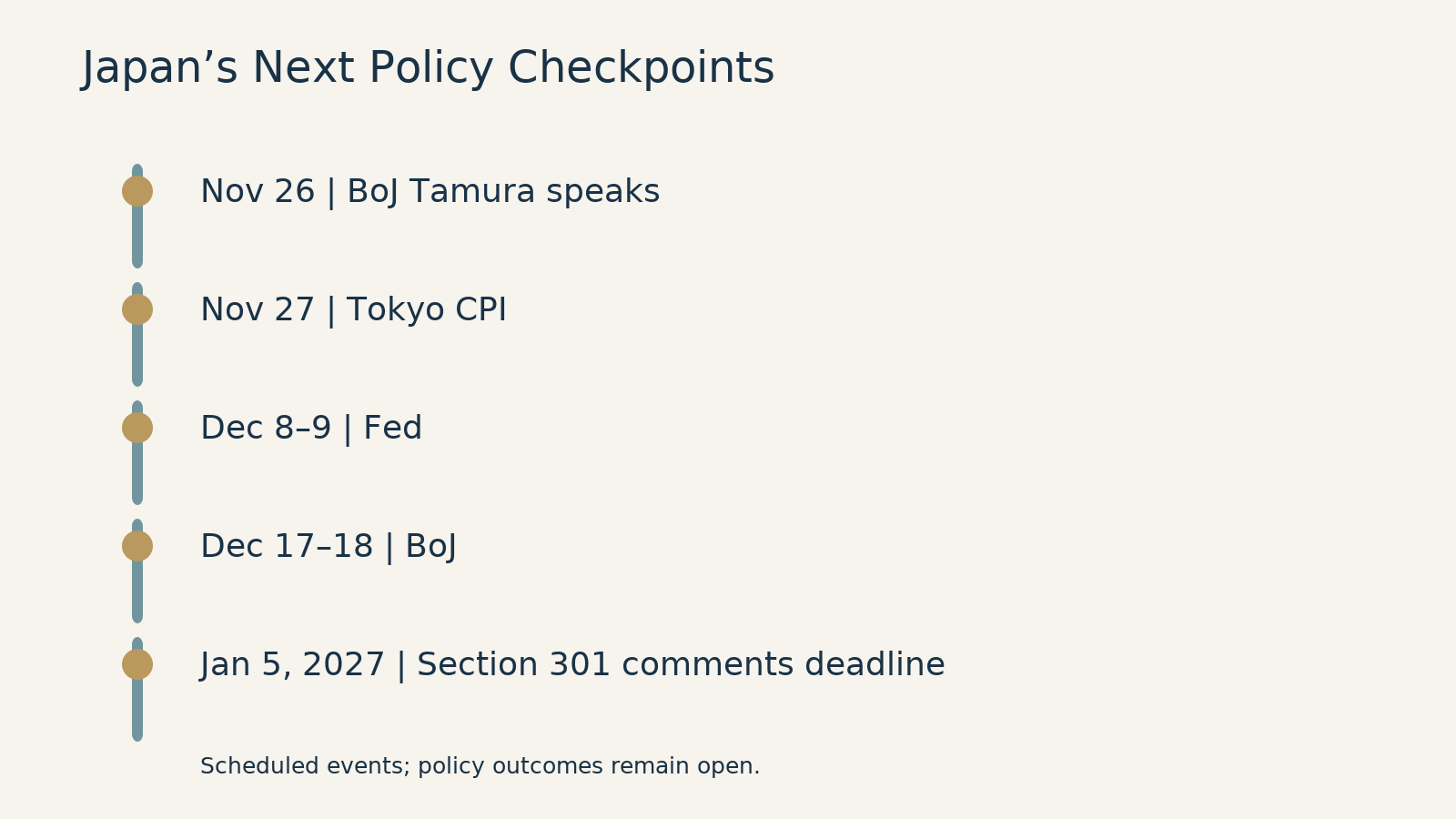
Tamura’s November 26 speech may clarify the policy debate. Tokyo’s November CPI release follows on November 27. The Fed meets December 8–9, and the BoJ meets December 17–18. USTR’s January 5 comment deadline is a procedural checkpoint, not a tariff effective date.
The next useful market signal is whether weakness remains concentrated or begins to spread through earnings expectations and broader participation. For the AI names, fresh orders and revised profit assumptions matter more than the size of the preceding drawdown. For Japan as a whole, Wednesday’s positive breadth is a reason to look beyond the Nikkei headline, not a guarantee that the broader market will remain insulated.
Editorial and data note
Official Nikkei historical prices anchor the index comparison. TOPIX and breadth are corroborated by market reporting. Selected stock returns come from the supplied session snapshot and are rounded. Unverified valuation estimates, stale earnings comparisons, final-close claims based on intraday observations, and unsupported causal claims have been removed or qualified. This commentary is informational and is not a recommendation or personalized investment advice.