
Market Calls / China
Hong Kong Ends Its Losing Streak as Southbound Flows Turn Negative
The Hang Seng gained 1.19%, but surrendered much of its intraday advance as southbound investors recorded HK$21.35 billion in net selling. A rebound with important limits.

Market date
Market Call: Hong Kong (HKEX)
Thursday, November 26, 2026
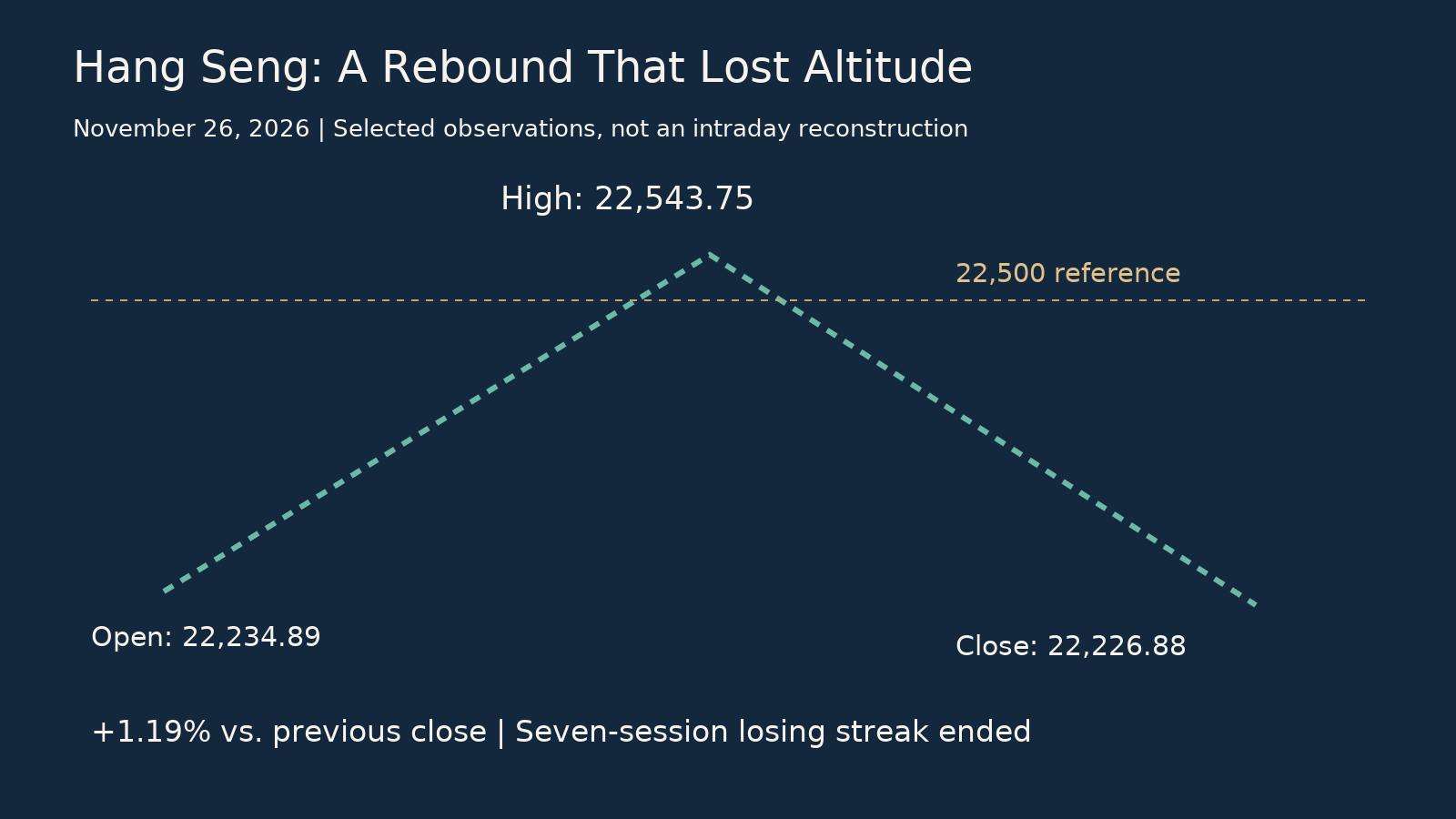
Hong Kong ended seven straight sessions of losses. The Hang Seng gained 1.19% to close at 22,226.88, after climbing as much as 2.6% (22,543) at midday. The index traded above 22,500 before slipping back below it. That makes 22,500 a reference area for the author’s technical interpretation, not an unbroken ceiling. The close gave back more than half of the gain at the high.
The Hang Seng Tech Index advanced 1.16% to 3,417.38, and the HSCEI rose 1.47% to 7,493.34. Turnover fell to HK$212.5 billion, from roughly HK$230 billion the day before.
The rally drew on state-owned banks (BoCom hit a record high), oil and coal, gold and metals, and a bounce in AI names. Zhipu rose 8.1% and MiniMax 7.5%. Li Auto gained 8% on its results, and BOSS Zhipin jumped 14.6%.
Prices and one important investor channel moved in opposite directions. ET Net’s closing report, distributed by KGI, records total southbound net selling of HK$21.35 billion, versus net buying of HK$6.43 billion the previous session. ETFs featured prominently among the net sales. These are channel-wide totals, not ETF-only figures, and they do not identify all buyers and sellers in Hong Kong.
The backdrop is not friendly. USTR’s proposals involve 14 economies, with different tariff terms and exemptions. They are not a uniform 20% levy on every partner. Chip-access restrictions remain a separate policy risk. On the positive side, Goldman Sachs upgraded Hong Kong to overweight.
Closing Snapshot
Hang Seng: 22,226.88, +1.19% (+260.9). Week −3.57%, one month −4.44%, year −13.57%.
Hang Seng Tech: 3,417.38, +1.16%. Week −7.64%, one month −12.06%, year −38.40%.
HSCEI: 7,493.34, +1.47%. Week −3.46%, one month −4.13%, year −16.27%.
Shanghai Composite: 3,476.88, +0.01%. Week −2.96%, one month −5.99%, year −12.79%.
CSI 300: 3,900.55, +0.06%. Week −1.81%, one month −4.99%, year −16.33%.
The HSI opened 268 points higher, reclaimed 22,000, touched 22,543 and then surrendered more than half of the peak gain. Month-end futures were slightly below spot: HSI 22,199, HS Tech 3,412, HSCEI 7,480.
Timing matters: a mid-session report of +1.7% is not inherently inconsistent with a +1.19% close. HKEX confirms the closing index level of 22,226.88, up 260.87 points.
Local analyst Tan Langwei argues that 22,700 must be retaken before building positions. That is a third-party view.
Stock Moves: Selected Supplied Observations
The draft’s stock-level snapshots are retained for context, not as a fully reconciled official closing tape. Unexplained extreme moves and unverified listing identities are excluded.
- BOSS Zhipin / Kanzhun (2076): HK$55.5, +14.6%. Q3 revenue RMB 2.416 billion (+11.7%); buyback of up to US$500 million.
- Zhipu / Z.AI (2513): HK$293.0, +8.1%. AI bounce after −15.1% on 11/25.
- Li Auto (2015): HK$45.80, +8.0%. Q3 loss narrowed 50%; expects a Q4 profit; volume 3.2x average.
- Changguang Chenxin (3277): HK$37.32, +8.1%. Image sensors.
- MiniMax (0100): HK$93.95, +7.5%. AI bounce after −13.8% on 11/25 and −48% over one month.
- Zhongji Innolight (3308): HK$515, +6.1%. AI optics.
- Zijin Gold Intl. (2259): HK$105.8, +5.7%. Gold.
- BoCom (3328): HK$9.20, +4.4%. Record high; banks rallied in the afternoon.
- PetroChina (0857): HK$9.775, +4.4%. Brent +3.5%; ended eight straight declines.
- ZTO Express (2057): HK$161.7, +4.5%.
- Lenovo (0992): HK$16.79, +3.5%. Bounce after −11.1%.
- Hua Hong (1347): HK$64.75, +3.6%. Bounce after −17.3%.
- CNOOC (0883): HK$21.32, +3.3%. Oil.
- China Shenhua (1088): HK$41.28, +3.3%. Coal.
- CCB (0939): HK$10.43, +2.2%. Largest contributor to the HSI (+31 points).
- ICBC (1398): HK$7.84, +2.3%. Banks.
- Meituan (3690): HK$62.70, +2.0%. Bounce after a 1-year-plus low.
- Tencent (0700): HK$341.0, +1.1%.
- Alibaba (9988): HK$82.50, +1.6%.
- HSBC (0005): HK$128.4, −0.2%.
- Xiaomi (1810): HK$26.60, +0.2%. Post-Q3; sold by Southbound.
- BYD (1211): HK$56.90, −1.8%. 52-week low; volume 1.6x average.
- Trip.com (9961): HK$306.2, −2.3%. Travel.
- Cathay Pacific (0293): HK$14.10, −4.2%. Airlines fell with oil.
- China Eastern (0670): HK$2.22, −5.3%. Oil.
- Air China (0753): HK$3.32, −4.7%. Oil.
Stock Connect Flows
Southbound net selling totaled HK$21.35 billion on November 26, compared with net buying of HK$6.43 billion a day earlier, according to ET Net/KGI. The year-to-date ranking was not verified.
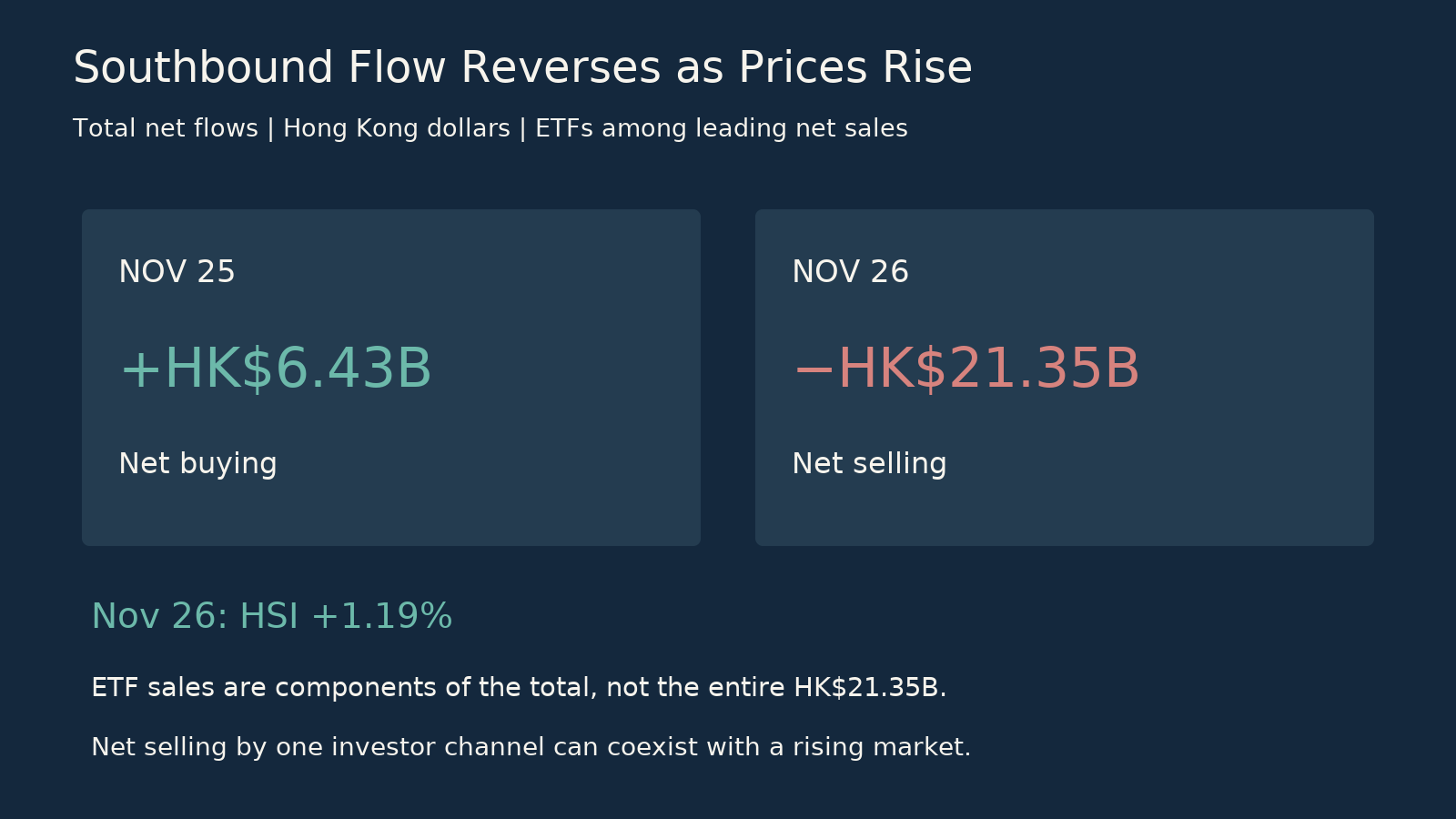
The same source reports the following November 26 net sales in Hong Kong dollars: Tracker Fund HK$8.45 billion, HSCEI ETF HK$2.19 billion and CSOP HS Tech HK$1.83 billion. Tencent was a net purchase of approximately HK$147 million. The source draft’s RMB labels and Shanghai/Shenzhen splits were not reconciled, so they are not mixed into this comparison.
The pattern is consistent with tactical trading, but it does not reveal the identity or motivation of the investors. It provides no evidence of “patriotic” intervention or a coordinated defense of the index. Aggregate southbound net selling also does not mean there were no mainland purchases: it means sales exceeded purchases through that channel. A higher HSI alongside those sales shows that price formation involved other demand as well; it does not establish either a durable recovery or an inevitable next decline.
China Macro, Yuan and News
Tariffs. USTR announced Section 301 determinations and proposed actions concerning 14 economies on November 25. The terms vary: the EU proposal specifies 15%, net of MFN rates and existing Section 301 tariffs, with exemptions. Country-specific notices must be consulted before assigning rates, stacking rules or implementation dates. The article treats these as proposals, not effective blanket duties.
Chips. New US chip restrictions (11/23) and a drop in the SOX during the week hit Hong Kong semiconductors and robotics on 11/25 (Hua Hong −17%, Biren −25%).
Activity. According to Bloomberg (11/16), October data came in below expectations despite stimulus. The LPR was held on 11/20 at 3.00% / 3.50%. October industrial profits are due around 11/27.
Yuan. Spot USD/CNY was 6.6592 (−0.23%) and CNH 6.6612. The yuan is up about 4.8% this year and sits at a roughly four-year high offshore. Recent PBoC fixings were around 6.71, about 400 pips weaker than estimates (\~6.67). The exact 11/26 fixing was not confirmed. SCMP reads this as the PBoC slowing the pace of appreciation.
External. U.S. October core PCE was 3.3% year over year. The supplied oil and gold snapshots use different times and contracts and are not presented here as a synchronized closing comparison. Energy and inflation remain relevant transmission channels, without proving why each stock moved.
Strategists. Goldman Sachs upgraded Hong Kong to overweight, citing earnings growth, cyclically low valuations and light positioning. That is a third-party opinion.
This Week’s Earnings and Supplied Company Notes
Li Auto (2015), Q3 2026. Revenue RMB 28.83 billion (+5.4% y/y). Gross margin 16.7% (11.0% in Q2). Net loss RMB 309.7 million (−50.4% y/y). Deliveries 99,964. Management expects a profit in Q4. Cash position was not reconciled in this review. The issuer also reports positive quarterly operating cash flow of about RMB3.2 billion and free cash flow of about RMB2.0 billion; neither figure is the cash balance.
Xiaomi (1810), supplied Q3 2026 figures, not independently refreshed. Revenue RMB 107.24 billion (−5.2%). Net profit RMB 3.88 billion; adjusted profit RMB 4.9 billion (−56.8%). Gross margin 20.2% (22.9% a year earlier).
- Autos: revenue RMB 23.9 billion (−17.7%), margin 19.2%, operating loss RMB 3.4 billion.
- Smartphones: record ASP (+39.8%), but segment margin only 9.2% because of memory costs.
BOSS Zhipin (2076), supplied Q3 2026 figures. Revenue RMB 2.416 billion (+11.7%). Buyback expanded to up to US$500 million. Q3 profit not confirmed.
JD (9618) and Bilibili (9626), reported 11/25: JD adjusted profit +44%; Bilibili advertising +20%.
Working Hypotheses (Unconfirmed)
H1. This is a technical oversold bounce (HS Tech −7.6% on the week) without net southbound buying. Southbound sold HK$21 billion into the rally, which warrants monitoring; it does not establish the probability of another decline or make 22,000 a reliable predictive boundary.
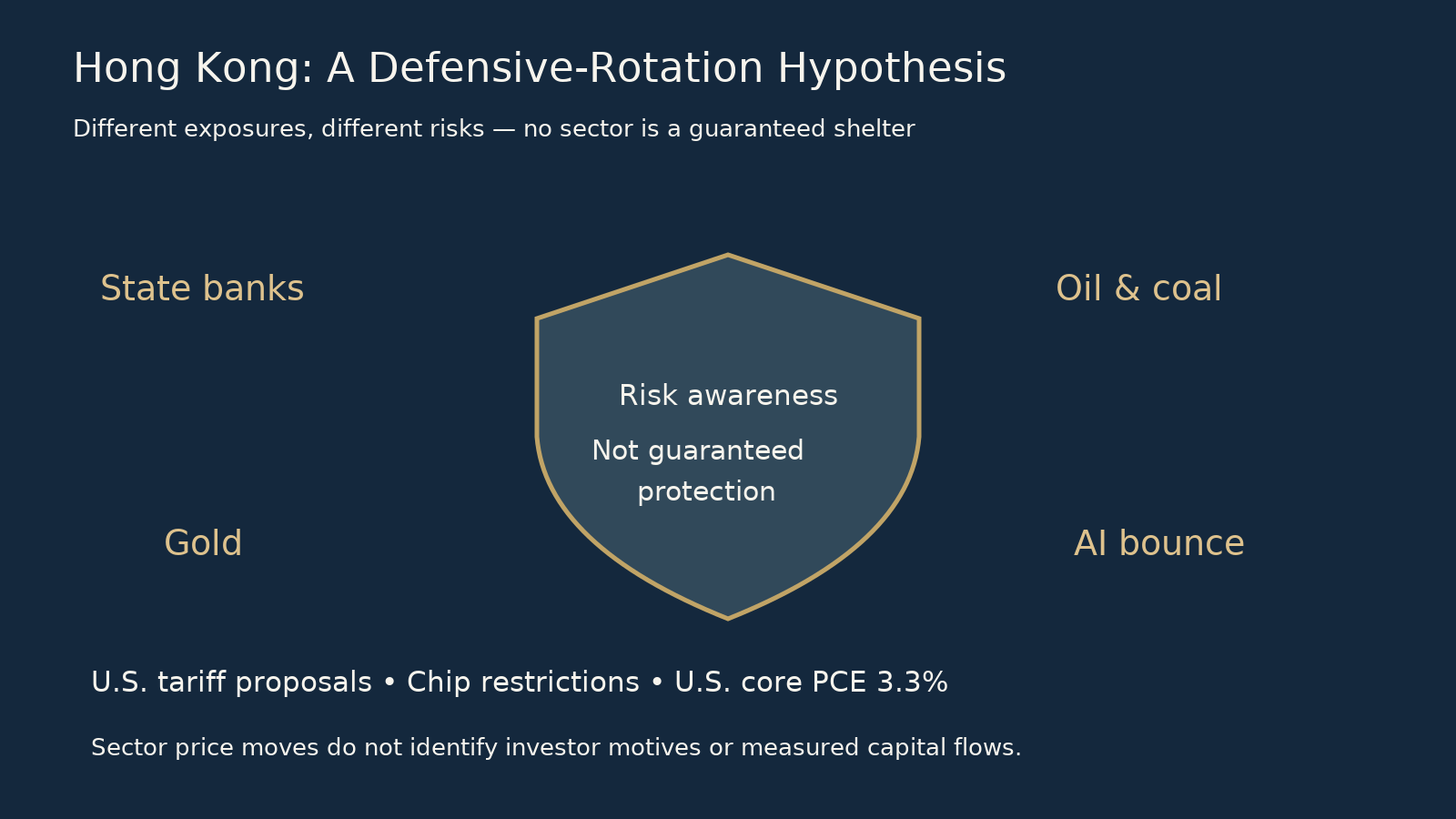
H2. The rotation into state banks, energy, coal and gold (dividends and protection) looks like a market defending itself against tariffs and the AI cycle, not renewed risk appetite.
H3. The reported Goldman upgrade is a third-party view, not a price floor. Index declines describe returns, not valuation; low prices require comparison with earnings, assets and risk before being called cheap. In the short run, the drivers are external: the SOX, tariffs and PCE.
H4. Yuan appreciation can raise the HK-dollar equivalent of RMB earnings, but the effect depends on costs, hedges and currency exposure. An interpretation that the PBoC is restraining appreciation does not establish the central bank’s intent.
Stock Profiles (Study Notes, Not Recommendations)
Market caps and multiples marked "est." come from StockAnalysis snapshots (Sep–Nov 2026) in the previous edition, adjusted for the 11/26 price. These are historical, price-scaled estimates rather than independently verified current valuations. Exact source dates are incomplete. Every thesis is a hypothesis.
BOSS Zhipin / Kanzhun (2076.HK) — HK$55.5, +14.6%
- Market cap: \~HK$50 billion est. (\~0.9 billion shares).
- Multiples: adjusted P/E \~11x est.; operating margin 36% (Q2).
- Thesis: leading recruitment platform with about US$2.8 billion in cash (≈40% of market cap), no reported bank debt, a buyback and a dividend.
- Catalysts: US$500 million buyback; a hiring recovery in China.
- Risks: weak labor market, data regulation, non-recurring gains inflating net profit.
JD.com (9618.HK) — HK$100.8, +0.5%
- Market cap: \~HK$266 billion est.
- Multiples: forward P/E \~6.2x est.; P/S 0.18x; net cash \~HK$179 billion.
- Thesis: a substantial reported cash position may affect enterprise valuation, but operating value requires reconciliation of cash availability, debt, leases and other claims.
- Catalysts: 12.12 shopping event, buybacks, smaller delivery losses.
- Risks: price wars, SAMR, idle cash.
Li Auto (2015.HK) — HK$45.80, +8.0%
- Market cap: not confirmed.
- Metrics: Q3 loss; gross margin 16.7%.
- Thesis: margin turnaround (11% to 16.7% in one quarter) and a return to profit in Q4.
- Catalysts: the i6; November deliveries (>40,000, Deutsche Bank estimate).
- Risks: price wars, the BEV transition, October deliveries −8.6% y/y.
Tencent (0700.HK) — HK$341.0, +1.1%
- Market cap: \~HK$3.07 trillion est.
- Multiples: trailing P/E \~11.6x est.; net margin 30%.
- Thesis: recurring businesses with an investment case dependent on the returns from AI spending; cheapness is not established by the supplied multiple.
- Catalysts: AI monetization in advertising and cloud.
- Risks: return on capex, regulation; size alone does not establish future return potential.
Xiaomi (1810.HK) — HK$26.60, +0.2%
- Market cap: \~HK$684 billion est.
- Multiples: trailing P/E \~18x (stale, pre-Q3).
- Thesis: ecosystem plus EV, punished by the cycle.
- Catalysts: margin recovery as memory costs normalize.
- Risks: adjusted profit −57%, auto losses, Southbound selling.
BeOne Medicines (6160.HK) — HK$251.2, +2.3%
- Market cap: \~HK$371 billion est.
- Multiples: forward P/E \~50x est.; gross margin 89%.
- Thesis: global zanubrutinib with operating leverage.
- Catalysts: clinical data, margin expansion.
- Risks: valuation, Biosecure, pharma tariffs.
Zhipu / Z.AI (2513.HK) — HK$293, +8.1%
- Market cap and multiples: not confirmed; loss-making.
- Thesis: an option on Chinese LLMs.
- Catalysts: products and agents.
- Risks: −44% in one month, −77% from the three-month high, Southbound selling.
What the Watchlist Still Needs
No candidate has a fully reconciled set of current cash, debt, margins and valuation inputs in this review. BOSS requires a clean bridge from adjusted earnings to cash generation. JD requires a defensible enterprise-value calculation and a view on margins and capital returns. Li Auto’s recovery needs to persist through deliveries, pricing and cash flow. The AI names require scrutiny of revenue quality, financing and competitive durability.
None of those questions can be answered by today’s percentage gain. The earlier draft’s return-multiple scenarios and relative “best” labels are not supported by a valuation model and are omitted. This remains a research list, not a recommendation or a ranking.
Calendar
- 11/27: China industrial profits (October)
- 11/30: final weekday of November; November 28 is a Saturday
- 11/30: official November PMI
- 12/1: Caixin PMI
- Early December: Politburo
- Mid-December: Central Economic Work Conference (date unconfirmed)
- Reported January 2027 trade deadline: not independently verified; consult the official agreement before relying on it.
Facts, Hypotheses, Open Items
Reported observations: HSI 22,226.88 (+1.19%), ending seven declines; HS Tech 3,417.38 (+1.16%); HSCEI +1.47%; turnover HK$212.5 billion; Southbound −HK$21.3 billion (selling ETFs); banks, energy and gold led; Li Auto +8%, BOSS +14.6%; BYD at a 52-week low; USD/CNY 6.6592; economy-specific U.S. tariff proposals; Goldman overweight on HK.
Hypotheses: technical bounce without flow; defensive rotation; medium-term valuation support.
Open items: exact PBoC fixing for 11/26; Southbound SH/SZ split in HKD; Li Auto's cash; BOSS's Q3 profit; updated official market caps.
Editorial note: This publication is provided for informational and educational purposes only. It is not investment research, a recommendation, an offer or solicitation, or personalized financial advice. Market conditions and available information can change quickly, and the views expressed here may prove incomplete or incorrect. Readers should consult primary sources and seek qualified professional advice where appropriate.