
Market Calls / China
Hong Kong Finds a Floor for the Day, Not Yet for the Cycle
Hong Kong recovered from a 19-month intraday low but still closed lower, as China's two-speed economy, tighter U.S. chip rules and the uncertain cash returns from AI investment kept the larger trend unresolved.

Market date
Hong Kong almost erased a steep morning selloff on Monday. That was the constructive part. The less reassuring part is that the Hang Seng still closed lower for a fifth consecutive session, technology shares remained deeply damaged, and the forces behind the decline—heavy AI spending, tighter access to advanced computing and weak domestic demand—did not disappear in the afternoon recovery.
Reporting cut-off: Monday, November 23, 2026, after the Hong Kong cash close. Market prices can change quickly. This is general market commentary, not a trade instruction.
The session: relief without a reversal
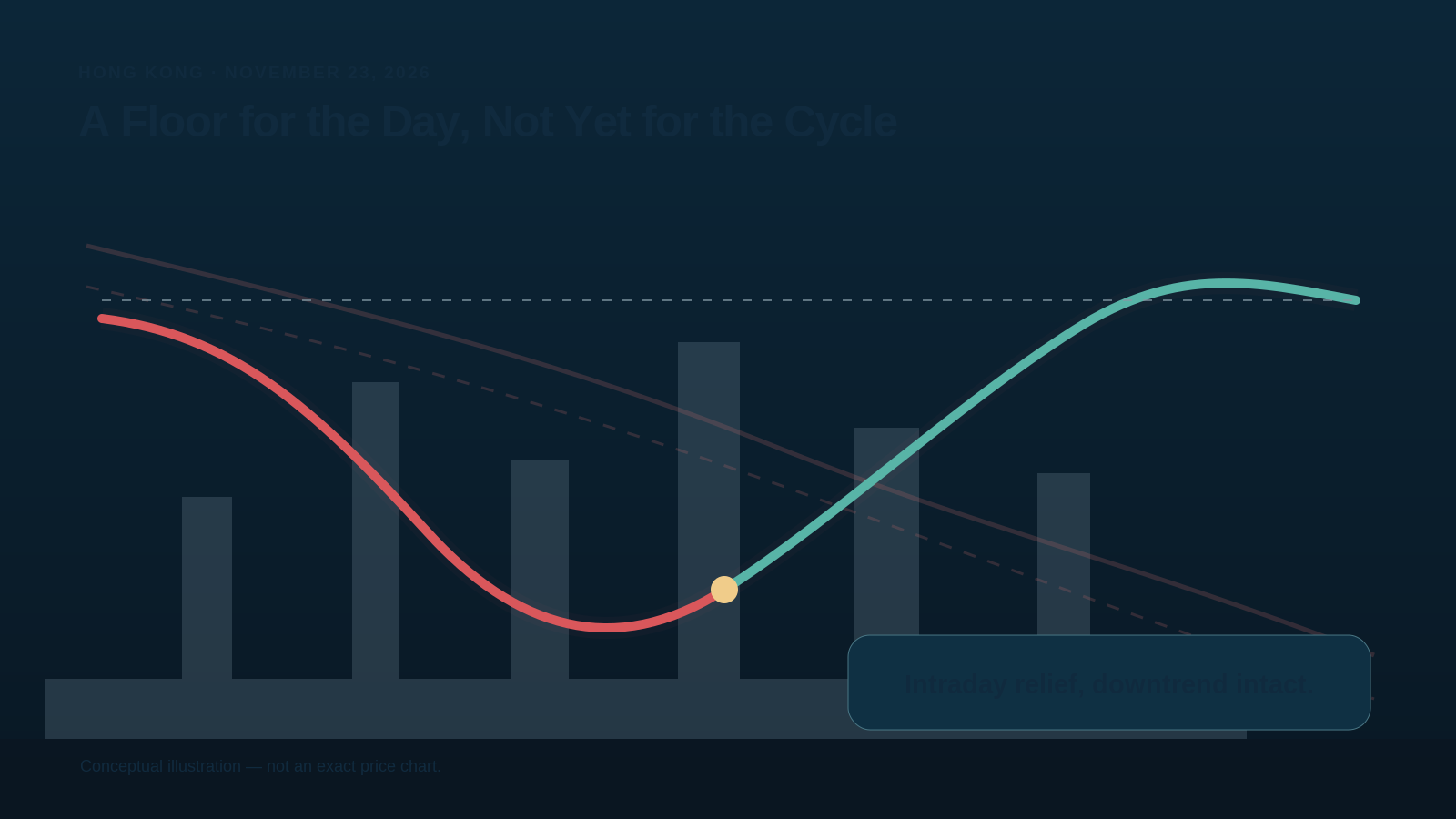
The Hong Kong exchange's daily quotation records the Hang Seng at 22,383.74, down 0.12%, after reaching an intraday low of 21,998.05. The index had dropped about 1.8% in early trading before recovering almost all of the loss. Turnover was HK$253.1 billion.
The Hang Seng Tech Index finished at 3,508.00, down 0.09%, after falling below 3,400 during the session. The HSCEI lost 0.35%. On the mainland, the Shanghai Composite edged up 0.15%, while Shenzhen and ChiNext finished considerably stronger.
That combination matters. Monday was not a uniform return of risk appetite. It was a sharp intraday repair after the Hong Kong benchmark touched a 19-month low, accompanied by greater resilience in parts of the mainland market. The close says that sellers lost control of the session. It does not establish that the broader downtrend has ended.
The distinction is especially important after five consecutive declines. A market can become temporarily exhausted near a widely watched low and still remain vulnerable to the same earnings, policy and positioning pressures in the next session.
Beijing loosened the trading constraint, not the earnings constraint
Before Monday's session, the Shanghai, Shenzhen and Beijing exchanges announced that the minimum financing margin ratio would fall from 100% to 80%, effective November 30. Reuters reported that the change allows investors to borrow more against the same collateral after outstanding margin loans declined by more than 20% from their June peak.
The measure can improve liquidity and make it easier for leveraged buyers to re-enter the market. It is therefore a credible contributor to the afternoon stabilization. Its limits are equally clear: a lower margin requirement does not improve corporate cash flow, repair the property market or establish that AI investment will earn an adequate return.
Calling the change a “policy put” would go too far. It is better understood as a market-support measure whose effect will be observable in turnover, margin balances and breadth after November 30. If trading activity rises without a corresponding improvement in earnings expectations, the policy may amplify movement without changing valuation fundamentals.
The new chip rule reaches beyond physical shipments
The external policy pressure is more structural. The U.S. Commerce Department's Bureau of Industry and Security published an interim final rule designed to prevent restricted entities from accessing advanced U.S. computing through data centers in third countries. The rule took effect on November 19.
This is not simply another restriction on shipping a chip directly to China. It adds licensing and due-diligence requirements where advanced computing hardware supports significant remote access for companies headquartered in China, Macau or other destinations covered by the rule. The practical consequences will depend on implementation, licensing and individual companies' infrastructure arrangements.
For Chinese internet platforms, the uncertainty operates in two directions. Advanced computing may become harder or more expensive to obtain, while investors are already asking whether the capacity purchased so far is producing enough revenue and cash. The regulation does not prove that every platform will lose access. It does raise the value of supply-chain flexibility, proprietary chips and efficient use of existing computing capacity.
China's October data describe two different economies
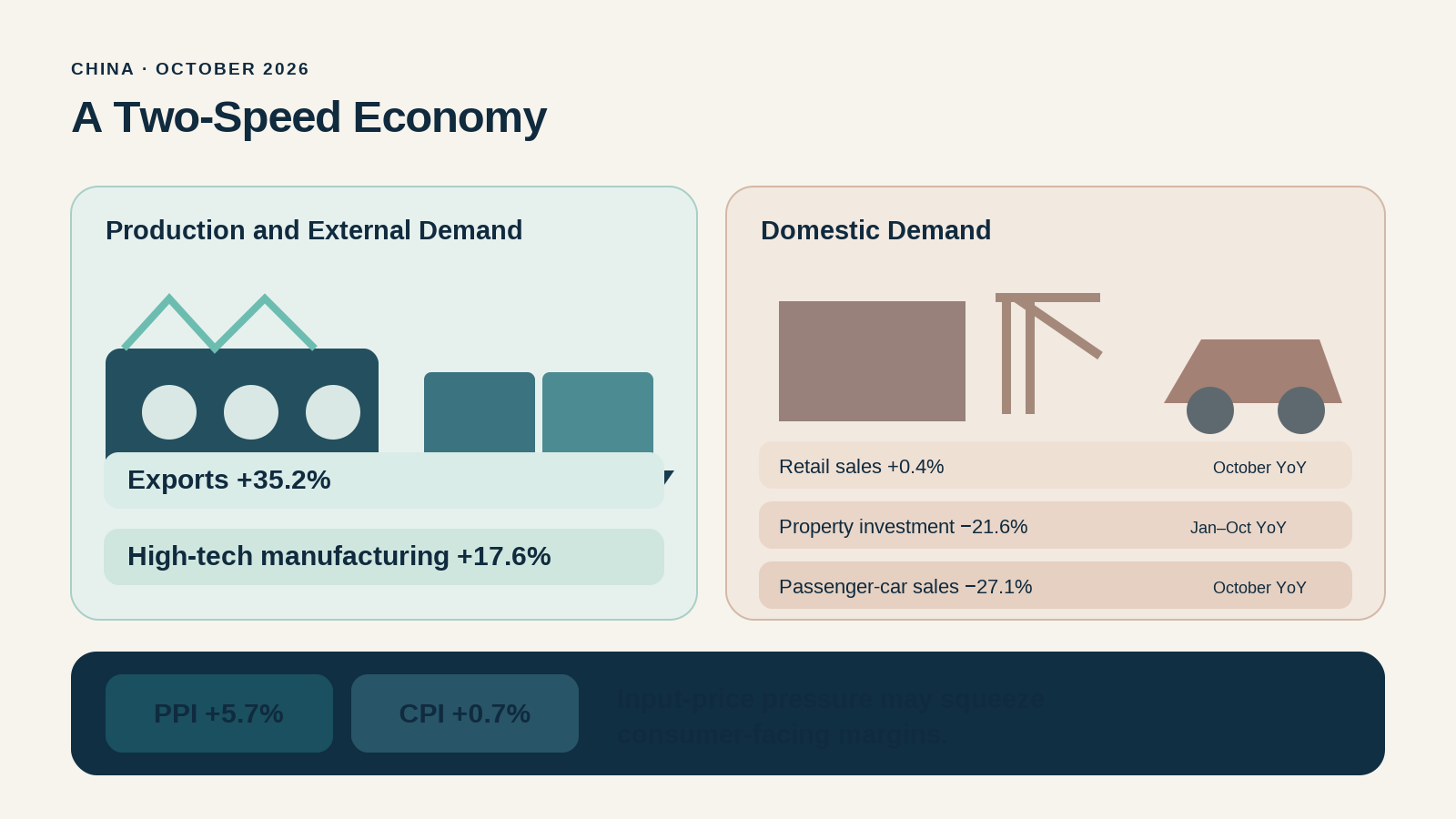
China's official October releases show a striking split between production and domestic demand. The National Bureau of Statistics reported that high-technology manufacturing rose 17.6% year over year, while total industrial output increased 4.8%. Customs data showed exports up 35.2% in U.S. dollar terms.
The domestic side was much weaker. Retail sales increased only 0.4% in October. Real-estate development investment fell 21.6% in January–October from the same period a year earlier. CPCA data cited by Caixin put October passenger-car retail sales down 27.1% year over year.
Prices add a margin question. October producer prices rose 5.7%, while consumer prices increased 0.7%. The two measures cover different baskets and stages of production, so the gap is not a direct company-margin calculation. It is nevertheless consistent with a difficult environment for businesses that face rising input costs but have limited ability to raise consumer prices.
That is the macro logic behind Monday's rotation. Export and high-technology production can remain strong while retail, property and autos struggle. “China growth” is not one trade when the components are moving at these speeds.
Three earnings reports, one capital-allocation question
Recent results from Tencent, Alibaba and Lenovo show why the market is separating sellers of AI infrastructure from the platforms financing it.
Tencent: resilient franchises, a costly compute cycle
Tencent's third-quarter release reported revenue of RMB207.3 billion, up 8% year over year. Non-IFRS profit attributable to shareholders fell 6% to RMB66.5 billion. Capital-expenditure payments reached RMB65.1 billion, and the company recorded negative free cash flow of RMB69.1 billion. Excluding compute-procurement prepayments, free cash flow would have been positive RMB16.9 billion.
That final distinction is informative but not exculpatory. A prepayment is different from a recurring operating loss, yet it still uses cash. Tencent's gaming, advertising, messaging and cloud franchises remain substantial. The market's question is how quickly compute spending converts into durable cloud revenue, advertising efficiency and cash generation.
Alibaba: cloud acceleration with another cash outflow
Alibaba's September-quarter release showed revenue of RMB271.5 billion, up 10%. AI Cloud and Compute Services revenue rose 53%, and recurring revenue from external cloud customers grew 67%. Free cash flow was an outflow of RMB34.5 billion, which the company attributed mainly to cloud-infrastructure expenditure.
Alibaba therefore presents both sides of the AI argument in the same report: rapid cloud growth and heavy cash consumption. Investment gains also contributed to the large increase in reported net income, so net income, adjusted operating performance and free cash flow should not be treated as interchangeable.
Lenovo: selling the buildout, but margins still decide the value
Lenovo's fiscal second-quarter release reported revenue of $30.2 billion, up 48%, and adjusted net income of $1.4 billion. Infrastructure Solutions Group revenue rose 178% to $11.3 billion, while its GPU-server pipeline reached $80 billion.
Lenovo is positioned differently from the internet platforms: it sells servers and infrastructure into the spending cycle. That can make its revenue benefit arrive earlier. It does not guarantee shareholder returns. Pipeline conversion, component costs, working capital and operating margins still determine how much of the demand becomes cash.
Who sells the buildout—and who pays for it?
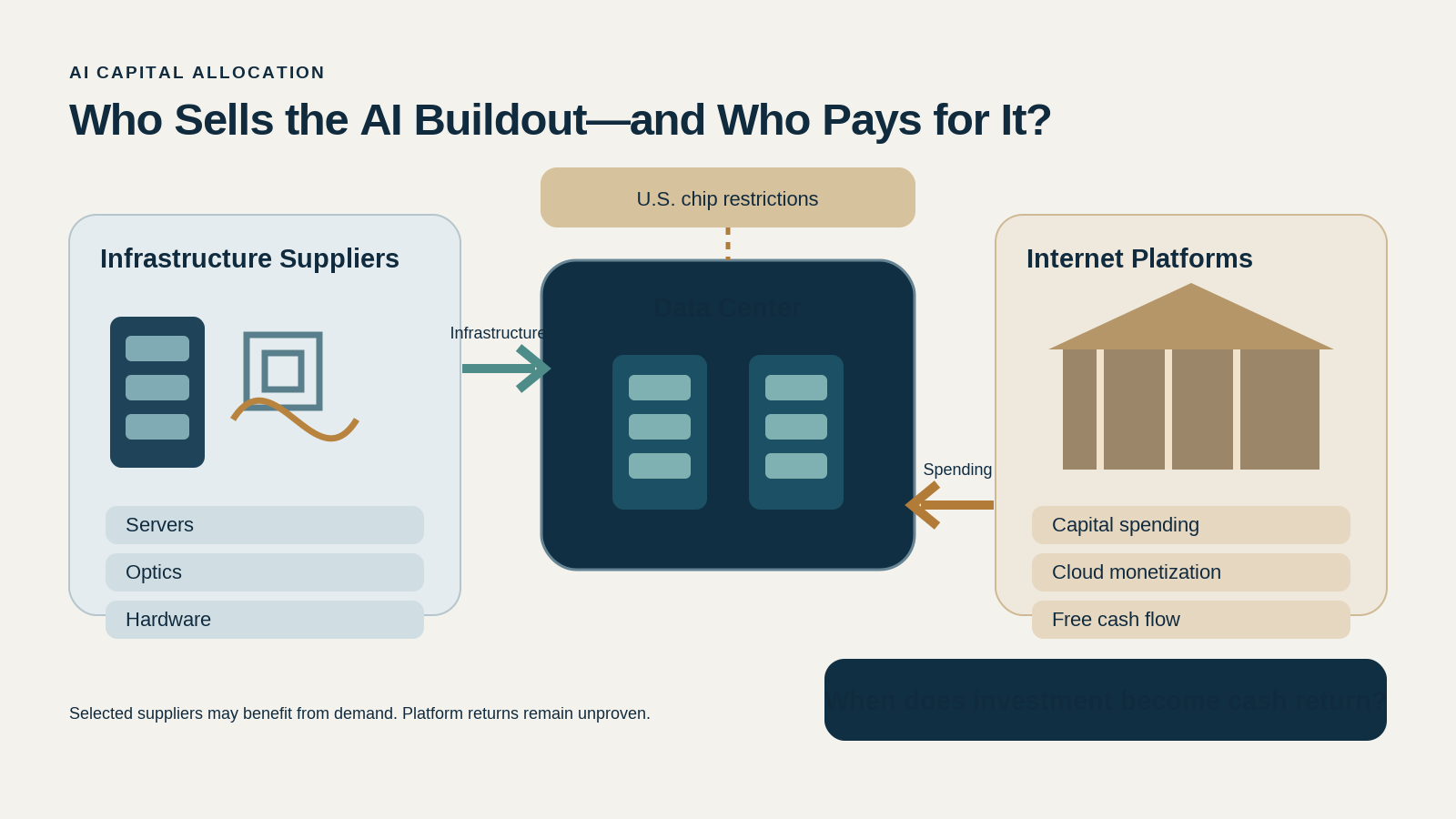
Monday's relative strength in selected hardware and optical names fits a reasonable market narrative. Infrastructure suppliers may recognize revenue as platforms expand computing capacity. Platforms absorb the capital expenditure first and must later prove that cloud services, advertising, agents or other AI products can monetize the investment.
This is not a permanent division between winners and losers. Suppliers can suffer from pricing pressure, customer concentration, inventory cycles and capacity overbuild. Platforms can eventually build high-margin services on top of their infrastructure. The timing of revenue and cash outflow is simply different.
U.S. chip restrictions complicate both sides. They can affect the availability and cost of advanced hardware, the design of data-center networks, and demand for domestic alternatives. The result will vary by company and product; a broad policy headline cannot establish each firm's exposure.
What the next sessions need to confirm
- Persistence after the intraday recovery. Holding above Monday's 21,998 low matters more than the shape of one afternoon rebound.
- Breadth and turnover. A durable turn should extend beyond a narrow group of hardware and healthcare names.
- Implementation of the margin change. November 30 will test whether easier financing creates sustained participation or merely short-term leverage.
- Compute access and compliance. Company disclosures will be more useful than assumptions about the BIS rule's impact.
- Cash conversion. For platforms, cloud growth must eventually appear in free cash flow. For suppliers, backlog must convert at acceptable margins.
- November PMIs and subsequent demand data. The October divide between strong production and weak consumption needs to narrow before a broad domestic recovery can be claimed.
Editorial judgment: Hong Kong found a floor for Monday's session, not enough evidence for the cycle. The recovery was real, and the close was much better than the morning low. The larger call remains conditional on breadth, cash returns, policy implementation and domestic demand.
Disclosure and limits: This article uses dated public sources and company releases. It contains no price target, personalized advice, or buy or sell recommendation. Non-IFRS and non-GAAP measures are company-defined and should be read with their reconciliations.
Sources and references
- HKEX — November 23 daily quotations
- Reuters — Chinese exchanges reduce margin requirement
- BIS — Rule on remote access to advanced computing
- NBS — October 2026 economic activity
- NBS — October retail sales
- NBS — January–October real-estate investment
- Tencent — Third-quarter 2026 results
- Alibaba — September-quarter 2026 results
- Lenovo — Fiscal Q2 2026/27 results