
Market Calls / Europe
Europe Rebounds on Tariff Relief. The Harder Questions Remain.
The STOXX 600 gained 1.75% as European stocks recovered. Imperial’s possible bid and Babcock’s submarine agreement stood out, while tariff proposals, ECB policy and dated valuations still demand care.

Market date
Europe recovered Wednesday’s losses on Thursday, but the rally answered a narrower question than the headlines suggested. Investors found reasons to mark down the immediate tariff threat. They did not receive a resolution of the trade dispute, a promise of easier money or proof that corporate earnings have turned.
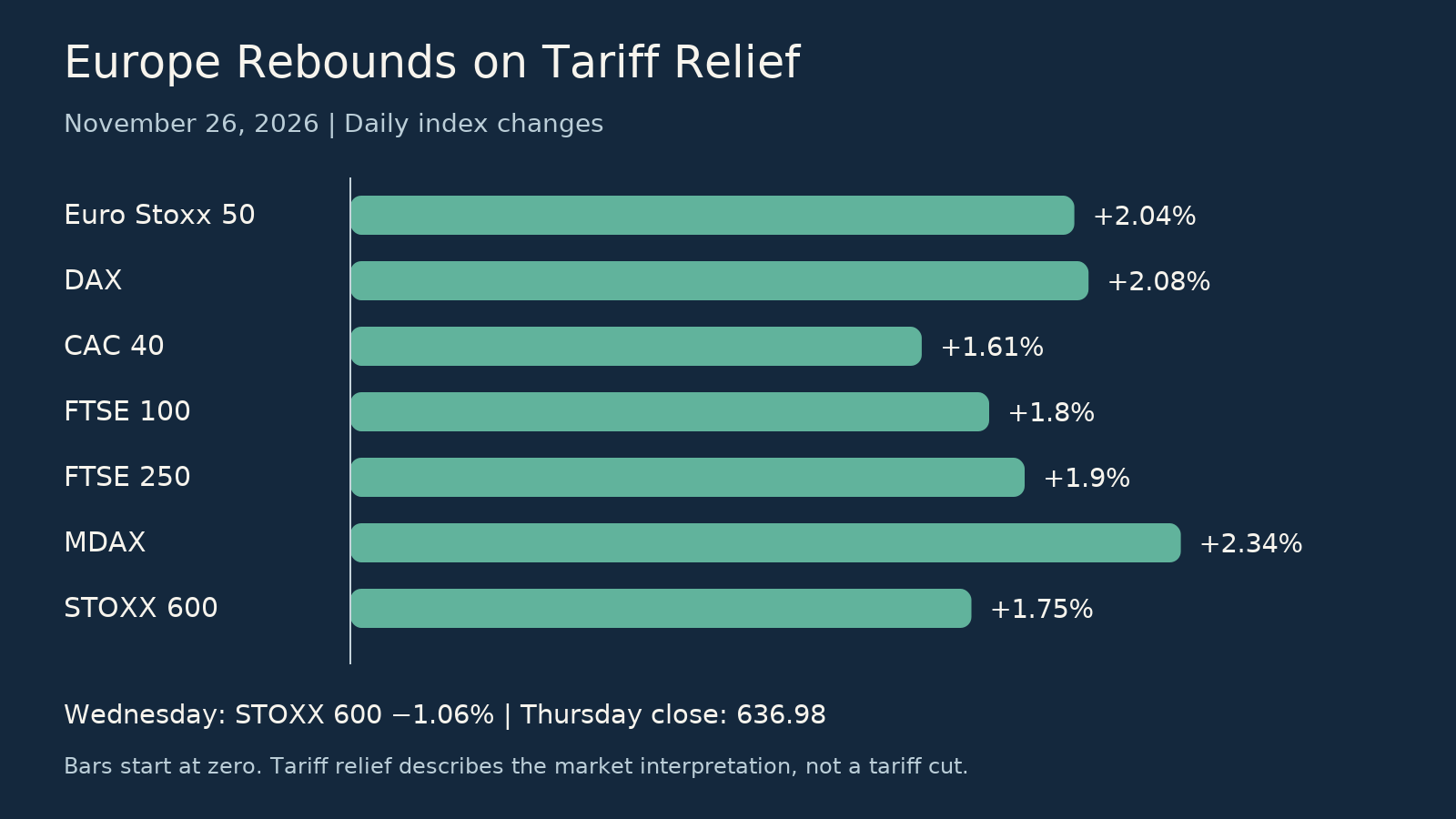
The STOXX 600 finished at 636.98, up 1.75%, after losing 1.06% the previous day. London benefited from takeover interest in Imperial Brands and a major submarine-services agreement for Babcock. Continental markets joined in, with the DAX back above 25,000 and French auto shares among the stronger performers.
U.S. cash equities were closed for Thanksgiving. That limits what this session can tell us about international follow-through. Reports described subdued trading, but this edition does not have a comparable, market-wide turnover series with which to quantify it.
The rebound in numbers
| Index | November 26 close | Daily change |
|---|---|---|
| STOXX 600 | 636.98 | +1.75% |
| Euro Stoxx 50 | 6,014.74 | +2.04% |
| DAX | 25,215.52 | +2.08% |
| CAC 40 | 8,108.74 | +1.61% |
| FTSE 100 | 10,609.30 | +1.8% |
| FTSE 250 | 24,092.70 | +1.9% |
| MDAX | 29,263.97 | +2.34% |
The STOXX figure is shown at two decimal places rather than the rounded 1.8% in the original market notes. Index returns describe the session; they do not measure money flowing into each market.
What changed on tariffs—and what did not
The important detail is in the USTR’s November 25 announcement. It makes Section 301 determinations concerning 14 economies and proposes action. For EU goods, the proposed rate is 15%, net of most-favored-nation rates and existing Section 301 tariffs, with exemptions for certain goods.
That wording matters. It does not describe a simple, universal 15-percentage-point surcharge on top of every existing duty. Equally, it is not a blanket reduction in tariffs already collected. Product treatment and the final action still matter to an exporter’s actual cost.
Written comments are due January 5, 2027, with hearings beginning January 25. Those are consultation dates, not an effective-date announcement.
The market interpretation is understandable: a less severe reading of a new trade threat can support a rebound in exposed shares. My interpretation is more limited than a trend call. A relief rally can be justified even while the underlying dispute remains unresolved. The next useful evidence is whether earnings expectations, orders and margins improve alongside prices.
Oil, bonds and the euro tell different stories
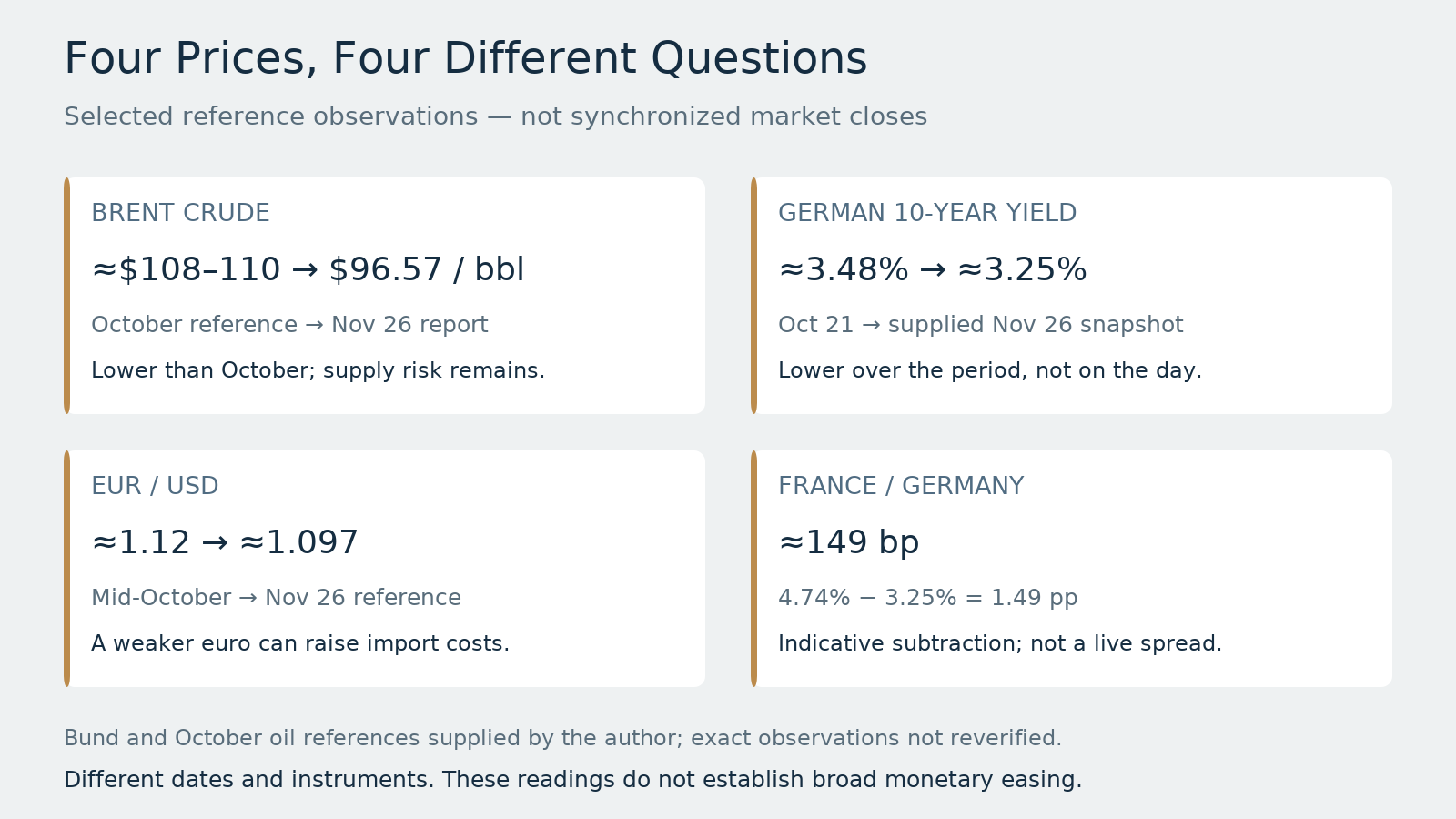
The supplied market notes put EUR/USD near 1.097, compared with roughly 1.12 in mid-October. They also put the German ten-year yield near 3.25%, down from about 3.48% on October 21, although approximately two basis points higher on the day. A fall over several weeks should not be confused with a daily bond rally.
France’s debt agency reported a TEC 10 reading of 4.74% on November 26. Subtracting the supplied 3.25% German reference gives 1.49 percentage points, or approximately 149 basis points. That is an indicative calculation using these inputs, not a separately verified, synchronized tradable OAT–Bund spread. Benchmark selection and observation time can change the comparison.
Oil needs similar care. Reuters reported a November 26 Brent settlement of $96.57 a barrel. That is broadly consistent with the original note’s $96.4–96.6 range, but other retrieved screens carried different observations. The source’s quoted dollar and percentage changes were also internally inconsistent, so this edition does not reproduce a daily oil return. The October $108–110 comparison is retained as an approximate author-supplied reference, not a verified contract-matched series.
Lower oil relative to October could ease some cost pressure. A weaker euro can work in the other direction by making dollar-priced imports more expensive. Lower benchmark yields can help discount rates, while a wide French risk premium can keep local financing expensive. These effects do not add up automatically to a broad easing in European financial conditions.
The ECB has not promised an easier path
The ECB’s account of its October 28–29 meeting, released on November 26, describes a council that held rates while debating the case for further tightening. A large number of members could have supported an increase. The absence of clear second-round inflation effects did not remove concern about energy costs or the need to prevent those effects from developing.
The practical distinction is between a decision already made and expectations about December. October’s hold is established. Another increase remains a prospective decision. Energy, wages and the next projections will influence it; Thursday’s equity rally does not settle it.
There is also a leadership development. The European Council has put forward Pablo Hernández de Cos to succeed Christine Lagarde when she leaves on February 7, 2027. It also put forward Laurence Boone and Markus Brunnermeier for executive-board positions. The Council will consult the European Parliament and the ECB Governing Council before a formal decision. Those consultations should not be described as separate parliamentary and ECB approvals.
A leadership nomination is not an interest-rate commitment. Assigning a definitive “dovish” path to the next presidency would turn an interpretation of a person into a forecast for a collective institution.
Company news mattered as much as the index
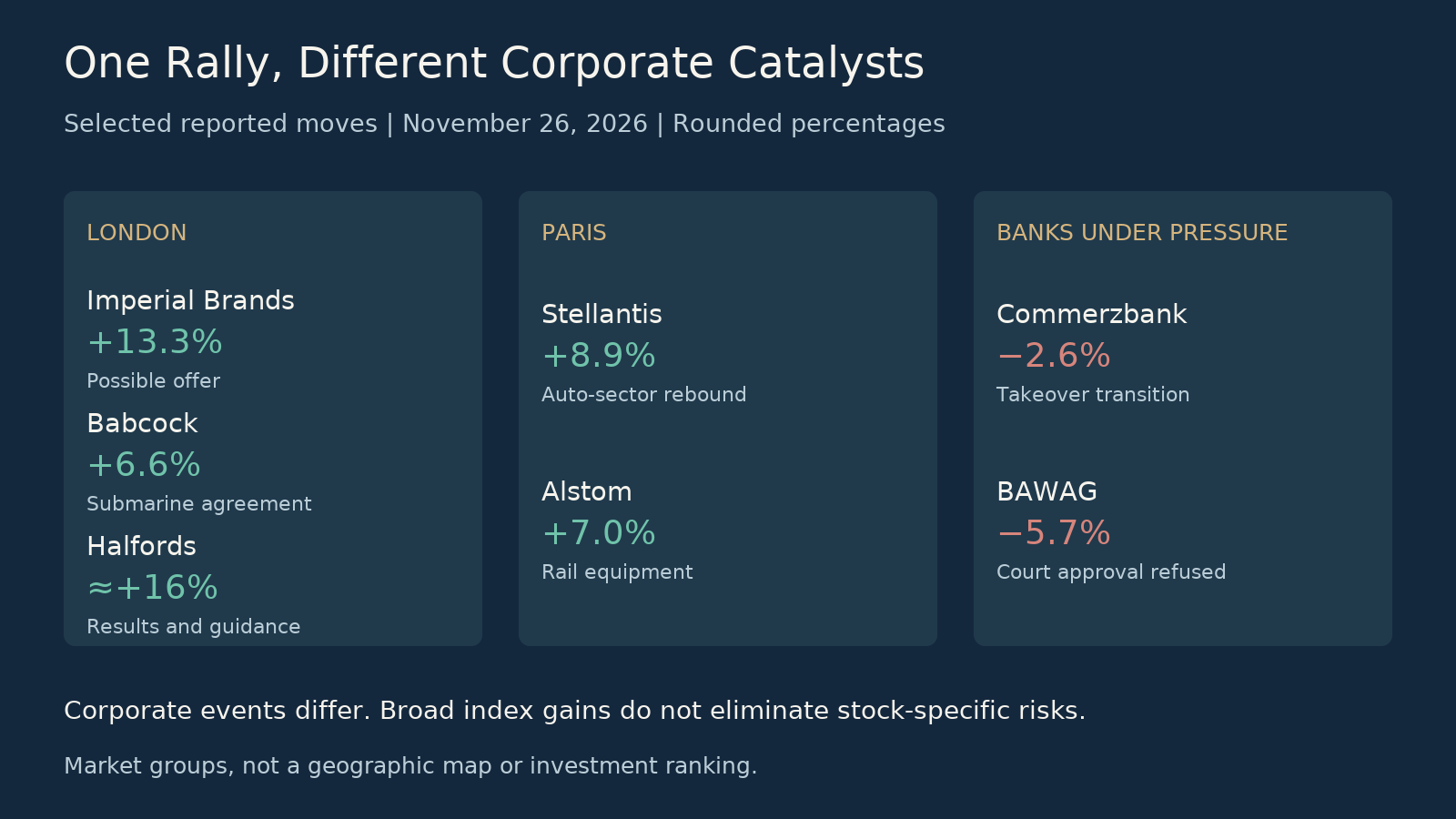
Imperial Brands: possible offer, no firm bid. The shares rose about 13.3%. Altria confirmed that it is considering an offer, likely entirely in cash, and is discussing a possible acquisition of part of Imperial’s business with a third party. It has not reached an agreement. Imperial said it had received no approach or proposal and had held no discussions with the parties referenced.
The distinction between interest and commitment is central to the trade. Altria’s announcement is under Rule 2.4 of the Takeover Code, not a firm-intention announcement under Rule 2.7. Its stated deadline is 5 p.m. London time on December 24, subject to an extension by the Takeover Panel. A deal premium can disappear if an offer fails to materialize.
Babcock: a large agreement, with execution still ahead. Shares gained about 6.6%. The company announced its £8.7 billion Gateway Agreement with the UK Ministry of Defence: £8 billion of contract backlog plus a £700 million framework. The initial term is five years, effective December 1, with a potential aggregate term of up to 15 years.
This improves visibility into submarine-support work. It does not make the entire headline figure immediate revenue, guarantee that every framework opportunity is called off, or establish a profit margin. Staffing, investment and delivery costs remain part of the investment case.
Halfords: an operating result behind the move. The stock rose approximately 16% in the supplied session notes. Its interim release reported pre-tax profit of £35.5 million, versus a restated £17.2 million, and upgraded guidance. Underlying pre-tax profit was a different measure: £39 million. Management also identified a contribution from favorable summer weather. That is a reason to examine how much of the improvement can recur.
Stellantis and Alstom: strong shares, unfinished business cases. Stellantis rose about 8.9% and Alstom about 7%. Their gains do not establish a return to healthy cash generation. For an automaker, pricing, utilization and cash burn matter more than a low headline multiple. For a rail supplier, backlog must turn into delivered projects and cash.
Two banks faced their own transaction risks. Commerzbank fell roughly 2.6% in the reported session snapshot. UniCredit said it had obtained the outstanding regulatory clearances and that its offer conditions were fulfilled, while requesting an extraordinary meeting to elect new shareholder representatives. Settlement and governance changes are distinct steps.
BAWAG fell roughly 5.7% in the later reported snapshot. Its own announcement confirmed that Ireland’s High Court declined to sanction the scheme implementing its proposed acquisition of Permanent TSB. BAWAG said it was considering the judgment. Earlier intraday screens showed a different direction; they should not be mixed with the later event-driven reading.
The wider watchlist includes Soitec’s chip rebound, Schaeffler’s deleveraging effort and Rheinmetall’s execution outlook. The original notes also contain reports about SAP restructuring and an Energiekontor accounting review. Those items were not independently resolved in this review and are not used here to establish a valuation conclusion. An accounting review, by itself, would not establish an accounting error.
The valuation screen needs a common date
The supplied StockAnalysis snapshots were collected on different dates between September and November. They have not been refreshed against November 26 company filings, share counts and consensus forecasts. They are retained below to show the starting research questions—not to represent verified current valuation.
| Company | Supplied historical reference | Question the snapshot raises |
|---|---|---|
| Imperial Brands | Nov 6, 2,973p: forward P/E 8.5x; FCF £3.3bn; cash £0.5bn against debt £11.2bn | How much operating cash remains after financing needs, and how much of today’s price depends on a bid? |
| Babcock | Oct 23, 939p: forward P/E 14.5x; net debt £358m; FCF £252m; operating margin 5.4% | Can additional work translate into durable margins and cash conversion? |
| Soitec | Oct 26, €117.30: forward P/E 141x; revenue €592m; net loss €220m | Does the substrate and photonics opportunity justify the valuation while reported earnings are negative? |
| Stellantis | Sep 18, €4.20: forward P/E 5.2x; net loss €19.5bn; FCF −€11.5bn | What restores cash generation, and how much financing might be needed first? |
| Alstom | Oct 16, €16.13: forward P/E 9.6x; operating margin 3.5%; cash €2.3bn against debt €3.56bn | What explains the subsequent price change, and have forecasts or share counts changed? |
| Schaeffler | Oct 16, €5.83: forward P/E 12.3x; net loss €374m; cash €2.5bn against debt €8.55bn | How much does the asset disposal reduce leverage relative to the demands of the auto cycle? |
A current share price cannot simply inherit an old P/E. Forecast earnings may have changed. Debt definitions, leases, restricted cash and reporting periods also need reconciliation before comparing balance sheets.
Babcock is a reasonable candidate for further research because the new agreement makes its operating question more concrete. That does not establish it as the best-valued stock in the group. Imperial is principally a cash-generation and possible-takeover case. Soitec, Stellantis and Schaeffler require different kinds of operating recovery. Alstom needs a fresh bridge between the old snapshot and the latest financial position.
No company is established here as passing every growth, profitability, balance-sheet and valuation filter. A large one-day gain does not answer those questions, and a large previous decline does not create a margin of safety on its own.
What to watch next
- November 27: France’s preliminary November inflation release and the scheduled sovereign-rating review remain the near-term watchlist. The U.S. cash-equity session is shortened after Thanksgiving. A ratings-calendar entry is not a prediction of an outlook change.
- November 29: the OPEC+ meeting is on the supplied calendar. Monitor an actual production decision rather than treating delegates’ expectations as an outcome.
- December: ECB projections and the policy decision will test whether recent energy relief changes the inflation assessment.
- December 24: Altria’s stated offer-or-withdraw deadline, unless extended by the Takeover Panel.
- January 5 and January 25, 2027: the USTR comment deadline and start of hearings, respectively.
My central question after Thursday is whether improved sentiment will be followed by better evidence on costs, cash generation and policy. The rebound is observable. A durable recovery still needs that evidence.
Method and data note: This edition combines the supplied market report with the linked checks below. Historical company fundamentals and the explicitly identified macro references remain supplied, unrefreshed snapshots. Conflicting observations are qualified rather than combined into a fabricated series. Daily moves are rounded where indicated; no target prices or projected returns are provided.
Editorial note: This publication is for information and education only. It is not personalized financial advice, an offer or a solicitation to transact. Market data and interpretations can change; readers should consult original disclosures and assess risks independently.
Sources and references
- European index closes — Deutsche Börse
- Euro Stoxx 50 and MDAX — finanzen.ch
- STOXX 600 historical observations — Investing.com
- London close — Reuters via Euronext
- French market session — MoneyVox, November 26
- Selected corporate moves — MarketScreener, November 26 snapshot
- Proposed Section 301 actions — USTR, November 25
- October monetary-policy meeting account — ECB
- ECB presidency nomination — European Council
- Possible offer for Imperial Brands — Altria
- Response to possible offer — Imperial Brands regulatory announcement
- Gateway Agreement — Babcock company announcement
- Halfords HY27 interim results
- Commerzbank offer conditions and EGM — UniCredit
- High Court decision — BAWAG ad-hoc release
- France TEC 10 reference — Agence France Trésor
- November 26 oil report — Reuters
- French inflation publication calendar — INSEE
- November 29 meeting schedule — OPEC
- U.S. Thanksgiving trading hours — NYSE