
Market Calls / Europe
Europe's Rebound Is Real. The Reset Is Not.
European equities staged their strongest rally in more than six months as chip stocks surged on Nvidia's confirmed leadership reversal, but gas, inflation and unresolved AI-return questions kept the move short of a full reset.

Market date
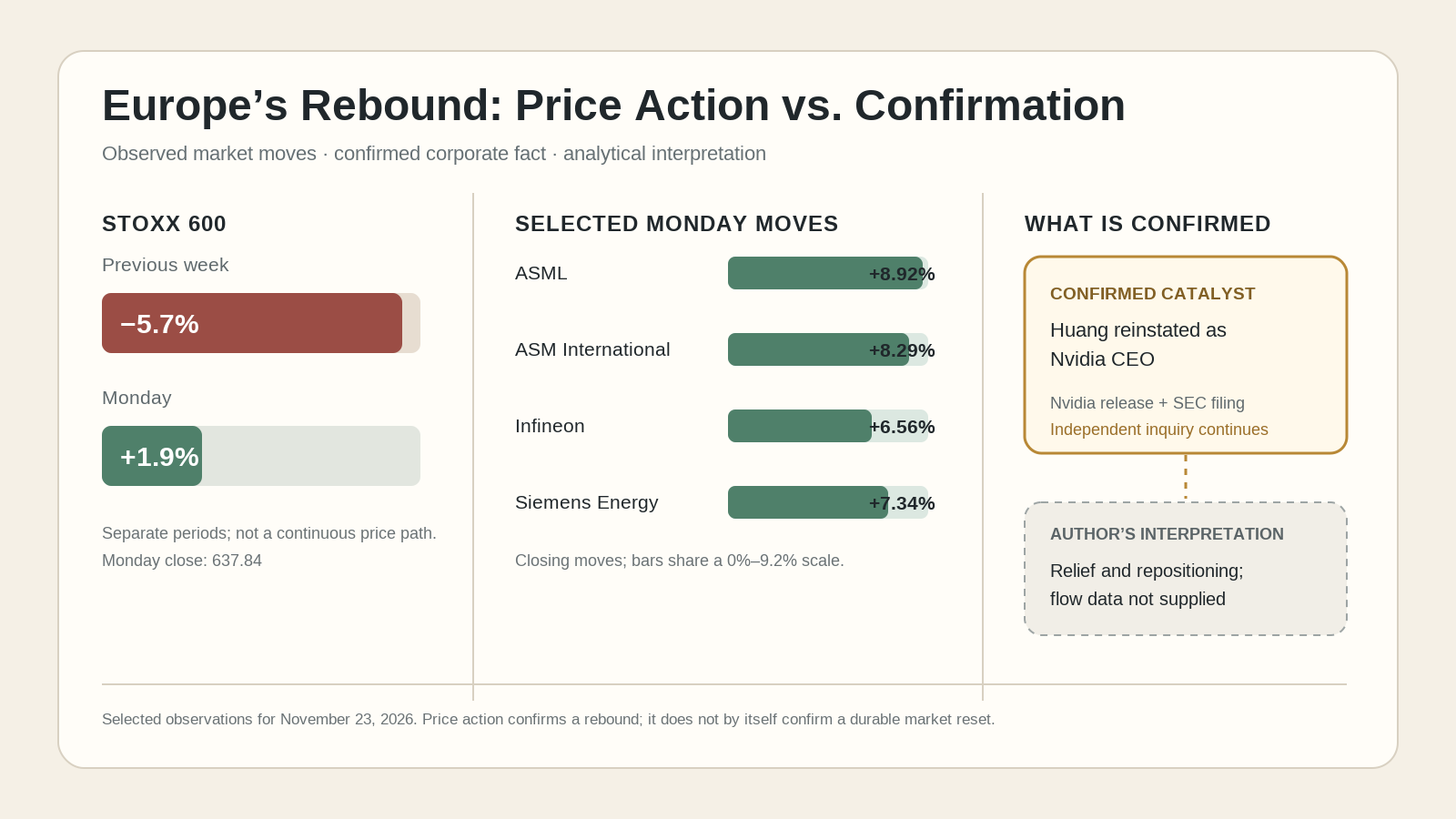
European shares delivered their strongest session in more than six months on Monday, with semiconductor and AI-infrastructure stocks leading a broad recovery. The move was real. So was the damage that preceded it: the STOXX 600 had just fallen for five consecutive sessions and lost more than 5.7% in its worst week since March 2025.
The distinction matters. One forceful rebound can repair positioning and sentiment without resolving the questions that produced the selloff—how quickly AI investment will generate cash returns, whether Europe can absorb another winter energy shock, and how much room the European Central Bank has to ease policy while inflation remains at 4%.
Reporting cut-off: Monday, November 23, 2026, after the European close and Nvidia's corporate announcement. Prices refer to the November 23 session unless otherwise stated. This is market commentary, not an instruction to trade.
A forceful rebound from a bruising week
The STOXX 600 closed 1.9% higher at 637.84, its largest daily gain since early May, according to Reuters. Technology rose 4.7%, while defence, industrial and mining shares each advanced more than 3%.
That breadth was encouraging, but the semiconductor complex still did most of the narrative work. ASML rose 8.92%, ASM International gained 8.29%, BESI added 9.25%, Infineon climbed 6.56% and Siemens Energy advanced 7.34%. These are closing moves, which differ materially from the lower intraday readings circulating earlier in the session.
The previous week explains the violence of the reversal. The pan-European index had closed Friday at 625.65 after losing more than 5.7% over five sessions. European technology had suffered an even sharper unwind as investors questioned both the financing of AI expansion and the timetable for returns on the capital being committed.
Monday therefore restored some risk appetite; it did not recover the entire prior decline. The STOXX 600's 1.9% gain was only a partial offset to a week in which the index lost more than three times as much.
Nvidia supplied a confirmed catalyst—and an unfinished governance story
Nvidia's leadership reversal was not merely a market rumour by the European close. The company announced on November 23 that its board had reinstated Jensen Huang as president, chief executive and a director, effective immediately. The decision was also disclosed in an SEC filing.
That confirmation removed the narrowest version of the uncertainty: who was leading Nvidia. It did not close the wider governance issue. Nvidia said an independent board committee would continue its investigation and that the company was strengthening oversight of national-security and export-control risks.
For European chip and power-equipment names, the announcement mattered because Nvidia sits at the centre of the spending network that supports demand for lithography, deposition, packaging, power semiconductors, electrical equipment and data-centre construction. A less chaotic leadership picture reduced the immediate risk of disruption across that chain.
The market reaction still should not be mistaken for proof that the underlying economics have improved. Nvidia's board decision is a fact. The idea that short covering and position rebuilding amplified Monday's move is an interpretation; this edition does not have a verified breakdown of flows.
Oil relief is not the same as energy relief
Energy markets sent Europe two different signals.
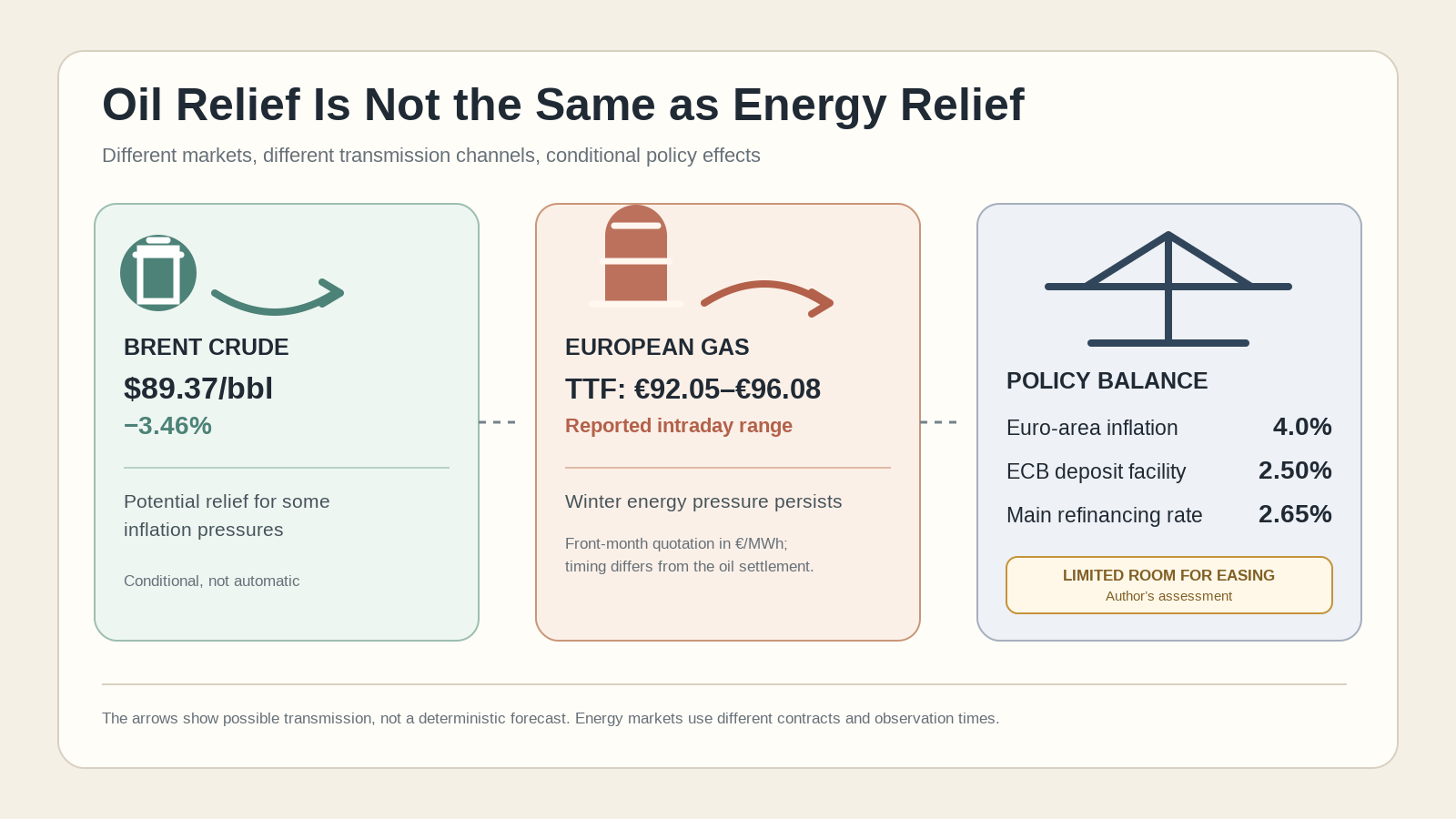
Brent crude settled 3.46% lower at $89.37 a barrel, its lowest close in roughly three months. Rising Middle Eastern supply and the restart of a Libyan pipeline outweighed continuing concern about attacks on shipping and energy infrastructure. Cheaper crude can reduce pressure on transport costs and some headline-inflation components if the move persists.
European natural gas moved in the other direction during the European session. A reported front-month TTF range of approximately €92.05 to €96.08 per megawatt-hour reflected colder weather forecasts, lower seasonal storage and continued LNG-supply anxiety. That is an intraday range rather than a reconciled settlement, and it should not be placed on the same scale as the Brent close.
The broader point is more important than false precision. Oil can fall while Europe's winter energy constraint tightens. Crude is global and diversified; European gas is more directly exposed to regional weather, storage and pipeline or LNG availability. A lower oil price may help some inflation channels without delivering broad energy relief.
The ECB constraint is inflation, not the stock market
Euro-area inflation was 4.0% in October, up from 3.8% in September, according to Eurostat. Energy accounted for 1.89 percentage points of the annual rate and was 21% higher than a year earlier.
That context limits how much the ECB can respond to a market correction. The central bank's deposit facility rate is 2.50%, not 2.65%. The main refinancing rate is 2.65%, while the marginal lending facility stands at 2.90%. The distinction is small numerically but important editorially because the deposit facility is the rate through which the ECB currently steers its policy stance.
At its October meeting, the ECB kept all three rates unchanged and explicitly avoided committing to a future path. Its concern was the same split visible in Monday's markets: the energy shock creates upside risk to inflation and downside risk to growth.
Better activity in parts of Germany may reduce recession anxiety, but it does not automatically create room for rapid easing. France remains a separate vulnerability. The French private-sector downturn deepened in November, and the country's debt trajectory continues to influence the risk premium on government bonds.
The result is an uncomfortable policy mix for equities. A softer oil price helps. Expensive gas, 4% inflation and fiscal uncertainty argue against declaring an all-clear.
Corporate dispersion survived the index rebound
A strong index day did not erase company-specific risk.
Abivax gained 4.7% after rejecting a short-seller report that questioned the safety of obefazimod. The share-price response is observable; the underlying scientific and safety dispute cannot be settled by the rebound. For an event-driven biotechnology company, efficacy, safety, cash needs and regulatory outcomes remain the thesis.
Drax rose more than 5% after forecasting annual core profit above consensus. The near-term earnings signal was constructive, while the longer-term debate remains tied to biomass policy and the subsidy framework after 2027.
Julius Baer fell 1.7% despite reporting a 17% increase in adjusted pretax profit for the first ten months. Slower net inflows mattered more to investors than the headline profit growth. Nemetschek dropped 5.7% after JPMorgan cut the stock to underweight from overweight.
This dispersion is useful. It shows that Monday was not a mechanical purchase of every European stock. The rally rewarded AI-linked exposures and selected corporate catalysts while continuing to penalise weaker flow, valuation and execution stories.
A watchlist needs failure points, not just narratives
The most interesting European names do not share one thesis.
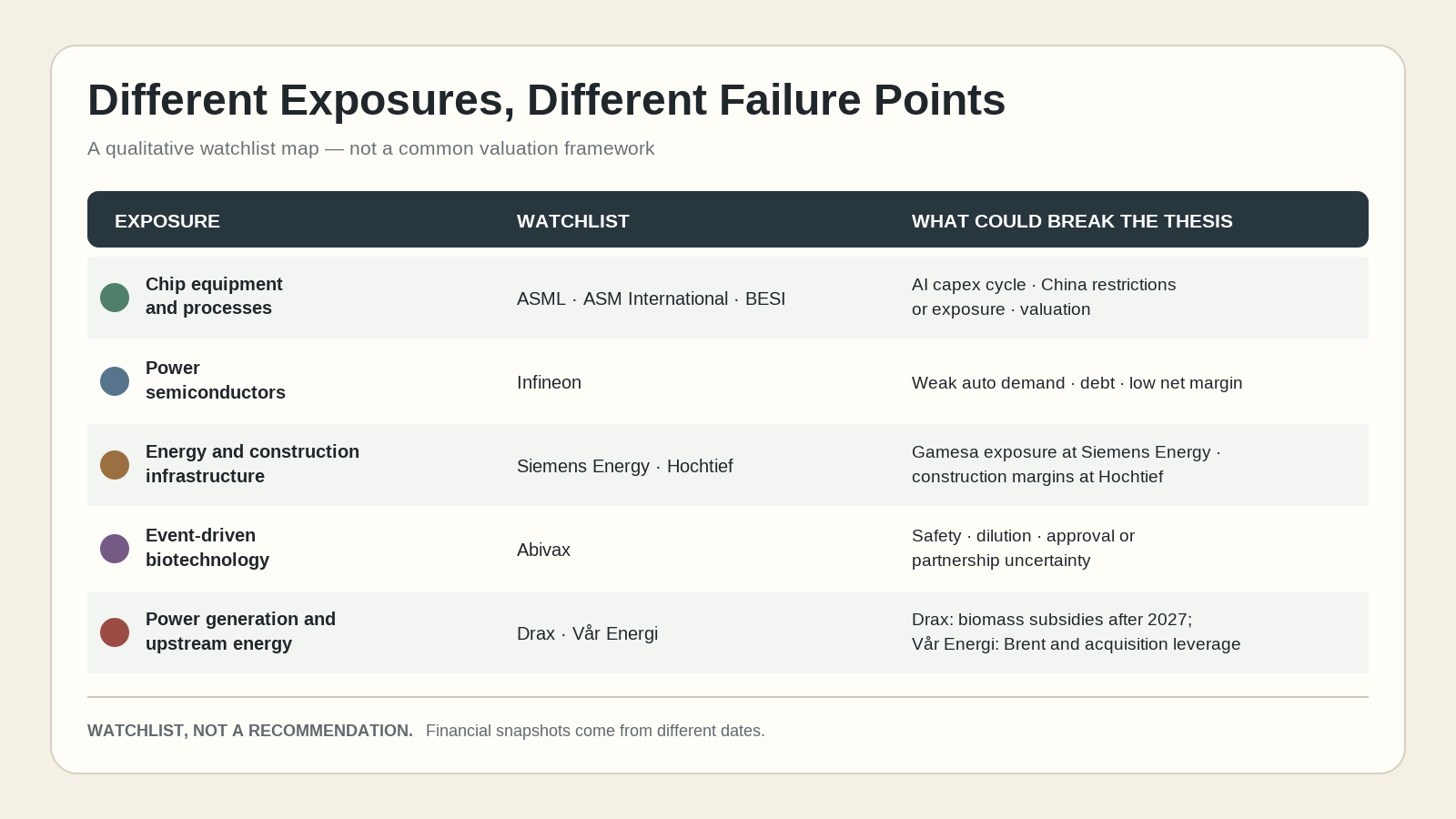
Chip equipment and processes. ASML, ASM International and BESI provide different parts of the semiconductor-production chain. Their common attraction is exposure to advanced computing investment. Their common vulnerability is that high expectations meet a cyclical industry, export restrictions and uncertainty over Chinese demand.
Power semiconductors. Infineon can benefit from data-centre power demand and a recovery in industrial and automotive end markets. Weak vehicle demand, leverage and low net margins relative to the most profitable chip-equipment companies are separate risks.
Energy and construction infrastructure. Siemens Energy and Hochtief sit closer to the physical buildout of power and data-centre capacity. Siemens Energy still carries Gamesa execution risk; Hochtief depends on construction discipline and margins. Demand can be strong while shareholder returns disappoint if project economics deteriorate.
Event-driven biotechnology. Abivax is governed by clinical, regulatory and financing milestones rather than the daily direction of the STOXX 600. A one-day rebound does not settle safety, dilution, approval or partnership uncertainty.
Power generation and upstream energy. Drax and Vår Energi respond to different commodity and policy variables. Drax's long-term economics depend heavily on the UK biomass framework. Vår Energi offers upstream scale but remains exposed to Brent, Norwegian taxation and acquisition leverage.
What would turn a rebound into a reset?
Several tests remain.
- Follow-through beyond one session. A durable recovery should survive after the immediate Nvidia relief has been absorbed.
- Evidence on AI returns. Orders and capital spending matter, but so do utilisation, pricing and cash returns on the infrastructure being built.
- Broader earnings confirmation. The market needs more than higher semiconductor multiples; industrial, consumer and financial earnings must support the move.
- Energy normalisation. A simultaneous easing in oil and European gas would carry more macro significance than cheaper crude alone.
- A clearer ECB path. Lower underlying inflation—not stock-market volatility—would create the strongest case for easing.
- Closure of Nvidia's governance process. Reinstatement resolves the leadership vacancy, while the independent investigation remains open.
Editorial judgment: Monday was a genuine and broad relief rally after an unusually severe selloff. It reduced the probability of an immediate continuation lower, but it did not establish that the valuation, energy, policy and governance risks behind the correction have disappeared.
Disclosure and limits: This article is general market commentary based on dated public sources. It does not contain price targets, personalised advice or buy and sell recommendations. The watchlist is a framework for further research, and corporate fundamentals may have changed since the financial snapshots used in the original draft.
Sources and references
- Reuters — European shares post strongest session in more than six months
- Reuters — STOXX 600 posts worst week since March 2025
- Nvidia Investor Relations — Jensen Huang reinstated
- SEC — Nvidia Form 8-K on leadership reinstatement
- Eurostat — October 2026 euro-area inflation
- European Central Bank — October 2026 monetary policy decision
- Reuters — Brent settles lower on November 23