
Market Calls / Crypto
Bitcoin’s Holiday Bounce Meets a Record Month of ETF Withdrawals
Bitcoin recovers near $60,700, but seven straight ETF outflow sessions and contracting stablecoin capitalization leave the liquidity question open.

Market date
Market Call — Crypto | Thursday, November 26, 2026. ETF flows through November 25; crypto prices are collection-time snapshots, not synchronized closing prices.
Bitcoin's return to roughly $60,700 offers relief after another difficult stretch. It does not yet answer the more important question: who will supply sustained demand once the holiday bounce runs its course?
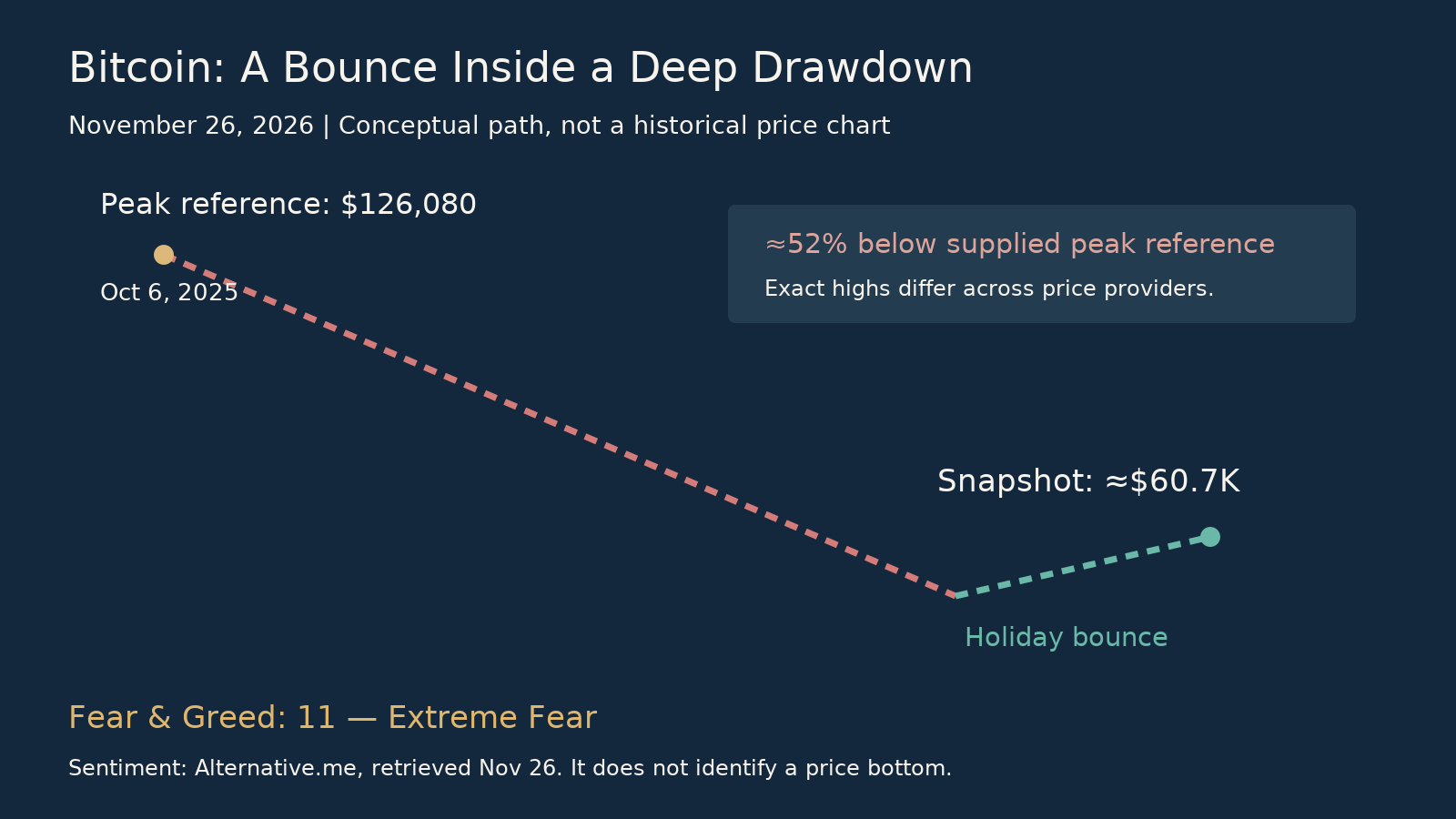
The supplied price board puts BTC at $60,723, down 24.1% over 30 days, and Ether near $1,703.50, down 26.6%. Alternative.me's sentiment page, checked for this edition, reads 11, or extreme fear. That describes the mood. It is not a timing signal that identifies a bottom.
Calling the move a “dead-cat bounce” would assume we already know what happens next. We do not. My interpretation is narrower: the recovery has arrived while ETF demand and broader liquidity measures remain weak. It needs confirmation.
The rebound and the drawdown
Against the supplied October 6, 2025 peak reference of $126,080, $60,723 implies a decline of approximately 51.8%. Exact intraday highs differ across exchanges and price aggregators, so the meaningful statement is a drawdown of roughly 52%, rather than a claim that one universal Bitcoin fixing exists.
The original collection contains 24-hour gains ranging from about 0.6% to 4.7%. Those readings use different venues and cutoff times. They should not be combined into one supposedly precise daily return. The same caution applies to the reported $57,200–$58,400 lows: an exchange-specific observation is not necessarily the consolidated market low.
Selected prices from the original collection
These observations preserve the source material's market context. The collection does not provide one common execution time, and this table is not a refreshed live quote service.
| Asset | Supplied price, USD | Supplied 30-day change |
|---|---|---|
| Bitcoin | 60,723 | −24.1% |
| Ether | 1,703.50 | −26.6% |
| BNB | 555.30 | −25.2% |
| XRP | 0.952 | −27.2% |
| Solana | 71.30 | −29.3% |
| TRON | 0.304 | −7.6% |
| Zcash | 718.75 | −41.6% |
| Dogecoin | 0.0569 | −26.7% |
| Chainlink | 9.32 | −18.2% |
| Cardano | 0.151 | −26.9% |
| Hyperliquid | 63.23 | −19.3% |
| NEAR | 3.10 | −31.1% |
| Monero | 448.80 | −25.0% |
The broad message is weakness across the collection, not a uniform daily move. The supplied total capitalization of roughly $2.06–$2.10 trillion and Bitcoin dominance near 59% also depend on provider coverage. A rising Bitcoin share can reflect greater losses elsewhere; it does not establish new money entering Bitcoin or a durable “flight to quality.”
ETF withdrawals: the November figure is still accumulating
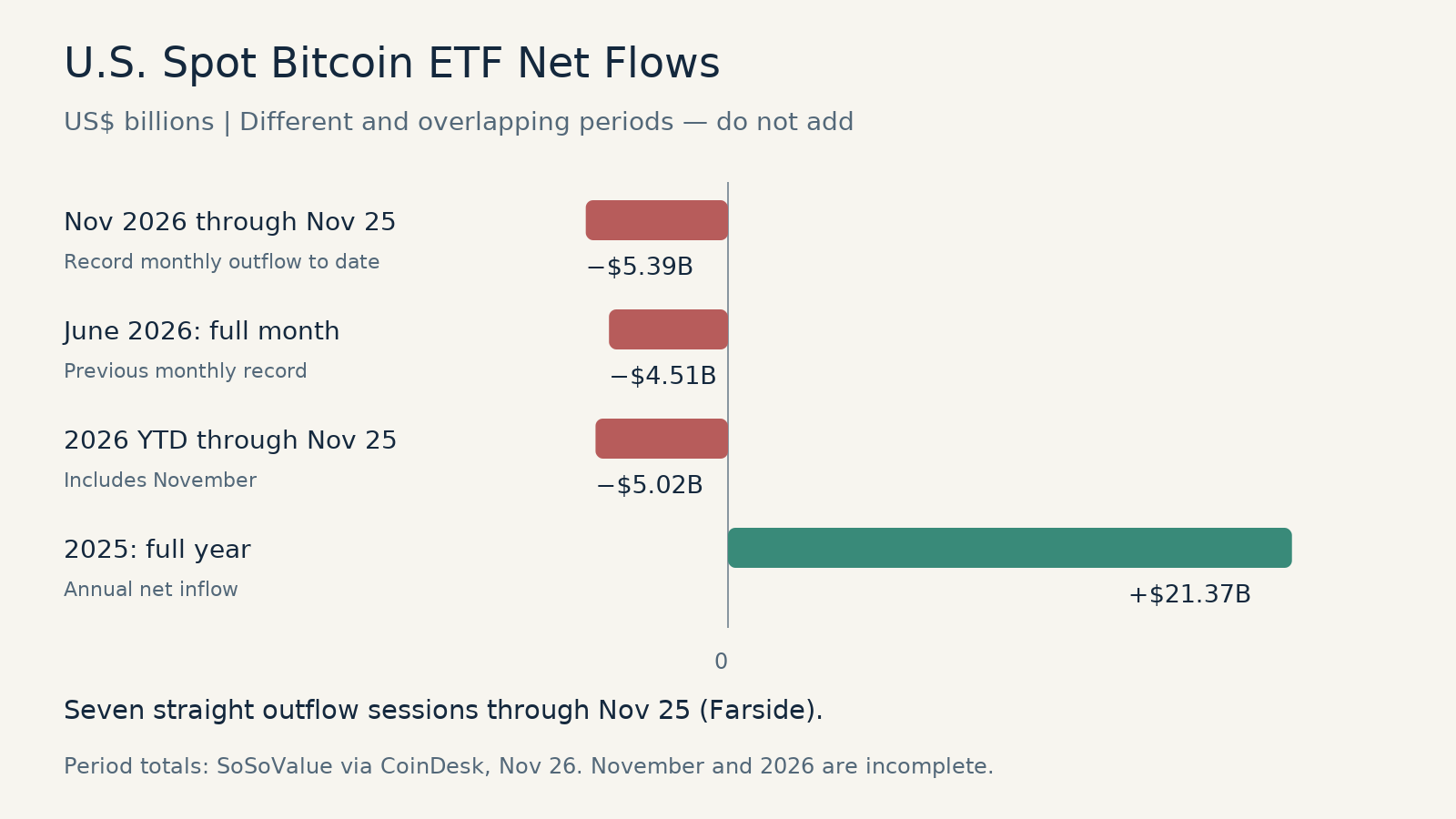
CoinDesk, citing SoSoValue, reports $5.39 billion of net withdrawals from U.S. spot Bitcoin ETFs through November 25. That already exceeds June's $4.51 billion full-month record. November is not finished.
The same report puts 2026 year-to-date net flows at negative $5.02 billion, compared with positive $21.37 billion for the whole of 2025. These periods overlap: November must not be added to the year-to-date total. Ether ETFs separately show approximately $1.30 billion of November withdrawals.
The daily data resolve an uncertainty in the original notes. Farside lists Bitcoin ETF net flows of −$569.7 million on November 23, −$231.4 million on November 24 and −$453.0 million on November 25. Its table shows negative sessions from November 17 through November 25: seven consecutive trading sessions, rather than the six-session count that applied through November 24.
IBIT accounted for $329.7 million of the November 25 withdrawal. ETF flows measure one investment channel; they do not capture all spot demand or prove that every holder is an institution.
Liquidity is a better test than the size of one bounce
A fresh check of DefiLlama puts total stablecoin capitalization at approximately $280.1 billion, down 5.72% over 30 days and 1.05% over seven days. That replaces the undated $315 billion figure in the supplied notes. Stablecoin capitalization is not identical to cash waiting to buy Bitcoin, but a shrinking aggregate is relevant to a liquidity thesis.
Short covering is a plausible contributor to the holiday rebound. The original derivatives snapshot, attributed to OKX through secondary reporting, describes higher open interest, funding of 0.0044% per period and a lower account long/short ratio. Those observations do not establish a market-wide positioning shift. Funding needs its settlement interval, and account ratios do not weight positions by dollar exposure. An increase in open interest also does not tell us whether the new positions are predominantly bullish.
This edition therefore does not use the unverified liquidation headline as a measured explanation of the rally. To distinguish a squeeze from improving demand, the useful follow-up is spot participation, ETF flows after the holiday, stablecoin issuance and positioning across more than one venue.
The supplied technical references put $57,000–$58,000 below the market and $61,000–$62,000, then $63,000–$65,000, above it. They are watch levels from the original collection, not validated support floors or price forecasts.
A demanding macro backdrop, with more than one transmission channel
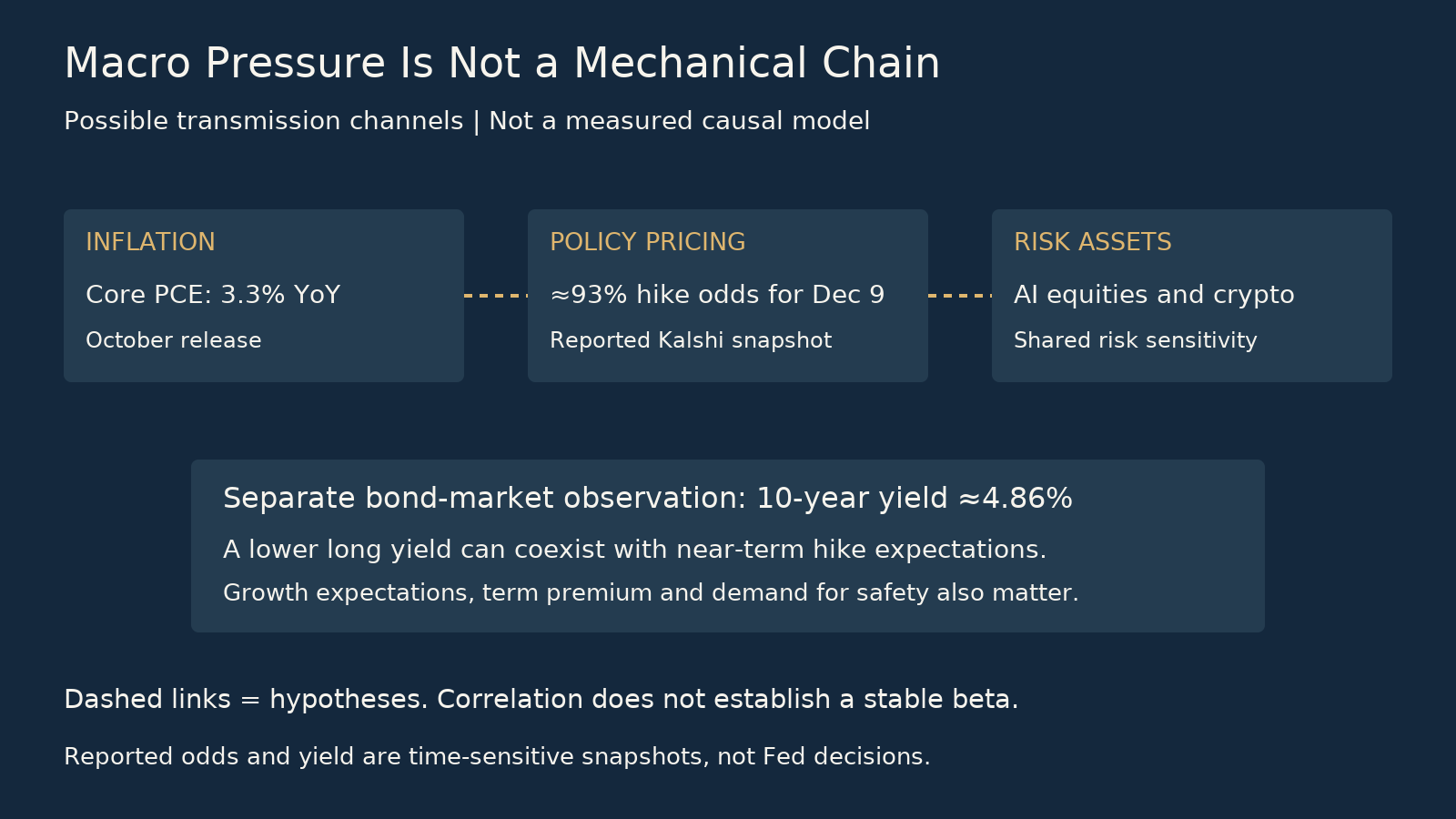
October PCE inflation was 3.8% year over year, with core inflation at 3.3%. BEA also revised third-quarter real GDP growth to a 4.3% annualized rate. These releases leave inflation and the policy response central to the discussion.
The roughly 93% probability in the source material refers to a reported Kalshi snapshot for a quarter-point December hike. Other reports quote different probabilities from futures markets. Contract definitions, timestamps and methodologies differ; they are not interchangeable observations, and none is a Federal Reserve decision. The FOMC meets December 8–9.
The supplied ten-year Treasury reading of about 4.86% is a separate observation. Longer yields can fall even as investors expect a near-term hike, because growth expectations, term premium, positioning and demand for safety also change. It would be misleading to draw a deterministic arrow from hotter inflation to that exact yield, then onward to a guaranteed crypto decline.
Crypto and AI equities may share sensitivity to leverage and investors' willingness to bear risk. But describing Bitcoin as a “high-beta Nasdaq” is an interpretation here, not the result of a measured correlation or beta study. Relationships can change with the time window and the market regime.
The official Federal Reserve calendar identifies Kevin Warsh as chair, resolving the source notes' uncertainty. It also dates the Beige Book to November 25, not Thanksgiving Day. U.S. cash equities are closed on November 26 and reopen for a shortened session on November 27, ending at 1 p.m. Eastern, or 3 p.m. Brasília. Crypto continues trading throughout.
Treasury companies and new fund constituents
The Block reports that Strategy's removal from MSCI's USA Index takes effect at the November 30 close. That concerns demand for Strategy shares. It does not itself order the company to liquidate Bitcoin. Estimates of passive equity selling should therefore not be relabeled as forced BTC sales, and an index event does not establish a local price bottom.
For HYPE, the primary document is more specific. Franklin's November 25 prospectus supplement says its underlying index adds HYPE effective December 1 and that the fund will invest in the expanded basket on or about that date. Inclusion is a distribution development. Its price impact depends on fund size, weights, subscriptions, execution and anticipation; it does not guarantee a particular volume of new demand or a positive return.
Research watchlist: use cases must survive the token test
The original screen favors usage, revenue, liquidity and a defensible valuation. Those are useful questions, but protocol activity and token-holder economics must be examined separately. The following are research hypotheses, not recommendations or a ranking.
| Asset | Question worth studying | What could weaken the thesis |
|---|---|---|
| HYPE | Can trading activity translate into durable token-holder value? | Dilution, venue concentration, liquidation stress and a high valuation relative to sustainable activity. |
| LINK | Does oracle and interoperability adoption create measurable demand for the token? | Adoption that produces limited value capture, competition and additional circulating supply. |
| ENA | Can the economics around synthetic dollars remain resilient across funding regimes? | Funding, custody, exchange, collateral and peg risks; protocol income need not accrue to ENA holders. |
| AAVE | Can lending usage generate durable value after operating and risk costs? | Liquidation shortfalls, contract vulnerabilities, governance decisions and regulatory constraints. |
| ONDO | Does growth in tokenized assets translate into economic rights for ONDO holders? | Product success without corresponding token benefits, supply releases and competition. |
| NEAR | Does cross-chain execution produce repeat, paying demand? | Subsidized activity, competition and dilution; an AI narrative alone is insufficient. |
| TEL | Can a remittance or banking proposition demonstrate sustainable economics? | Weak liquidity, execution risk and a price move without a verified catalyst. |
Ethena's own documentation explicitly discusses funding, liquidation, custody, exchange-failure and backing-asset risks. That is a better starting point than assuming a favorable funding regime will return on schedule.
The draft's exact buyback percentages, current FDVs and unlock dollar amounts have not been independently reconciled for every token. They are not treated as established catalysts here. A supply-based valuation requires the correct supply definition and date, while an unlock increases potentially tradable supply without proving immediate sales. Dollar estimates made before a large price move also become stale.
For the same reason, this edition does not turn the original “hot coins” list into buy signals. Returns drawn from different collection times cannot support a clean ranking. LINK's relative strength within one supplied snapshot is worth investigating, but does not establish it as the only large asset with a positive weekly return across the entire market.
Regulatory activity is not a completed rulebook
The CFTC's October 13 advanced notice of proposed rulemaking addresses crypto-asset transactions and markets, including the contemplated CTX and CAM frameworks. The Federal Register confirms a December 14, 2026 comment deadline. This is a consultation, not a blanket authorization for every platform, product or token.
USTR's proposed Section 301 actions across 14 economies add another potential risk to the macro outlook. Proposed tariff rates and product exclusions need to be read by jurisdiction; they are not a settled, universal increase in costs.
Other claims in the source notes—including specific legislative votes, reserve restrictions, custody exemptions, security incidents and delistings—require their own authoritative records. They are not reproduced as confirmed developments in this edition. The report also does not claim comprehensive coverage of Brazil, MiCA, the FCA or Hong Kong regulation.
What would change the assessment?
Three developments would matter more than the size of today's green candle: sustained improvement in spot and ETF demand, stabilization in broader liquidity measures, and evidence that token-specific economics justify the risks being taken. A softer inflation surprise could help sentiment, but it is not the only possible route to recovery.
The near-term agenda is the November 27 shortened U.S. session, the reported November 30 MSCI change, HYPE's scheduled index addition around December 1, the December 8–9 FOMC meeting and the December 14 CFTC comment deadline. Token unlocks and options-expiry estimates need their own live calendars before use.
My working view remains cautious: a holiday recovery has occurred within a substantial drawdown while important measures of demand remain weak. That is a reason to demand more evidence, not a claim that the next move must be lower.
Source and method note: Primary documents and data pages were checked where accessible. The price board preserves explicitly labeled observations from the supplied collection. ETF totals are attributed to their reporting source; daily flows were checked against Farside. No full historical price series, synchronized cross-venue quotes, comprehensive on-chain audit or measured crypto-equity beta was produced.
Editorial note: For information and education only; not a recommendation, solicitation or personalized investment advice. Digital assets involve material price, liquidity, custody, technology and regulatory risks. Consult the underlying sources and assess risks independently.
Sources and references
- Farside Investors: daily Bitcoin ETF flows
- CoinDesk / SoSoValue: November and annual ETF flows
- Alternative.me: Fear & Greed Index
- DefiLlama: stablecoin capitalization
- BEA: October personal income and PCE
- BEA: Q3 GDP second estimate
- Federal Reserve: November calendar
- Federal Reserve: December calendar
- NYSE: trading holidays and early closes
- Franklin Crypto Index ETF: November 25 prospectus supplement
- The Block: MSCI November index changes
- CFTC: advanced notice, Regulation CTX and CAM
- Ethena: protocol risk documentation
- USTR: proposed Section 301 actions