
Market Calls / Brazil
Brazil's Risk-Premium Reset: Stocks Slide as the Dollar Tests R$6
Brazilian equities fell even as Wall Street rallied, while the dollar briefly traded above R$6 and long-term rates stayed near 15%, leaving fiscal credibility and Petrobras's US$122 billion plan at the center of the risk-premium debate.

Market date
Brazilian assets remained under pressure on Monday even as Wall Street staged a forceful technology-led rebound. The contrast is the market call: global risk appetite improved, but domestic equities still fell, the dollar briefly traded above R$6 and long-dated interest-rate futures remained near 15%. Brazil is not simply following the international cycle. It is repricing fiscal credibility, political risk and the cost of capital after the election.
Reporting cut-off: Monday, November 23, 2026, after the B3 close and Petrobras's after-market business-plan announcement. Market prices and legislative developments can change quickly. This is market commentary, not a trade instruction.
The post-election regime change
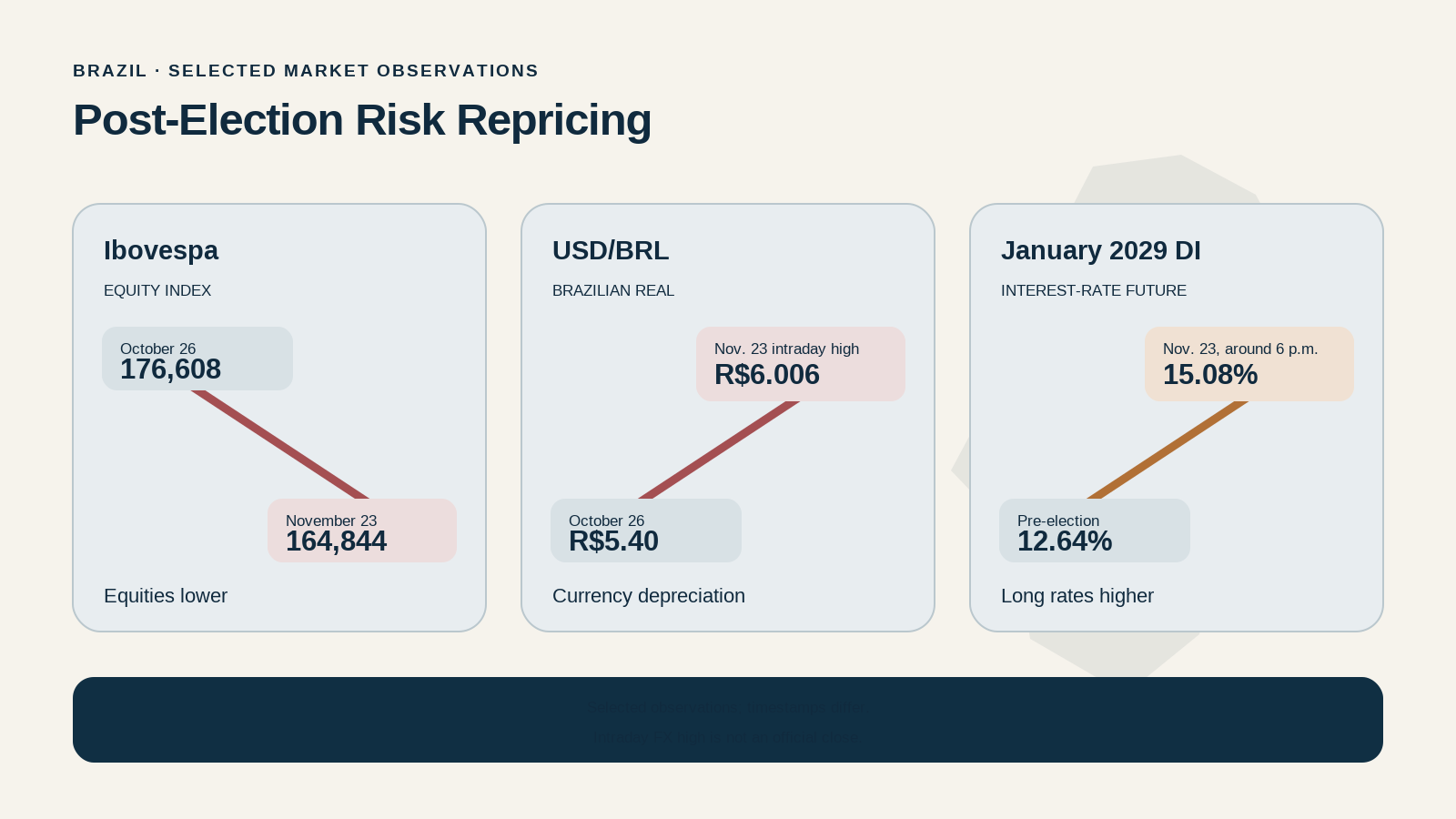
President Luiz Inácio Lula da Silva won the October 25 runoff against Flávio Bolsonaro, a result that forced investors to unwind positions built around a different electoral outcome. The next session was extraordinary. Agência Brasil reported that the Ibovespa closed October 26 at 176,608.23, down 13.88%, after a circuit breaker interrupted trading. The dollar finished at R$5.403, up 8.21%.
The moves were not a verdict on every listed company. They were a simultaneous repricing of the currency, long-term interest rates and the discount rate applied to Brazilian earnings. Exporters initially received some protection from the weaker real, while banks, domestic cyclicals and market infrastructure absorbed more of the shock.
By November 23, the index was lower still. Reuters published a preliminary close of 164,843.99, the observation used in the accompanying graphic. B3's consolidated market report later put the official close at 164,796.05, down 0.95%. The difference is small economically but important editorially: a preliminary figure should not be presented as the final exchange record.
The same care applies to foreign exchange. The dollar reached an intraday high around R$6.006, then reversed and closed near R$5.9262. The high shows the intensity of the morning risk-off move; it is not the official closing rate.
Monday's session: global relief, domestic resistance
The Ibovespa traded between 164,129.33 and 166,373.68 before closing at 164,796.05. Oil producers were among the main drags: Petrobras preferred shares fell 3.21% and PRIO lost 3.29%, while Brent weakened and investors waited for Petrobras's new five-year investment plan.
New York moved in the opposite direction. The S&P 500 gained 4.74% and the Nasdaq 6.51%, driven by a sharp reversal in AI-related shares. Ordinarily, that degree of global relief would support emerging-market risk. Brazil's inability to participate shows that the domestic discount rate was carrying more weight than the international equity impulse.
The currency contained a second message. The real recovered from its morning low despite a firm dollar abroad, helped by discussion of future central-bank appointments and comments from economic officials. That recovery was useful but incomplete. Trading above R$6 in the morning revealed how quickly fiscal and institutional uncertainty can migrate into the exchange rate.
The rate curve remains the central constraint
The January 2029 DI future ended near 15.08%, compared with 12.64% before the election in the supplied market snapshot. Other long maturities also remained above 15%. These are futures rates, not a forecast delivered by the central bank, but they directly influence the discount rate investors apply to long-duration equity cash flows.
The Central Bank's November 19 Focus readout, released on Monday, showed 2026 IPCA expectations at 5.15%, 2027 inflation at 5.12%, year-end 2026 Selic at 13.75% and year-end 2027 Selic at 13.00%. Expected 2027 GDP growth fell to 1.00%. Focus figures are market medians, not central-bank forecasts.
That combination—high inflation expectations, a high policy rate and weak growth—helps explain why apparently low equity multiples have not produced a broad rebound. A 6x or 7x earnings multiple can remain depressed when investors demand a much larger return simply to hold local risk.
Oversold conditions may support a bounce, but they do not change the arithmetic of a higher discount rate. For a more durable recovery, the market needs evidence that long-term rates can fall for fundamental rather than merely technical reasons.
Fiscal policy: a vote is not the same as an anchor
The Senate approved a fiscal package on November 18. Reuters described a combination of spending restraints and revenue measures intended to improve the 2027 primary balance. Economists cited in that report viewed the package as constructive but insufficient to stabilize debt without additional action on mandatory spending.
On Monday evening, the Chamber approved urgency for the bill by 318 votes to 135. That procedural vote allowed the package to move more quickly; it was not final approval of the substantive text. At this edition's cut-off, the final Chamber outcome had not been verified.
This distinction matters because markets are not pricing a single legislative headline. They are pricing the size of the measures, the risk of dilution, implementation, the 2027 budget and the government's willingness to reinforce the framework if debt projections deteriorate.
A credible fiscal anchor would reduce the risk premium by changing expected debt dynamics. A package that improves one year's balance but leaves the longer-term expenditure path unchanged may bring temporary relief without a sustained fall in long rates.
Petrobras turns the debate from rumor to capital allocation
Petrobras approved a US$122 billion investment plan for 2027–2031 after the market closed, according to Reuters. The amount is 11.9% above the prior five-year program. Exploration and production will receive US$87 billion, more than 70% of the total.
The official plan replaced the earlier range of anonymously sourced expectations. Investors now have a clearer number, but not an automatic conclusion. Higher capital expenditure can create value if projects earn attractive returns and accelerate production. It can reduce distributions and destroy value if capital is directed by noncommercial priorities or if costs rise faster than output.
The next questions are therefore operational: project returns, production milestones, refining economics, fuel pricing, leverage and the amount of free cash flow available for dividends. The company's November 24 presentation should provide more detail than Monday's headline total.
Same selloff, different exposures
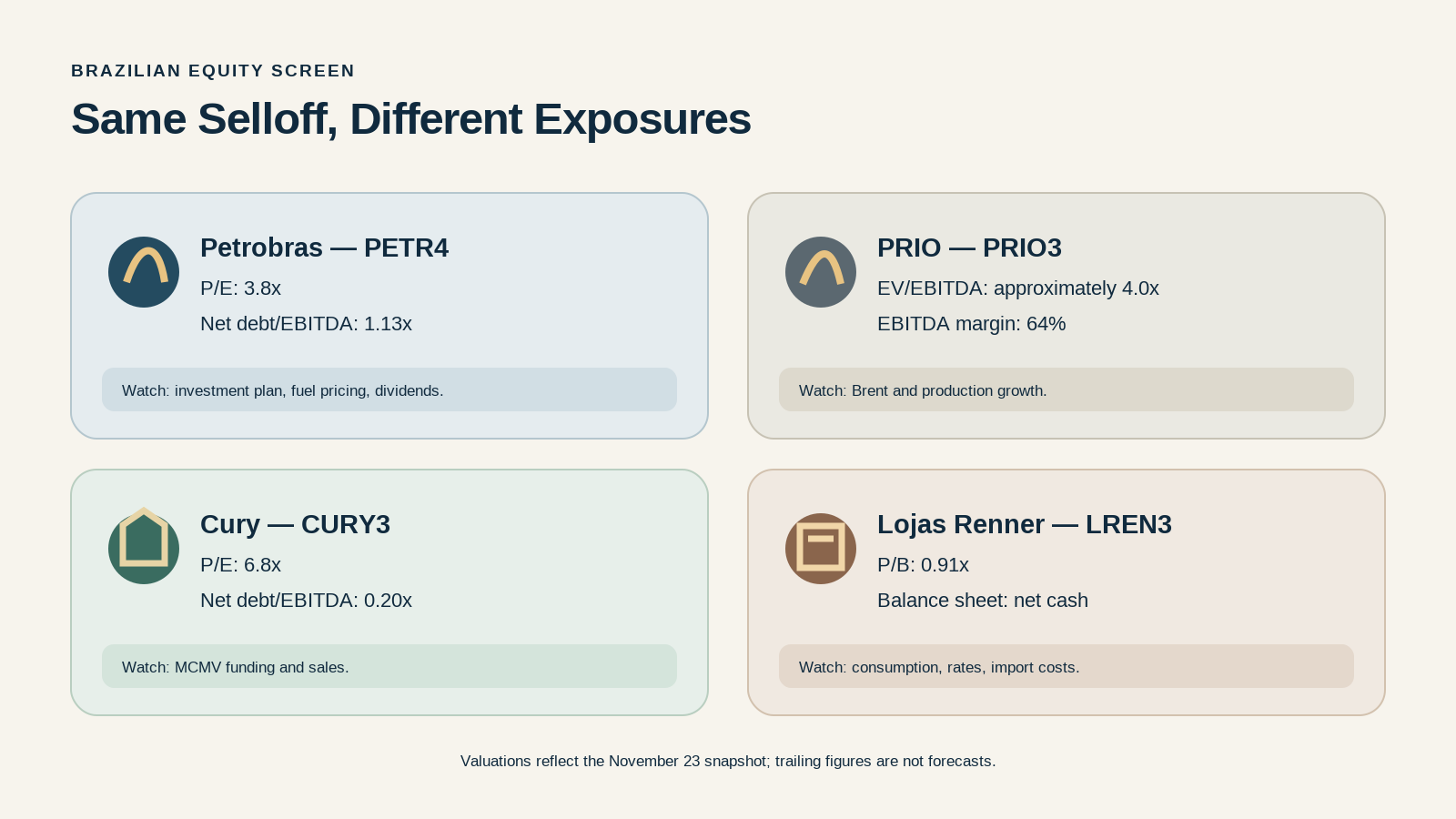
The four companies in the accompanying screen should not be ranked on a single valuation axis. Their multiples describe different businesses and different risks.
Petrobras — policy and capital allocation
The 3.8x trailing P/E and 1.13x net debt-to-EBITDA ratios in the November 23 snapshot suggest substantial reported earnings relative to price. The discount also reflects oil prices, state control, fuel-pricing uncertainty and the investment plan. The valuation cannot be interpreted without a view on how US$122 billion will be allocated and what it leaves for shareholders.
PRIO — production economics and Brent
PRIO's approximately 4.0x EV/EBITDA and 64% EBITDA margin point to a strong operating profile in the supplied snapshot. Dollar-linked revenue offers partial protection against real depreciation. It does not remove commodity risk. Production growth, lifting costs and Brent remain the principal operating variables.
Cury — housing policy and funding
Cury's 6.8x trailing P/E and 0.20x net debt-to-EBITDA frame a profitable, low-leverage housing developer. Exposure to Minha Casa Minha Vida and FGTS funding differentiates it from purely market-rate developers, but does not eliminate credit, execution or policy risk. Sales, launches and funding availability matter more than a low multiple in isolation.
Lojas Renner — consumption and imported costs
Renner's 0.91x price-to-book and net-cash balance sheet provide a different form of resilience. The operating risks are domestic consumption, high interest rates, competition and a weaker currency raising imported merchandise costs. Trading below book value is a starting observation, not proof of undervaluation.
Relief rally or durable recovery?
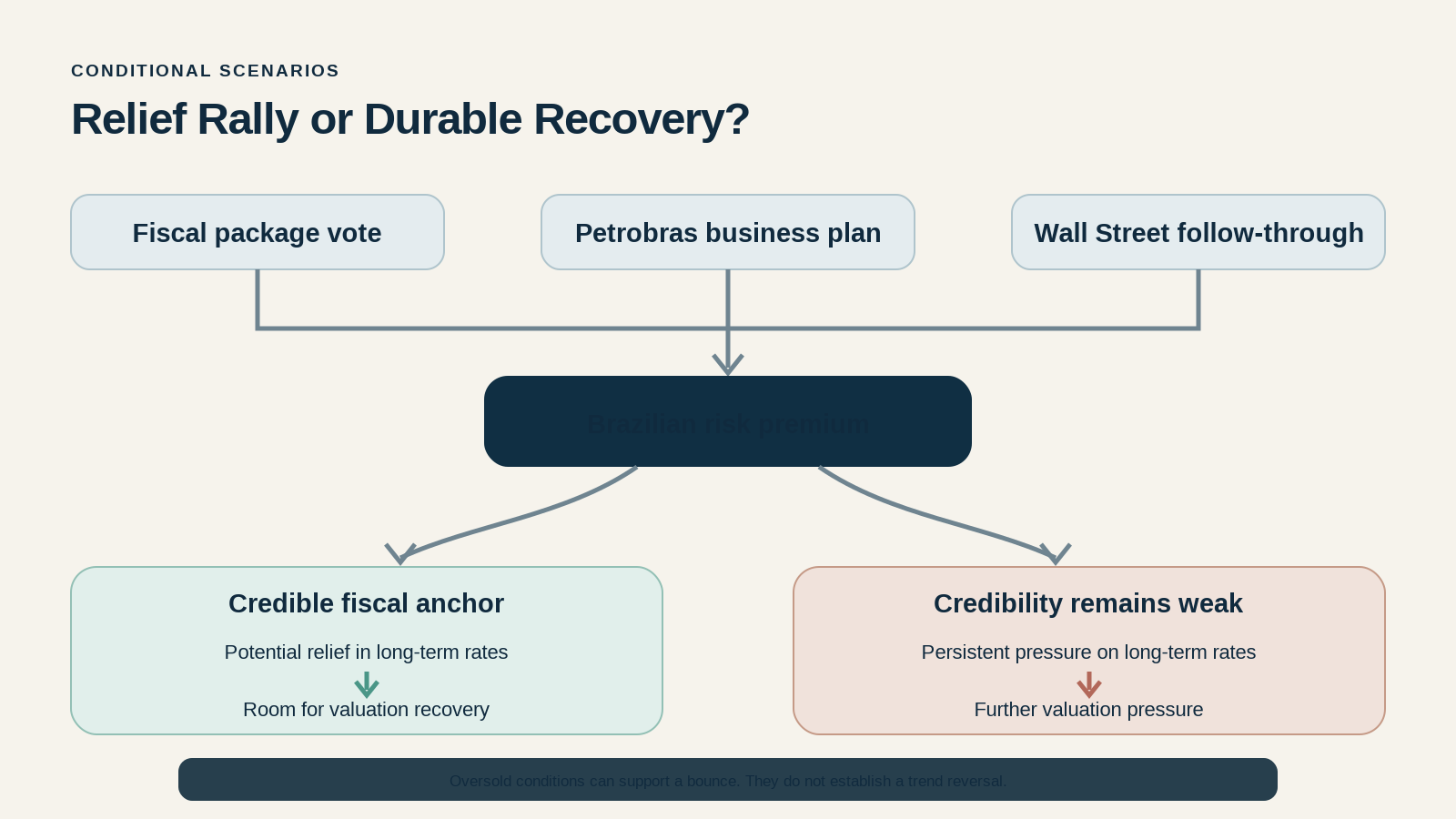
Tuesday's setup depends on three separate developments: the Chamber's treatment of the fiscal package, the market's detailed reading of Petrobras's business plan, and whether Wall Street's rebound survives another session.
Those inputs flow through the same variable: the Brazilian risk premium. If the fiscal package preserves meaningful measures, subsequent policy strengthens the medium-term anchor, and Petrobras demonstrates investment discipline, long rates could ease and valuations could recover. That is a conditional path, not a prediction.
The opposing scenario is equally plausible. If fiscal credibility remains weak, the package is diluted or long-term expenditure concerns dominate, rates may stay near current levels or rise further. In that environment, apparently cheap stocks can become cheaper because the required return keeps increasing.
Wall Street matters, but it cannot substitute for domestic credibility. A strong global tape can create room for relief; it cannot resolve Brazil's debt trajectory or determine Petrobras's capital returns.
What to monitor next
- Final Chamber vote and amendments. Urgency was approved; the substantive outcome remains the relevant fiscal signal.
- Petrobras's November 24 presentation. Look beyond the US$122 billion total to project returns, production and distributions.
- The January 2029 and 2031 DI contracts. A durable decline would be more meaningful than one session's easing.
- USD/BRL after the R$6 test. The official close below R$5.93 shows intraday recovery, not necessarily a final peak in country risk.
- Breadth in the Ibovespa. A recovery led by only a few oversold domestic names would be less persuasive than broad participation.
- Foreign flows and commodity prices. Oil and iron ore can either offset or amplify the domestic repricing.
Editorial judgment: Brazil is experiencing a risk-premium shock, not enough evidence yet of an acute recession. Depressed prices create room for sharp rebounds, but the turn will be defined by fiscal credibility and the direction of long-term rates—not by technical oversold readings alone.
Disclosure and limits: This article is general market commentary based on dated public sources. Valuation multiples are trailing snapshot measures and are not forecasts. The article contains no price targets, personalized advice, or buy or sell recommendations.