
Market Calls / Brazil
Brazil Catches Its Breath: Ibovespa Rises 1.58% as Fiscal Hopes Ease Long Rates
Stocks, the real and long rates improved as Brazil assessed fiscal measures and economic-team speculation. The updated B3 close shows relief, while execution and inflation remain the next tests.

Market date
Brazilian assets found some relief on November 25. Stocks rose, the real strengthened, and longer-dated interest-rate futures eased as investors assessed fiscal measures and speculation about the next economic team. The combination was encouraging, but one session cannot establish that the risk premium accumulated over recent weeks has disappeared.
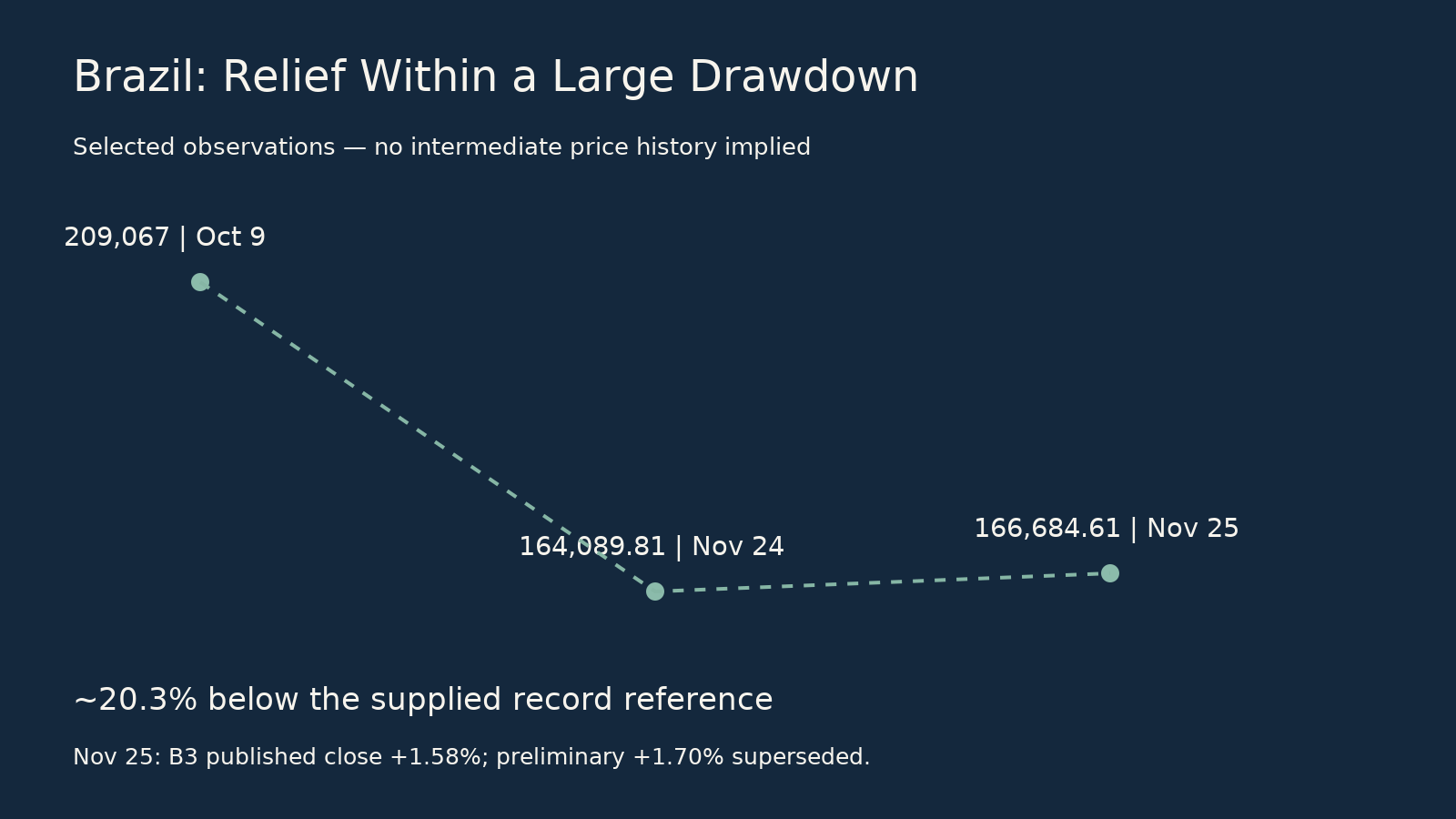
The updated close matters. B3’s published market summary put the Ibovespa at 166,684.61, up 1.58%. The original briefing used Reuters’ earlier preliminary figure of 166,880.13 and a 1.70% gain. This edition uses the later B3 figure and preserves the distinction rather than treating both as final closes.
Against the supplied October 9 record reference of 209,067, the updated level remains approximately 20.3% lower. That arithmetic describes the drawdown; it does not isolate how much was caused by the election, fiscal policy, commodities, or global markets.
A better day across stocks, currency and rates
The session’s high was 167,105.33 and its low 164,042.13. The commercial dollar finished around R$5.817 in closing reports, while the original feed snapshot showed R$5.8251. Those quotations come from different conventions and timestamps and should not be combined into one precise return calculation.
The direction was clear: USD/BRL fell, meaning the real strengthened during the day. The draft’s claim that the real had gained 17.3% over a month was not established by the supplied comparison. A rise in USD/BRL means a weaker real, and the inverse currency return requires its own calculation. The unsupported monthly statement is therefore omitted.
Banking, retail, and housing shares featured in the supplied list of gainers. Bradesco rose about 4.3%, Banco do Brasil 4.0%, BTG Pactual 6.0%, Cury 5.0%, and Magazine Luiza 6.6%. These rounded quotations describe relative performance; they do not prove a single cause for every move.
Lower long-term rates offer a plausible channel for relief in financing-sensitive businesses. Expectations about fiscal execution may also affect the currency and valuations. But attributing the entire rally to a newly signed law would overlook information already anticipated by the market, changes in positioning, and company-specific developments.
Long rates eased; the curve still carries a premium
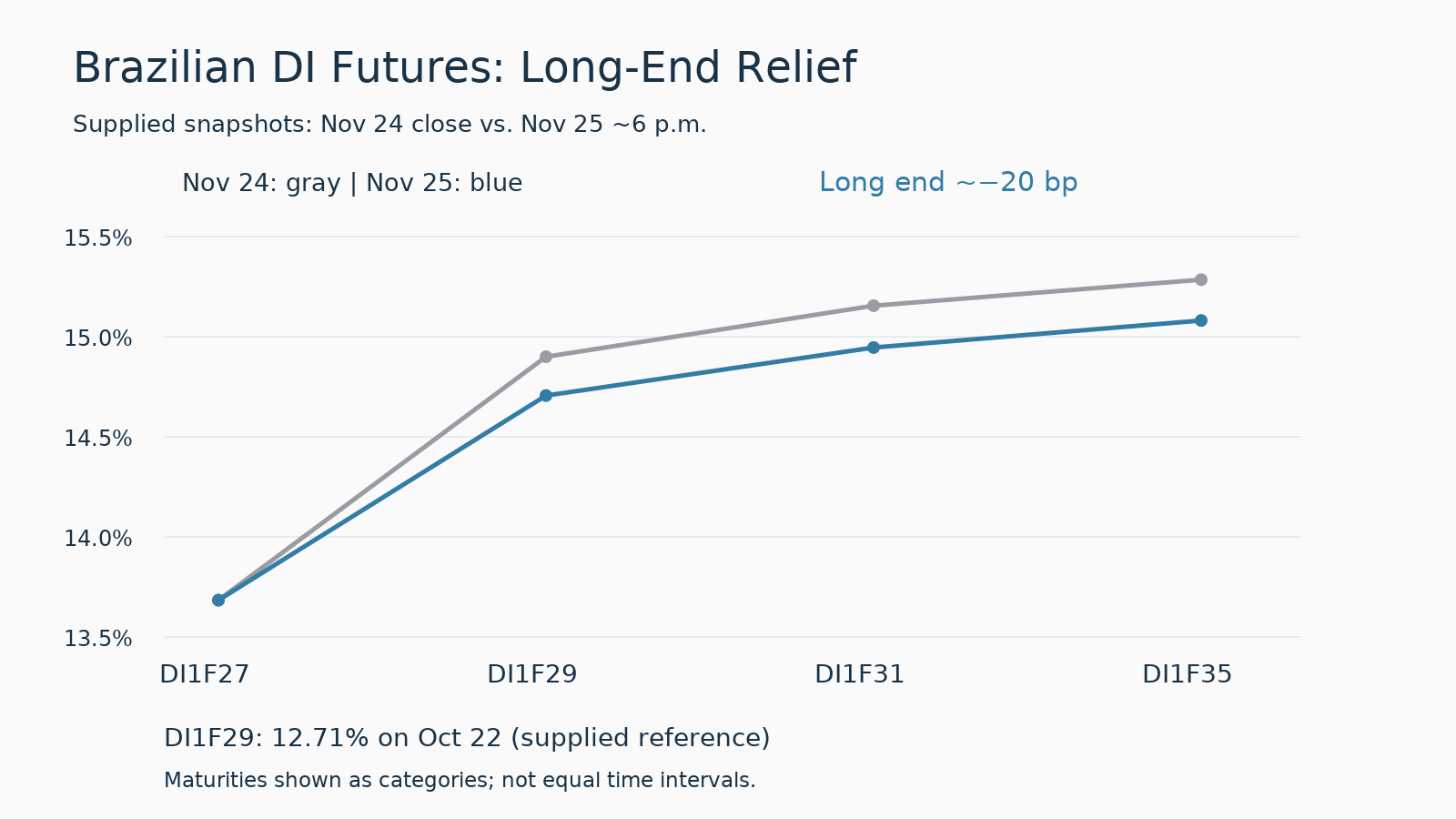
The supplied DI comparison uses November 24 closing observations and November 25 readings around 6 p.m. It is therefore a close-to-snapshot comparison, not a claim that every value is an official settlement.
| Contract | Nov 24 | Nov 25 snapshot | Change |
|---|---|---|---|
| DI1F27 | 13.684% | 13.684% | 0.0 bp |
| DI1F29 | 14.900% | 14.706% | −19.4 bp |
| DI1F31 | 15.155% | 14.946% | −20.9 bp |
| DI1F35 | 15.285% | 15.081% | −20.4 bp |
These four maturities form an upward-sloping curve. They do not demonstrate the “inverted short end” described in the original draft, because no shorter maturities were supplied to establish that claim.
The January 2029 contract remained approximately 200 basis points above the supplied October 22 reference of 12.71%. A roughly 20-basis-point daily decline is meaningful, but small beside that earlier increase. Futures rates incorporate expectations and risk premia; they are not direct forecasts of a single future Selic setting.
A signed law and a proposed amendment are different milestones
Complementary Law 239 was signed and published on November 24. The Senate’s account says it provides additional fiscal-management tools and, under specified conditions, allows real expenditure growth to be limited to 2% rather than 2.5%. It attributes potential relief of up to R$50 billion to government calculations.
That maximum estimate is not cash already saved. Activation conditions, implementation, revenue behavior, and budget execution determine the realized effect. Other estimates in the briefing use different assumptions and horizons; they should not be treated as interchangeable measures of recurring savings.
The proposed constitutional amendment on mandatory spending is a separate matter. Reports of authorization or discussion do not establish a filed text, congressional approval, or an effective constitutional change. The investment question is what the eventual proposal contains and whether it can be passed and implemented.
Similarly, speculation about Luiz Carlos Trabuco and other potential finance ministers is not an appointment. A name may alter expectations, but the durability of any repricing depends on the mandate, policy design, political support, and execution that follow.
Petrobras puts capital allocation back in focus
Petrobras’ November 23 filing confirms a 2027–2031 business plan with US$122 billion in planned investment: US$113 billion in its implementation portfolio and US$9 billion in opportunities still under evaluation. Planned spending and completed investment are different stages.
For shareholders, the relevant calculation links operating cash generation, oil prices, debt, project returns, and distributions. A low historical earnings multiple does not establish that all capital-allocation risk has been priced in. Nor does an extraordinary payout prove that a particular dividend level can be sustained.
The draft’s payment dates, per-share dividend figure, and transaction details require their own corporate notices before being used as actionable calendar entries. They are not reproduced here as verified instructions for investors.
Different exposures behind the rebound
Petrobras: Research should test the new spending plan against cash generation under different oil-price and currency assumptions. Pricing policy, execution, leverage, and the mix between investment and distributions remain central.
Vale: Iron ore, production, costs, capital expenditure, and liabilities matter more than the size of a one-day rebound. A weaker real can affect translated earnings and costs, but cannot guarantee better shareholder returns if commodity prices weaken.
PRIO: Production growth and cost discipline offer a different oil exposure from Petrobras. The supplied historical margin and leverage figures should be refreshed before describing it as the best pure-play opportunity. A Brent threshold alone cannot establish investment attractiveness.
Bradesco: A discount to historical book value requires an assessment of asset quality, expected returns on equity, capital, and current results. The original estimated P/E and P/B were scaled from October prices without updating third-quarter earnings, so they are not treated as verified current valuation measures.
WEG: International revenue and electrical-equipment demand provide important exposures. They do not make the shares a guaranteed dollar refuge or establish that valuation offers no margin of safety. Current earnings expectations, trade rules, order mix, and price all need examination.
Embraer: Reports of proposed U.S. trade measures affecting aircraft are a material research issue. A proposal is not an implemented tariff. Product coverage, timing, exemptions, contractual terms, and production geography determine the eventual effect; the draft’s unverified 10% headline is not used as a confirmed operating assumption.
Cury: Housing demand, execution, funding access, and Minha Casa Minha Vida policy deserve direct analysis. Low-income housing is not immune to interest rates or funding constraints. The October balance-sheet description needs reconciliation with current results before making a net-cash or valuation claim.
Magazine Luiza and smaller companies: Rate relief can improve sentiment toward financially sensitive businesses, but operating progress and financing needs must support the thesis. A large prior decline, or a sharp monthly rebound, does not establish multibagger potential.
No company in this edition is ranked as a verified multibagger candidate. The original screen’s historical figures are useful leads for research, but they are not a substitute for updated statements and a valuation model.
The next tests are fiscal execution and inflation
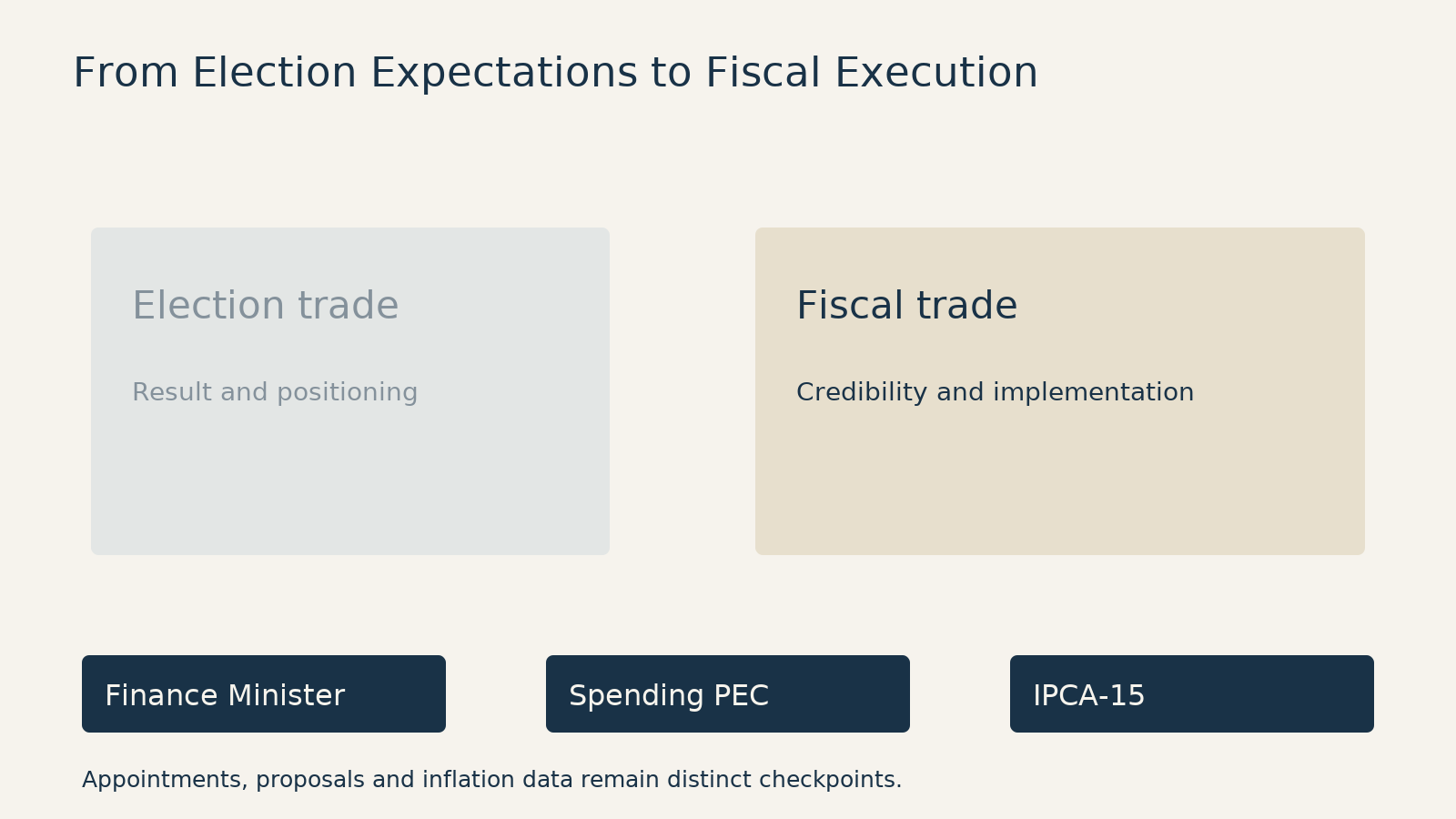
The phrase “from election trade to fiscal trade” captures a shift in attention, not a measured decomposition of returns. Investors are watching the economic team, the content of spending proposals, and inflation because each can alter expectations about financing costs and debt dynamics.
The November IPCA-15 release is expected on November 26 in the market reporting reviewed here. Thanksgiving closes regular U.S. cash-market trading that day, followed by a shortened session on Friday. Less participation can make moves less representative and increase sensitivity to individual orders; it does not determine direction.
The original draft still described U.S. PCE as forthcoming despite including later market observations. By the time of this edition, the report had been released. That chronology is another reason not to blend morning forecasts, intraday quotations, and evening closes into one simultaneous market picture.
A firmer real and lower long rates are consistent with some reduction in perceived risk. They do not prove that foreign investors returned in size: current B3 flow data would be needed for that claim. Nor does the gap between spot USD/BRL and a survey forecast directly measure a currency risk premium.
A more durable recovery would require evidence that fiscal measures are credible and executable, inflation expectations are improving, and companies can deliver earnings at the prevailing cost of capital. Wednesday provided relief. The next releases and policy decisions will test how much of it can last.
Data and editorial note
The headline uses B3’s later published close rather than Reuters’ preliminary figure. DI rates and selected stock moves retain their supplied snapshot status. Fiscal law and Petrobras plan details were checked against official records. Unverified monthly currency claims, stale valuation estimates, appointment speculation, and proposed tariffs are excluded or explicitly qualified.
This article is informational market commentary, not a recommendation to buy or sell securities or personalized investment advice.