
Market Calls / Brazil
Brazil: Fiscal Relief Meets a Market Still Selling the Rally
A firmer real and lower long yields survived Brazil’s fiscal relief rally. Equities did not. Petrobras, Vale and the gap between exporters and domestic stocks explain the harder recovery test.

Market date
Brazil’s fiscal package gave investors a reason to buy on Tuesday morning. By the close, that was not enough to keep the equity market higher.
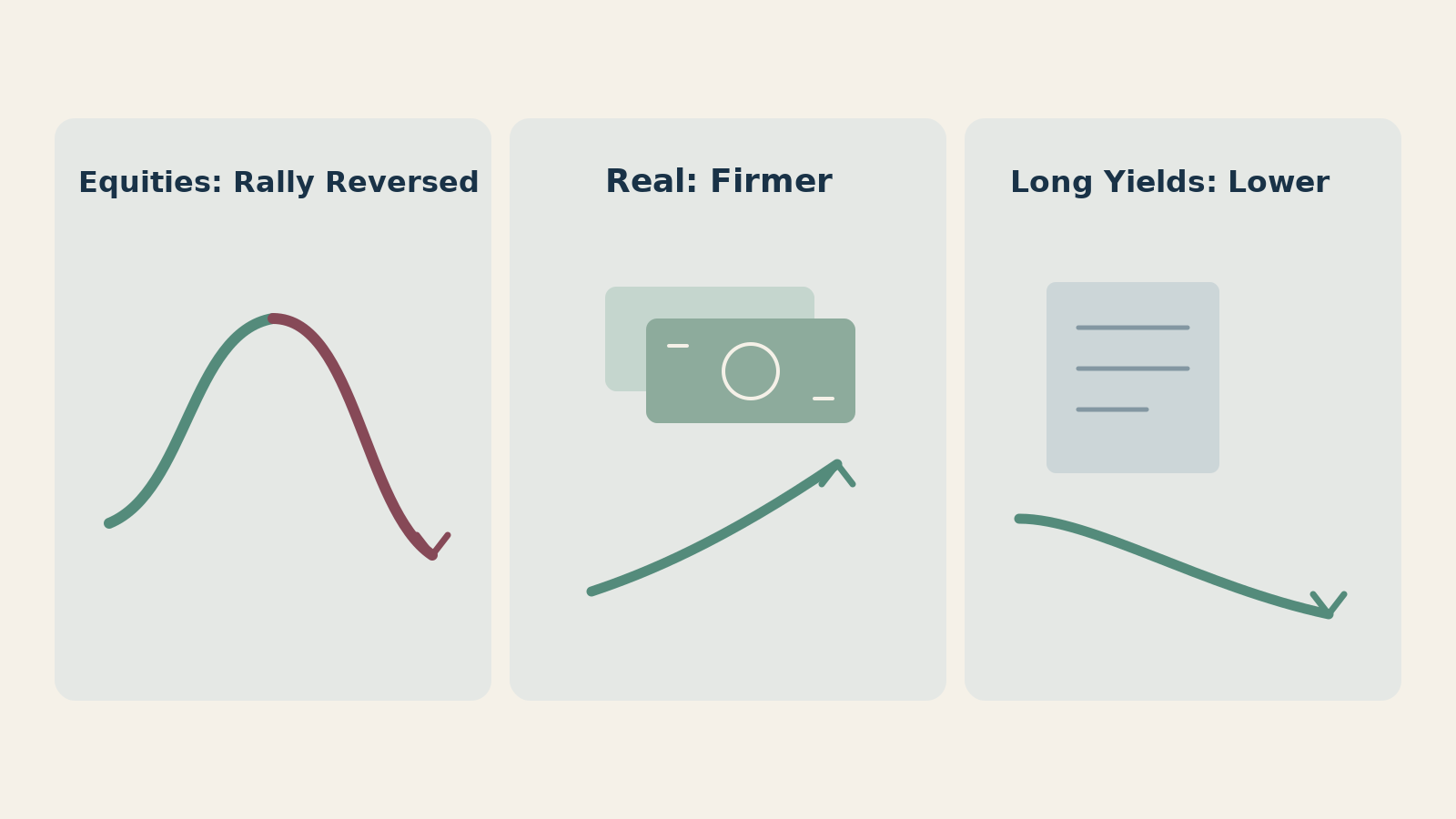
The Ibovespa reached 167,579.78 before reversing to 164,089.81, down 0.43%, its fourth consecutive decline. The real held onto a modest gain against the dollar, while longer-dated interest-rate futures retained some relief. Vale and Petrobras weighed on the stock index.
The divergence is the story of November 24. Fiscal action can reduce some of the premium investors demand to hold Brazilian assets without resolving the earnings risks facing its largest listed companies. A firmer currency and lower yields are helpful conditions. They are not a guarantee of an equity recovery.
What the closing numbers establish
The updated Reuters report and the Estadão closing bulletin both put the Ibovespa at 164,089.81. Reuters initially circulated 164,088.77 as a preliminary reading. The final figure is used here; the much higher late-session observation in the underlying research material is not treated as a closing price or attributed to the auction without evidence.
| Observation | November 24 reference |
|---|---|
| Ibovespa | 164,089.81; −0.43% |
| Morning high | 167,579.78 |
| Commercial dollar, selling quote | R$5.9107; −0.26% |
| January 2027 DI | 13.684% in UOL’s last-trade account |
| January 2029 DI | 14.900% in the same account |
| January 2031 DI | 15.155% in the same account |
The DI figures require care. A separate rate feed displayed 14.853% for January 2029 and 15.111% for January 2031, identifying its observations as provisional rather than confirmed B3 settlement rates. Those values support the direction described in the original notes, but should not be mixed with another provider’s closing observations to manufacture an exact daily change. The roughly 22-basis-point decline cited in those notes belongs to that particular snapshot.
Turnover also differs across reports: updated Reuters gives R$34 billion, while the Estadão bulletin gives R$24.3 billion. Their coverage and calculation basis were not reconciled here, so volume is not used to strengthen the investment argument.
The currency move was less dramatic than its intraday low suggested. UOL reported a dollar range of R$5.8014–R$5.9550 before the R$5.9107 close. Some of the real’s support also came from a weaker dollar abroad. Fiscal news is therefore a plausible contributor, not an isolated explanation for the entire exchange-rate move.
The fiscal package is now law; delivery remains the test
The approval is no longer merely a bill awaiting signature. The Planning Ministry confirmed on November 24 that President Lula signed Complementary Law 239/2026, after the Chamber passed the measure without changes to the Senate text.
The ministry describes potential savings of up to R$56 billion in 2027 and links the package to the government’s primary-surplus objective of 0.5% of GDP. The measures address tax benefits, cross-tax offsets and spending controls, including a conditional reduction in the real expenditure-growth ceiling. These are government estimates and objectives, not realized savings.
There are also qualifications to the headline adjustment. Agência Brasil reports an exclusion of up to R$10.5 billion of extraordinary diesel-subsidy spending from the 2026 fiscal-target calculation. Implementation dates, regulation and the treatment of exceptions matter when moving from the headline number to the actual budget trajectory.
The market response suggests that concrete measures still have value. It does not establish that investors now regard Brazil’s medium-term debt path as settled. Additional proposals, their political feasibility and appointments to the next economic team remain relevant. Reports about another package should be judged as proposals until their terms and legislative progress are clear.
That is the distinction between immediate relief and a durable reduction in financing costs: the first can follow an announcement; the second requires a sequence of credible decisions and budget results.
Inflation expectations leave little room for complacency
The Selic remains 13.75%. The Focus survey dated November 19 and published November 23 showed median market expectations of 5.15% for 2026 IPCA inflation and 5.12% for 2027. The latter rose from 5.00% a week earlier. The median forecast for the end-2027 Selic increased to 13.00%, from 12.75%.
Those are respondents’ forecasts, not promises from the central bank. They nevertheless illustrate the obstacle facing rate-sensitive equities: investors still expect restrictive financing conditions to persist.
The same survey put the end-2026 exchange rate at R$5.55 per dollar. Its distance from spot does not prove that the forecast must move higher; it could narrow through changes in either expectations or the currency. What matters for companies is how exchange rates, interest costs and customer demand interact over the life of their cash flows.
A one-day decline in long yields is helpful at the margin. With the longer DI observations still around 15%, it does not amount to a broad reset in the cost of capital.
Vale and Petrobras show why the index lagged
Reuters’ updated close showed Vale down 5.51% and Petrobras preferred shares down 1.82%. These supersede the slightly different percentage moves in the earlier research snapshot.
Vale’s decline accompanied weakness in mining shares abroad, even though the most actively traded Dalian iron-ore contract rose 1%. That is a useful warning against assigning a single commodity quote as the cause of an equity move. Different contracts, regional demand, costs and the outlook for shareholder distributions can all matter. A specific additional company catalyst was not established for this article.
Petrobras had more company news to digest. Its official 2027–2031 plan sets out $122 billion of investment, divided between $113 billion in the implementation portfolio and $9 billion under evaluation. A plan describes intended capital allocation across several years; it is not an immediate cash outflow or a guarantee that every project will proceed unchanged.
The company separately approved R$15.6 billion of extraordinary shareholder remuneration. The official announcement schedules a single payment for December 23 for B3-listed shares. That distribution and the investment program need to be assessed together: the question is how much cash remains available after operations, investment, debt obligations and other commitments under different oil-price assumptions.
A low trailing P/E cannot answer that on its own. The approximate valuation in the original screen depended on older earnings and recalculated share-price inputs. It is not presented here as a verified current multiple. Nor would multiplying the preferred-share price by an approximate total share count establish an exact company equity value across different share classes.
Braskem adds a separate financing risk. Reuters reported a sharp Tuesday decline following Monday’s rally and confirmation of a preliminary creditor agreement. The original notes’ different capital-injection totals are not combined here: funding, debt restructuring and potential dilution require the transaction documents, not a comparison of headline amounts.
Exporters and domestic businesses face different hurdles
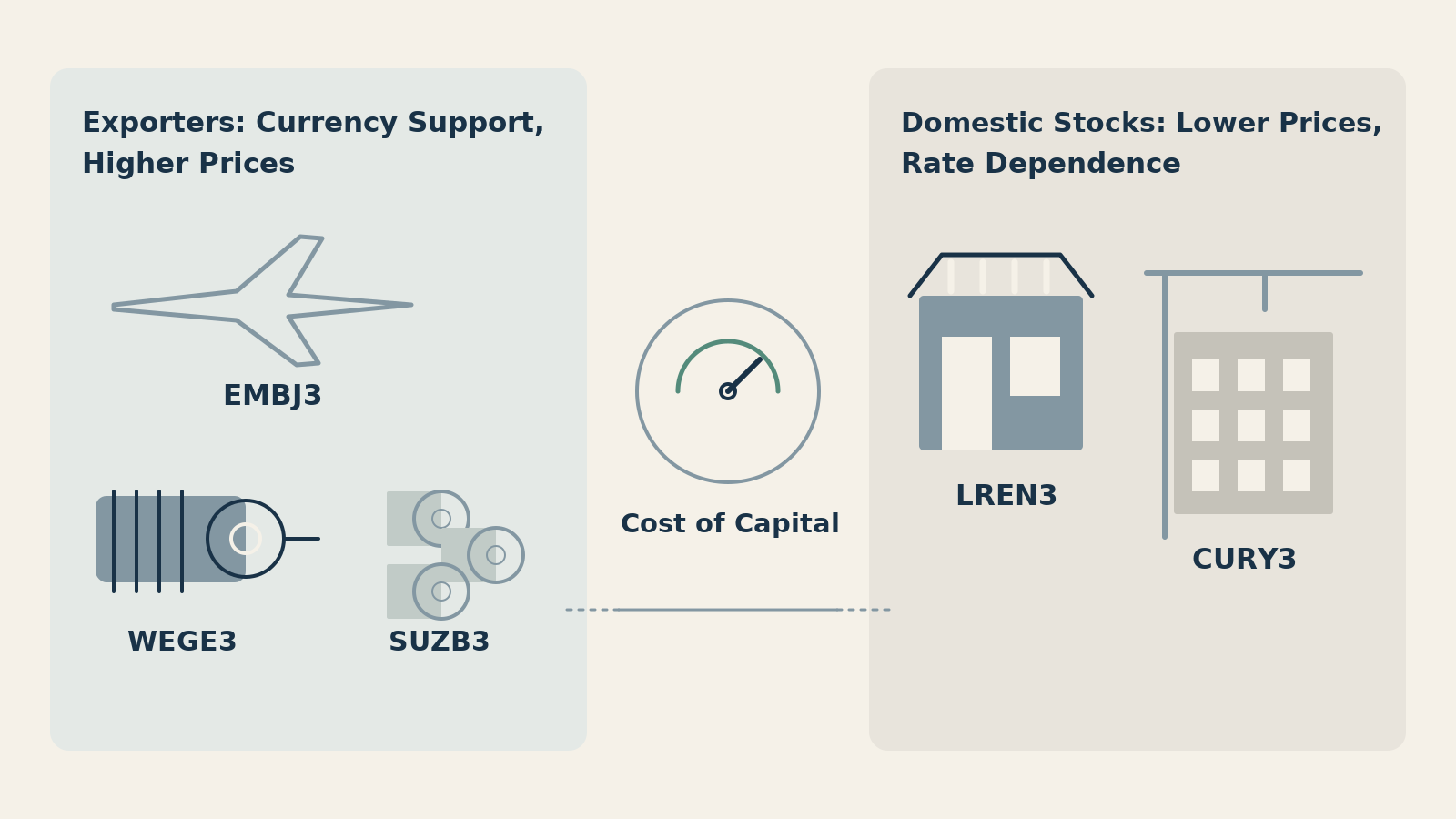
The research universe divides broadly into exporters whose currency exposure may help operating results, and domestic companies whose recovery is more closely tied to financing conditions and local demand. These are analytical groupings, not mutually exclusive categories. Exporters also face interest costs, and domestic businesses can have significant import exposure.
The time horizon matters. The real strengthened on Tuesday; the exporter thesis concerns the weaker currency over the broader period discussed in the research. The two statements should not be read as the same daily catalyst.
Embraer: orders need to become deliveries and cash
Embraer provides the clearest operating evidence among the exporters discussed. Its third-quarter release reported approximately $2.3 billion of revenue, up 17% in dollars, and a $35.7 billion backlog. It raised its full-year revenue and adjusted free-cash-flow guidance.
Adjusted net income was R$379.8 million, below R$450 million a year earlier; the company pointed to higher net financial expenses and taxes. Stronger revenue and improved operating execution therefore did not translate into higher adjusted bottom-line profit.
The business case rests on production, deliveries, mix and service income as much as currency translation. A dollar revenue base with some real-denominated costs can help, but imported inputs, hedges and financing also affect the outcome. Backlog supports visibility; it does not eliminate supply-chain or execution risk.
WEG and Suzano: currency exposure is not a valuation conclusion
WEG’s international industrial exposure and the net-cash position recorded in the reference screen make it a different business from a heavily indebted cyclical producer. The screen’s approximate 33-times P/E, however, was not independently refreshed for this edition. It should not be treated as proof of either cheapness or excessive valuation without consistent current price and earnings inputs.
For Suzano, dollar pulp revenue provides a potential operating benefit when translated into a weaker real. Pulp prices, dollar debt, hedging and capital expenditure can offset or complicate that benefit. Accounting gains from derivatives also need to be distinguished from recurring operating cash generation. The shares are not a risk-free substitute for holding dollars.
The larger point is that an export advantage can already be reflected in the price. The original screen recorded substantial prior gains in these exporters. Those observations explain the comparison being made; they are not refreshed total-return measurements or a forecast of what comes next.
Renner and Cury: lower prices still need an earnings case
Lojas Renner and Cury sit on the other side of the comparison. A fall in the price paid for future profits can improve a prospective investment case, but only if those profits remain achievable.
For Renner, the relevant checks are sales, margins, inventory, consumer credit and the cost of imported goods. A net-cash balance sheet in a historical snapshot is a useful starting point; its current status and cash commitments still need checking.
For Cury, funding conditions, housing-program rules, selling prices, construction costs and cash collection are central. The P/E near nine times and balance-sheet description carried in the October reference are historical inputs, not verified November 24 valuation claims.
Neither company becomes an established high-growth opportunity simply because its shares fell. A lower discount rate could support valuations, but an earnings recovery must be assessed separately. The same caution applies to Bradesco and Banco do Brasil: credit costs, loan growth and bank-specific risks cannot be inferred from price declines alone.
Lower oil has two effects at once
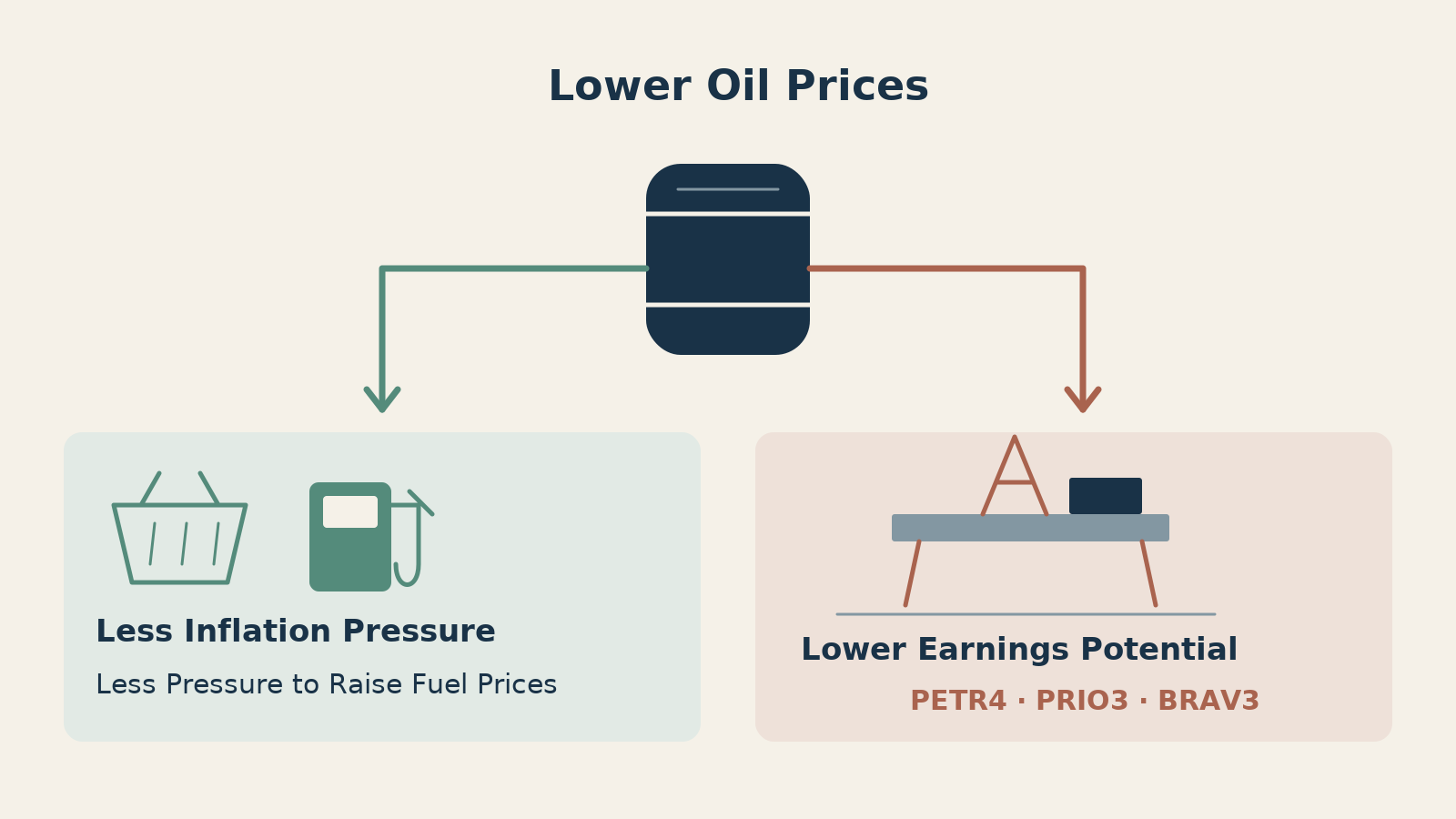
A softer oil price can reduce imported inflation pressure and lessen pressure to increase domestic fuel prices. It can simultaneously reduce the revenue and earnings potential of oil producers. These channels coexist; they are not rival predictions about Brazil.
For Petrobras, PRIO and Brava, the effect depends on realized prices, production, operating costs, hedging, taxes and financial structure. A weaker real can offset some dollar-price weakness when revenue is translated into reais, but it does not automatically protect dollar margins or cash flow. Petrobras also has refining and other operations, making its exposure different from that of a more concentrated upstream producer.
For households, the pass-through is not mechanical. Exchange rates, taxes, distribution margins, subsidies and pricing decisions can delay or dilute relief at the pump. Lower crude prices therefore create room for less inflation pressure; they do not establish the size or timing of the eventual consumer-price effect.
The next evidence to watch
The BEA schedules its next Personal Income and Outlays release, including PCE inflation, for November 25. The IBGE calendar places November’s IPCA-15 release on November 26. Brazil’s December Copom meeting is scheduled for December 8–9. Those are data and decision dates, not predetermined policy outcomes.
At home, the fiscal test shifts toward implementation and any additional measures. In companies, the tests are concrete: Petrobras’s investment discipline and distributions; Vale’s commodity and cost outlook; Embraer’s delivery conversion; and the ability of domestic businesses to preserve margins and cash under expensive financing.
The equity reversal leaves a simple question for the next sessions: can buying survive beyond the first favorable headline? A sustained improvement would be more persuasive if lower long rates were accompanied by firmer earnings expectations and broader participation across the market.
Tuesday showed that fiscal action can still move Brazilian assets. It also showed how much remains between an initial rally and a recovery shareholders can rely on.
Editorial note: This edition covers the November 24, 2026 session and incorporates subsequent same-day official confirmation of the fiscal law. Final, preliminary and provisional market observations are distinguished where they differ. Older company-screen inputs are not current valuation estimates. General market commentary, not personalized investment advice or a recommendation to trade.
Sources and references
- Reuters — Updated November 24 equity-market close
- Estadão — Closing market bulletin, November 24
- UOL — Currency and last-trade interest-rate observations
- Taxas do Tesouro — Provisional DI observations and methodology
- Planning Ministry — Official confirmation of fiscal-law signature
- Agência Brasil — Fiscal measures and diesel-subsidy exception
- Banco Central do Brasil — Focus survey, November 19
- Banco Central do Brasil — Copom policy statements
- Petrobras — Official 2027–2031 business plan
- Petrobras — Extraordinary remuneration and payment dates
- Embraer — Official third-quarter 2026 results
- IBGE — IPCA-15 publication calendar
- BEA — PCE release calendar
- Banco Central do Brasil — 2026 Copom calendar