
Market Calls / Brazil
Brazil’s Confidence Test: A Rally Still Needs a Fiscal Case
Brazil’s rebound, a softer IPCA-15 and the reported Trabuco acceptance change sentiment. The DI curve and company cash flows still demand a closer look.

Market date
Market Call — Brazil | November 26, 2026. Main market and DI observations: November 25 close. Inflation release: November 26. A later political update is identified separately below.
Brazil's November 25 rebound was visible across assets. The Ibovespa rose 1.58% to 166,684.61, the spot dollar fell to R$5.8168, and longer DI futures yields retreated. The next morning's softer IPCA-15 added a favorable inflation reading. It could not have caused the previous day's rally: the chronology matters.
The question is how much of the relief can outlast the headlines. A possible change at the Finance Ministry can alter expectations quickly. A credible fiscal program takes longer to assess, and longer still to implement.
November 26 update: Reuters reported at 6:46 p.m. Brasília time, citing a source, that Luiz Carlos Trabuco had accepted Lula's invitation to become finance minister. The report said Bradesco and the presidency had not immediately responded. The original draft's description of an entirely unanswered invitation is therefore superseded by this attributed report; formal appointment and policy details remain separate matters. The historical table also shows the Ibovespa extending its rally on November 26, to approximately 176,800. The graphics below retain their stated November 25 cutoff and must not be read as today's closing dashboard.
What Wednesday's recovery repaired—and what it did not
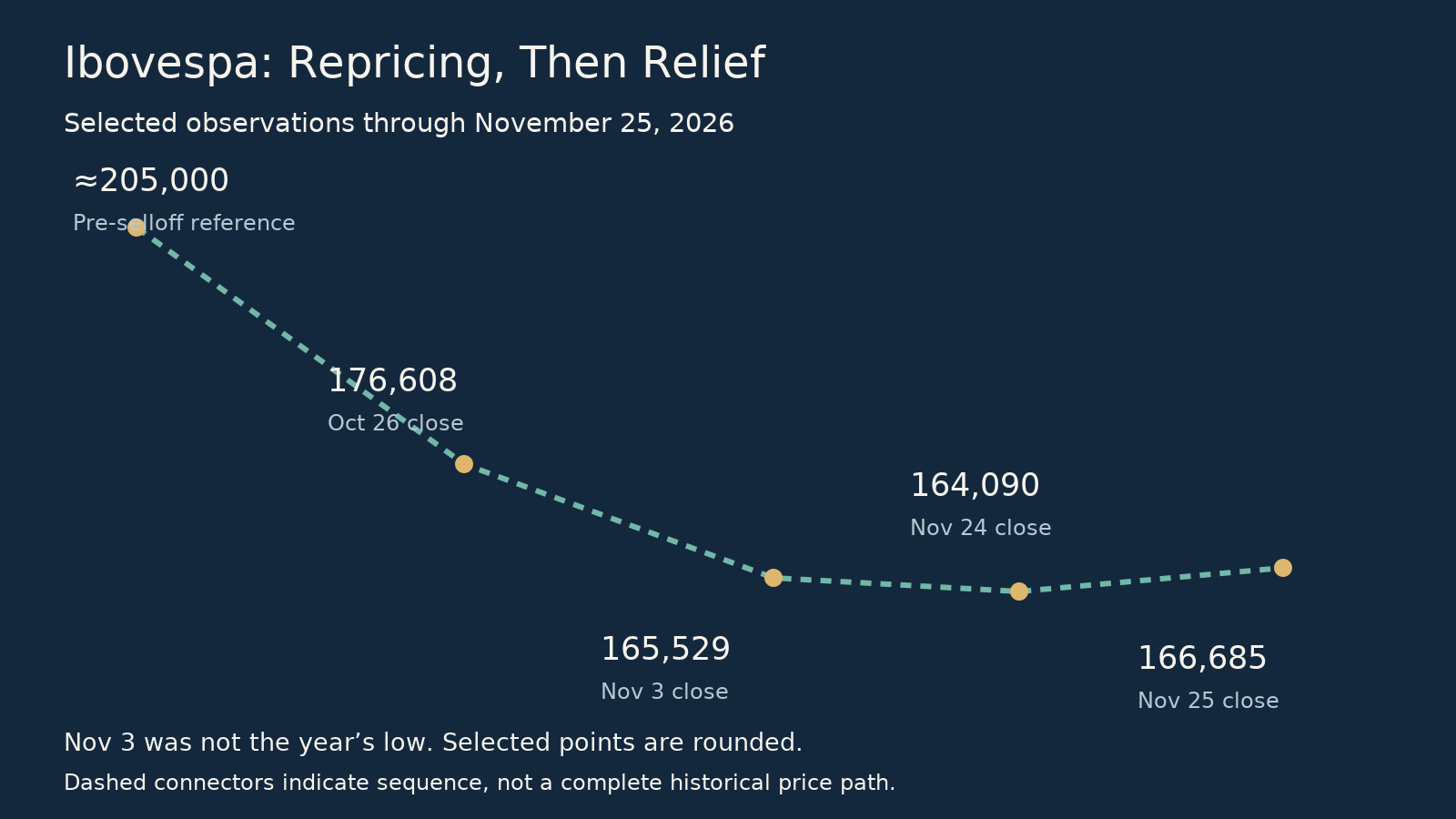
The November 25 close resolves the conflicting index figures in the supplied notes: 166,684.61 is the level reported by the financial-market closing bulletin. It was a meaningful bounce, but still well below the roughly 205,000-point reference before October's sharp repricing.
The historical series also corrects an important label. The November 3 observation near 165,529 was a close, not the intraday low, and cannot be described as the year's low in this edition. The index closed lower on November 24, near 164,090. Connecting selected observations does not reproduce all the intervening trading.
The supplied session notes show strength in rate-sensitive names, including retailers, homebuilders and vehicle rental. That pattern is consistent with relief over the cost of capital. It does not demonstrate that earnings forecasts improved by the same amount, or that short covering was the only source of buying.
In foreign exchange, the November 25 spot-dollar close is distinct from a PTAX reference rate and from the R$6.006 intraday high quoted for November 23. A stronger real can reduce some imported-cost pressure, but exporters face a different translation effect. There is no single direction that benefits every listed company.
The DI curve: lower yields, still a demanding cost of capital
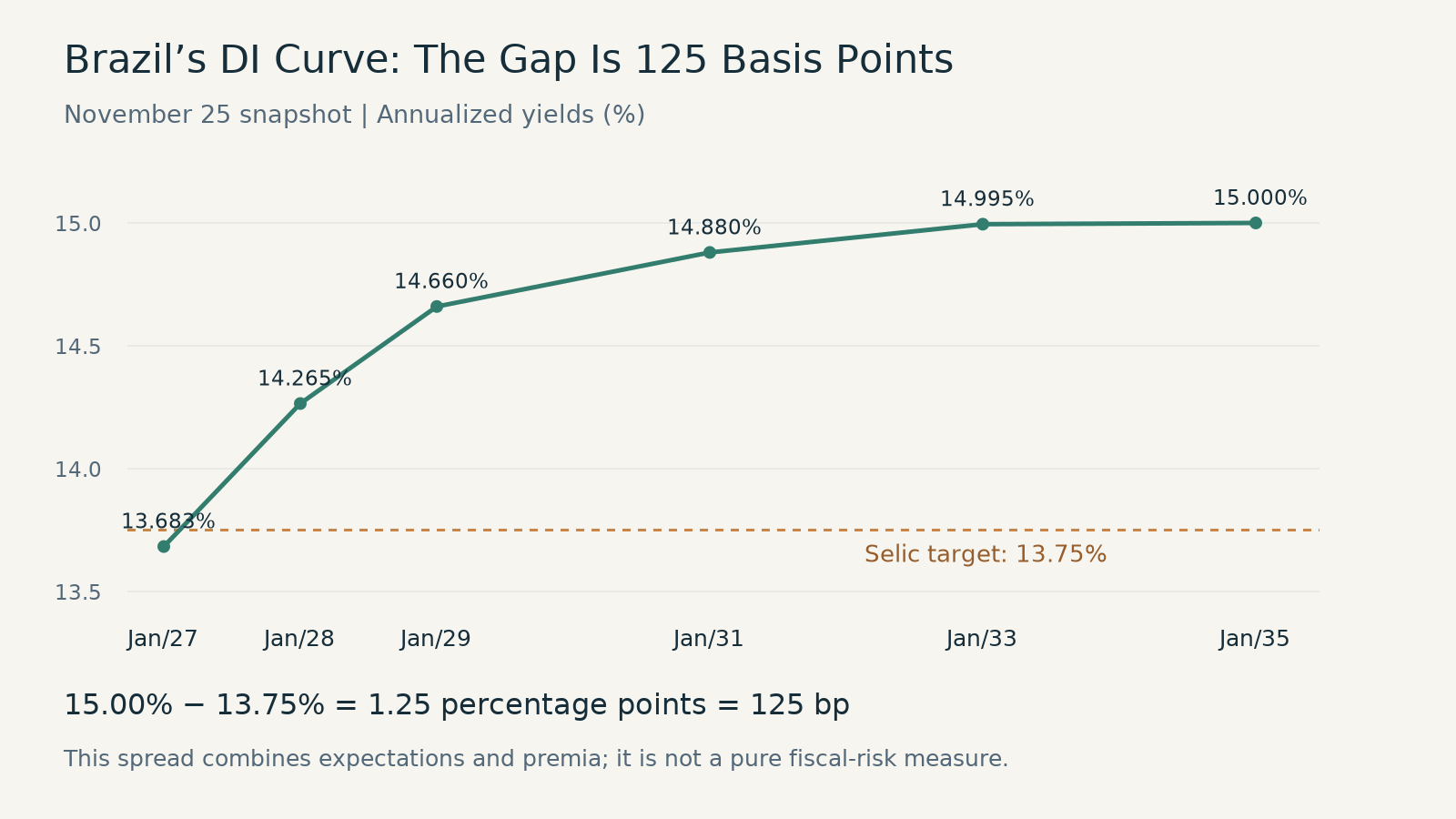
The Selic target stood at 13.75% after the November Copom decision. The supplied November 25 curve starts near that level and rises toward 15% at the long end.
| DI maturity | November 25 yield, annualized |
|---|---|
| January 2027 | 13.683% |
| January 2028 | 14.265% |
| January 2029 | 14.660% |
| January 2031 | 14.880% |
| January 2033 | 14.995% |
| January 2035 | 15.000% |
The January 2028–2035 closing levels match Bom Dia Mercado's report. January 2027 is retained from the supplied collection. Daily changes in the draft are not repeated because closing-to-closing comparisons and comparisons with the exchange's previous settlement can differ.
The arithmetic is straightforward: 15.00% minus 13.75% equals 1.25 percentage points, or 125 basis points. Calling that entire difference a fiscal premium would go too far. A DI futures rate reflects expectations for accumulated overnight rates over its horizon, together with risk premia and market pricing effects. Fiscal credibility can influence it, but cannot be isolated by subtracting today's Selic target.
Nor does the upward slope establish a specific 2027 hike. Different expected policy paths and risk premia can produce similar quoted rates. A fall in the long end is welcome for valuations, but does not by itself confirm a new easing cycle.
Inflation relief is real, but the composition matters
The November IPCA-15 rose 0.22%, down from 0.32% in October. The accumulated increase was 4.38% in the year and 4.64% over twelve months. Food and beverages rose 1.51%, while transport fell 0.71%; airfares declined 9.57%. The softer headline therefore contains both continuing household pressure and substantial relief in particular categories.
IPCA-15 is a separate index with a different collection window from the full IPCA. Its twelve-month reading above 4.5% is relevant context, but should not be presented as a formal determination that the monetary-policy target has been breached: the target framework uses IPCA.
The supplied November 23 Focus snapshot places expectations for 2026 and 2027 IPCA at 5.15% and 5.12%, respectively. These are surveyed forecasts, not Banco Central promises. The concern is the distance between a better recent monthly print and the inflation path respondents still expect ahead.
A durable improvement would require more than one favorable release: composition, underlying inflation, exchange-rate effects and expectations all matter. The cost of capital can remain high even while the latest headline slows.
A ministerial name is a signal; the fiscal program is the test
The market response to reports about Trabuco suggests that the economic team's perceived credibility matters. It does not measure how much spending can be restrained, what Congress will approve or how the debt trajectory will change.
The supplied notes also discuss a constitutional amendment addressing mandatory spending. Until a text, timetable and financing assumptions are available, that remains a policy proposal to evaluate rather than savings that can be booked in advance. The same discipline applies to primary-deficit projections, spending freezes and one-off receipts: their accounting scope and timing must be reconciled before adding them together.
My interpretation is that the rally reflects a willingness to reconsider a very pessimistic position. The harder test is whether personnel choices are followed by measures that survive political negotiation and execution. A reported acceptance can change sentiment without resolving that test.
The stock screen needs comparable inputs
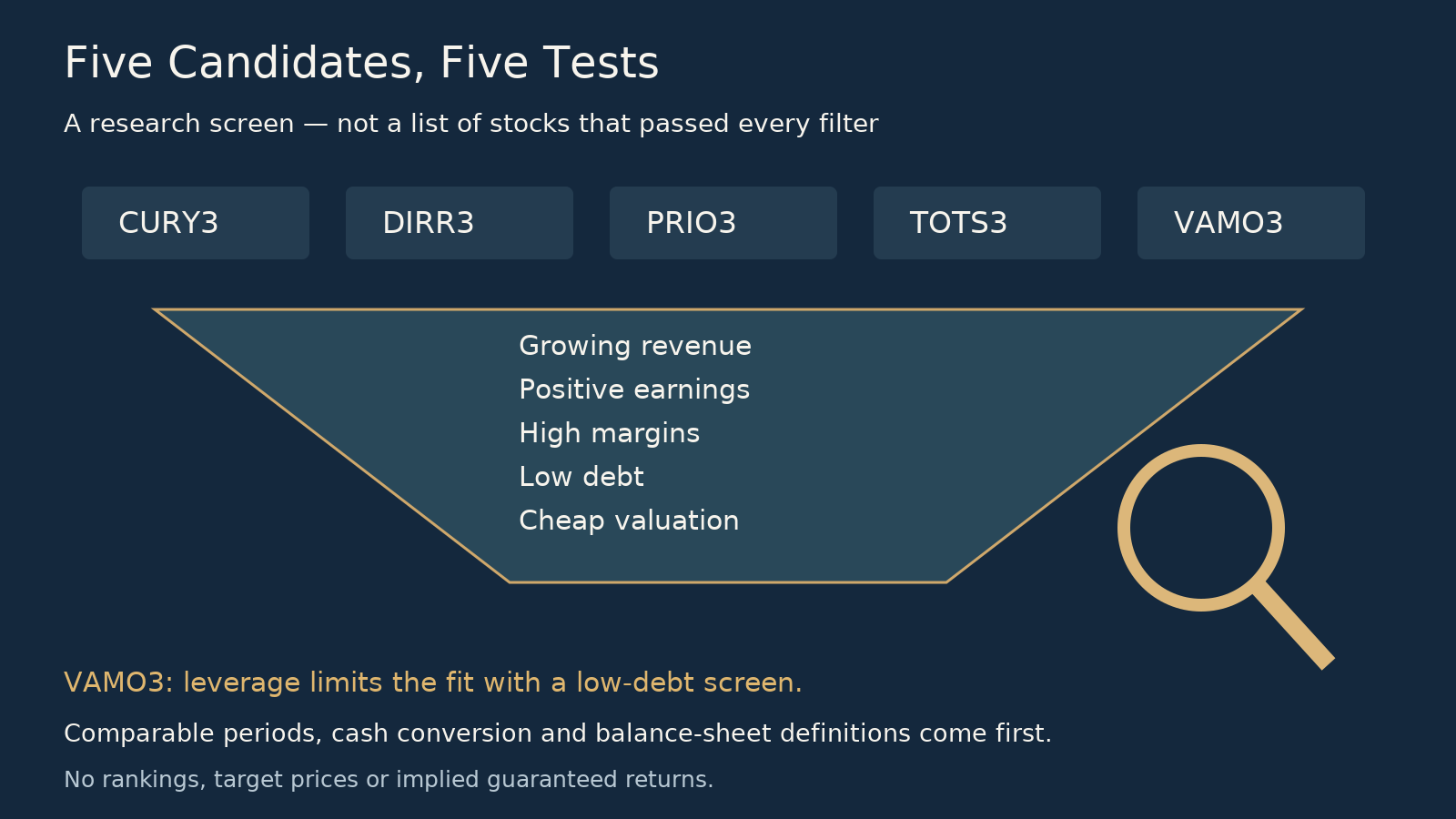
The research filter is sensible: revenue growth, positive earnings, attractive margins, manageable debt and a valuation supported by sustainable cash generation. The five names below are candidates for those tests, not five companies certified to pass them all.
Several supplied ratios are internally inconsistent. For example, R$8.6 billion of market capitalization divided by R$1.33 billion of profit implies approximately 6.5 times earnings, rather than the quoted 7.4 times. Similarly, R$5.2 billion divided by R$1.08 billion implies roughly 4.8 times, rather than 6.2 times. Dates, ownership attribution or profit definitions may differ. Until reconciled, these are screening inputs, not precise current valuations.
Trailing dividend yields are distributions relative to a reference price, not promises of future income. A sharp share-price decline is also not, on its own, evidence of a larger margin of safety.
Cury: distinguish attributable profit from the activity's total
Cury's third-quarter release reports R$313.9 million of net income attributable to Cury, up 23% year over year. The broader activity's net income was R$369.6 million. Those are different denominators for valuation and profitability analysis. The attributable net margin was 17.1% for the quarter, compared with the activity's 20.1% margin.
The research case is execution in residential development and the economics of housing finance. Continued support for Minha Casa Minha Vida could help demand, but an election result does not guarantee funding, eligibility rules or margins. Cash conversion, construction costs, cancellations and geographic concentration belong beside reported profit.
Direcional: a strong gross margin does not settle the earnings question
Direcional's release reports approximately R$201 million of attributable quarterly profit and a 45.2% adjusted gross margin. An adjusted gross margin is not a net margin, and a record at that level does not establish that every measure of earnings is accelerating.
The comparison with Cury needs consistent accounting definitions, treatment of nonrecurring items and cash-flow measures. Riva's customer mix, financing availability and the timing of receivable conversion can alter the risk profile. The lower share-price reference in the supplied screen is an invitation to investigate those differences, not proof of superior upside.
PRIO: dollar exposure with oil and execution risk
The supplied PRIO snapshot describes a high-margin oil producer with dollar-linked revenue and production growth. Those characteristics may offset some effects of a weaker real, but the shares are not a guaranteed hedge against Brazilian fiscal risk.
Oil prices, operating costs, investment requirements, financing currencies and taxes all affect the result. The draft's valuation and production figures should be reconciled to the company's reporting currency and period before use. A successful production ramp can coexist with falling commodity prices or higher capital needs.
Totvs: recurring revenue still needs a cash-flow valuation
The software thesis rests on durable customer relationships, recurring revenue and profitable growth. None automatically makes the current multiple cheap. Acquisitions, debt, adjusted earnings and the cash cost of maintaining growth need to be included in the assessment.
The draft's undated daily price move and unread November filing are not treated as verified catalysts. The research question is what recurring earnings are worth after investment and financing costs, rather than whether a historical premium has compressed.
Vamos: rate sensitivity comes with leverage
The supplied screen places Vamos's leverage around three times net debt to EBITDA. That is materially different from a net-cash profile. Better rental economics and lower funding costs could help, but the company should not emerge from a “low debt” funnel as an unqualified pass.
A useful sensitivity analysis would specify refinancing dates, floating-rate exposure, fleet utilization, residual values and capital expenditure. Simply assuming a 200-basis-point curve decline cannot quantify the change in equity value. EBITDA also omits costs that are important to a capital-intensive rental business.
Turnarounds and corporate events require a separate file
The original notes identify Natura, MRV, CSN and Braskem as businesses requiring greater attention to losses, leverage or restructuring. A relief rally can occur before a balance sheet improves. These situations should be assessed through financing needs and operating recovery rather than grouped with companies already meeting a conservative screen.
For Braskem, any debt-for-equity terms, offering price and creditor agreement must be checked against the latest company documents; a preliminary arrangement is not a completed restructuring. For Embraer, a proposed tariff is not a confirmed final charge, and its effect depends on product scope, customers, contracts and implementation. The supplied figures for these events are not republished here as verified terms.
What to watch after the headline
The most useful follow-up is whether long yields remain lower as fiscal details emerge, whether inflation expectations improve alongside current releases, and whether companies convert accounting profit into cash. Ministry appointments, a spending proposal and a favorable monthly index answer different questions.
The calendar also needs dated releases rather than inherited placeholders. U.S. equities are closed for Thanksgiving on November 26 and trade a shortened session on November 27. The supplied domestic calendar points to inflation, labor, credit and fiscal data ahead; readers should check each issuing agency's current schedule. The next policy decisions should be assessed against their official notices, not treated as implied by the shape of the DI curve.
A fiscal discount can narrow. The point is to identify what would justify that change: a credible program, an executable financing path and company cash flows that can support their valuations. A stronger market is evidence of repricing. It is not yet a completed fiscal adjustment.
Verification note: The article separates November 25 prices and rates from the November 26 inflation release and later political update. Exact current valuations, selected company-event terms and several figures from the original compilation remain unverified and are not presented as confirmed facts. Selected historical points do not constitute a full time series.
Editorial note: For information and education only; not a recommendation, solicitation or personalized investment advice. Estimates and interpretations may be incomplete or incorrect. Consult the underlying sources and assess risks independently.
Sources and references
- Estadão Conteúdo: November 25 market closing bulletin
- Investing.com: dated Ibovespa historical observations
- B3: October 26 daily bulletin
- Bom Dia Mercado: November 25 DI closing rates
- Banco Central: Copom decisions
- IBGE via Agência Gov: November IPCA-15 release
- Febraban: November 23 economic bulletin and Focus table
- Reuters: November 26 report on Trabuco, attributed to a source
- Cury: third-quarter 2026 results
- Direcional: third-quarter 2026 results
- NYSE: holidays and trading hours