
Market Calls / Crypto
Bitcoin’s Rebound Runs Into a Liquidity Squeeze
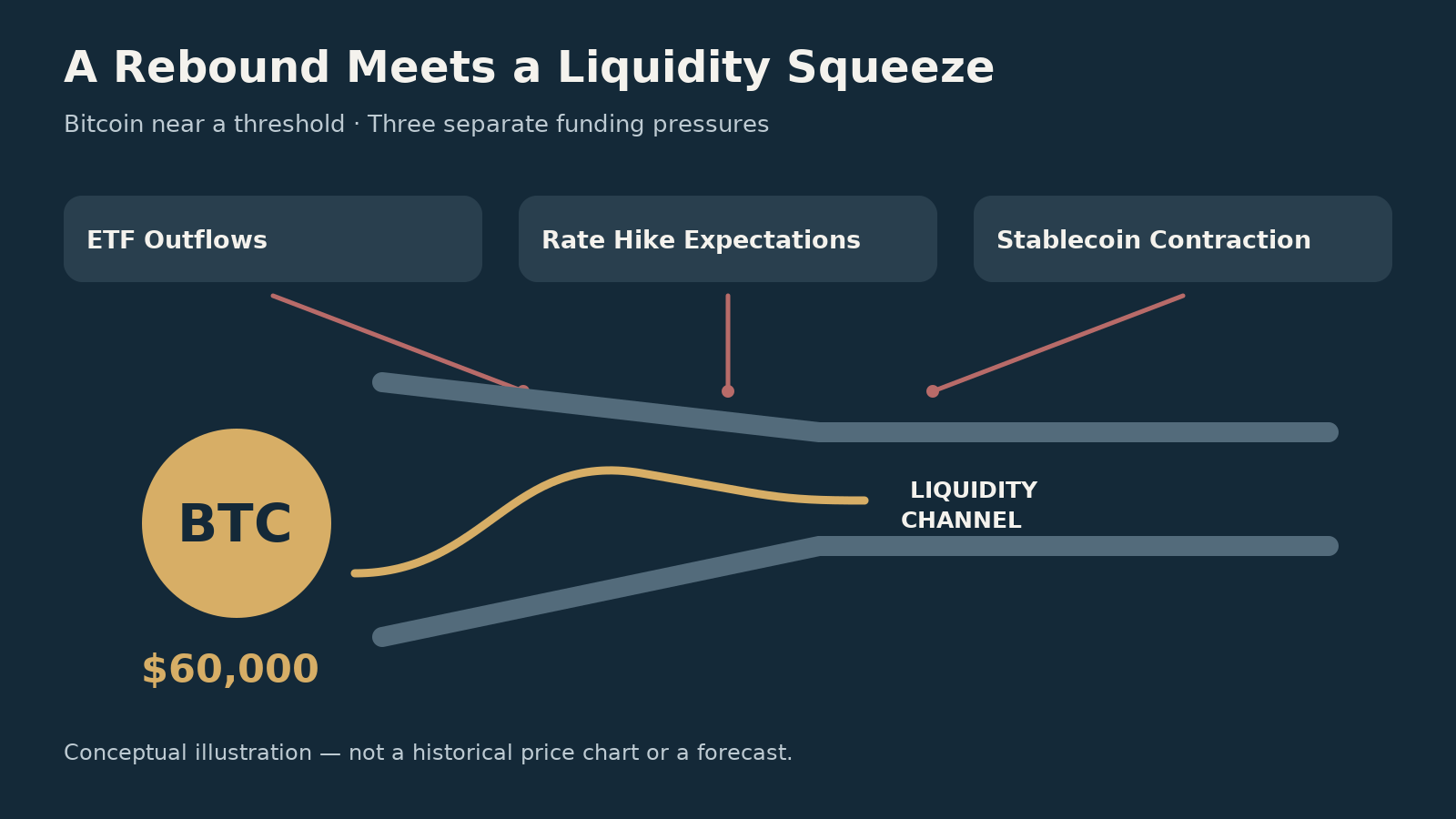
Bitcoin returned to the $60,000 threshold as ETF redemptions, contracting stablecoin supply and expected monetary tightening constrained the rebound. Monad’s unlock introduced a separate supply risk.

Market date
Bitcoin recovered with technology stocks on Monday, then struggled to hold the move. By the supplied November 24 snapshot, BTC was trading at $59,661, down 2.5% over 24 hours, after a rebound toward $64,500. The market was back at the $60,000 threshold before the argument for a lasting recovery had acquired much new evidence.
The clearest obstacle was investment demand. U.S. spot Bitcoin ETFs recorded $569.7 million in net outflows on November 23, their fifth consecutive negative session. Stablecoin supply was also lower over the preceding week and month, while market commentary continued to anticipate a December Federal Reserve rate increase.
Together, those observations support a cautious reading of the bounce. They do not prove that every price decline has the same cause, or that liquidity must continue to deteriorate. They show why a sharp recovery in price can run ahead of a recovery in the funding conditions needed to sustain it.
Data cutoff: November 24, 2026. The supplied price dashboard is approximately 21:00 UTC; external data use their separately identified reporting windows. ETF figures below cover the completed November 23 session. November 24 ETF reporting was incomplete when checked.
A dated dashboard, not a consolidated close
Crypto trades continuously. A quote at 21:00 UTC should not be combined with a morning dominance reading or a differently defined exchange-volume total and presented as one synchronized market close.
The supplied TradingView snapshot showed the following selected observations:
| Asset | Price | 24-hour change |
|---|---|---|
| Bitcoin | $59,661 | −2.5% |
| Ethereum | $1,672.60 | −2.1% |
| Solana | $69.23 | −3.8% |
| XRP | $0.9186 | −2.2% |
| Hyperliquid | $59.65 | −6.5% |
| Monero | $499.40 | +2.6% |
| Zcash | $727.60 | −6.2% |
| Monad | approximately $0.0092 | −20.5% |
These are the source manuscript’s timestamped quotes, not independently reconstructed exchange closes. Contemporaneous reporting corroborated Bitcoin’s retreat toward $60,000, while live token pages showed different prices as the session progressed.
Total market capitalization was $2.03 trillion in that same dashboard. Dividing its $1.20 trillion Bitcoin capitalization by the total gives roughly 59.1% dominance. That calculation is internally consistent with the supplied inputs; it is not a reason to replace another provider’s reading without examining asset coverage and timing.
Monero’s positive daily move stood out against the losses elsewhere. It does not by itself identify the buyers, establish a privacy-token rotation or explain why Zcash moved in the opposite direction.
ETF redemptions are the most concrete demand signal
Farside’s November 23 table shows $509.3 million leaving BlackRock’s IBIT, $61.1 million leaving Grayscale’s smaller BTC fund and $12.6 million leaving BITB. Fidelity’s FBTC received $13.3 million. The combined net result was an outflow of $569.7 million, with IBIT accounting for approximately 89% of the net total.
The preceding four sessions were also negative. Using Farside’s displayed totals for November 17, 18, 19, 20 and 23 gives approximately $2.37 billion in aggregate outflows. Small differences from other reports reflect rounding or revisions, not a materially different five-session pattern.
The November 24 row was still partial when checked. Its provisional entries cannot be treated as a completed reversal of the trend.
ETF redemptions describe a reduction in demand through a specific investment channel. They are not a complete census of Bitcoin ownership, and they do not tell us that all institutions are abandoning the asset. The Block reported cumulative net inflows since launch still around $52 billion. A difficult month can coexist with substantial investment accumulated over a longer period.
Ethereum products also lost approximately $85 million on November 23, while Solana and XRP products recorded smaller outflows. The immediate test is whether fresh demand begins to absorb supply consistently, rather than whether one session produces a forceful short squeeze.
Stablecoins and rates: pressure with important limits
The directly checked DefiLlama page showed stablecoin capitalization of approximately $281.1 billion, down 1.11% over seven days and 5.73% over 30 days. Its one-day change was positive at 0.19%. The distinction matters: the broader contraction had not prevented a small daily expansion.
A shrinking stablecoin base is consistent with less capital available within the ecosystem. It does not prove that the entire change represents investors cashing out of speculative positions. Redemptions, payments, shifts among issuers and changes in data coverage can affect the total. Nor does outstanding stablecoin supply equal money committed to buying Bitcoin.
Still, the combination of weaker ETF demand and a smaller stablecoin base makes the rebound harder to interpret as a clear improvement in funding conditions. That is an editorial inference from two separate datasets, not a measured causal decomposition of Bitcoin’s decline.
The rates backdrop adds another constraint. Contemporary market reports described expectations for a 25-basis-point Fed increase in December. The October 29 probability quoted in the draft is stale, so this edition does not present it as a current FedWatch reading.
Higher expected dollar yields can increase the opportunity cost of holding assets without contractual cash flows. A firmer dollar and tighter financing can also constrain leveraged positions. Neither relationship is mechanical: crypto prices can rise during tightening if adoption, positioning or new demand overwhelms those effects.
The next scheduled macro evidence is October PCE inflation and the second estimate of third-quarter GDP on November 25 at 8:30 a.m. Eastern, or 10:30 a.m. Brasília time. The Fed’s calendar places the Beige Book on November 25 at 2 p.m. Eastern, correcting the November 26 date in the original draft. Thanksgiving follows on November 26, reducing participation in U.S. cash markets while crypto continues trading.
Monad adds a separate supply problem
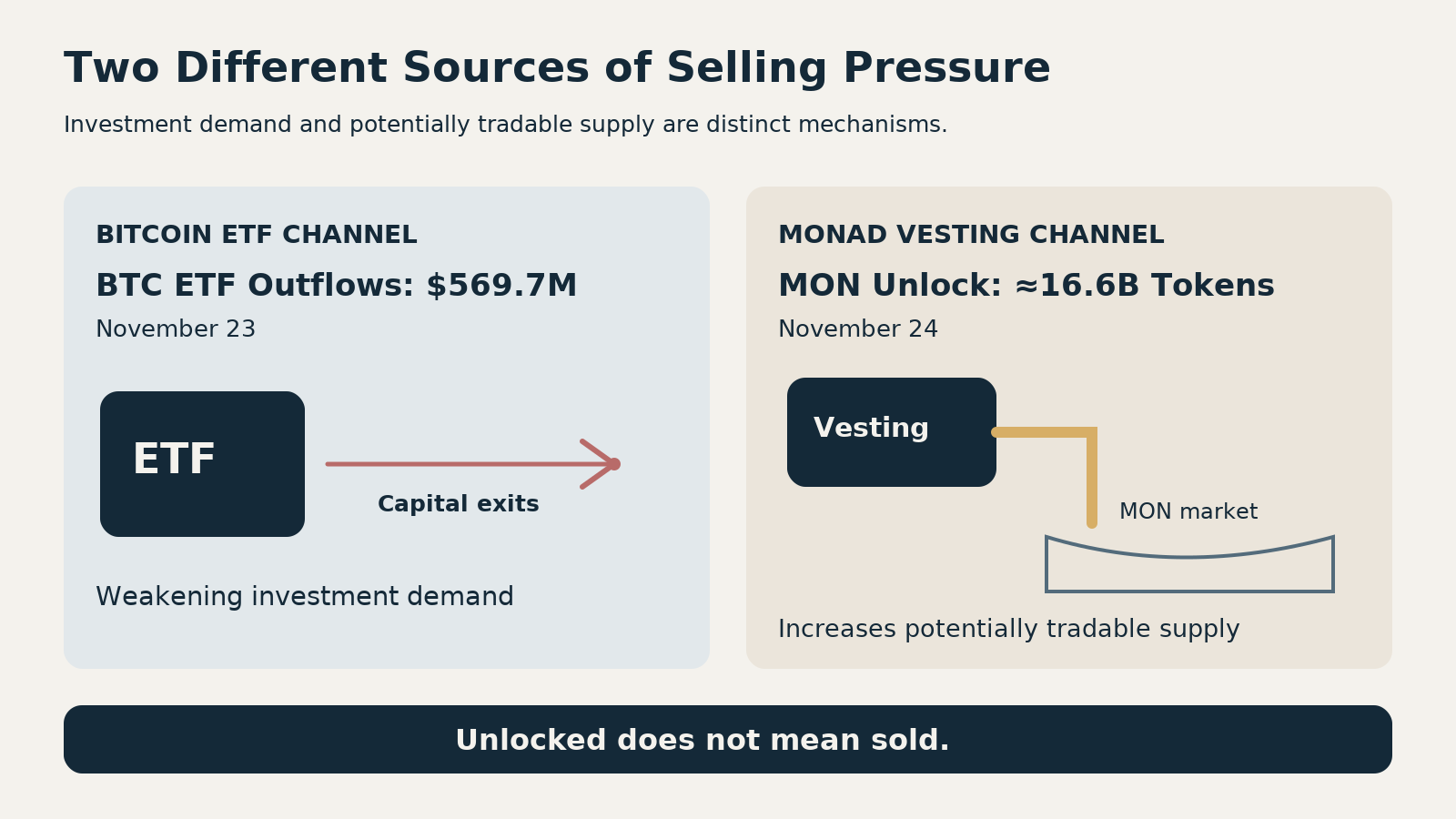
ETF redemptions and token unlocks should not be represented as the same mechanism. Redemptions reveal weakening demand through a fund channel. An unlock makes previously restricted tokens potentially transferable; it does not demonstrate that their recipients sold them.
The checked Monad schedules support a November 24 release of approximately 16.6 billion MON. CoinGecko listed about 10.7 billion for the team, 4.92 billion for investors and 988 million for the Category Labs treasury. A team-verified schedule on Tokenomics.com also showed 16.6 billion. The upper end of the draft’s 16.6–17.1 billion range was not reproduced in those checks, so the graphic uses the corroborated approximate amount.
The supplied price snapshot showed MON down 20.5%. That timing is consistent with investors repricing the supply overhang, but the daily move cannot tell us how many unlocked tokens reached exchanges or were actually sold.
Unlock status, circulating-supply classification and exchange selling are three distinct observations. Data providers can update them at different times. Applying the token price to a hypothetical post-unlock float produces a scenario, not a verified market capitalization.
The draft also used 100 billion MON as a maximum-supply denominator. The checked DefiLlama page does not identify a finite maximum. Accordingly, this edition avoids presenting a price-times-100-billion calculation as a definitive fully diluted valuation. Initial supply and maximum future supply are not interchangeable.
Corporate buying and institutional adoption need context
Strategy’s November 23 filing reported the purchase of 457 BTC for $29.6 million during November 16–22, at an average price of $64,898 including fees. Total holdings reached 851,305 BTC. The filing also described using part of the proceeds from common-stock sales for preferred-stock repurchases.
The purchase confirms that this corporate buyer remained active. It does not establish that corporate demand as a whole offset ETF redemptions. The simultaneous management of preferred securities also makes financing decisions relevant to the treasury strategy; interpreting that as evidence of imminent financial distress would go beyond the filing.
Two institutional developments deserve attention apart from daily prices. The Justice Department announced a civil action seeking forfeiture of more than $1.1 billion in USDC linked to the October Binance theft. Its announcement described the wider theft as exceeding $6 billion, resolving the draft’s conflicting headline estimates for the purpose of attribution to that official account. A forfeiture request is a legal action, not a completed distribution to victims.
The ECB separately approved an expansion of collateral eligibility for qualifying assets issued on licensed DLT platforms, with implementation planned for June 2027 and specific requirements still to be detailed. This supports the broader tokenization infrastructure theme. It is not an endorsement of Ethereum, Chainlink, Ondo or any other token.
A watchlist organized around questions
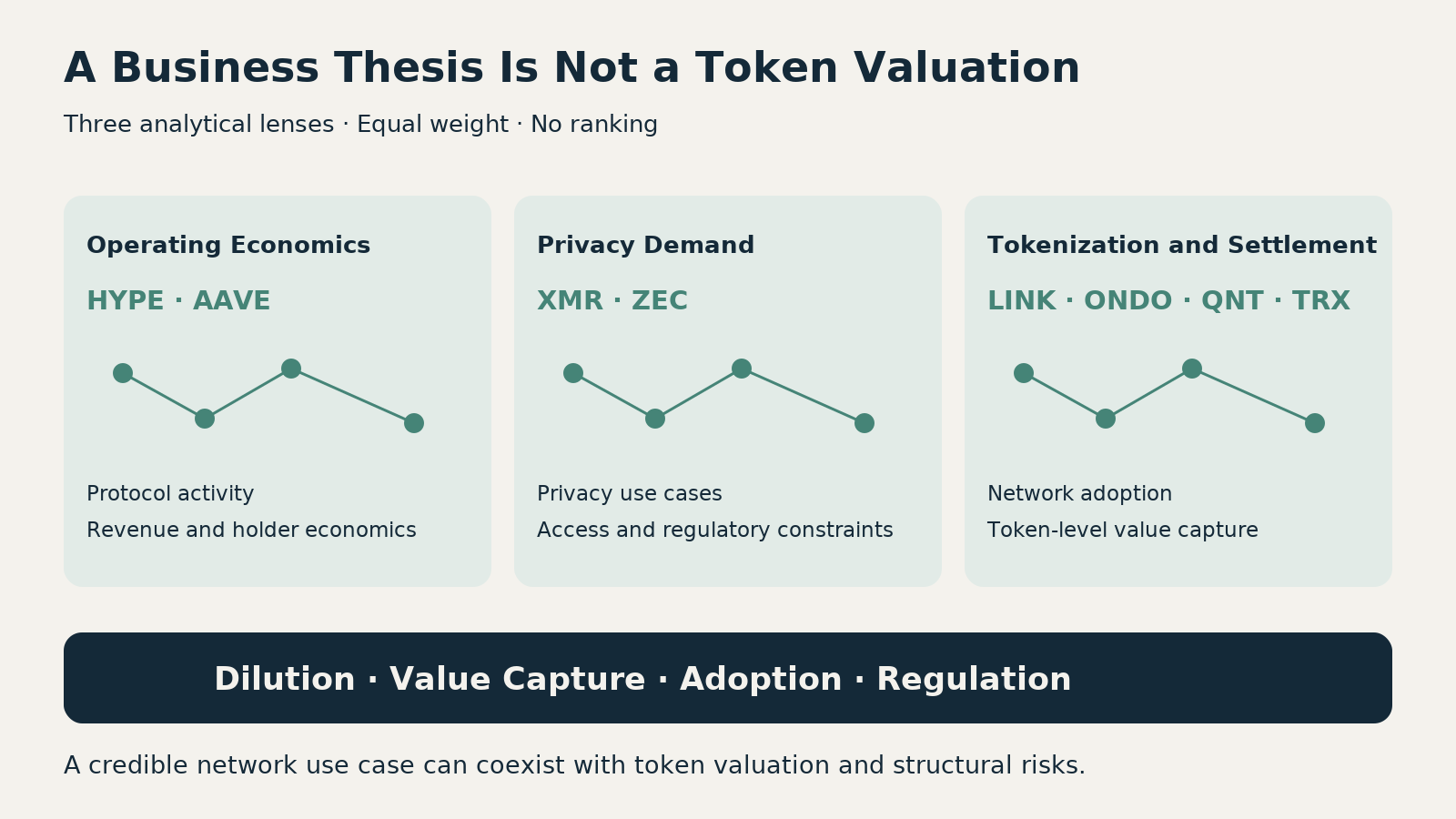
The useful distinction is between a network’s economic role and the return available to someone buying its token. Three groups deserve separate evaluation.
Operating economics — HYPE and AAVE. For Hyperliquid, examine trading activity, the definition of protocol revenue, the amount that reaches buybacks and the net effect of burns and future distributions. Gross fees and holder revenue should not be used interchangeably. For Aave, loan demand, utilization, revenue retained by the protocol and losses through liquidations or oracle failures matter alongside total value locked. TVL is neither profit nor token-holder cash flow.
Privacy demand — XMR and ZEC. A credible use case does not remove listing, custody, regulatory or liquidity constraints. Monero and Zcash also have different designs and adoption patterns. Their contrasting daily moves are a reminder to evaluate each separately. No conclusion about quantum resistance or the cause of a rally should be inferred from a market narrative alone.
Tokenization and settlement — LINK, ONDO, QNT and TRX. The central question is how usage creates demand for the token or transfers economic value to holders. More tokenized assets can benefit service providers without proportionate token returns. Higher yields on tokenized Treasuries do not automatically accrue to a governance token. Settlement volume also needs to be assessed alongside fees, concentration and governance.
Across all three groups, the same checks apply: dilution, value capture, adoption and regulation. This edition omits precise valuation ratios where circulating supply, fee definitions or the denominator could not be reconciled. Labeling a token a potential multibagger does not resolve those gaps.
What would change the call?
A more convincing recovery would combine sustained spot buying, less persistent ETF redemptions and clearer evidence that new token supply is being absorbed. Stabilizing stablecoin supply would help the funding picture, although it would still need to be read alongside trading depth and actual demand.
The price levels in the draft—around $60,000, the recent rebound near $64,000–$65,000 and the previous low around $55,000—are reference points, not boundaries the market must respect. A brief move above one of them says less than the quality of trading and flows that follow.
For now, the rebound has shown that positioning can turn quickly. It has not shown that funding pressure has eased enough to support a durable recovery. November 25’s macro releases and the next complete ETF reports will provide a firmer test than the size of Monday’s bounce.
General market commentary, not personalized investment advice. Quotes are dated snapshots; live prices, supply classifications and reported flows can change or be revised.
Sources and references
- Farside Investors — Bitcoin ETF flows
- The Block — November 23 crypto ETF outflows
- CoinDesk — Bitcoin retreat and monetary expectations, November 24
- DefiLlama — Stablecoin capitalization
- CoinGecko — Monad supply and unlock schedule
- Tokenomics.com — Monad unlock schedule
- DefiLlama — Monad unlocks and supply
- Federal Reserve — November 2026 calendar
- BEA — Personal Income and Outlays
- Economic release calendar — PCE and GDP
- Strategy — November 23 Form 8-K
- U.S. Department of Justice — Civil action concerning stolen cryptocurrency
- ECB — DLT collateral eligibility expansion